Week 2-3 Lectures
 Call Kai
 Learn
Learn Practice Test
 Spaced Repetition
 Match
Match Flashcards
 Knowt Play
1/63

There's no tags or description
Looks like no tags are added yet.
Name | Mastery | Learn | Test | Matching | Spaced | Call with Kai | Chat |
|---|
No analytics yet
Send a link to your students to track their progress
64 Terms
What are ~96% of the elements in the human body composed of?
Oxygen, carbon, nitrogen, hydrogen
What are the other ~4% of elements in the human body?
Calcium, phosphorus, potassium, sulfur
What are the trace elements of the human body?
Iron, iodide
What makes up atoms?
Neutrons, electrons, protons
What is the atomic number?
# of protons/electrons in the atom
What is the atomic mass number?
# of protons + # of neutrons
How can you find the # of neutrons in an atom?
Mass # - Atomic #
What is an isotope?
An element that has more neutrons than normal
Carbon 13, Carbon 14
Why does the shape and size of molecules matter?
Size and shape determine how molecules interact with one another.
Ex: Morphine has a similar structure to naturally occurring endorphins. This similarity allows it to bind to the same type of receptor and have successful interactions.

What is a covalent bond?
The sharing of a pair of valence electrons by two atoms
What is a nonpolar covalent bond?
A covalent bond between atoms with equal or very similar electronegativities, resulting in equal electron sharing and no significant dipole moment.
What is a polar covalent bond?
A covalent bond between atoms where one atom is more electronegative than the other, resulting in unequal electron sharing and a dipole moment
Ex: Water

What is an ionic bond?
Where atoms with opposite charges are attracted to one another
What is an ion with a positive charge? A negative charge?
Cation, Anion
Pharmaceutical comapnies construst drugs with ionic bonds. Why?
Ionic interactions are strong in dry/solid environments but become much weaker in water
This allows ionic compounds to form stable solid formulations such as tablets and capsules
When exposed to water in the digestive tract, the ionic interactions are disrupted, allowing the compound to dissolve and become available for absorption
What is an hydrogen bond?
A reversible, weakish bond within a molecule that invovles highly electronegative atoms, primarily:
N—H
O—H
What are van der waals attractions?
Weak attractions that occur when atoms and molecules are very close together
What is steric hindrance?
The slowing or prevention of a chemical reaction caused by the physical crowding of bulky groups of atoms around a reactive site
What is a chemical reaction?
Where atoms are rearranged to form new substances
Can be the breaking or forming of chemical bonds
What is Cohesion?
Where two particles of the same substance are attracted to one another
Water droplets clinging together
What is Adhesion?
Particles of one substance being attracted to particles of a different substance
Water droplets clinging to a tupperware lid
How does water move up a tree?
Occurs within the xylem:
Via adhesion of the water molecules to the cell wall
Via cohesion of water molecules together
Overall, allows a transport-driven tension that helps move the water upward
What atom is the centerpiece of all organic compounds? Why?
Carbon — it is very stable and very versatile
How many electrons does carbon have? Where are they located?
6 e-
2 within the inner shell
4 within outer shell
Due to carbon only have 6 e-, how many bonds can it form?
4 total
It is capable of completing its outer shell by sharing its 4 electrons with other atoms via single or double bonds
Wants an outer shell of 8 electrons!
What are isomers?
Molecules that have the same composition but vary in architecture
What is a structural isomer?
Molecules that share the exact same molecular formula but differ in how those atoms are connected to one another

What is a geometric isomer?
Molecules that have the same chemical formula and atom connections, but a different spatial arrangement in three-dimensional space
Also called cis-trans isomers
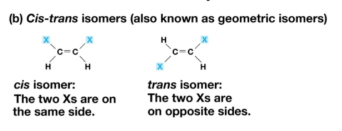
What are enantiomers?
Molecules that have the same chemical formula and atom connections, but are non-superimposable mirror images of each other
Much like our right and left hands!

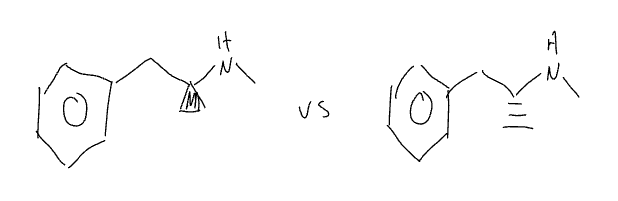
What type of isomer is this?
Enantiomers
Why is it important than we understand the existence of isomers?
Particularly relevant to cis-trans isomers, two molecules can have the same molecular formula and even connectivity, but their difference in 3D arrangements will can cause them to interact differently with other molecules and therefore produce vastly different biological effects
Ex: D-methamphetamine acts on the CNS and triggers a massive dopamine release while L-methamphetamine has no effect on the CNS
The D-isomer is highly addictive while the L-isomer helps clear congestion
What makes up macromolecules?
Polymers, which are made from monomers
What is the name of the process for synthesizing a polymer?
Dehydration

What is the name of the process for breaking down a polymer?
Hydrolysis
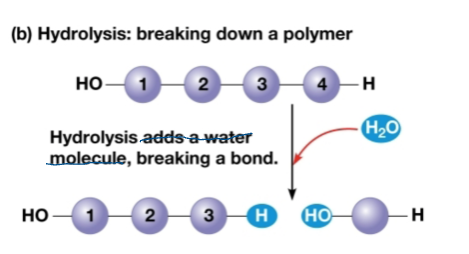
What are monomers?
Small molecules that serve as building blocks
What are polymers?
Long chains of monomers
What are carbohydrates?
Sugars and the polymers of sugars
How are carbohydrates formed?
Via dehydration
What are monosaccharides?
The simplest forms of sugar and the basic building blocks of all carbohydrates
Monosaccharides have formulas that are multiples of what?
CH2O
Ex: 6 x (CH2O) = C6H12O6
Glucose!
What are disaccharides?
Formed via 2 covalently bonded monosaccharides
Glucose + Fructose = Sucrose
Glucose + Galactose = Lactose
What are polyaccharides?
Large, complex carbohydrates made of long chains of simple sugar molecules
What two types of polyaccharides exist?
Storage
Glycogen — animals
Starch — plants
Structural
Cellulose — found in plant cell walls; the most abundant organic polymer on Earth
What are Lipids?
Hydrophobic compounds composed mostly of hydrocarbons
Very hydrophobic
Insoluble in H2O
What are some examples of Lipids?
Fats, phospholiids, steroids, and waxes
What are Fats composed of?
Glycerol and 3 fatty acids
What two types of fats are there?
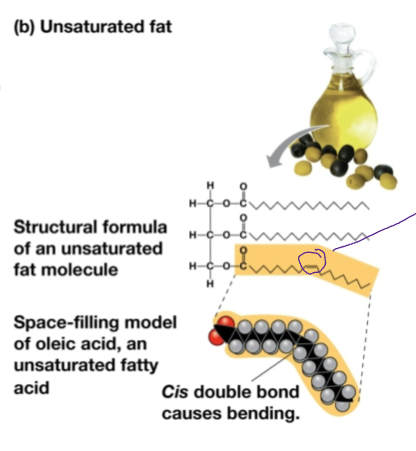
Unsaturated and Saturated Fats
Unsaturated Fats
Found primarily in animal fats
Solid at room temperature
Fully hydrogenated
No double bonds

Saturated Fats
Found primarily in fish and plant fats
Liquid at room temperature
Not fully hydrogenated
Contains double bonds
Has a “kink” in the structure
What are phospholipids a major part of?
The plasma membrane of cells and organelles

What is the composition of phospholipids?
Phosphate head
Glycerol body
Fatty acid tails

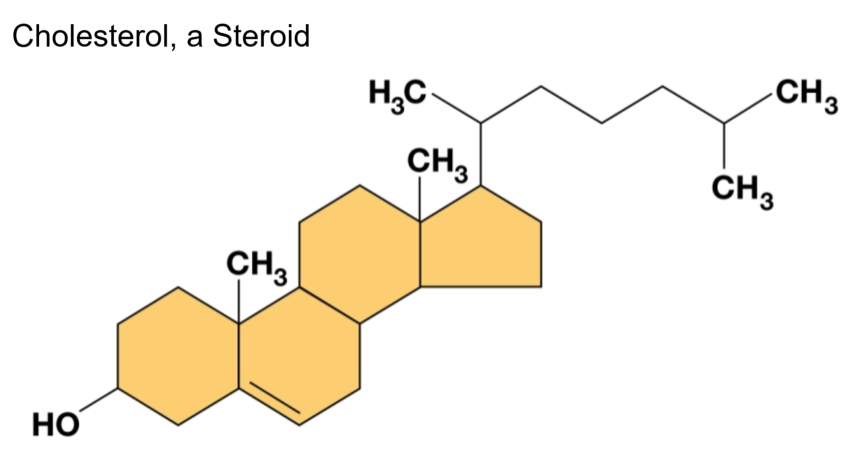
What are steroids composed of? How are they differentiated? What is this important for?
Composed of 4 fused rings with different functional groups
Important in terms of membrane fluidity
(t/f) — All proteins are polypeptides and all polypeptides are proteins
False. All proteins are polypeptides, but not all polypeptides are proteins
Proteins are folded, polypeptides are not
What key factor allows for the wide range of protein functions?
The way it folds/creates its shape
Enzymatic protein function
Selective acceleration of chemical reactions

Defensive protein function
Protection against disease

Storage protein function
Storage of amino acids

Transport protein function
Transport substances

Hormonal protein function
Coordination of an organism’s activities

Receptor protein function
Response of a cell to chemical stimuli

Contractile and motor protein function
Movement

Structural protein function
Support

What is the primary structure of proteins?
Their chain of amino acid monomers
In the primary structure of proteins, what type of bond binds the monomers together?
Peptide bonds
Type of covalent bond