Smooth Muscle Contraction & Regulation
 Call Kai
 Learn
Learn Practice Test
 Spaced Repetition
 Match
Match Flashcards
 Knowt Play
1/70

There's no tags or description
Looks like no tags are added yet.
Name | Mastery | Learn | Test | Matching | Spaced | Call with Kai | Chat |
|---|
No analytics yet
Send a link to your students to track their progress
71 Terms
What is the main difference between skeletal and smooth muscle in regards to appearance?
skeletal is striated and organized, smooth is unstriated and random
What is the main difference between skeletal and smooth muscle in regards to nuclei?
skeletal myofibers are multinucleated, smooth myofibers have a single nucleus
What is the main difference between skeletal and smooth muscle in regards to shape?
skeletal is cylindrical, smooth is arranged in sheets
What is the main difference between skeletal and smooth muscle in regards to size and length?
skeletal is large and spans the entire muscle, smooth is small and doesn't span the entire muscle
What is the main difference between skeletal and smooth muscle in regards to nervous system innervation?
skeletal is voluntary with somatic innervation, smooth is involuntary with autonomic innervation
What is the main difference between skeletal and smooth muscle in regards to approximate resting membrane potential?
skeletal is -90 mV, smooth is -60 mV
What makes up thick filaments in smooth muscle?
myosin
(same as skeletal, but longer in smooth)
What makes up thin filaments in smooth muscle?
actin, tropomyosin
(NOT troponin)
refers to filaments found in smooth muscle (but NOT skeletal muscle) that have no contractile properties, help support the overall shape of the cell, and anchor dense bodies
intermediate
the Z line equivalent in smooth muscle that anchors actin filaments and is positioned throughout the cell with some attached to the membrane
dense bodies
True or false: Contraction in smooth muscle is similar to skeletal muscle in that actin binds to myosin, there is a power stroke, and the overall muscle shortens.
true
(however, the overall smooth muscle seems to twist and shrink)
refers to requiring neuronal stimulation for contraction (i.e. action potential causing sufficient depolarization)
neurogenic
refers to contraction being caused by the muscle cells themselves and their own fluctuating membrane potentials, not a separate signal from a neuron
myogenic
refers to smooth muscle that is comprised of discrete fibers, each operating independently of the others
multi unit
Is multi-unit smooth muscle neurogenic or myogenic?
neurogenic
In multi-unit smooth muscle, do the fibers depend on one another to contract?
no
What are five examples of multi-unit smooth muscle?
ciliary muscle, iris, piloerector muscles, larger blood vessels, larger bronchi
Why does unitary smooth muscle act as a functional syncitium? What enables this?
cell membranes are adherent to one another via gap junctions, so there is continuous ion flow between cells
refers to smooth muscle that is a mass of cells arranged in sheets or bundles that contract together, a functional syncytium
unitary (single unit)
Is unitary/single-unit smooth muscle neurogenic or myogenic?
myogenic
In unitary smooth muscle, what mostly causes action potential and contraction?
the cells' own fluctuating membrane potential
(though it can also be caused by some neuronal stimulation, hormones, or stretching)
A functional syncytium...
A. is a pair of antagonistic muscles causing a joint to move in opposite directions
B. is able to contract as a unit because action potentials move between adjacent cells through gap junctions
C. is a functional junction between a smooth muscle fiber and an autonomic nerve ending
D. is all of the above
E. is none of the above
B
Smooth muscle cells communicate via which type of synapse?
A. chemical
B. electrical
C. neither
B
What are four examples of unitary/single-unit smooth muscle?
walls of organs, smaller blood vessels, GI tract, uterus
type of single-unit smooth muscle that contracts in bursts triggered by action potentials that increase cytosolic calcium
most abundant in hollow organs that push contents through, such as the GI tract (e.g., peristalsis)
phasic
Where is phasic unitary smooth muscle commonly found?
GI tract
type of single-unit smooth muscle that is partially contracted at all times; due to lower resting potential (-40 to -55 mV) which is independent of action potentials
tonic
What enables tonic unitary smooth muscle to always be partially contracted?
there are always a few open voltage gated calcium channels
True or false: Tonic unitary smooth muscle incrementally varies its strength of contraction depending on the specific region it's in.
true
(example: arteriolar smooth muscle is more tonic)
swellings at neuromuscular junctions in smooth muscle formed by autonomic nerve fibers branching on top of the muscle fiber sheet
they do not directly contact the muscle but instead form diffuse junctions and release neurotransmitters that bind to receptors on the myocyte surface
varicosities

Are varicosities excitatory or inhibitory?
can be either
(whereas skeletal muscle is ONLY excitatory)

In single unit smooth muscle, autonomic innervation via neurotransmitters does NOT usually initiate contraction, like in multi unit smooth muscle or skeletal muscle. Instead, what do neurotransmitters do?
modify rate and strength of contraction
True or false: There is a T tubular system in smooth muscle, similar to skeletal muscle.
false
(not as large, so you don't need T tubules to go deep into the muscle to stimulate it)
Since there are no T tubules in smooth muscle, where are the dihydropyridine receptors found? What do they do?
plasma membrane, act as a voltage gated calcium channel
Is the contraction process in smooth muscle faster or slower than in skeletal muscle?
slower
(cross bridges are maintained longer)
Smooth muscle contraction 1: An increase in cytosolic calcium may be caused by neuronal simulation, hormonal stimulation, stretch, or spontaneous generation. Where does this calcium mostly come from to initiate contraction?
extracellular fluid
Smooth muscle contraction 2: Calcium enters smooth muscle cell from extracellular fluid and binds to what?
calmodulin
Smooth muscle contraction 3: After calcium enters the smooth muscle cell from extracellular fluid and binds to calmodulin, a calcium-calmodulin complex is formed. This complex serves as an enzyme an activates what other enzyme?
myosin light chain kinase
Smooth muscle contraction 4: The calcium-calmodulin complex acts as an enzyme and activates another enzyme: myosin light chain kinase (MLCK). What does MLCK do?
phosphorylates light chains of myosin heads
Smooth muscle contraction 5: What happens once MLCK, activated by the calcium-calmodulin complex, phosphorylates the light chains in the globular heads of myosin?
myosin heads bind to actin to form cross bridges
Smooth muscle contraction 6: Once MLCK, activated by the calcium-calmodulin complex, phosphorylates the light chains in the globular heads of myosin, myosin can bind to actin to form cross bridges. What else does activated MLCK do?
activates myosin ATPase to cleave ATP into ADP and phosphate, providing energy for the power stroke
Smooth muscle contraction 7: Activated MLCK phosphorylates the light chains of myosin to allow cross bridges to form. It also activates myosin ATPase to cleave ATP, providing energy for the power stroke. What enzyme acts next to pump calcium out of the smooth muscle cell?
calcium ATPase
Smooth muscle contraction 8: After the power stroke, calcium ATPase pumps calcium out of the smooth muscle cell. This activates what other enzyme to dephosphorylate the myosin light chains? What does that cause? The smooth muscle then relaxes.
myosin phosphatase, causes detachment of myosin from actin
What is the relationship between myosin light chain kinase (MLCK) and myosin phosphatase?
they have opposite functions: MLCK phosphorylates myosin light chains, myosin phosphatase dephosphorylates them
In smooth muscle, the cross bridge CANNOT form unless what happens?
MLCK phosphorylates myosin light chains
Smooth muscle can have sustained contractions that last a while. Why?
as long as myosin light chain is phosphorylated, the muscle keeps contracting
What is the difference between skeletal and smooth muscle contraction in regards to the main calcium source?
skeletal is intracellular all from SR, smooth is extracellular mostly from ECF
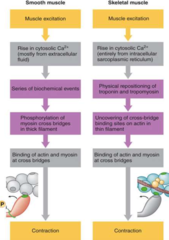
What is the difference between skeletal and smooth muscle contraction in regards to the calcium binding protein?
troponin C in skeletal, calmodulin in smooth

What is the difference between skeletal and smooth muscle contraction in regards to formation of cross bridges?
skeletal requires no phosphorylation, just troponin complex pulling tropomyosin away from actin; smooth requires phosphorylation of myosin light chains

What is the difference between skeletal and smooth muscle contraction in regards to the speed of the cross bridge cycling process and overall contraction time?
skeletal is faster, smooth is slower
What is the difference between skeletal and smooth muscle contraction in regards to the force of contraction?
skeletal is smaller, smooth is greater
What is the difference between skeletal and smooth muscle contraction in regards to the triggering of the release of myosin from actin?
new ATP molecule binds to myosin head in skeletal, phosphatase cleaves phosphate from myosin light chains in smooth
What is the difference between skeletal and smooth muscle contraction in regards to the amount of energy required?
skeletal needs 300x more, smooth needs less
refers to the relaxation of smooth muscle tissue after being stretched, not present in skeletal muscle
allows hollow organs to maintain a similar amount of pressure inside its lumen despite long-term, large changes in length of the muscle cell (prolonged stretch)
stress relaxation response
potentials in unitary smooth muscle in which the membrane potential gradually depolarizes on its own due to a shift in passive ionic fluxes accompanying changes in channel permeability
**when the membrane depolarizes beyond threshold, that is when an action potential is generated
pacemaker potentials

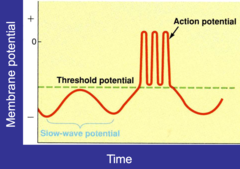
potentials in unitary smooth muscle that are always below threshold, alternating between hyperpolarizing and depolarizing swings in potential caused by automatic cyclical changes in sodium ion transport across the membrane
**the starting point of the sub threshold membrane potential is determined by neural and local factors (such as stretch)
slow wave potentials

In a slow wave potential, does the potential move closer to or farther from threshold during a depolarizing swing?
closer

In a slow wave potential, does the potential move closer to or farther from threshold during a hyperpolarizing swing?
farther
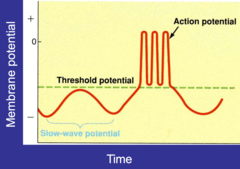
Pacemaker potentials in unitary smooth muscle will eventually reach threshold since the membrane potential just keeps on depolarizing. How can slow wave potentials reach threshold if the depolarizing swings are never high enough?
some other factor like a neurotransmitter, hormone, or stretch allows threshold to be reached at the peak of a depolarizing swing
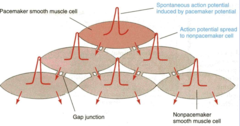
non-contractile cells that make up a very small fraction of overall smooth muscle cells; self-excitable, so constant activity going on
they initiate an conduct the action potential to the contractile cells in the functional syncytium and are responsible for myogenic activity
pacemaker cells

Pacemaker cells form an electrical synapse (gap junction) with the non-pacemaker smooth muscle cells, allowing for direct transfer of ions. This makes them responsible for what kind of activity: neurogenic or myogenic?
myogenic
What is the only thing that causes multi-unit smooth muscle to contract?
neuronal stimulation
(the classic mechanism: released neurotransmitter triggers membrane depolarization and this elicits contraction)
Multi-unit smooth muscle potentials are usually what kind of potential?
**enough of a potential for neurotransmitter to open up some voltage gated channels, a little calcium comes in, triggers contraction even before an action potential is necessary
junction potential
Hormones may do what three things to smooth muscle?
depolarize cells, hyperpolarize cells, cause contraction without affecting channels at all
How do hormones trigger depolarization of the smooth muscle membrane?
open sodium or calcium channels
(usually occurs without an action potential, triggers contraction)
How do hormones trigger hyperpolarization of the smooth muscle membrane?
close sodium and calcium channels and open potassium channels
How do hormones trigger contraction without a change in the membrane potential?
stimulate a receptor that affects the release of calcium from the SR
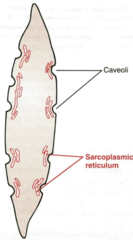
plasma membrane indentations with the cytoplasmic portion in close proximity to the sarcoplasmic reticulum; during an action potential, these can trigger calcium release from the SR due to their close proximity (stretch response)
Basically, these cause an increase in cytosolic calcium other than it coming in from extracellular fluid.
caveoli
Which of the following is most commonly responsible for initiating contraction of smooth muscle?
A. stimulation by motor neurons
B. inhibition of acetylcholinesterase
C. membrane potential drifting to threshold as a result of automatic changes in ion movement across the membrane
D. excitation of the gap junctions by a transmitter substance
E. stimulation by the autonomic nervous system
C
Choose the FALSE statement about smooth muscle.
A. it is under involuntary control
B. it does not have troponin
C. its contraction is initiated neurogenically only
D. it is found in walls of hollow tube-like organs
E. it is innervated by the autonomic nervous system
C
Where does calcium primarily come from to trigger smooth muscle contraction?
A. extracellular fluid
B. sarcoplasmic reticulum
C. caveolae
A