(1) introduction & amino acids
 Call Kai
 Learn
Learn Practice Test
 Spaced Repetition
 Match
Match Flashcards
 Knowt Play
1/76

Earn XP
Name | Mastery | Learn | Test | Matching | Spaced | Call with Kai | Chat |
|---|
No analytics yet
Send a link to your students to track their progress
77 Terms
know the functional groups: amine, alcohol, thiol, ether, aldehyde, ketone, carboxylic acid, ester, thioester (weaker than ester), amide, imine, disulfide, phosphate ester, diphosphate ester, phosphate diester
refer to pics (one is not listed)

how much of the human body is water? how much is required for normal metabolic activity?
70% of the mass of human body is water, need more than 65%
water is a xxx for our body and biochemical reactions
solvent
why do things have shape in our bodies
water determines structures of macromolecules
what is the bond length of O—H in water?
1 A (10-10 m)
what is the angle of water molecule, why is this important
it’s bent in 104.5 degrees, and this gives water its polarity because the 2 lone pairs on O repel each other; without polarity, there’s no H bonding
what kind of bonds can water form?
hydrogen bonds
name what D and A are in hydrogen bond (D—H- - -A)
D—H is a weakly acidic hydrogen donor group
O-H, N-H, S-H
A is a weakly basic hydrogen acceptor atom
O, N, S
what is hydrogen bond
electrostatic interaction bt smt slightly positive and smt slightly neative
up to how many bonds can water form
4 hydrogen bonds (2H and 2 lone pairs)
compare acidity and basicity with electron
acidic is electron deficient (+) so it’s electron accepting
basic is electron rich (-) so it’s electron donating
T/F water can be both hydrogen donor and hydrogen acceptor
true
what kind of functional groups can water form H bonds with? (4)
polar
hydroxyl group
keto group (acetone; dissolve in water)
carboxylate ions (acceptor only)
ammonium ions (donor only)

how does adding or removing a bond affect charge
adding bond is + charge
removing a bond is - charge
what is the covalent bond strength in kj/mol
around 400 kj/mol
what are the different kinds of noncovalent bonds? (5)
ionic interaction
van der waals forces
hydrogen bond
dipole-dipole interaction
london dispersion forces
what charges is used in van der waals forces
partial +/-
T/F ionic interactions are the same as ionic bonds, explain
false, ionic interactions are carbon based (C & N)
what is bond strength
the energy needed to break a bond
what is the difference between noncovalent and ionic interactions
noncovalent is electrostatic
ionic interaction is solid charge interaction
what’s the conversion of 1 cal = ? J
1 cal = 4.18 J, so 1kcal=4.18 kJ
what is the bond strength of ionic interactions in kj/mol
80 kj/mol
what is the bond strength of hydrogen bonds in kj/mol
20
what is the bond strength of dipole-dipole interactions
10 kj/mol
what is the bond strength of london dispersion forces
less than 1 kj/mol (0.3)
can a polar molecule cause a dipole to form in a nonpolar molecule
yes
what does solubility depend on
depends on the ability of a solvent to interact with a solute more strongly than solute particles interact with each other
what kind of material is water an excellent solvent for? (2)
hydrophilic material such as polar (alcohol) and ionic (NaCl)
what kind of material is water a poor solvent for?
hydrophobic materials (oil)
what part of water will bind to the Na+ in NaCl
the lone pairs on oxygen because it has partial negative
what part of water will bind to the Cl- in NaCl
the H ends because it has partial positive
what is gibbs free energy equation
𝚫𝑮 =𝚫𝑯 −𝑻𝚫𝑺
what sign of deltaG makes a reaction spontaneous?
negative
what is delta H measuring? what should it be to be more spontaneous?
enthalpy change
deltaH should be negative (more bond FORMING) = -G = more spont
exothermic
what is delta S measuring and what should it be for a more spontaneous reaction
randomness of system
more randomness = +S =-G =spont
what is the hydrophobic effect
the tendency of water to minimize its contact with hydrophobic molecules
like oil in water
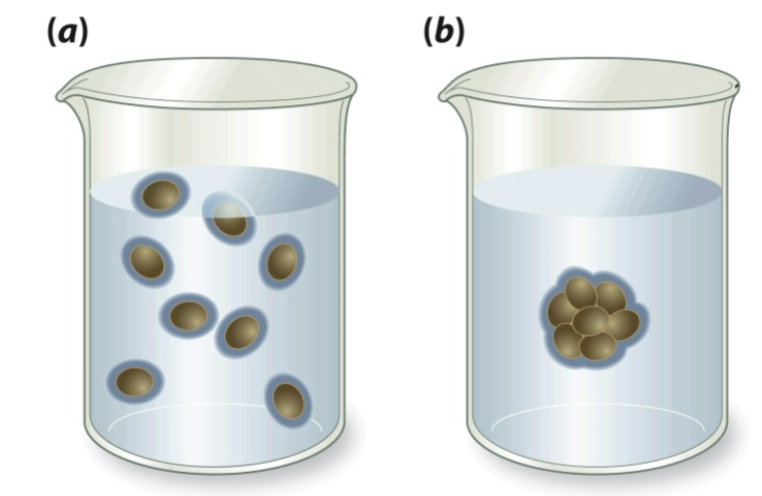
describe entropy of the two figures and which is higher
in A, the dark blue surface of oil is trying to maximize number of H bonds
structuring H2O gets rigid, decreasing randomness
in B, there is less dark blue, and more light blue, so water entropy is higher
what are amphiphiles
molecule with both polar (hydrophilic) and nonpolar (lipophilic) groups
polar head and nonpolar tail
polar group has ionizability
when an amphiphile is thrown in water, which group faces the outside and why
the polar component interact with water so they face outside
what drives the hydrophobic tail of an amphiphile in water together
hydrophobic effect because by clustering the acid tails together, the total surface area exposed to water is minimized and thus increases entropy
what are proteins found in for life? (8)
hair and nails
blood
brain and nerves
enzymes
cellular construction workers
antibodies
cellular messengers
muscles
what is sickle cell disease from
results from an error (mutation) in just one amino acid of hemoglobin
what kind of structures can amphiphiles make
micelle (sphere shaped cluster with hydrophobic interior)
bilayer
what is a protein
polymer of amino acids hooked end to end like beads on necklace
how would proteins become active
they must twist and fold into their final or native conformation
all amino acids are chiral except
glycine
all chiral amino acids have what stereochemistry
L-stereochemistry
what is Ka
the acid dissociation constant that measures the strength of an acid
what is the relationship between pka and acid strength
lower pka means stronger acid
what happens to an R group if the solution pH<pKa
R group is in protonated form (equilibrium shift to protonated mc)
because pH is more ACIDIC than pka
what happens to an R group if the solution pH>pKa
R group is in deprotonated form (equilibrium shift to unprotonated mc)
bc pH is more BASIC than pka
what is the ratio of protonated :deprotonated when pH = pKa
50:50
what is the ratio of protonated : deprotonated when pH is one unit LESS than pKa
90:10
what is the ratio of protonated : deprotonated when pH is TWO units LESS than pKa
99:1
ionized molecules are more…. while un-ionized molecules are more…
ionized: more hydrophilic
un-ionized: more lipophilic
what pH does the amino acids turn dipolar? what’s another term for dipolar ions
7.4 (amino grp is protonated and COOH grp is unprotonated)
Zwitterions
pKa of amino acid COOH group
2.2
pka of amino acid alpha amino group
9.4
what is isoelectric point (pI)
the pH at which a mc carries no net electric charge (total charge is 0)
name and draw the amino acids with nonpolar side chains
glycine (Gly, G)
alanine (Ala, A)
valine (Val, V)
leucine (Leu, L)
isoleucine (Ile, I)
methionine (Met, M)
proline (Pro, P)
phenylalanine (Phe, F)
tryptophan (Trp, W)
name and draw the amino acids with uncharged polar side chains
Serine (Ser, S)
Threonine (Thr, T)
Asparagine (Asn, N)
Glutamine (Gln, Q)
Tyrosine (Tyr, Y)
Cysteine (Cys, C)
name and draw the amino acids with charged polar side chains
lysine (Lys, K)
arginine (Arg, R)
histidine (His, H)
aspartic acid (Asp, D)
glutamic acid (Glu, E)
what is the pka of tyrosine side chain
10.46 (phenol)
what is the pka of cysteine side chain
8.37 (sulfahydryl)
how does cysteine form disulfide bonds
thiol groups (S-H) gets oxidized by oxygen to make strong S-S
2 cysteine = 1 disulfide bond = 1 cystine
what is pka for lysine side chain
10.5
what is pka for arginine side chain
12.5
how to get modified amino acid residues
post translational modification - modification of standard R groups after protein synthesis
what is the order of protein synthesis
DNA → RNA → protein by ribosome
how is a peptide bond formed
condensation reaction (loss of H2O)
forms amide bond between the two aa’s (C from COO- and N from NH3+)
Are all peptide bonds amide bonds? Are all amide bonds peptide bonds? Why
Yes. A peptide bond is just a specific type of amide bond that connects two amino acids
No. Amide bonds can exist in non-biological molecules (like nylon or acetaminophen), while peptide bonds only form between amino acids.
what terminus marks the beginning of the polypeptide
N-term
what are amino acids in a polypeptide referred to as
amino acid residuesw
what kind of polymers are polypeptides
linear
are all the backbones identical in protein
Yes, from alpha amine to C, to CO, to NH, to C, to CO…
what is the reaction equation between glutathione (GSH) and oxygen
2 GSH + Xoxidized → GSSG (glutathione disulfide) + Xreduced
reduced GSH is antioxidant and helpful for body
why is GFP (green fluorescent protein) important
it can be linked to another protein to make that said protein GLOW (when GFP is agitated), allowing scientists to be able to see proteins under the microscope and in different colors