APES Unit 4 Vocab
 Studied by 0 people
 Call Kai
 Learn
Learn Practice Test
 Spaced Repetition
 Match
Match Flashcards
 Knowt Play
1/61

There's no tags or description
Looks like no tags are added yet.
Name | Mastery | Learn | Test | Matching | Spaced |
|---|
No study sessions yet.
62 Terms
Crustal Abundance
The relative quantity of different elements or minerals found in the Earth's crust.
Ore
A naturally occurring solid material from which a metal or valuable mineral can be extracted.
Metal
A solid material that is typically hard, shiny, malleable, and ductile, and is a good conductor of electricity and heat. Metals are used in various applications, including construction and manufacturing.
Reserve
A known quantity of a resource that can be extracted and processed economically.
Strip Mining
A method of mining that involves stripping away the overburden to access mineral deposits near the surface, often resulting in significant environmental impact.
Mine Tailings
The residual waste material left after the extraction of valuable minerals from ore, often containing harmful substances that can pollute the environment.
Open-Pit Mining
A surface mining technique where a large excavated pit is created to access minerals, allowing for the extraction of ore and surrounding rock. This method can lead to extensive land disturbance and pollution.
Mountaintop Removal
A form of surface mining where the tops of mountains are blasted off to expose coal seams, often causing severe environmental degradation and habitat destruction.
Placer Mining
A method of extracting valuable minerals from alluvial deposits by washing or using gravity separation techniques, often practiced in riverbeds and sedimentary deposits.
Subsurface Mining
A mining technique that involves digging tunnels or shafts underground to access minerals that are too deep to be reached by surface methods, often resulting in less land disturbance but higher risk of worker safety issues.
Core
A central part of the Earth, composed primarily of iron and nickel, existing in liquid outer and solid inner forms.
Mantle
The layer of the Earth located between the crust and the core, composed of semi-solid rock that flows slowly over geological time, playing a crucial role in tectonic activity.
Magma
Molten rock located beneath the Earth's surface that can create igneous rocks through cooling and solidification.
Asthenosphere
The upper layer of the mantle located beneath the lithosphere, characterized by a semi-fluid state that allows for the movement of tectonic plates.
Lithosphere
The rigid outer layer of the Earth, composed of the crust and upper mantle, that is divided into tectonic plates.
Plate Tectonics
The theory that explains the movements of the Earth's lithosphere which is divided into tectonic plates that float on the semi-fluid asthenosphere, leading to geological phenomena such as earthquakes and volcanic activity.
Earthquake
A sudden release of energy in the Earth's crust that causes seismic waves, often resulting in ground shaking.
Hot Spot
An area in the mantle where heat causes magma to rise and create volcanoes, not located at a plate boundary.
Volcano
A geological formation resulting from the eruption of magma from beneath the Earth's crust, often associated with tectonic activity.
Tsunami
A series of ocean waves with very long wavelengths caused by large-scale disturbances in or near a body of water, such as earthquakes or volcanic eruptions.
Divergent Boundary
A tectonic plate boundary where two plates move apart, leading to the formation of new crust as magma rises from below the Earth's surface.
Seafloor Spreading
The process by which tectonic plates move apart at a divergent boundary, allowing magma to rise and create new oceanic crust.
Convergent Boundary
A tectonic plate boundary where two plates collide, often leading to the formation of mountains or subduction zones.
Subduction
the process where one tectonic plate moves under another and sinks into the mantle.
Island Arc
A chain of volcanic islands formed at a convergent boundary where an oceanic plate subducts beneath another oceanic plate.
Collision Zone
A region where two tectonic plates collide, often leading to volcanic activity and the creation of mountain ranges.
Transform Boundary
A tectonic plate boundary where two plates slide past one another, causing earthquakes.
Fault
A fracture in the Earth's crust where blocks of rock have moved past each other, causing earthquakes.
Igneous Rock
Rock formed from cooled magma or lava.
Sedimentary Rock
A type of rock formed by the accumulation and consolidation of mineral and organic particles, often layered and may contain fossils.
Metamorphic Rock
Rock formed under heat and pressure, changing existing rocks.
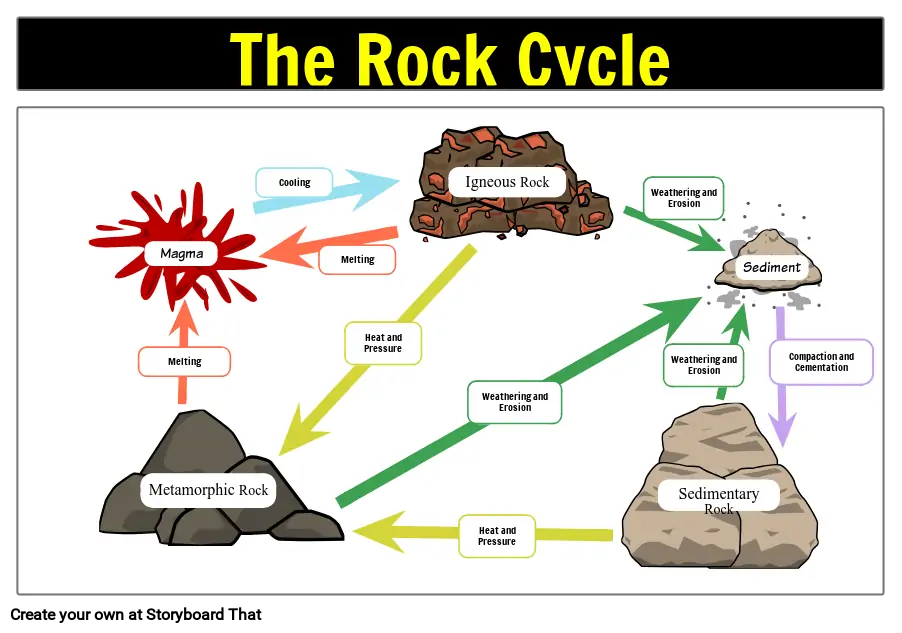
Rock Cycle
The continuous process of formation, breakdown, and reformation of rocks through geological processes such as erosion, melting, and metamorphism.
Physical Weathering
The process of breaking down rocks into smaller pieces through physical forces, such as freeze-thaw cycles, abrasion, and temperature changes. This type of weathering does not alter the chemical composition of the rocks.
Chemical Weathering
A process that alters the chemical composition of rocks and minerals through reactions with water, air, and other substances. This can lead to the formation of new minerals and the breakdown of the rock.
Acid Precipitation (Acid Rain)
Precipitation that contains elevated levels of sulfuric or nitric acids, resulting from atmospheric pollution. It can harm ecosystems, corrode buildings, and affect soil quality.
Erosion
The process by which soil, rock, and other surface material are worn away and transported from one location to another by wind, water, or ice.
Parent Material
The layer of material from which soil develops, composed of rock, minerals, and organic matter. It influences soil properties and fertility.
Soil Horizon
The different layers of soil that vary in composition, texture, and color, formed through processes like weathering and organic activity.
A Horizon
the top layer of soil, rich in organic material and nutrients, where most biological activity occurs.
O Horizon
The top layer of soil, consisting mainly of organic matter, decomposed leaves, and other plant material, which is crucial for nutrient cycling.
Humus
the organic component of soil formed by the decomposition of plant and animal matter.
E Horizon
A soil layer that is leached of minerals and nutrients, often lighter in color than surrounding horizons.
B Horizon
The layer of soil beneath the A horizon, typically containing minerals and organic matter leached from the upper layers. It is also known as the subsoil and plays a crucial role in soil fertility.
C Horizon
The deepest soil layer, consisting of weathered parent material and rock fragments. It is not influenced by biological activity and lies beneath the B Horizon.
Porosity
The measure of void spaces in a material, indicating its ability to hold fluids.
Water Holding Capacity
The amount of water soil can retain for use by plants, influenced by soil texture and structure.
Permeability
The ability of soil or rock to transmit water and air through its pores.
Cation Exchange Capacity (CEC)
The ability of soil to retain and exchange cations, which are positively charged ions. It is crucial for soil fertility and nutrient availability.
Base Saturation
the proportion of soil bases to acids, expressed as a percentage of the cation exchange capacity. It indicates the nutrient-holding capacity of the soil.
Watershed
An area of land that drains rainwater and snowmelt into a common water body, such as a river or lake.
Ecological Succession
The process of change in the species structure of an ecological community over time, often following a disturbance.
Primary Succession
The process of ecological succession that occurs in an environment that has not previously been inhabited, such as after a volcanic eruption or glacier retreat, leading to the establishment of a stable ecosystem over time.
Pioneer Species
Species that colonize barren environments first, facilitating ecosystem development.
Secondary Succession
the process of ecological recovery that occurs in an area where a disturbance has destroyed an ecosystem, but soil and some organisms still exist.
Climax Community
A stable and mature ecological community that has reached equilibrium after ecological succession, featuring a diverse range of species.
Disruption
An event that significantly alters or disturbs an ecosystem, such as natural disasters or human activity, leading to changes in the community and species composition.
Resistance
The ability of an ecosystem to withstand disturbances without changing significantly.
Resilience
The ability of a system or community to recover from disturbances or changes, restoring its original structure and function.
Intermediate Disturbance Hypothesis
the theory that ecosystems experiencing moderate levels of disturbance can maintain higher species diversity than those with high or low disturbance.
Periodic Disruption
a natural or human-induced event that alters the structure or function of an ecosystem, allowing species diversity to thrive.
Episodic Disruption
Refers to irregular events that disturb ecosystems, leading to changes in community structure and function.
Random Disruption
an unpredictable event that alters an ecosystem, potentially leading to changes in species composition and biodiversity.