The role of chromosomes and hormones
 Call Kai
 Learn
Learn Practice Test
 Spaced Repetition
 Match
Match Flashcards
 Knowt Play
1/11

There's no tags or description
Looks like no tags are added yet.
Name | Mastery | Learn | Test | Matching | Spaced | Call with Kai | Chat |
|---|
No analytics yet
Send a link to your students to track their progress
12 Terms
Biological sex
The classification of an individual based on the physical and physiological attributes determined by chromosomes, hormones and reproductive organs that are typically associated with being male or female
Gender
Your psychological identity and the behavioural aspects of identifying as male, female or a non-binary individual
Chromosones
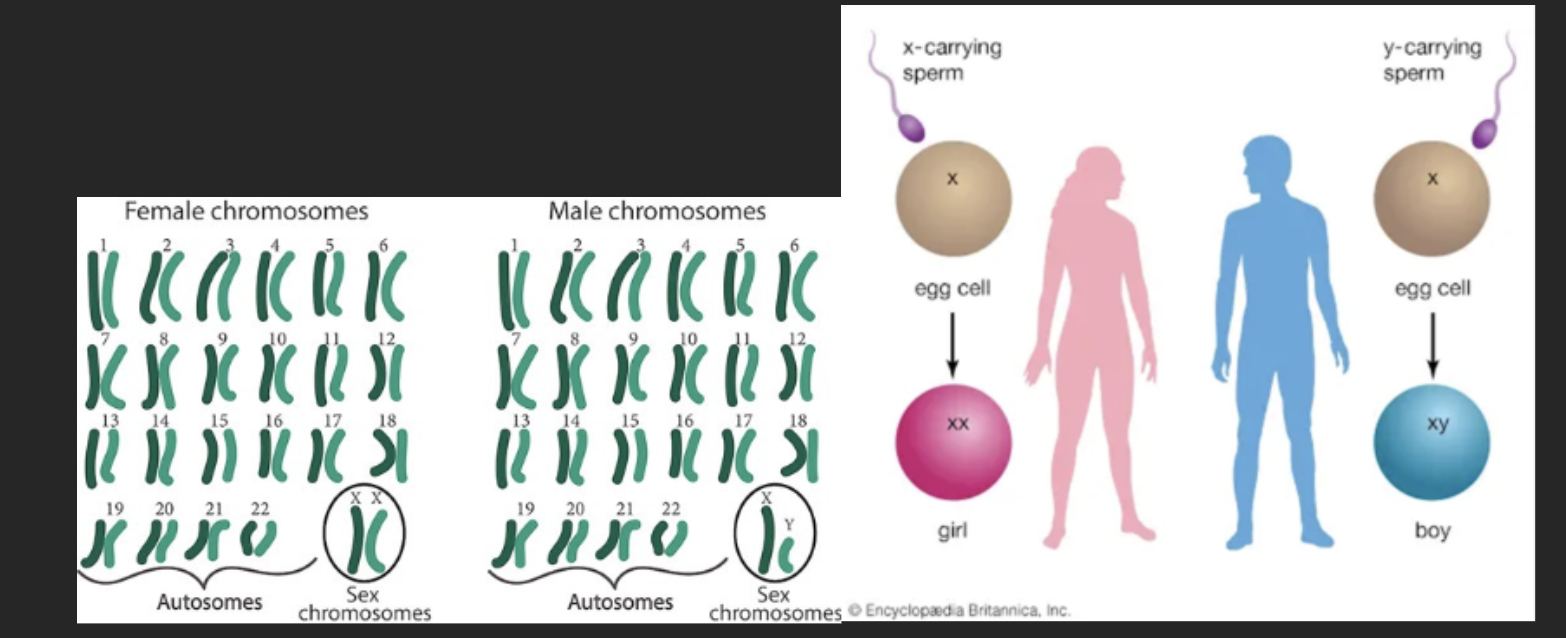
23 pairs of chromosomes inherited from the DNA of our biological parents.
Our biological sex is determined by one of these pairs; the ‘sex chromosomes.’
A female embryo (XX) inherits one ‘X’ chromosome from the biological mother and an ‘X’ chromosome from the biological father.
A male embryo (XY) inherits one ‘X’ chromosome from the biological mother and a ‘Y’ chromosome from the biological father.
Only biological males (XY) can produce a Y chromosome
It is the biological father's genetic information that will determine the biological sex of the embryo.
The Y chromosome is smaller than the X chromosome because it contains fewer genes.
It includes the SRY gene (Sex-determining Region Y gene) which is what causes testes to develop in a male (XY) embryo.
Testosterone - how does it contribute to our sexual development
Known as an androgen (male sex hormone). Biological males have 10 times the level of biological females and it is released when the SRY gene is detected on the Y chromosome. Production of testosterone during 7th week of gestation leads to the development of male sex organs (testes & penis). Levels in biological males rise during puberty and affect physical traits such as body and facial hair, muscle mass and height. In biological females, most testosterone in the ovaries is converted to oestrogen.
Oestrogen
Although produced in both the testes and ovaries, oestrogen levels are much higher in biological females. Before birth, oestrogen promotes the development of the endocrine system in both males and females. Oestrogen Influences the development of secondary sex characteristics such as breast development and the menstrual cycle (ovulation). In biological males, it affects the development of male sex organs, erectile function and sperm cell production.
Oxytocin
Known as the ‘cuddle’ or ‘love’ hormone, oxytocin is produced by biological males and females. Levels are higher in biological females and higher again during and after childbirth. This hormone prepares the female body for childbirth and lactation to aid breast feeding. It also reduces stress hormones such as cortisol in both biological males and females.
Evaluating the Role of Chromosomes and Hormones in Biological Sex
Wang et al
Wang et al (2000) studied the link between testosterone and sexual development in a sample of 227 adult, biological males suffering from ‘male hypergonadism’. This is a condition whereby the body does not produce enough testosterone, sperm or both. These males had been struggling with low mood, libido, muscle mass and more. After 180 days of testosterone therapy, the participants reported an improvement in sexual function, an improvement in mood, and muscle strength.
Deeming and Ferguson
Deeming and Ferguson (1989) arranged for the incubation of alligator eggs at varying temperatures to see how this affected biological sex when they hatched. They found that when the eggs were incubated at 30 degrees (C), 100% of the eggs produced biological females, and when the eggs were incubated at 33 degrees (C), 100% of the eggs produced biological males.
Wu et al
Wu et al (2012) studied the importance of the SRY gene in sex development. They administered an injection into mice to inhibit (silence) the expression of the SRY gene (located on the Y chromosome). They observed for testes production in the male mice but were unable to locate them. Instead, ovaries had developed. They concluded that feminisation of the male sex organs had occurred, despite the mice having XY sex chromosomes. Therefore, this study shows that chromosomes in general may not be the only factor that determines biological sex.
Koopman et al
Koopman et al (1991) found that when the SRY gene from male mice was implanted into female mouse embryos, they developed physical traits typical of a biological male.