Bio Plants
 Call Kai
 Learn
Learn Practice Test
 Spaced Repetition
 Match
Match Flashcards
 Knowt Play
1/58

There's no tags or description
Looks like no tags are added yet.
Name | Mastery | Learn | Test | Matching | Spaced | Call with Kai | Chat |
|---|
No analytics yet
Send a link to your students to track their progress
59 Terms
What is Transpiration
Transpiration is the loss of water vapour from the leaves of a plant, caused by evaporation of water from the surfaces of mesophyll cells followed by diffusion of water vapour through the stomata into the air.
Whta are the factors affecting transpiration (4)
Air Movement
Humidity
Temperature
Light Intensity
How does high air movement affect the rate of transpiration
Increases the rate
Good air flow removes water vapour from the air surrounding the leaf which increases the conc gradient between the leaf and the air increasing water loss
How does high humidity affect the rate of transpiration
Decreases the rate
When the air is saturated with water vapour (high humidity) the conc gradient is less so less water is lost
How does high light intensity affect the rate of transpiration
Increases the rate
Guard cells are responsive to the light intensity
When it is high, they are turgid and the stomata open allowing water to be lost
How does high temperature affect the rate of transpiration
Increases the rate
Particles have more kinetic energy, so transpiration occurs at a faster rate. Water molecules evaporate from the mesophyll cells and diffuse out through the stomata faster than they do at lower temperatures.
Diagram of plant tissue and exchange of substances through the Stoma
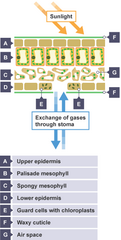
What is the role of the waxy cuticle
Prevents water loss by evaporation
What is the role of the upper epidermis
Thin and transparent to allow light to enter the palisade mesophyll layer underneath it
What is the role of the palisade mesophyll?
Column shaped cells tightly packed with chloroplasts to absorb more light TO MAXIMISE PHOTOSYNTHESIS
What is the role of the spongy mesophyll
Contains internal air spaces that increase the SA:V ratio for the diffusion of gasses mainly CO2
What is the role of the lower epidermis
Contains guard cells and stomata
What is the role of the Guard cells
Guard cells open and close the stomata, controlling gas exchange and water loss.When guard cells take up water they become turgid and the stomata open, allowing CO2 to diffuse in for photosynthesis and O2 and water vapour to diffuse out. When guard cells lose water they become flaccid and the stomata close, reducing water loss.
What is the role of the Stomata
Where gas exchange takes place
Opens during the day,closes during the night
Evaporation takes place here
Found in much greater concentration on the underside of the leaf to reduce water loss
What is the role of the vascular bundle
Contains xylem and phloem to transport substances to and from the leaf
What is the role of the Xylem
Transports water into the leaf for mesophyll cells to use in photosynthesis and for transpiration from stomata
What is the role of the Phloem
Transports sucrose and amino acids around the plant
How is the leaf best adapted for optimal diffusion and photosynthesis
Large SA, which increases the SA available for diffusion of CO2 and absorption of light for photosynthesis
Thin- allows Co2 to diffuse to palisade mesophyll cells quickly
How is the network of veins best adapted for optimal diffusion and photosynthesis
"The extensive network ensures xylem can supply water close to every cell (shortening diffusion distance for photosynthesis)
How is the Epidermis best adapted for optimal diffusion and photosynthesis
Its thin and transparent- allowing more light to reach the palisade cells
How is the cuticle best adapted for optimal diffusion and photosynthesis
It is thin and made of wax- to protect the leaf without blocking sunlight
How is the palisade layer at the top of the leaf best adapted for maximum light absorption
The palisade layer is situated near the upper surface with tall, tightly packed cells containing dense chloroplasts to maximize sunlight absorption for photosynthesis.
How is the spongy later best adapted for optimal diffusion
It has air spaces- whcih allow CO2 to diffuse through the leaf, increasing the SA
What is meristem tissue
Unspecialised actively dividing cells that are responsible for growth
Where is meristem tissue found
In the roots and shoots of plants
Describe the movement of water from the soil to the plant
From soil into root hair cells
Soil has a higher water potential than the root hair cells.
Water moves by osmosis through the partially permeable membrane into the root hair cells.
From root hair cells into xylem
Cells closer to the xylem have a lower water potential.
Water moves by osmosis from cell to cell until it enters the xylem vessels in the root.
Up the xylem to the leaves
Water moves up the xylem as a continuous column by transpiration pull (mass flow), helped by cohesion between water molecules.
From xylem in the leaf to outside air
Water moves by osmosis from xylem into mesophyll cells, then evaporates into the air spaces.
Water vapour then diffuses out through the stomata to the outside air.
What is a trophism
A growth response to a stimulus
What is phototrophism
A response to light
What is geotrophism
A response to gravity
Does Auxin diffuse to the shaded or bright side when light is directional on a plant?
Shaded side, causing those cells to elongate resulting in the shoot bending and growing towards the sunlight
What is Positive tropism
The plant grows towards the stimulus
What is negative tropism
Plant grows away from stimulus
What are shoots response to gravity and light
They grow up
Positive phototropic response
Negative geotropic response
What are roots response to gravity and light
They grow down into the soil
Negative phototrophic response
Positive geotropic response
What is the role of Auxins
Hormones that control cell elongation in plants
Where are auxins mostly made
In the tips of growing shoots
If light shines all around the tip not directionally what happens to the distribution of Auxin
Auxin is distributed evenly throughout and the cells in the shoot grow at the same rate
What is the role of IAA (auxins) in the shoots
Higher IAA concentration stimulates cell elongation which bends the plant toward the stimulus
What is the role of IAA (auxins) in the roots
Higher IAA concentration inhibits cell elongation causing the roots to bed downwards
What is the purpose of a clinostat in experiments
Is used to eliminate the effects of gravity, allowing observations of plant growth responses
What is a clinostat
An apparatus that rotates plants to study their growth responses
What is an isotonic solution
Same water potential as the cell.
No net movement of water in or out.
Cell keeps its normal shape (not swollen or shrunken).
What is a hypertonic solution
Lower water potential outside than inside the cell (more concentrated solution outside).
Water moves out of the cell by osmosis.
Cell shrinks and becomes wrinkled - this is a crenated cell.
What is a hypotonic solution?
Higher water potential outside than inside the cell (more dilute solution outside).
Water moves into the cell by osmosis.
Cell swells and may burst (lyse)
What is a plasmolysed cell
A plasmolysed cell is a plant cell that has lost so much water by osmosis (in a hypertonic solution) that the cell surface membrane pulls away from the cell wall.
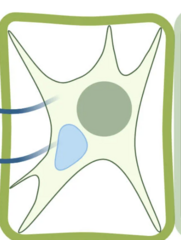
What is a turgid cell
A turgid cell is a plant cell that has taken in water by osmosis (in a hypotonic solution) until the vacuole is full, the cytoplasm is pressed against the cell wall, and the cell becomes firm.
What is plasmolysis
the process where cells lose water in a hypertonic solution causing the cell membrane to pull away from the cell wall.
What is the Xylem's Function and Direction
Transports water and mineral ions from roots to stems and leaves
Unidirectional (upwards)
What is the Xylem's structure and support
Xylem vessels are composed of dead, hollow cells with no cytoplasm and no end walls, forming a continuous tube for the transport of water and mineral ions.
Lignin strengthens the cell walls
What is the Xylem's process and does it require energy
Part of the transpiration stream
Does NOT require energy
What is the function and direction of the Phloem
Transports sucrose and AA from leaves to the rest of the plant
Bidirectional (up&down)
What is the structure and support of the Phloem
Phloem consists of living sieve tube elements joined end to end, with sieve plates between them and very little cytoplasm, plus companion cells alongside that contain a nucleus and many mitochondria to provide energy.
Sieve plates between cells allow for substances to pass through
What is the process that the Phloem carry's out and does it require energy
Translocation (transport of sugars from sources to sinks (roots fruits ect))
Requires energy
What is the cell's state in the Xylem compared to the Phloem
Xylem=dead
Phloem=living
What are the specialised cells in the Phloem called
Sieve tubes
Companion cells
What are sieve tubes and what do they do
They are specialised cells for transport
NO nuclei
Each sieve tube has a perforated end so its cytoplasm connects one cell to the next
What are companion cells and what do they do
One or more companion cells attached to each sieve tube provides energy for transport of substances
A sieve tube is completely depended on its companion cell.
Gives sieve tubes energy and provides it with genetic material.
How are the root hair cells adapted for their function in the roots
They have a long, thin root hair extension, giving a large surface area for absorption of water and mineral ions.
They have a thin, partially permeable cell membrane and cell wall, giving a short diffusion pathway for water entering by osmosis.
They contain many mitochondria, providing energy (ATP) for active transport of mineral ions from the soil.
Passage of water into the mesophyll cells from the soil
Soil
Root hair cells
Cortex
Xylem vessels
Veins of leaf
Mesophyll cells