ANP Ch 4 Personal
 Call Kai
 Learn
Learn Practice Test
 Spaced Repetition
 Match
Match Flashcards
 Knowt Play
1/53

There's no tags or description
Looks like no tags are added yet.
Name | Mastery | Learn | Test | Matching | Spaced | Call with Kai | Chat |
|---|
No analytics yet
Send a link to your students to track their progress
54 Terms
What are cells?
The smallest living units

What is Cell theory?
Cells are the structural and functional unit of life
All organisms are made of cells
Continuity of life has a cellular basis
Cells can only arise only from other preexisting cells
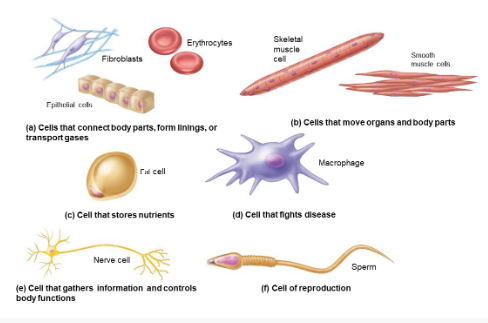
How are cells different?
There are 250 different types of human cells
Differ in shape, size, and subcellular components
Differences lead to differences in function
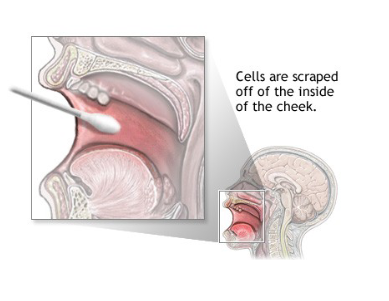
How do you take a buccal smear of a patient?
You scrape the cells off the inside of the cheek.
How are cells generalized?
All cells have some common structures and functions
What are the three basic parts of human cells?
Plasma membrane: flexible outer boundary
Cytoplasm: intracellular fluid containing organelles
Nucleus: DNA containing control center

How is the plasma membrane a physical barrier?
It encloses the cell, acts as an active barrier separating intracellular fluid (ICF) from extracellular fluid (ECF)

What are the four functions of the plasma membrane?
Physical Barrier
Selective permeability: determines which substances enter/exit the cell
Communication: interacts with specific chemical messengers and relay messages to the cell interior
Cell recognition: allows cells to recognize each other

What is the structure of the plasma membrane
Lipid Bilayer: flexible
Specialized membrane proteins: float through fluid membrane “fluid mosaic” pattern
Glycocalyx: surface sugars

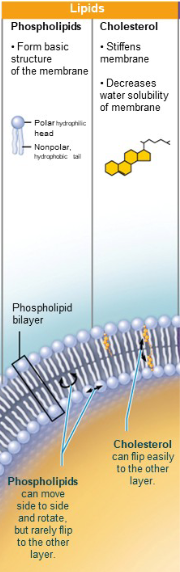
What kind of lipids are in the plasma membrane?
Lipid bilayer is made of up
-75% of phospholipids:
—phosphate heads: polar (charged, hydrophilic)
—fatty acid tails: nonpolar (no charge, hydrophobic)
-Cholesterol: increases membrane stability, stiffens and decreases permeability
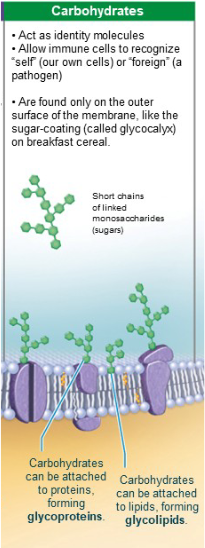
What is the glycocalyx inside of the plasma membrane?
Consists of sugars (carbohydrates sticking out of cell surface
Some sugars are attached
-Lipids (glycolipids)
-Proteins (glycoproteins)
Every cell type has different patterns
-Functions as markers for cell-to-cell recognition
What are membrane proteins inside of the plasma membrane?
Allow cell communication with the environment
Most have specialized membrane functions
-float freely
-tethered to intracellular structures
Two types:
-integral proteins
-peripheral proteins
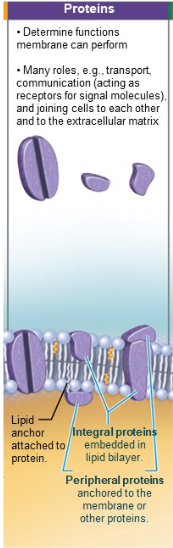
What are integral proteins?
Firmly inserted into membrane
Most are transmembrane proteins (span entire membrane)
-have both hydrophobic and hydrophilic regions

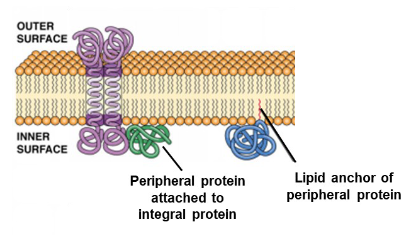
What are peripheral proteins?
Loosely attached via lipids or other proteins
-may include filaments on intracellular surface used for plasma membrane support
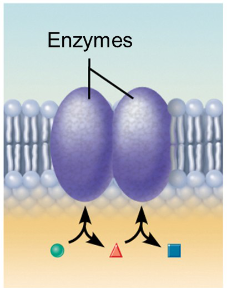
How to membrane proteins provide enzymatic activity?
Act as an enzyme with its active site exposed to the substances in solution
How to membrane proteins provide cell-cell recognition?
Serves as identification tags

How to membrane proteins provide attachment?
Attachment to extra cellular matrix
-helps maintain cell shape
-fixes location of certain membrane proteins
-plays a role in cell movement

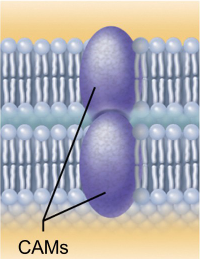
How to membrane proteins provide cell-to-cell joining?
Hook together in various kinds of cellular junctions
Provide temporary binding sites that guide cell migration and other cell-to-cell interactions (CAMs are cell adhesion molecules)
How to membrane proteins provide transport?
Provide channels across membrane for a particular solute
Some require ATP

How are membrane proteins receptors?
Receptors for signal transduction
-act as a binding site for specific chemical messengers, such as a hormone
—when bound - initiates a chain of chemical reactions in the cell

What is cytoplasm
All cellular material located between plasma membrane and nucleus

What is cytoplasm composed of?
Cytosol: gel-like solution (DONT MIX UP WITH CYTOPLASM)
-made up of water and soluble molecules (proteins, salts, sugars, ect.)
Inclusions: insoluable molecules, vary with cell type
-ex. pigments, lipid droplets, crystals
Organelles: metabolic machinery structures of cell
-each with specialized function
-either membranous or non-membranous
What are cytoplasmic organelles?
Mitochondria
Endoplasmic reticulum
Golgi apparatus
Peroxisomes
Lysosomes
Ribosomes
Cytoskeleton
Centrioles
What are the membranous cytoplasmic organelles?
Mitochondria
Endoplasmic reticulum
Golgi apparatus
Lysosomes
Peroxisomes
membranes allow for compartmentalization (dividing things into separate categories)
What are nonmembranous cytoplasmic organelles
Ribosomes
Cytoskeleton
Centrioles
What are functions of mitochondria?
“power plant” of cells
-produce most of cell’s ATP via cellular respiration
Enclosed by double membranes
-inner membranes folds - cristae
-membrane proteins necessary for cellular respiration
resemble bacteria
-contain own DNA, RNA, and ribosomes
-capable of cell division bacteria use (binary fission)

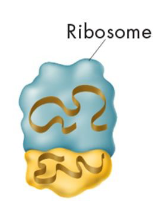
What are the functions of ribosomes?
site of protein synthesis
-protein and ribosomal RNA (rRNA
two switchable forms
-free ribosomes: free floating
—synthesis of soluble proteins that function in cytosol and other organelles
-membrane-bound ribosomes: attached to membrane of endoplasmic reticulum (ER)
—site of synthesis of plasma membrane proteins, lysosome proteins, and proteins to be secreted from cell
What is the function of endoplasmic reticulum (ER)
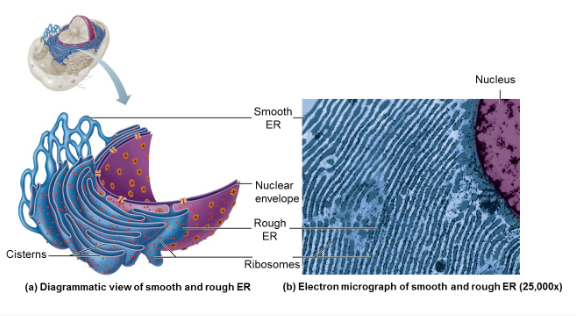
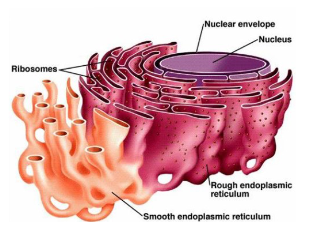
consists of series of parallel, interconnected cisterns (flattened membranous tubes that enclose fluid-filled interiors)
-continuous with other nuclear membrane
two varieties:
-rough ER
-smooth ER
What are functions of rough ER (RER)
appears rough - studded ribosomes
-synthesis of plasma membrane proteins, lysosome proteins, and proteins to be secreted from cell
proteins enter cisterns as they are synthesized
-modified as they wind through tubes
-final protein enclosed in vesicle and sent to Golgi apparatus

What are functions of smooth ER (SER)
tubules continuous with RER
have enzymes that function in:
lipid metabolism
absorption, synthesis, and transport of fats
absorption, synthesis, and transport of fats
storage and release of calcium
detoxification of some drugs and pesticides
concerting glycogen to free glucose
What are the functions of the golgi apparatus
stacked and flattened membranous cistern sacs
-modifies, concentrates, and packages proteins and lipids received from RER

What steps are involved int the golgi apparatus
Three steps are involved:
transport vesicles from ER fuse with cis (inner) face of Golgi
Proteins or lipids taken inside
-further modified, tagged, sorted, and packaged
Transport vesicles pinch off trans (outer) face
-directs traffic to one of three pathways

What is the are the three pathways the final transport vesicle of the golgi apparatus?
Secreted out of cell, e.g., hormones
Incorporated into cell membrane, e.g., transport protein
Develop into lysosomes
What are the function of lysosomes?
Contain digestive enzymes (acid hydrolases)
acidic spherical membranous bags
isolate potentially harmful intracellular digestion from rest of cell