Water pollution
 Studied by 0 people
 Call Kai
 Learn
Learn Practice Test
 Spaced Repetition
 Match
Match Flashcards
 Knowt Play
1/43

There's no tags or description
Looks like no tags are added yet.
Name | Mastery | Learn | Test | Matching | Spaced |
|---|
No study sessions yet.
44 Terms
Hypoxia
Lacking oxygen in water
problem in the gulf
Mississippi river
•collects water from 40% of the U.S.
•Delivers it to the Gulf of Mexico, along with fertilizers and wastes from feedlot animals
•Drained wetlands no longer intercept agricultural runoff
Dead zone
Place in Gulf of Mexico with no oxygen
Each year, oxygen disappears from thousands of square miles of ocean water.

Process of oxygen depletion
•Abundant nitrogen promotes growth of phytoplankton (photosynthetic microorganisms)
•Zooplankton (microscopic animals) eat phytoplankton
•These dead organisms are eaten by bacteria, which also consume oxygen
•Dead zones last from May to September
•Until cold weather mixes the water
•The gulf’s $2.8 billion fishery is impacted
Congress passed the 1998 Harmful Algal
Methods to reduce hypoxia
•Options to reduce nitrogen: use less fertilizer and restore/promote nitrogen and denitrification processes
•An action plan to reduce the size of the hypoxic area 50% by 2015 has not shrunk the area’s size
•In 2014, the dead zone occupied 5,700 square miles
•It is unreasonable to pollute water and expect it to provide us with goods and services as usual
•Globally coastal dead zones have doubled every decade since 1960
Federal water pollution control act 1948
•The first federal action regarding water pollution
•Provided technical assistance but nothing else
•Waterways became open chemical and waste sewers
•In 1969, Ohio’s Cuyahoga River actually caught fire
Clean water act of 1972
•Passed by Congress in response to public outrage about polluted water
•Charged the EPA with restoring and maintaining the chemical, physical, and biological integrity of waters
One of the most effective environmental laws enacted
Cuyahoga river fire
In 1969, the Cuyahoga River caught on fire because it was polluted with flammable industrial sources
Point source solution
•easy to identify, monitor, and regulate
•Factories, sewage systems, power plants, underground coal mines, oil wells
Solution: treat the water before release
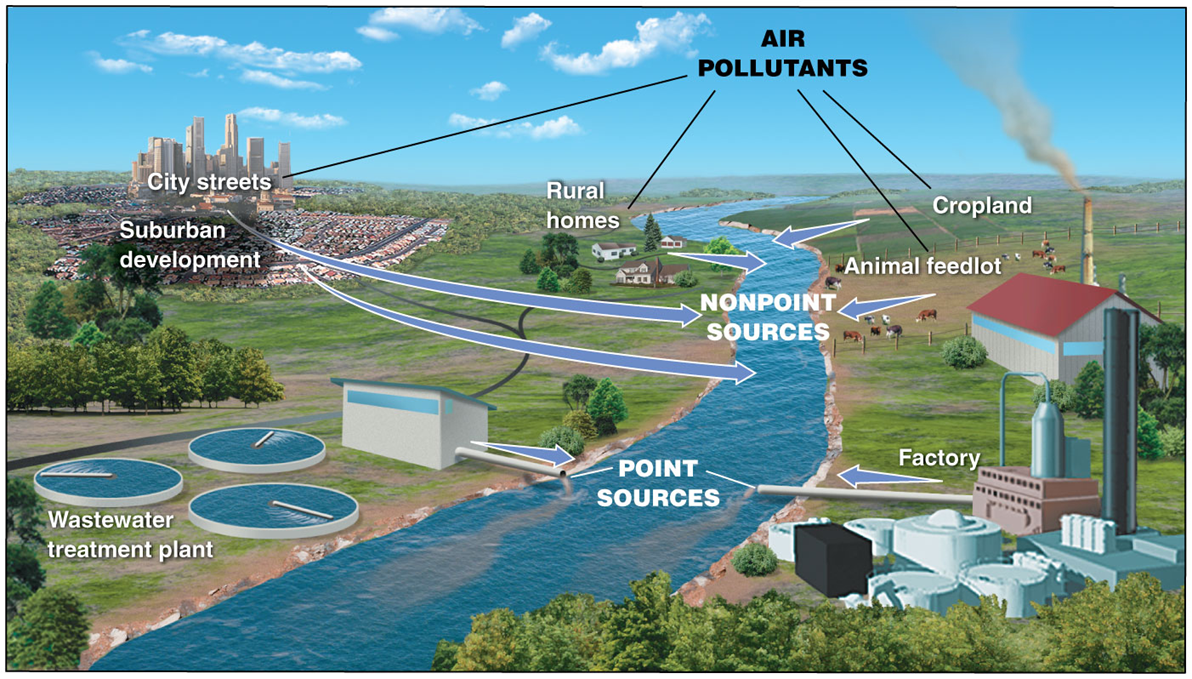
Nonpoint source pollution
•poorly defined and scattered
•Agricultural runoff, storm-water runoff (streets, parking lots, lawns), atmospheric deposition
Solution: reduce/remove source
Pathogens
•disease-carrying bacteria, viruses, parasites
•Found in human and animal excrement
Strategies to prevent disease in public health
•Purification and disinfection of public water supplies
•Sanitary collection and treatment of wastes
•Sanitary standards where food is prepared for the public
•Personal and domestic hygiene practices
•Public-health departments set and enforce standards
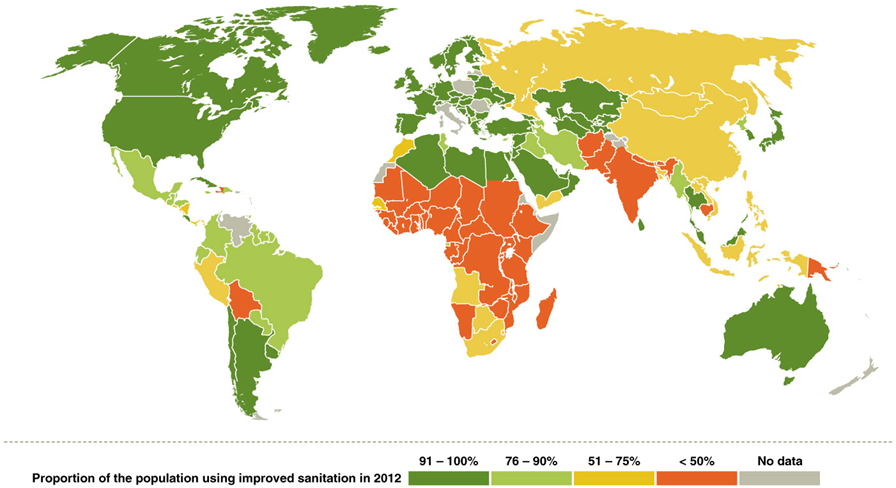
Millennium development goal 7
•to halve, by 2015, the proportion of people without clean water or sanitation
•The world is on track for water, but not sanitation
Organic matter
•human and animal wastes
•Leaves, grass, trash, etc.
•Most (except plastic and some synthetic chemicals) is biodegradable
•Bacteria and detritus feeders consume organic matter and oxygen
can deplete water’s dissolved oxygen
bacteria consuming organic matter keep dissolved oxygen low
Biochemical oxygen demand BOD
•a measure of the amount of organic material in water
•How much oxygen is needed to break matter down
•The higher the BOD, the greater the likelihood DO will be depleted
•A high BOD limits or precludes animal life
•A BOD value for raw sewage = 220 ppm
•Even 10 ppm can deplete water of DO
Dissolved oxygen DO
•Water holds much less dissolved oxygen (DO) than air
•Cold water holds more DO (10 ppm)
•Even a little organic matter can deplete water’s DO
•Bacteria consuming organic matter keep the DO low
•A DO < 2 or 3 ppm kills fish and shellfish
•Only bacteria can live in anaerobic (no oxygen) conditions
Oxygen sag curve
When sewage with a high BOD is discharged into a stream, it creates an oxygen deficit and severely affects the
stream’s biology
Inorganic chemicals
heavy metals (lead, mercury, arsenic, nickel), acids from mine drainage or precipitation
•Road salts used to melt ice and snow
Organic chemicals
petroleum, pesticides
•Industrial chemicals: polychlorinated biphenyls (PCBs), cleaning solvents, detergents
Biomagnification
chemicals become concentrated when going up the food chain
•Higher concentrations change water chemistry
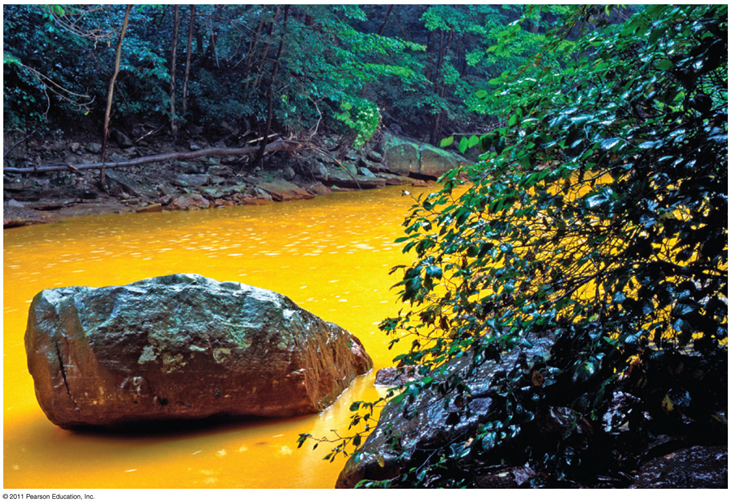
Acid mine drainage
The runoff from mining operations releases acid and heavy metals kills all aquatic life.
Origin of sediments
•Land weathering and storms wash sediments into water
•Erosion from farms, deforestation, overgrazing, construction, mining, roads increases sedimentation
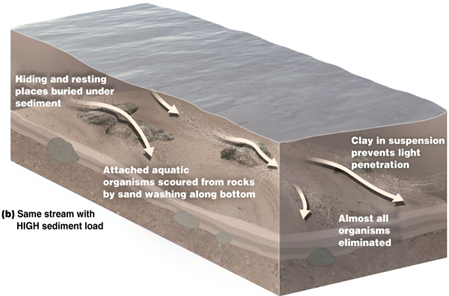
Impact of sediment load on environment
•Clay and humus make water muddy
•Reducing light penetration and photosynthesis
•Settled material coats everything, reducing photosynthesis
•Smothering gills, feeding structures, and eggs
Bed load
•destructive sand and silt that is not suspended, but is washed along the bottom
•Rolling particles scour organisms from rocks
•Smothering bottom life
•Filling in hiding places
•Plants can’t become established on the shifting sand
•Storm-water management reduces bed load with drains
Nutrients
•inorganic materials that are essential for plants
•Phosphorus and Nitrogen: the two most important nutrients may become limiting factors or pollutants
•Nutrients become pollutants when they stimulate undesirable plant growth in water
Point source
•untreated or poorly treated sewage outfalls
•Particularly in developing countries
Nonpoint source
agriculture (fertilizers, manure, crops, irrigation water), lawns/gardens, golf courses, drains
Pollution
•any quantity that is harmful to human health or the environment
•It prevents full use of the environment
•The concentration, not presence, of a substance is the concern
Criteria pollutants
•the EPA’s list of 167 substances
•Toxins, nutrients, hardness, pH
•Identifies and recommends concentrations for all water
Criteria maximum concentration CMC
the highest single concentration beyond which impacts occur
Criterion continuous concentration CCC
highest sustained concentration beyond which impacts occur
Drinking water standards and health advisories
the EPA’s table of standards for 94 contaminants
•Enforceable under the Safe Drinking Water Act (SDWA) of 1974
•Presented as maximum contaminant levels (MCLs)
Arsenic
a known human carcinogen occurring naturally in groundwater
•Drinking water’s MCL was 50 μg/L (1 μg/L = 1 ppb)
•Scientists warned this was much too high
•After political delays, the EPA lowered it to 10 μg/L
State sanitary codes
•Every state has one, generally adapted from the EPA’s federal regulations and defined testing procedures
•The set of rules and regulations regarding the minimum requirements for the management of waste and healthy human habitation, as well as water sources including recreational waters.
Louisiana state sanitary code
•Louisiana Administrative Code, Title 51. Public Health
•Covers human diseases, food safety, regulations for food preparation and storage, restaurants, butchers, animal husbandry and facilities, sewage treatment, etc
•Governs our drinking water quality and stipulates MCLs and monitoring requirements
•Follows the EPA standards
•MPN (most probable number) of colony forming bacteria, generally Coliform bacteria or E. coli
Maximum contaminant level MCL
•Under the Louisiana State Sanitary Code all PWS are tested for a long list of chemical compounds, both organic and inorganic, as well as particulates, radioisotopes, disinfectants and disinfectant byproducts, heavy metals, asbestos, cyanide, PAHs (Polycyclic Aromatic Hydrocarbons), pesticides, herbicides, fungicides, etc.
•Chlorination and disinfectant byproducts (Bromodichloromethane, Dichloroacetic Acid, Trichloroacetic Acid, Perchlorate ion)
•Fluoridation
Public water supplies PWS
•Monitored for Microorganisms (potential pathogens)
•
•MPN (Most Probable Number)
•number colonies per water volume streaked on petri dishes
Louisiana total coliform rule
•Louisiana State Sanitary Code, Title 51, Part XII, Chapter 9
•Frequency of testing dependent upon the number of people serviced by the PWS (once a month to more than five times per day
•Two stage test for ‘indicator’ species:
•Coliform bacteria
•E. coli bacteria
or Fecal Coliform Bacteria