2 3 General Parturition, Obstetrics, and Fetotomy
 Call Kai
 Learn
Learn Practice Test
 Spaced Repetition
 Match
Match Flashcards
 Knowt Play
1/63

There's no tags or description
Looks like no tags are added yet.
Name | Mastery | Learn | Test | Matching | Spaced | Call with Kai | Chat |
|---|
No analytics yet
Send a link to your students to track their progress
64 Terms
The fetus --> progesterone MUST DECREASE for parturition to occur
What induces parturition in domestic species? What hormone?
1. initiation of myometrial contractions (removal of "progesterone block")
2. expulsion of fetus
3. expulsion of fetal membranes (placenta)
What are the 3 stages of parturition in domestic species?
1. maturation of FETAL hypothalamic-hypophyseal-adrenal axis
2. inc. fetal corticoids (inc. stress of fetus and ACTH)
3. Dec. progesterone and inc. estrogen
Name the 3 mechanisms of parturition
Relaxin (relaxation of pelvic ligaments)
Prolactin (part of the initiation of lactation)
What are 2 other critical hormones involved in parturition?
Progesterone --> Androstenedione --> Estradiol
What hormones come from the same base?
Prostaglandin F2alpha
What hormone causes luteolysis?
The fetus puts pressure on the cervix --> oxytocin release --> stimulates uterine contractions --> pushes fetus into cervix (cycle until cervix opens)
Occurs during stage 1 (Initiation of myometrial contractions and removal of progesterone block)
What is Ferguson's Reflex in mares, cows, and ewes, and during which stage of parturition does it occur?
Stage 1 (initiation of myometrial contractions and removal of the progesterone block)
During which stage of parturition might you start to see symptoms like restlessness, anorexia, abdominal discomfort, increased pulse and resp., nesting/isolation, shifting weight, arched back, and elevated tail?
Expulsion of the fetus:
fetus enters cervical canal
rupture of chorionic membranes/chorioallantois (water break)
active controlled abdominal pressing
delivery of fetus
What happens during stage 2 of parturition?
Stage 2
What stage of parturition is this?

Stage 3
What stage of parturition is this?

PRESENTATION: cranio-longitudinal
POSITION: dorso-sacral
POSTURE: head and forelimbs extended
Name the NORMAL presentation, position, and posture of a fetus being delivered
Write this out when studying
Relationship of spine of fetus as it enters birth canal to spine of dam
What is presenting to me?
CAN BE:
Longitudinal: spine to spine (cranial=head exits first, caudal=butt exits first)
Transverse: sideways (ventral=feet of foal exits first, dorsal=back of foal exits first)
When we say "presentation" of the fetus being delivered, what does this mean? What are the options?
a. cranio-longitudinal
e. ventral transverse
f. caudo-longitudinal
Select which of the following words can be used to describe "presentation" of fetus:
a. cranio-longitudinal
b. dorso-sacral
c. flexed
d. dorso-pubic
e. ventral transverse
f. caudo-longitudinal
Relationship of dorsum of fetus relative to pelvis of mare
How is the fetus laying?
CAN BE:
Dorso-sacral (upright)
Dorso-pubic (upside down)
Dorso-left ilial (laying on side)
Dorso-right ilial (laying on side)
When we say "position" of the fetus being delivered, what does this mean? What are the options?
b. dorso-sacral
d. dorso-pubic
Select which of the following words can be used to describe "position" of fetus:
a. cranio-longitudinal
b. dorso-sacral
c. flexed
d. dorso-pubic
e. ventral transverse
f. caudo-longitudinal
Anatomic relation of fetal extremities to its own body
Where is its head, neck, and legs?
CAN BE:
flexed
extended
retained
(be specific about joints affected)
When we say "posture" of the fetus being delivered, what does this mean? What are the options?
c. flexed
Select which of the following words can be used to describe "posture" of fetus:
a. cranio-longitudinal
b. dorso-sacral
c. flexed
d. dorso-pubic
e. ventral transverse
f. caudo-longitudinal
NORMAL: cranio-longitudinal, dorsal sacral, head and forelimbs extended
Describe the delivery

40%: caudo-longitudinal, dorso-sacral, hindlimbs extended
Just like horses, it is normal for canines to be delivered cranio-longitudinal, dorso-sacral, with head and forelimbs extended. What other positioning in canines is normal?
Dystocia
This is defined as difficult giving birth which may include factors like large fetus, fetal malformation, multiple feti, or abnormal PPP
HIGHEST INCIDENCE OF DYSTOCIA: cattle
LOWEST INCIDENCE OF DYSTOCIA: cats
also more common in primipara (1st baby) than multipara
What animals have the highest incidence of dystocia? Which have the lowest?
Be clean, gentle, and use lots of lube
What 3 factors make up the theriogenologist mantra?
They may have more difficulty because the pelvis is smaller as a result of fat
What do you need to keep in mind for overweight animals preparing to give birth?
Both head and forelimbs of fetus PLUS examiners arm should be able to fit into pelvis with ease
How can you estimate fetal size and if an animal will be able to be delivered vaginally? (cattle and horses)
d. J-Lube
Which lubrication must you be careful to use because it is fatal if introduced to the abdomen?
a. petroleum
b. methylcellulose
c. KY Jelly
d. J-Lube
Methylcellulose
What lube should be used in dystocia management?
Give slowly and ONLY ONCE
How should you give an epidural to a pregnant patient? How many can you give?
Clip the area = sacrococcygeal (pump the tail and find most cranial moveable space)
What should you do when introducing a spinal needle with stylet to horses for an epidural? What joint are you looking for?
Arthrocentesis with sharp needles
When is hair removal not indicated and why? (Not pertaining to reproduction)
Hanging drop technique = put some liquid into hub to make a bubble which will suck in automatically when you get into epidural space (sac of fluid around spinal cord)
What is happening for this epidural?

1. assisted vaginal delivery (ex. chains)
2. controlled vaginal delivery (ex. anesthetized. common in horses to raise back legs to get baby back in mare so you can reposition)
3. fetotomy
4. c-section
In what ways can you correct and deliver large animal births?
Mutation
This is the process by which the fetus is restored to a deliverable position to get out naturally
Repulsion
This is the process of pushing the fetus out of the maternal pelvis back into the uterine cavity to correct the abnormality
Rotation
This is turning the fetus on its longitudinal axis
Version
This is turning the fetus on its transverse axis into a cranial or caudal presentation (common in draft horses)
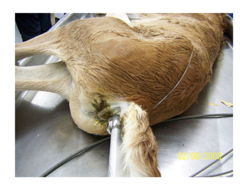
"Leg Retained" = cranio-longitudinal, dorso-sacral, right forelimb flexed at the carpus
TO FIX: bring limb up midline by cupping your hand over the hoof and fetlock and pulling forward
Describe this position. How do you fix it?

Caudo-longitudinal, dorsal sacral, right hindlimb flexed at hip
This is the action of repulsion
What position is this? What is this person doing?

Congenitally contracted tendons = cannot undo and fetotomy is often needed
What is this?

Retention of both front limbs = cranio-longitudinal, dorso-sacral, both forelimbs flexed at the shoulder
Describe this position

Presentation of one hindlimb = cranio-longitudinal, dorso-sacral, head and forelimbs extended, one hindlimb flexed at the hip
Describe this position

Dog sitting = cranio-longitudinal, dorso-sacral, head and forelimbs extended, both hindlimbs flexed at the hips
Describe this position

Flexed neck/head retained = cranio-longitudinal, dorso-sacral, head flexed right and both forelimbs extended
HOW TO FIX: can put fingers in mouth (intermandibular space), noose around lower jaw or around head that passes thru mouth, or nose hold to bring head around
Describe this position. How can you fix it?
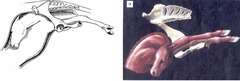
This is WRY NECK = same as a flexed neck but impossible to correct since the spine is fixed in this position = fetotomy or c-section is necessary and foal will not survive
Describe this position. How can you fix it?

Breech = caudo-longitudinal, dorso-sacral, hind limbs flexed at the hip
Describe this position
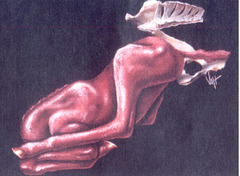
Hock presentation = caudo-longitudinal, dorso-sacral, hind limbs flexed at HOCK AND STIFLE
Describe this position

Rear feet pointed down = caudo-longitudinal, dorso-pubic, hind limbs extended
(when feet point up like this and soles are down it means the foal is backwards = often cause rectal tears)
Describe this position

Dorso-transverse
Describe this position
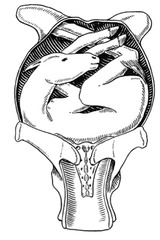
Ventro-transverse (foal may get caught in fornix. also may be difficult to differentiate from twins)
Describe this position. What do you need to keep in mind about this position?

Twins = one is anterior, one is posterior (you must differentiate from dog sitting)
Describe this position

TOP: traction on both forelimbs simulatenously = SHOULDER LOCK
BOTTOM: traction on one forelimb and then opposite forelimb undoes shoulder lock
What problem is happening in the top picture, and how is it being corrected on bottom?

Hip lock (can rotate fetus to fix)
This occurs when the the calf does not rotate as the fetal head emerges from the vulva, and the widest part of the fetus gets caught on the pelvis of the dam
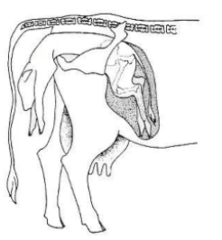
Partial and full
What are the two types of fetotomies?
Partial
Which type of fetotomy is the most common?
Partial fetotomy
Which type of fetotomy is most common in horses?
partial fetotomy
In which type of fetotomy can you make as little as one cut, often due to fetal posture or oversize, where you may amputate the head, neck, or limbs
full fetotomy
In which type of fetotomy do you make 5-6 specific cuts?
1. decapitation/cervical amputation
2. amputation of forelimb
3. amputation of other forelimb
4. detruncation (may be done in one or two cuts)
5. Division of pelvis diagonally
Name the cuts you make in a full fetotomy
If you cut below, you can get the chains around it. But if you cut above hock, there is nothing for the chain to attach to
Why might you choose to cut below the hock as opposed to above the hock for a fetotomy?
Detruncation transection (behind the shoulders)
What step of the fetotomy is this?

Detruncation lumbar transection (in front of the limbs = easier bc no ribs)
What step of the fetotomy is this?

Put the top part behind the shoulders and cut at an angle so that you don't leave sharp edges from the spinal column and damage the repro. tract of the dam
What is the proper way to remove the head and neck in a fetotomy?

Fetotomy step where you remove the forelimb
What is happening here?
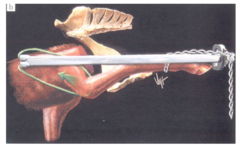
Fetotomy step where you remove the hind limb and split the pelvis
What is happening here?