AP Psych Midterm
 Call Kai
 Learn
Learn Practice Test
 Spaced Repetition
 Match
Match Flashcards
 Knowt Play
1/447

There's no tags or description
Looks like no tags are added yet.
Name | Mastery | Learn | Test | Matching | Spaced | Call with Kai | Chat |
|---|
No analytics yet
Send a link to your students to track their progress
448 Terms
Overconfidence Bias
Tendency to think you know more than you do or are better at something than you are.
Hindsight Bias
Tendency to believe, after learning the outcome, that you knew it all along; often called Monday Morning Quarterbacking.
Barnum Effect
Tendency to accept very general or vague characterizations of oneself as accurate.
Experimental Method
Research approach that manipulates an independent variable to observe its effect on a dependent variable; often uses random assignment and control groups.
Non-Experimental Method
Research approaches that do not manipulate the independent variable (e.g., case studies, naturalistic observation, surveys, correlations, meta-analyses).
Independent Variable (IV)
The variable that the experimenter manipulates; the presumed cause.
Dependent Variable (DV)
The variable measured in an experiment; the presumed effect.
Random Assignment
Assigning participants to experimental and control groups by chance to reduce bias.
Experimental Group
Group exposed to the independent variable.
Control Group
Group not exposed to the independent variable.
Double-Blind Procedure
Neither participants nor researchers know the expected outcome to prevent bias.
Single-Blind Procedure
Participants are unaware of the expected outcome, but researchers may know.
Placebo Effect
Behavioral change due to expectations rather than the actual treatment.
Hawthorne Effect
Alteration of behavior by subjects due to awareness of being observed.
Demand Characteristics
Cues that may indicate the research objectives and influence participant behavior.
Random Sampling
Selecting a sample so that every member of the population has an equal chance of inclusion.
Convenience Sampling
Sampling based on availability, which can lead to biased results.
Sampling Bias
Flawed sampling that produces unrepresentative data.
Naturalistic Observation
Watching subjects in their natural environment without manipulating the environment.
Case Study
In-depth study of a single person, group, or situation over time; rich data but limited generalizability.
Survey Method
Gathers self-reported attitudes or behaviors, often via representative random samples.
Social Desirability Bias
Respondents give answers they think will look good, concealing true opinions.
Wording Effect
How question wording influences respondents’ answers.
Informed Consent
Ethical requirement to inform participants and obtain voluntary participation.
Confidentiality
Protecting participants' data from disclosure.
Debriefing
Providing participants with a full explanation after participation in a study.
Ethics in Animal Research
Clear purpose, humane treatment, legal acquisition, and minimizing suffering.
Ethics in Human Research
Informed consent, protection from harm, confidentiality, and debriefing.
Theory
An explanation that organizes observations and predicts outcomes.
Scientific Method
Systematic observation, measurement, experiment, and the formulation, testing, and modification of hypotheses.
Applied Research
Research with clear, practical applications intended to solve real-world problems.
Basic Research
Research aimed at growing general knowledge, not necessarily with immediate applications.
Experimental Hypothesis
A statement predicting that the independent variable will affect the dependent variable.
Null Hypothesis
A statement that there is no effect or relationship between variables.
Replication
Repeating a study to see if findings hold with different participants and conditions.
Descriptive Research
Research that aims to observe and describe behavior (case studies, surveys, naturalistic observation).
Correlational Research
Research to detect naturally occurring relationships between variables; cannot establish causation.
Experimental Research
Research that manipulates variables to determine cause-and-effect relationships.
Third Variable Problem
A correlation may be due to a third variable influencing both variables.
Directionality Problem
Uncertainty about which variable affects the other.
Positive Correlation
Variables move in the same direction (both increase or both decrease).
Negative Correlation
Variables move in opposite directions (one increases as the other decreases).
Correlation Coefficient (r)
A number from -1 to +1 that measures the strength and direction of a linear relationship.
Illusory Correlation
Perceiving a relationship between two variables when none exists; often due to memorable events or selective attention.
Recency Bias
Tendency to rely on the most recently received information when forming judgments.
Regression to the Mean
Extreme scores tend to move toward the average on subsequent measurements.
Statistical Significance
Probability that observed results are due to chance; p-value < .05 is commonly used threshold.
p-value
Probability of obtaining results at least as extreme as observed, assuming the null hypothesis is true.
Effect Size
The magnitude of a relationship or difference, indicating practical significance.
Qualitative Research
Research relying on non-numerical data (interviews, observations, narratives).
Quantitative Research
Research relying on numerical data and statistical analysis.
Meta-Analysis
Statistical synthesis that combines results from multiple studies.
Normal Distribution
Bell-shaped, symmetrical distribution where mean = median = mode; about 68% within ±1 SD.
Skewness
Asymmetry in a distribution caused by outliers; positive skew has more low scores, negative skew has more high scores.
Outliers
Scores that are far from the rest of the data and can distort distributions.
Range
Difference between the highest and lowest scores.
Standard Deviation
Average distance of scores from the mean; measures data spread.
Mean
Arithmetic average of a set of numbers.
Median
Middle value when data are ordered.
Mode
Most frequently occurring value in a data set.
Percentile Rank
Percentage of scores that fall below a given score.
Neuron
a nerve cell; “building block” of the nervous system Icons of Science
Cell Body (Soma)
Life support center of the neuron.
Dendrites
Branching extensions at the cell body. Receives messages from other neurons.
Axon
Long single extension of a neuron, covered with myelin sheath to insulate and speed up messages through neurons.
Terminal Branches of axon
Branched ending of axons. Transmitting messages to other neurons
Synapse
the junction (space) between the axon of one neuron and the dendrite of another
Neurotransmitter
chemicals that carry messages across the synapse from one neuron to another
Action Potential
The “firing”
Resting Potential
the neuron is ready to fire (chilling waiting on orders)
Electrochemical Process
Electrical inside the neuron; chemical outside the neuron (neurotransmitters)
Excitatory
neurotransmitter effect that makes it more likely that the receiving neuron will generate an action potential or “fire”
Inhibitory
neurotransmitter effect that makes it less likely that the receiving neuron will generate an action potential or “fire”
Reuptake
Neurotransmitters in the synapse are reabsorbed into the sending neurons through the process of reuptake. This process applies brakes on neurotransmitter action.
Refractory Period
After a neuron has fired an action potential it pauses for a short period to recharge itself to fire again
Lock & Key Mechanism
Neurotransmitters bind to the receptors of the receiving neuron
Agonists
It excites; It is similar enough to the neurotransmitter molecule that it mimics the effects on the receiving neuron.
Antagonists
It inhibits; It has a similar enough structure to the neurotransmitter to occupy its receptor and block its action.
Acetylcholine (ACh)
vital role in movement and memory
too much – muscle contractions, convulsions
some spider venoms cause floods of ACh
too little – immobility, extreme lethargy
Botulin causes paralysis by blocking its release
Undersupply of ACh has been linked to Alzheimer’s disease
Dopamine
deals with movement, learning, attention & emotion
lack of dopamine has been linked to Parkinson’s Disease
too much has been linked to Schizophrenia
Many drugs cause our brain to flood with Dopamine
Serotonin
involved in mood control, hunger, sleep / arousal
lack of serotonin has been linked to clinical depression (Prozac and other antidepressants raise levels)
Endorphins
“endogenous morphine”
involved in pain control
most addictive drugs work with endorphins (opioids)
Glutamate
Major excitatory neurotransmitter. Involved in learning, memory, and brain development.
Oversupply can over stimulate the brain and cause seizures and migraines
GABA
Major inhibitory neurotransmitter Prevents a neuron from generating a nerve impulse.
Undersupply linked to seizures, tremors, and insomnia
Norepinephrine
Helps control alertness and arousal
Undersupply can depress mood
Substance P
Involved in pain perception and immune response
Oversupply can lead to chronic pain
Efferent (Motor) Neurons
info to body parts for movement
Interneurons
info within central nervous system
Afferent (Sensory) Neurons
info to CNS from body parts
Central Nervous System
brain and spinal cord
CNS
Receives Info from the peripheral and then tells it what to do
Peripheral Nervous System
ll nerves that are not encased in bone
everything but the brain and spinal cord
Divided into Somatic and Autonomic
Somatic Nervous System (Peripheral)
controls voluntary muscle movement
uses motor (efferent) neurons
Autonomic Nervous System (Peripheral)
controls the automatic functions of the body
Divided into sympathetic and parasympathetic
Sympathetic Nervous System
“Fight or Flight” response
automatically accelerates heart rate, breathing, dilates pupils, slows down digestion
Parasympathetic Nervous System
automatically calms the body down after a stressful event
heart rate and breathing slow down, pupils constrict, and digestion speeds up
think, “parachute”
Reflexes
normally, afferent neurons 🡪 spine 🡪 brain & brain sends orders for movement 🡪 efferent neurons
some reactions occur when sensory neurons reach just the spinal cord & spinal cord sends orders
Neural Networks
interconnected neurons
regular connections or routes of communication for different tasks, processes, etc.
body/brain “learns” networks over time
“muscle memory” in sports (“practice makes permanent”)
Brain
made up of…neurons, glial cells (or glia - support neural cells by insulating them, removing waste, etc.), connective tissues, cerebrospinal fluid
can be divided into three major sections: hindbrain, midbrain, forebrain
Glial Cells
They have four main functions: (1) to surround neurons and hold them in place; (2) to supply nutrients and oxygen to neurons; (3) to insulate one neuron from another; (4) to destroy pathogens and remove dead neurons.
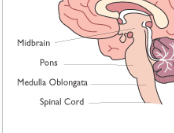
Brain stem (hindbrain)
Midbrain: top
Pons: Middle
Medulla (Medulla Oblongata)