BIOL 0510 - Virology
 Call Kai
 Learn
Learn Practice Test
 Spaced Repetition
 Match
Match Flashcards
 Knowt Play
1/107

There's no tags or description
Looks like no tags are added yet.
Name | Mastery | Learn | Test | Matching | Spaced | Call with Kai | Chat |
|---|
No analytics yet
Send a link to your students to track their progress
108 Terms
What is a virus?
an acellular obligatory intracellular parasite that can infect the cells of a host organisms
What’s the average size of a virus?
20-300 nm
What is the general structure of a virus?
a protein shell (capsid) encasing genetic material
What type of genetic material can viruses have?
single or double stranded RNA or DNA
What does an enveloped virus have?
a lipid membrane derived from the host cell surrounding the capsid with viral glycoproteins protruding out of it
What does the lipid membrane require to stay intact?
moisture otherwise it will dry out and the capsid is unable to invade host cells on its own
viral proteins can be…
structural or regulatory
Provide examples of viral structural proteins
proteins for the capsid or glycoproteins
Provide examples of viral regulatory proteins
enzymes like polymerases, transcription factors and proteins for making the host cell environment more suitable
What is T-antigen in polyomavirus?
a regulatory protein
What does polyomavirus use SV40 T-antigen for?
blocking tumor suppressor gene p53 and pRb which affects E2F which is a transcription factor for the cell cycle
What is the effect of SV40 T-antigen in cells?
The cells don’t die as easily and replicate indefinitely. Scientists use this to immortalise cells
What happens when SV40 T-antigen is injected into monkey cells?
the virus goes through the lytic life cycle and the cells never become cancerous
What happens when SV40 T antigen is injected into rodent cells?
the virus is unable to destroy the cells which results in tumours
What are four main shapes that viruses can take?
helical, spherical, complex and polyhedral
Describe how a helical virus is arranged?
the viral proteins are arranged in a spiral around the genetic material
Give examples of a helical virus
Tobacco Mosaic Virus, rabies and ebola
Describe how a spherical virus is arranged?
as a spherically shaped enveloped capsid with spike proteins embedded in it, surrounding genetic material
Describe how a polyhedral virus is arranged?
a many-sided capsid, usually 20 triangular faces surrounding genetic material
Give examples of a polyhedral virus
Adenovirus, papillomavirus and poliovirus
Provide examples of a spherical virus
coronavirus, influenza and measles virus
Provide an example of a complex virus?
bacteriophage
Describe the shape of a bacteriophage
They have a polyhedral head connected to a helical body with legs for attachment. So, they resemble a lunar lander
Describe acute infections
rapid and self-limiting so they can be cleared in a number of weeks

Describe persistent/chronic infections
Capable of lasting for months to years. Can start intense, ease off and then reactivate

What are latent infections?
an extreme version of persistent infections that can remain dormant and then reappear

What are the five main stages of the viral life cycle?
attachment, entry, replication, assembly and release
What is the goal of the viral life cycle?
Making more virus
What must occur in order for more virus to be made?
copying of viral genome and translation of viral proteins
What must occur in the attachment phase?
viral attachment proteins must bind to viral receptors and co-receptors on the host cell
Why is the attachment phase important?
It allows the virus to stick to the surface of the host cell and triggers intracellular signalling required for viral entry
What are receptors?
cell membrane molecules that bind to a ligand to transmit a cellular signal
Many receptors have sugars linked to them. What do they do?
modify them
What cellular events do normal ligands typically induce after receptor binding?
intracellular signalling e.g endocytosis or transcriptional changes
Do viruses tend to share receptors?
No. Viruses have unique and specific receptors
Viral trafficking is directed by…
attachment
What is tropism?
preferential targeting of a specific host species or cell type
What is tropism determined by?
host cell factors e.g receptors
What are the main categories of tropism?
cellular, tissue and host
What does it mean if a virus has a broad tropism?
it can affect a wide range of hosts
What is host range determined by?
specific host attachment sites and other cellular factors
What is permissibility?
the ability of a virus to enter a host cell and complete an infection cycle
Provide an example of a virus with broad tropism
rabies
Which host receptor did SARS CoV-2 have to bind to for successful entry?
hACE2 on lung tissue
Why did COVID have to be studied on transgenic animal models?
Mice don’t have the same ACE2 receptor as humans so they couldn’t be infected with COVID unless we modified them to express the human receptor
What is the receptor used by influenza?
Sialic acids which are terminal sugars on glycosylated sugars and proteins
Which sialic acid is attached to in avian influenza?
alpha 2,3 linked SA in their airways
Which sialic acid is attached to in human influenza?
alpha 2,6 linked SA in the upper respiratory tract
What type of sialic acid do swine have?
both 2,3 and 2,6
Why do humans occasionally get avian flu?
we have alpha 2,3 linked SA deep in our lungs
What is the 2nd step of the viral lifecycle?
entry
What’s the main method of viral entry?
endocytosis
How does endocytosis work?
Binding to receptor initiates formation of an endosome containing the viral particle
What are some of the different types of endocytosis?
Cathrin-mediated, caveolar and macropintocytosis
What’s a second method of viral entry?
fusion which is usually done by enveloped viruses
How does fusion work?
viral and host membranes fuse and the nucleocapsid is released into cell
What’s a third method of viral entry?
penetration e.g bacteriophage poking into the host membrane to inject genetic material
What does trafficking mean?
movement of the virus from the surface to the site of replication
What cellular component sometimes helps shuttle viruses?
microtubules
What is endosomal escape?
movement from endosome into the cytoplasm
What is uncoating?
disassembly of the virus capsid to be able to release genetic material
How does acidification help viruses?
at a low pH, conformational changes in the virus's surface proteins allow for membrane fusion and viral uncoating, facilitating infection escape from the endosome where it can release its genetic material into the cytoplasm
Where do DNA viruses traffic to?
nucleus
How do DNA viruses make their way to the nucleus?
using nuclear localization signal (NLS) to direct virus towards the nuclear pore
Where do RNA viruses traffic to?
the cytoplasm
What’s the 3rd step of the viral lifecycle?
replication - making copies of the viral genome
Which viruses use host enzymes for replication?
DNA viruses
Which viruses use viral enzymes for replication?
RNA viruses
Describe the diversity of genetic material amongst RNA viruses?
single stranded, double stranded and segmented
Describe the diversity of genetic material amongst DNA viruses?
circular, double stranded and single stranded
What does DNA/RNA (+) mean?
the genome is in an mRNA form that can be made directly into protein once in enters cell
What does DNA/RNA (-) mean?
the genome is in complementary strand form which needs to be copied into mRNA before proteins can be made
How do DNA viruses make more progeny?
enter the nucleus, replicate DNA using host cell DNA-dependent DNA polymerase, go through transcription with DNA-dependent RNA polymerase, then translation and protein synthesis in the cytoplasm
Why is the genome of DNA viruses less prone to mutations?
host cell enzymes which have proofreading abilities were used to replicate it
Why does using the viral machinery to replicate lead to more mutations?
doesn’t come with proofreading capabilities
What other factors contribute to mutations?
rate of replication, number of circulating strains and the segmentation of the genome
What are some examples of viruses with segmented genomes?
reoviruses, retroviruses and oxomyxoviruses e.g influenza
What is antigenic drift?
small point mutations that occur over time due to replication
What is antigenic shift?
reassortment of two or more genomes to make a new virus strain
When is antigenic shift likely to occur?
when a host cell is infected with 2+ viruses with segmented genomes
What kind of genetic material does influenza have?
single stranded RNA with multiple segments
How are the number of circulating strains and the segmentation of the genome related to influenza?
Swine lung cells are permissive to both avian and human influenza. During replication, reassortment could occur and make a virus that can infect humans but isn’t similar enough to previous strains that humans have been exposed to
Given that influenza has 8 RNA segments, how many new assortments can be made?
2^8 =256
What kind of virus caused the 2009 swine flu?
triple assortment
How do influenza strains differ from each other?
Symptom severity, species tropism and receptor usage
Which other virus can reassort?
rotaviruses
Rotaviruses are the leading cause of…
diarrhea in children
How do some RNA viruses create more progeny?
use their own RNA-dependent RNA polymerase (RNA to RNA)
What’s a second way that some RNA viruses create more progeny?
using reverse transcriptase (RNA-dependent DNA polymerase) which makes RNA into DNA to then use the host cell’s enzymes
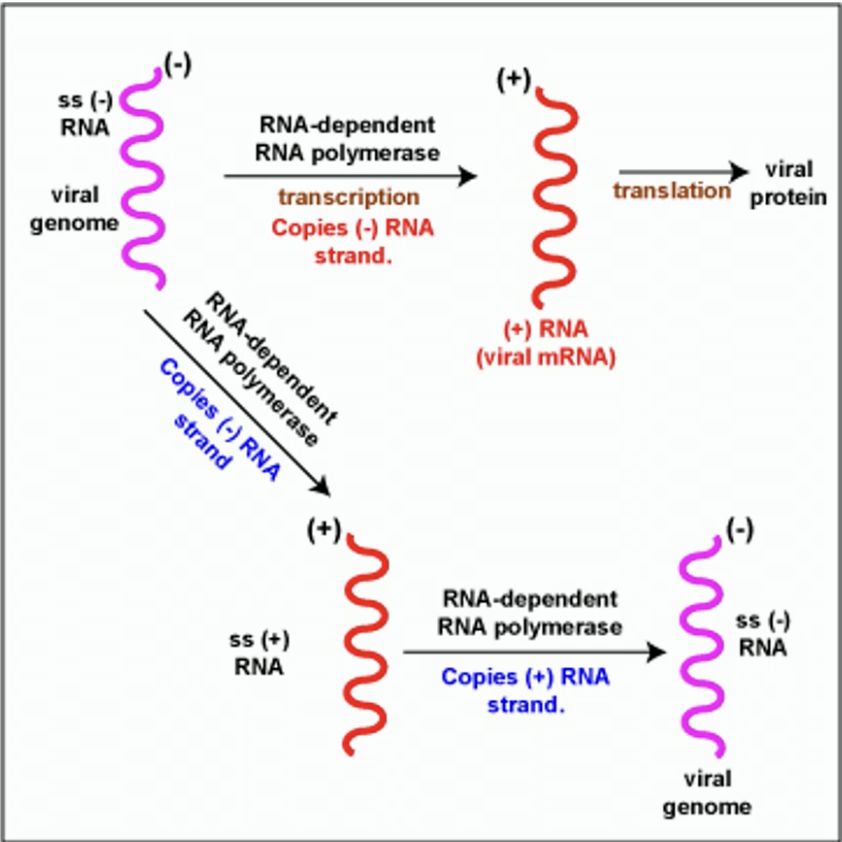
How are viral proteins made from single stranded (-) RNA viral genomes?
RNA-dependent RNA polymerase transcribes it into the (+) version which is then translated to make proteins
How are more copies of viral single stranded (-) RNA made?
RNA-dependent RNA polymerase transcribes it into the (+) version. Then the same enzymes makes lots of copies of the (-) version
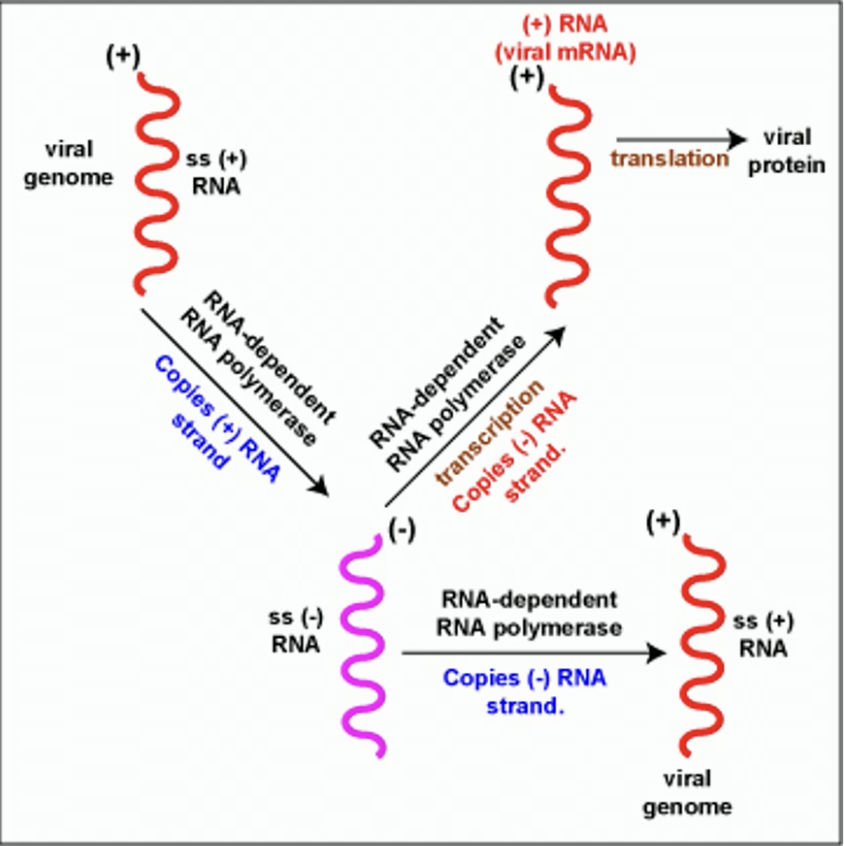
How are viral proteins made from single stranded (+) RNA viral genomes?
RNA-dependent RNA polymerase is used to make the (-) strand. Then, those strands are transcribed and translated
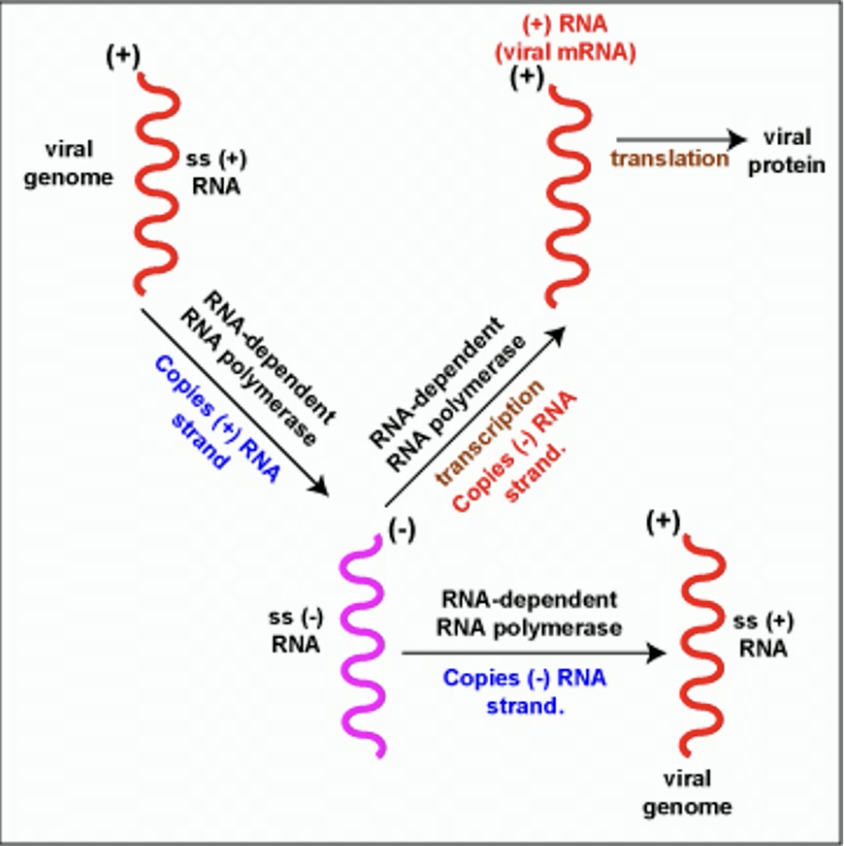
How are more copies of viral single stranded (+) RNA made?
RNA-dependent RNA polymerase is used to make the (-) strand. Then the same enzyme is used to make lots of complementary (+) strands
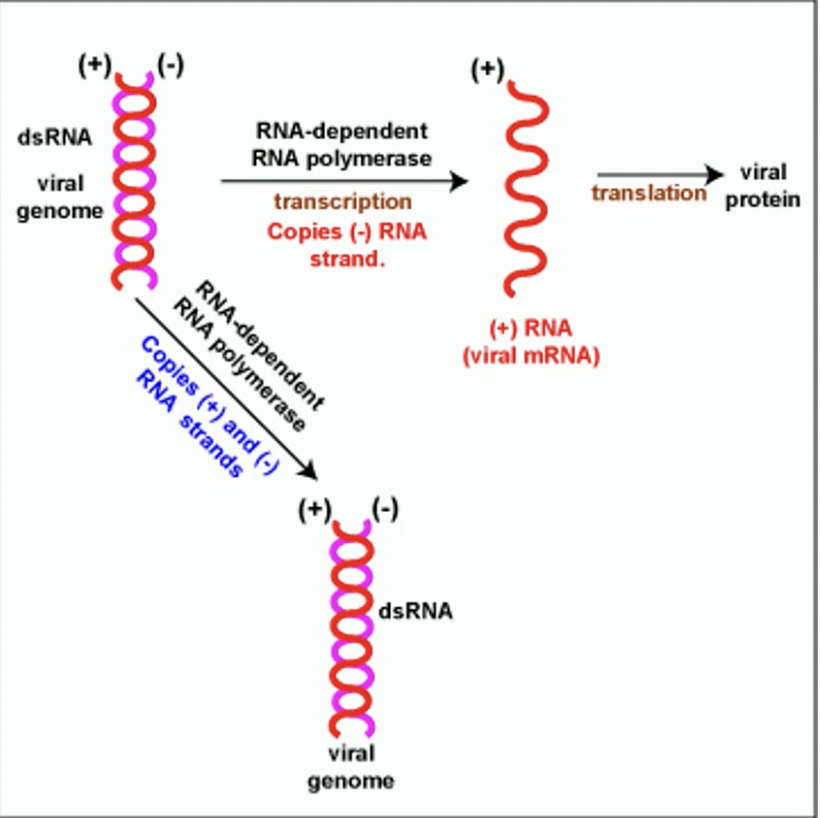
How are viral proteins made from double stranded RNA?
typical transcription and translation using RNA dependent RNA polymerase
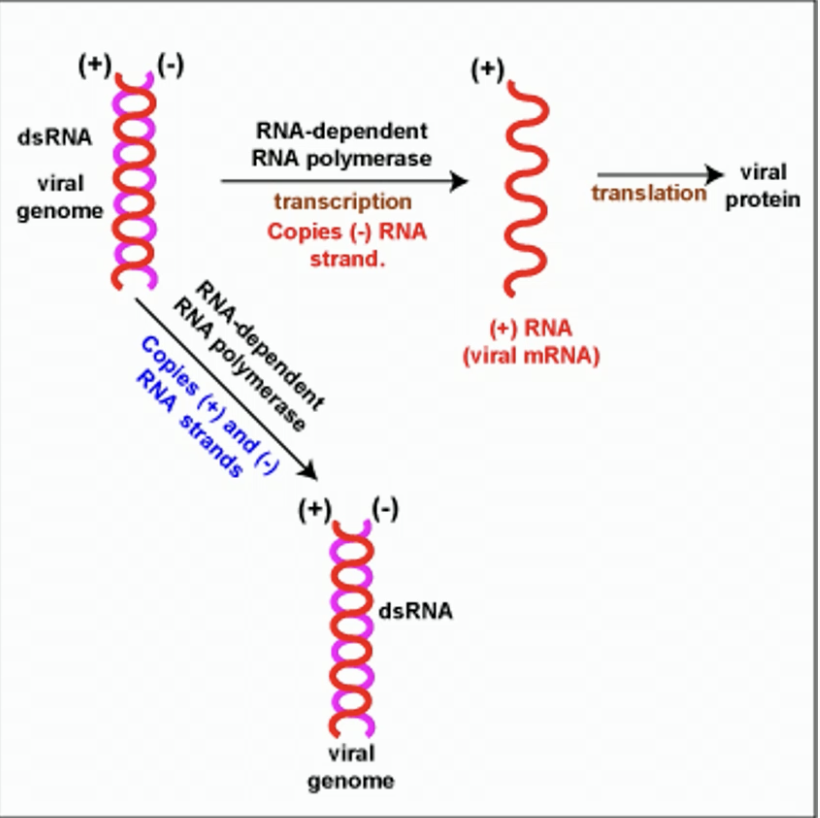
How are more copies of viral double stranded RNA made?
semi-conservative replication can be done on both strands using RNA-dependent RNA polymerase to remake copies of the double strand
What is reverse transcriptase?
RNA dependent DNA polymerase
How does retrovirus replication work?
reverse transcription converts RNA into DNA. Dd DNA polymerase makes it double stranded. Then, integrase inserts the viral DNA into the host cell’s genome.
How does the Linnaeus system of classification organise viruses?
by family, then genus, species and then subspecies
How does the Baltimore system of classification organise viruses?
DNA or RNA —> capsid shape —> naked or enveloped —> genome architecture —> group
What is the new virus taxonomy based upon?
based upon genetic sequence alone, groups are based upon evolutionary relatedness.