Regulatory Strategies for Controlling Enzymes
 Call Kai
 Learn
Learn Practice Test
 Spaced Repetition
 Match
Match Flashcards
 Knowt Play
1/61

There's no tags or description
Looks like no tags are added yet.
Name | Mastery | Learn | Test | Matching | Spaced | Call with Kai | Chat |
|---|
No analytics yet
Send a link to your students to track their progress
62 Terms
Allosteric Enzymes
Binding at regulatory site triggers conformational change that is transmitted to active site
Cooperativity
Action of one site affects other sites
What are the 2 models of allosteric enzymes?
Concerted
Sequential
What is the concerted model?
First binding changes binding in all sites
What is the sequential model?
Stepwise alteration of sites
What is ATCase?
- Aspartate Transcarbamoylase
- Catalyzes the first step in the biosynthesis of pyrimidines giving rise to pyrimidine nucleotides cytidine triphosphate (end product of the pathway.

ATCase composition
- 3 large catalytic subunits and 3 small regulatory subunits (Quaternary structure)
- Each catalytic subunit consists of 3 chains, while the regulatory unit consists of 2 chains
At sufficiently high concentrations of _____, ATCase is inhibited by an end-product feedback mechanism
CTP
Where is the binding site for CTP on ATCase?
Allosteric site found on the regulatory subunit
High concentrations of ______ acts as an allosteric activator for ATCase.
ATP
What are the two distinct quaternary forms of ATCase
T state and R state
What is the T state?
T (Tense) state and has low affinity for the substrate and lower catalytic power compared to the R state.
What is the R state?
R (relaxed) state has a high affinity for the substrate and high catalytic power.
Which state is more favored in the absence of substrate?
T-state
Which state is more favored in the presence of CTP?
T state
Is ATCase a concerted or sequential mechanism?
Concerted
The R state is favored by ___________ binding and stabilized by _________ binding.
substrate
ATP
What are Isozymes?
- Enzymes of different amino acid sequences catalyzing the same reaction
- These enzymes differ in kinetic parameters and regulatory properties
- Helps fine tune metabolic pathways within specific tissues

What are the two types of covalent modification in proteins?
- Regulatory modification (reversible)
- Structural modifications (mostly irreversible)
What are the 3 types of regulatory modification
- Phosphorylation
- ADP ribosylation
- Acetylation
What are the 3 types of structural modifications?
- Glycosylation
- Lipid modifications
- Gamma carboxylation of amino acid residue
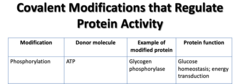
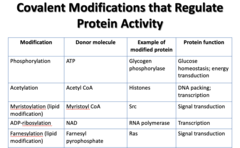
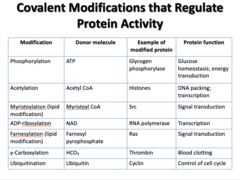
What is the donor molecule, example, and function of Phosphorylation?
Donor molecule: ATP
Example: Glycogen phosphorylase
Function: Glucose homeostasis; energy transduction
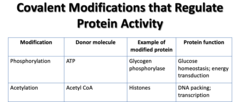
What is the donor molecule, example, and function of Acetylation?
Donor molecule: Acetyl CoA
Example: Histones
Function: DNA packing; transcription
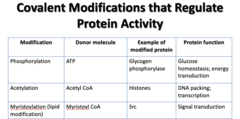
What is the donor molecule, example, and function of Myristoylation (lipid modification)?
Donor molecule: Myristoyl CoA
Example: Src
Function: Signal transuction
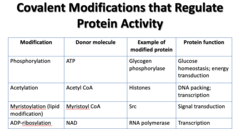
What is the donor molecule, example, and function of ADP-ribosylation?
Donor molecule: NAD
Example: RNA polymerase
Function: Transcription
What is the donor molecule, example, and function of Farnesylation (lipid modification)?
Donor molecule: Farnesyl pyrophosphate
Example: Ras
Function: Signal transduction
What is the donor molecule, example, and function of Gamma-Carboxylation?
Donor molecule: HCO3-
Example: Thrombin
Function: Blood clotting

What is the donor molecule, example, and function of Ubiquitination?
Donor molecule: Ubiquitin
Example: Cyclin
Function: Control of cell cycle
What is phosphorylation?
- Addition of a phosphate group to a protein.
- Energy in the form of ATP is required.
Enzymes that catalyze phosphorylation reactions are called....
Kinases
Serine/Threonine are phosphorylated by...
Serine/Threonine kinases
Tyrosine is phosphorylated by...
Tyrosine kinases
Dephosphorylation (removal of phosphate groups) is catalyzed by....
Phosphatases
What is Ribosylation?
-The enzyme ADP-ribosyltransferase transfers the ADP-ribose group from Nicotinamide Adenine Dinucleotide (NAD+) onto Arginine, Glutamate or Aspartate residues.
What is an example of ADP-ribosyltransferases?
Bacterial toxins such as cholera toxin, pertussis toxin, and diphtheria toxin
What does Diphtheria toxin do?
Catalyzes the ADP-ribosylation of eukaryotic elongation factor-2 (eEF2), inactivating it and inhibiting protein synthesis
What are Histone proteins?
Histone proteins are components of the nuclear chromatin structure
How are histones acetylated?
- Lysince residues of histones are acetylated by Acetyl-CoA.
- The enzyme that catalyzes this reaction is histone acetyltransferase (HAT)
What enzyme reverses the acetylation process?
Histone deacetylase (HDAC)
What does histone acetylation regulate?
Gene expression
What are lipid modifications?
- Lipid molecules covalently bound to the N and C termini of proteins
- Generally fatty acids (palmitate and myristate) or unsaturated lipids [farnsyl or geranyl-geranyl (prenyl groups) moieties] bind to proteins.
![<p>- Lipid molecules covalently bound to the N and C termini of proteins</p><p>- Generally fatty acids (palmitate and myristate) or unsaturated lipids [farnsyl or geranyl-geranyl (prenyl groups) moieties] bind to proteins.</p>](https://assets.knowt.com/user-attachments/67bb7e8f-c08f-417e-8a11-143f078e0ca7.png)
What is Gamma-Carboxylation?
Carboxylation of glutamate side groups
What is an example of Gamma-Carboxylation?
Prothrombin (first 10 glutamate residues in N-terminus of the protein are carboxylated)
Gamma carboxyglutamate is a stronger Calcium ______ than glutamate
chelator - type of bonding of ions and their molecules to metal ions
How is Prothrombin activated?
Binding of Ca2+ promotes Prothrombin to interact with the membrane enabling to be near enzymes that catalyzes it to the active form (Thrombin).
What are zymogens?
Enzymes synthesized as inactive precursors
How are zymogens activated?
Proteolytic cleavage of one or more peptide bonds.
What are examples of zymogens?
Enzymes secreted in the digestive system, blood clotting factors, and hormones
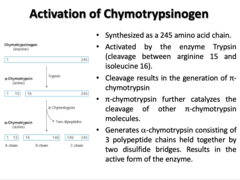
What is chymotrypsinogen synthesized as?
A 245 amino acid chain
How is Chymotrypsinogen activated?
Why is controlling protein degradation important to the cell (3 reasons)?
- To provide building blocks for energy and synthesis
- To eliminate misfolded or damaged proteins
- Regulation of pathways
What are the lifetimes of proteins?
Different proteins have lifetimes that range from few minutes to weeks or more
Where does protein degradation take place?
Within lysosomes or independent of lysosomes
Ubiquitin
- Involved in the protein degradation in the presence of ATP, independent of lysosomes
- Consist of 76 amino acid residues
- Proteins are marked for degradation by covalently linking them to ubiquitin
Ubiquitination of proteins
- The carboxy-terminal glycine residue of ubiquitin becomes covalently attached to sevaral E-amino groups of several lysine residus on a protein for degradation
- Forms an isopeptide bond which requires ATP
What 3 enzymes are required for Ubiquitination?
- Ubiquitin activating enzyme (E1)
- Ubiquitin conjugating enzyme (E2)
- Ubiquitin-protein ligase (E3)
What are the functions of the enzymes?
- E1 recognizes protein to be degraded and binds.
- E2 binds to E1
- Different amounts of E3 binds to E2 to form a tag
Is one ubiquitin molecule enough to mark a protein for degradation?
No
How many ubiquitin molecules are required to mark a protein for degradation?
4 or more ubiquitin molecules in chains mark a protein for degradation.
Where are ubiquitin molecules attached to each other at?
Lysine residue 48 in ubiquitin serves as the site for attachment of the subsequent ubiquitin molecule
26S Proteasome
- Ubiquitin marked proteins are degraded by the proteasome
- Resembles a barrel
- Consists of cap proteins and catalytic core protein
- Marked proteins are unfolded and the isopeptide bond is broken releasing ubiquitin before degradation
- Requires ATP
- Ubiquitin is recycled
- N-terminal threonine nucleophile recognizes sites to be degraded
Difference between proteasome and lysosome
Proteasome is more specific