Physics Chapter 5
 Call Kai
 Learn
Learn Practice Test
 Spaced Repetition
 Match
Match Flashcards
 Knowt Play
1/53

There's no tags or description
Looks like no tags are added yet.
Name | Mastery | Learn | Test | Matching | Spaced | Call with Kai | Chat |
|---|
No analytics yet
Send a link to your students to track their progress
54 Terms
Work formula
F x d
f = force
d = displacement
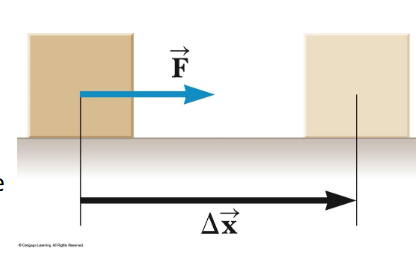
The work, W, done by a constant force during a linear displacement along the x-axis is
W = Fx Δx
Fx = x-component of the force
Δx = objects displacement
The work equation applies when
the force is in the same direction as the displacement
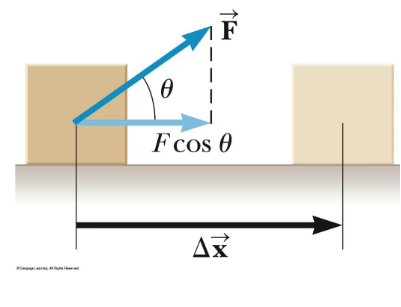
W = (F cos θ) Δx
F = the magnitude of the force
Δ x = the magnitude of the object’s displacement
θ = angle between F and Δx
work gives no information about
• The time it took for the displacement to occur
• The velocity or acceleration of the objec
work is a ____ quantity
scalar
no direction associated with it
Si unit of Work
newton x meter = Joule
Joule is equal to
kg x m2 / s2
The work done by a force is zero when
the force is perpendicular to the displacement
cos 90o = 0
If there are multiple forces acting on an object, the total work done is
the algebraic sum of the amount of work done by each force
The total work must be found for x, y, and z directions
separately
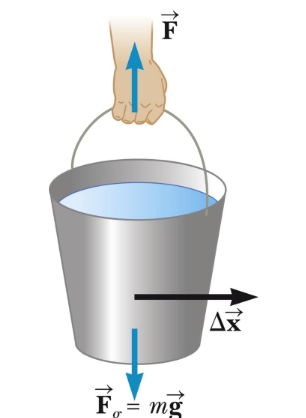
when work is zero
displacement is horizontal
force is vertical
cos90= 0 since work, W = (Fcos theta)d
W= 0 x J
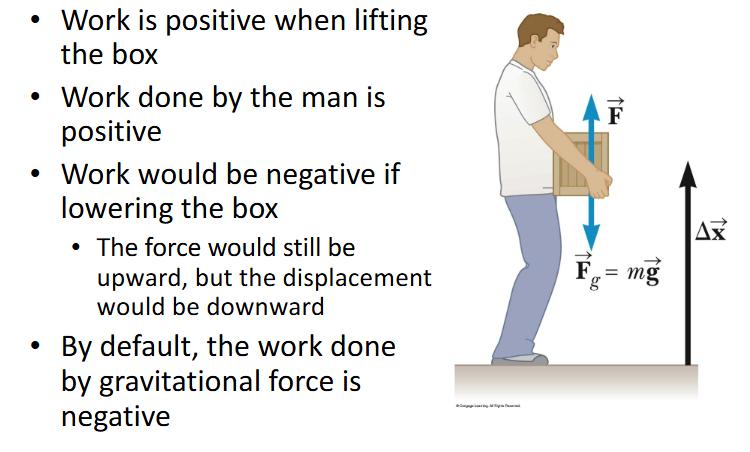
work can be
positive or negative
positive work
gained energy
the force and the displacement are in the same direction
negative work
lost energy
the force and the displacement are in the opposite direction
Positive and negative work done simply provide
energy exchange information
work being negative or positive example
Kinetic energy
Energy associated with the motion of an object of mass m moving with a velocity v
KE = ½ mv2
mass (m) in kinetic energy formula is a ____ quantity
scalar
velocity (v) in kinetic energy formula is a ____ quantity
vector
not related to speed (which is scalar)
KE in kinetic energy formula is a ____ quantity
scalar (same units as work)
work is related to
kinetic energy
Work-Kinetic Energy Theorem (WET)
When work is done by a net force on an object and the only change in the object is its speed, the work done is equal to the change in the object’s kinetic energy
Wnet = KEf - KEi = ΔKE
in Wnet = KEf - KEi = ΔKE, speed will increase if
net work is positive
in Wnet = KEf - KEi = ΔKE, speed will decrease if
net work is negative
Potential energy
associated with the position of the object within some system
property of the system, not the object
system
a collection of objects interacting via forces or processes that are internal to the system
Gravitational Potential Energy
the energy associated with the relative position of an object in space near the Earth’s surface
objects interact with the earth through the gravitational force
the potential energy is for the earth-object system
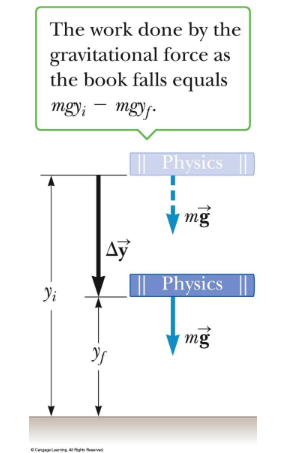
Work and Gravitational Potential Energy
• PE = mgy = mgh
• Wgravity = -mg(yf - yi )
• Units of Potential Energy are the same as those of Work and Kinetic Energy
Joule (J)
GPE/PEg=mgh
h=y
To consider non-conservative forces and gravity, the work-energy theorem can be extended to include potential energy
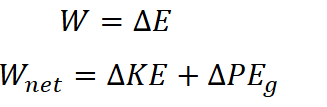
If other conservative forces are present in the work energy theorem, potential energy functions can be developed for them and their change in that potential energy added to the right side of the equation
ΔPEs = spring potential energy

ΔPEg if spring is horizontal
not present/taken out of equation
There are two general kinds of forces
conservative
nonconservative
conservative force
Work and energy associated with the force can be recovered
Nonconservative force
The forces are generally dissipative, and work done against it cannot easily be recovered
A force is conservative if the work it does on an object moving between two points is
independent of the path the objects take between the points
• The work depends only upon the initial and final positions of the object
• Any conservative force can have a potential energy function associated with it
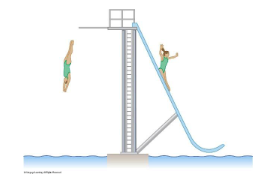
Examples of conservative forces include:
• Gravity
• Spring force
• Electromagnetic forces
Potential energy is another way of looking at the work done by
conservative forces
A force is nonconservative if the work it does on an object depends on
the path taken by the object between its final and starting points
Examples of nonconservative forces
Kinetic friction (see next slide), air drag, propulsive forces
Friction Depends on the Path
• The blue path is shorter than the red path
• The work required is less on the blue path than on the red path
• Friction depends on the path and so is a non-conservative force

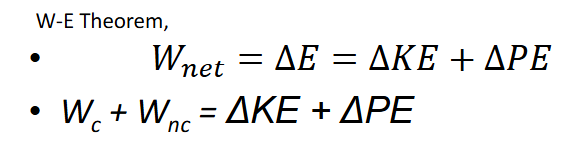
work-energy theorem can be expressed in terms of the work done by both
conservative forces, Wc, and nonconservative forces, Wnc
To say a physical quantity is conserved is to say that
the numerical value of the quantity remains constant throughout any physical process, although the quantities may change its form
In Conservation of Energy, the total mechanical energy remains
constant
In any isolated system of objects interacting only through conservative forces, the total mechanical energy of the system remains
constant
Law of Conservation of Energy (LCE)
we can neither create nor destroy energy
another way of saying energy is conserved
if the total energy of a system does not remain constant, the energy must have crossed the boundary by some mechanism
system needs to be defined precisely
Total mechanical energy is the sum of the
kinetic and potential energies in the system
Other types of potential energy functions can be added to modify this equation
ΔE = 0 because no energy change (same throughout)
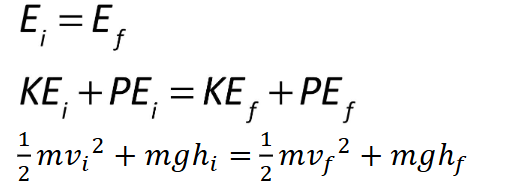
A location where the gravitational potential energy is zero must be chosen for
each problem
• The choice is arbitrary since the change in the potential energy is the important quantity
• Once the position is chosen, it must remain fixed for the entire problem
• Choose a convenient location for the zero-reference height
• Often the Earth’s surface
• May be some other point suggested by the problem
Potential Energy Stored in a Spring
The force used in stretching or compressing a spring is a conservative force
involves spring constant, k
displacement is directly proportional to the applied force
Hooke’s Law gives the force
Hooke’s Law
Fs = - kx
Fs is the restoring force
Fs is in the opposite direction of x
k depends on how the spring was formed, the material it is made from, thickness of the wire, etc.
negative sign depends on direction