VO6 - Parameterizations 4
 Call Kai
 Learn
Learn Practice Test
 Spaced Repetition
 Match
Match Flashcards
 Knowt Play
1/42

There's no tags or description
Looks like no tags are added yet.
Name | Mastery | Learn | Test | Matching | Spaced | Call with Kai | Chat |
|---|
No analytics yet
Send a link to your students to track their progress
43 Terms
What is convection?
circulation driven by differences in density / buoyancy
caused by radiation, surface warming, cooling of the atmosphere
In which 3 categories can convection be divided in parameterizations?
turbulent convection in the BL
shallow convection
deep convection
On which scales and in which models is turbulent convection parameterized?
up to the BL top
10min
Climate, NWP, partially also in LES (dx~10-100m)
On which scales and in which models is shallow convection parameterized?
about height of BL top + 1km
20 - 60min
Climate, NWP (regional and global)
On which scales and in which models is deep convection parameterized?
up to the tropopause
1 - 3h
Climate, Global NWP
How does convection influence the core variables?
vertical transport of:
moisture
energy
momentum
For which parameterized values is convection responsible?
convective precipitation
convective cloudiness
aerosol dispersion / lifting
subgrid vertical winds
TKE
What would happen if convection were not parameterized in NWP models?
the circulation would at least be as large as the effective resolution
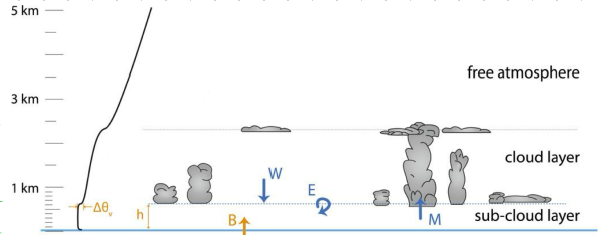
Explain this plot.
shows maritime shallow convection in the trade winds region
walker circulation leads to subsidence inversion at ~2.7km
cloud layer then is located between the well-mixed and shallow maritime BL and the subsidence inversion due to descending part of the walker circulation
Which models can be used to study shallow convection?
LES with dx~10-100m and domains up to 50×50km, today even over whole countries
Why is deep convection challenging to simulate in LES?
stronger winds, more complicated microphysics, much larger required model domain
How are rising and sinking air due to convection reffered to?
“convective” rising air
“environmental” sinking air
Which method can be used to see the dispersion due to convection over time?
ground released radioactive trace → decay gives time dependency
a normal tracer would just get mixed with no time description
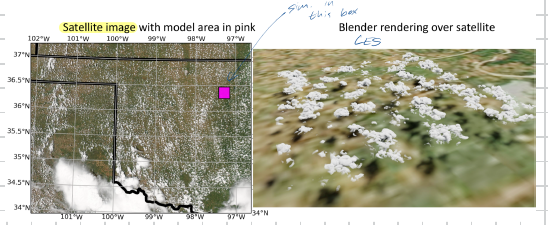
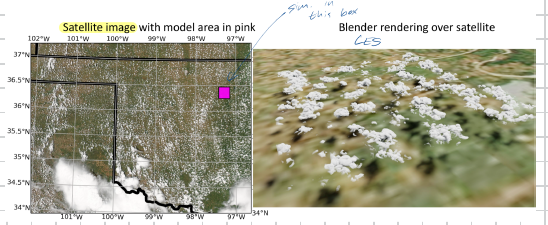
Explain this plot.
shows continental shallow convection in LES
horzontal 25×25m grid
1024×1024 grid cells
25.6×25.6km area
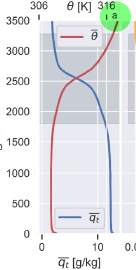
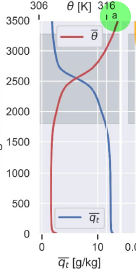
What does this plot show?
From LES:
Average humidity and potential temperature show typical inversion with high continental BL, neutral stratification below cloud, then stable
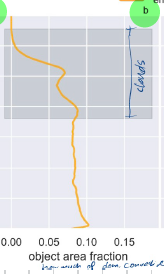
What does this plot show?
From LES:
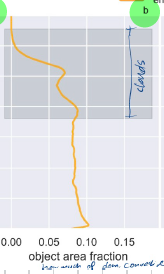
10% of the BL classified as convective seen in the object area fraction (how much of the domain is convective), proportion decreases in the cloud layer
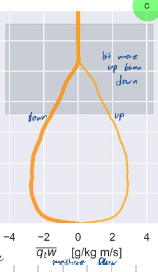
What does this plot show?
From LES:
convective air transports more moisture upward than surrounding air downward
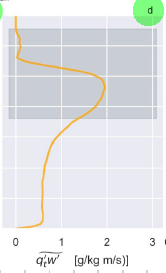
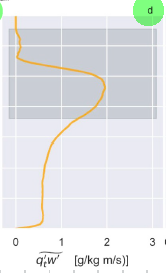
What does this plot show?
From LES:
humidity anomaly transport (q’ = q - qmean) is highest in the cloud
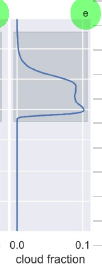
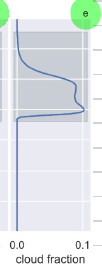
What does this plot show?
From LES:
cloud cover up to 10%, gray background marks cloud cover > 0
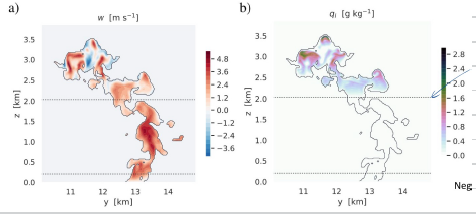
Can individual convection be regarded as bubbles or plumes?
no complete description as either one → chaotic 3D fluid-dynamic process
In general for convection, bubbles or plumes?
When averaged over many clouds, a plume-like structure emerges
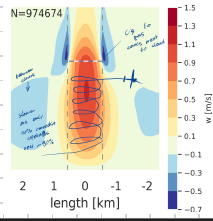
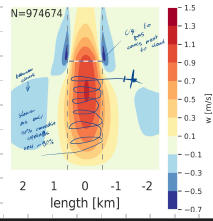
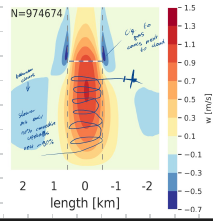
Explain this plot.
composite of 106 shallow cumulus cross sections from LES
normalized in height with cloud base
normalized in x with cloud length
updrafts strongest in middle under cloud at ~0.7 x cloud base
narrow strong downdraft at cloud edges (subsiding shell)
weak downdraft between the clouds in the BL
What does EDMF stand for and what is it?
Eddy Diffusivity Mass Flux
possible parameterization of convection
What is the basic assumption in the EDMF?
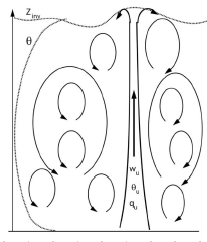
convective vertical flux can be divided in 2 components
Eddy diffusivity
Mass flux
Explain the Eddy diffusivity component of the EDMF parameterization in general.
unorganized turbulent flows that only act locally between adjacent layers and have a diffusive effect
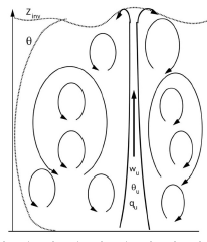
Explain the Mass flux component in the EDMF parameterization in general.
Organized strong updrafts with inertia, which allow transport across multiple layers and can transport variables against the gradient
How much of the domain of the EDMF does the Eddy Diffusivity component make up?
~90% of the domain
How much of the domain of the EDMF does the Mass Flux component make up?
~10%
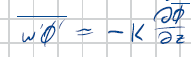
How are fluxes in the environment in the EDMF approximated?
K-approach / Boussinesq closure
How is the mass flux in the updraft in the EDMF approximated?
with the mass flux definition M = au (wu - w)
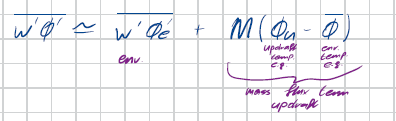
How does the flux approximation in the EDMF look like and what has been done to get to this form?
Environmental fluxes (diffusive) are approximated by the K-approach / Boussinesq closure
Fluxes in the updraft are approximated with the mass flux definition

What are properties of K?
K >= 0
K small at BL top
K = 0 at ground
K increases with thermal instability
K decreases with thermal stability
K increases with rising TKE
What is the most common parameterization of convection?
Mass flux
On what is the mass flux parameterization based?
idealized steady-state plume, which continuously moves air from lower BL to the inversion
What is a important assumption in the mass flux parameterization?
mostly assumed properties in plume are horizontally homogeneous (BL-approximation)
What are the 3 most important processes acting on a cylindrical steady state mass flux?
Entrainment / Detrainment
positive/negative buoyancy
vertical pressure gradients
Explain how entrainment / detrainment affects a cylindrical steady state mass flux.
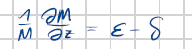
Mixing of environmental air into the updraft slows the ascent
Explain how buoyancy affects a cylindrical steady state mass flux.
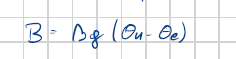
vertical acceleration due to positive or negative buoyancy, latent heat relevant as release increases buoyancy
Explain how vertical pressure gradients affect a cylindrical steady state mass flux.
the faster the ascent, the more air in front of parcel while ascending → creates positive pressure pertubation at parcel top and negative below
leads to downward pressure gradient slowing the parcel

On what does the rate of entrainment / detrainment depend?
distribution of a variable inside the updraft
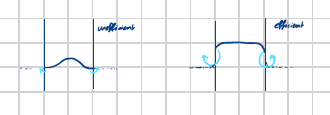
What are counter-gradient fluxes?
in comparison to eddy diffusivity, the mass flux component can also transport against the gradient
Give an example for a counter-gradient flux.
At 2500m eddy diffusivity transports moisture from the BL to the free atmosphere, and potential temperature in the opposite direction.
The mass flux can transport heat from the “cold” BL across the inversion (inertia)
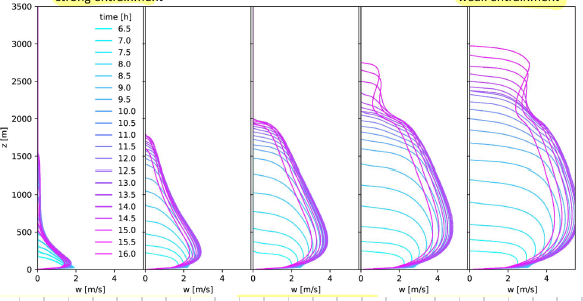
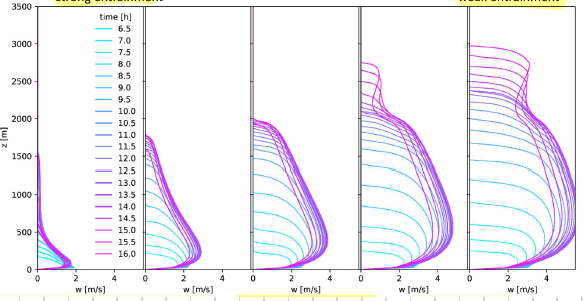
Explain this plot.
left: strong entrainment
right: weak entrainment
with sufficient entrainment condensation height is never reached
for weak entrainment condensation height is reached → release of latent heat leads to second acceleration above cloud base