CH 4 - PT 1: Epithelial Tissues
 Note
Note Call Kai
 Learn
Learn Practice Test
 Spaced Repetition
 Match
Match Flashcards
 Knowt Play
1/34

Earn XP
Description and Tags
Comprehensive vocabulary flashcards reviewing general histology, four basic tissue types, special characteristics and classification of epithelial tissues, and structural varieties of exocrine and endocrine glands.
Name | Mastery | Learn | Test | Matching | Spaced | Call with Kai | Chat |
|---|
No analytics yet
Send a link to your students to track their progress
35 Terms
Tissues
Groups of cells similar in structure that perform a common or related function.
Histology
The study of tissues.
Four Basic Tissue Types
Epithelial, connective, muscle, and nervous tissue.
Epithelial Tissue (Epithelium)
A sheet of cells that covers a body surface or lines body cavities.
Covering and Lining Epithelium
An epithelial form that forms the outer layer of skin, lines open cavities, and covers walls and organs of the ventral body cavity.
Glandular Epithelium
Specialized type of epithelial tissue composed of cells adapted to produce and release chemical substances
Five Distinguishing Characteristics of Epithelial Tissue
Polarity, 2. Specialized contacts, 3. Supported by connective tissue, 4. Avascular but innervated, 5. Regeneration.
Apical Surface
The upper free side of epithelial cells exposed to a surface or cavity, which is mostly smooth but may have specialized projections called microvilli.
Microvilli
Specialized fingerlike projections found on some apical surfaces of epithelial cells.
Basal Surface
The lower attached side of epithelial cells that faces inwards toward the body and attaches to the basal lamina.
Basal Lamina
An adhesive sheet that holds the basal surface of epithelial cells to underlying cells.
What is epithelial polarity?
The (top and bottom) of an epithelial tissue: the upper free apical surface bordering an open body space or cavity and a lower basal surface attached to underlying connective tissue via the basal lamina.
Simple Epithelia
Epithelial tissue consisting of a single cell layer, located where a thin barrier is desirable.
Stratified Epithelia
Epithelial tissue consisting of two or more cell layers, located in high-abrasion areas such as the lining of the mouth.
Squamous Cells
Flattened and scale-like epithelial cells with flattened nuclei.
Cuboidal Cells
Box-like, cube-shaped epithelial cells that are approximately as tall as they are wide, with spherical central nuclei.
Columnar Cells
Tall, column-like epithelial cells with tall, thin nuclei usually located closer to the basal surface.

Simple Squamous Epithelium

Simple Cuboidal Epithelium

Simple Columnar Epithelium
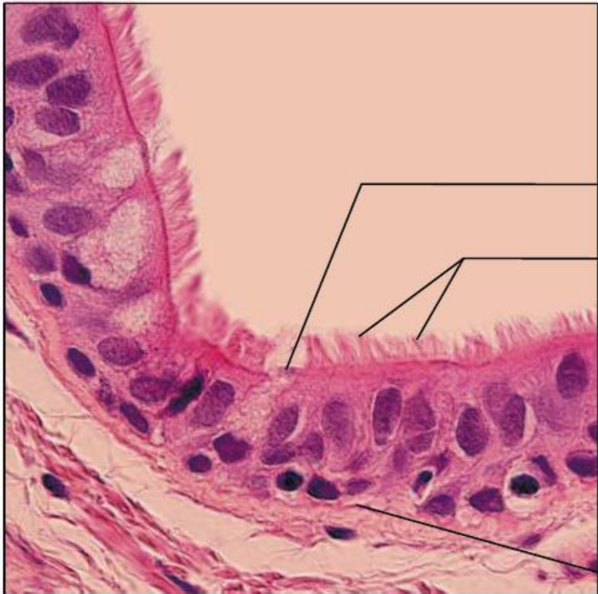
Pseudostratified Columnar Epithelium

Stratified Squamous Epithelium

Transitional Epithelium
Gland
One or more cells that make and secrete an aqueous fluid called a secretion.
Endocrine Glands
Ductless glands that produce hormones, secreting them into interstitial fluid to enter the blood.
Exocrine Glands
Glands that retain connecting cells to form ducts through which secretions are transported onto body surfaces or into body cavities.
Goblet Cell
A unicellular exocrine gland that secretes mucus
Categorization Criteria for Multicellular Exocrine Glands
Definition: Categorized by duct structure (simple = unbranched duct; compound = branched duct) and secretory unit shape (tubular = tube-like; alveolar = sac-like; tubuloalveolar = combination of both).
Simple Squamous Epithelium
description: A single layer of flattened cells with disc-shaped central nuclei and sparse cytoplasm
functions in diffusion, filtration, and secreting lubricating substances in serosae
located in air sacs of lungs, lining of heart, blood vessels, lymphatic vessels, and serosae.
Simple Cuboidal Epithelium
Description: A single layer of cube-like cells with large, spherical central nuclei
functions in secretion and absorption
located in kidney tubules, gland ducts, and ovary surface.
Simple Columnar Epithelium
Description: A single layer of tall cells with round to oval nuclei; many cells bear microvilli, some bear cilia, layer may contain mucus secreting unicellular glands, (goblet cells)
functions in absorption and secretion of mucus and enzymes
located lines most of the digestive tract, gallbladder, and small bronchi.
Pseudostratified Columnar Epithelium
Description: A single layer of cells of differing heights with nuclei at different levels. May contain goblet cells and cilia.
functions in secreting and propelling mucus
locations: lines the trachea, upper respiratory tract (if ciliated) and sperm-carrying ducts (non-ciliated)
Stratified Squamous Epithelium
Description: A thick epithelium composed of several cell layers with cuboidal/columnar basal cells and flattened surface cells
function: protects underlying tissues in areas subjected to abrasion
location: nonkeratinized type in moist linings of esophagus, mouth, and vagina/ keratinized variety in epidermis of skin.
Transitional Epithelium
Description: An epithelium resembling stratified squamous and cuboidal whose surface cells flatten when stretched
function: stretches readily
location: lines ureters, bladder, and part of the urethra to permit urine distension.

Pseudostratified Columnar Epithelium