Physics Exam 1
 Call Kai
 Learn
Learn Practice Test
 Spaced Repetition
 Match
Match Flashcards
 Knowt Play
1/88

There's no tags or description
Looks like no tags are added yet.
Name | Mastery | Learn | Test | Matching | Spaced | Call with Kai | Chat |
|---|
No analytics yet
Send a link to your students to track their progress
89 Terms
An object in free fall experiences a constant, downward acceleration of g=m/s2 , what is the value of g?
9.8 m/s2
Work is done when a force is applied to an object that moves. The work done is the product of the average (what?) times the (what?) moved and has MKS units of (what?)
1.) force
2.) distance
3.) Joule
What is the time interval called that motion repeats itself in a vibrating system?
period (T)
What, f=1/T, has units of Hertz?
frequency
What is 1 Hz equivalent to?
1 Hz= 1 oscillation/second
What is the relationship between the restoring force, F, and the displacement, y, in a simple harmonic motion (SHM) in the equilibrium position?
linear
F=-Ky
What are the other requirements for SHM?
equilibrium position and a linear restoring force
In a vibrating system the total (what?) changes from (what?) energy of motion to (what?) energy back to (what?) energy of motion during each cycle?
1.) mechanical
2.) kinetic
3.) potential
4.) kinetic
What does mechanical energy equal?
mechanical= kinetic + potential
What is energy the measure of? What is its units?
energy is the measure of the ability to do work
units are Joule (J)
What is Power? What are its units?
power is the rate of doing work
units are Watt
In a plucked string, what is the lowest frequency? What are the higher frequencies?
lowest frequency= fundamental frequency
higher frequencies= harmonics
What type of wave are sound waves?
longitudinal vibrations of air molecules
What type of waves are waves on a violin string?
transverse vibrations of string molecules
What happens in a longitudinal wave?
particles move back and forth in the same direction that the wave travels
What happens in transverse waves
like a big rope being flipped/a violin string- particles being moved are moving PERPENDICULAR to the direction of the waves
What happens to sound waves when they encounter a curved barrier?
they are reflected
when a wave bounces off a surface (the principle behind an echo)
What happens to sound waves when their speed in the medium changes?
they are refracted
this is when a wave bends because its speech changes
What is diffraction?
when a wave bends or curves around an obstacle
how you can hear sound around a corner of a building
What is the science of sound called?
acoustics
What is the change in velocity per unit of time?
acceleration
What are the most familiar sources of sound, including drumheads or a piano soundboard?
vibrating bodies
Wave motion transports what from one point in space to another?
energy
What type of motion is any type or motion that repeats itself after successive equal time intervals?
periodic
What type of wave is the stationary, wavelike pattern that results from the interference of two or more traveling waves?
standing wave
When incident and reflected waves overlap what can happen?
interference
can be constructive (leads to a large wave motion) or destructive (leading to a smaller wave motion)
What is the effect that is the apparent shift in frequency observed when the source or the observer is in a relative motion? When they are moving towards each other how does the frequency appear? What about when they are moving away from each other?
The Doppler effect
frequency appears higher when they are moving towards each other
frequency appears lower when they are moving away from each other
What is the spreading out of waves when they encounter a barrier or pass through a narrow opening?
diffraction
What happens when a sound source, such as a supersonic plane, moves faster than the speed of sound? What does this create as it passes stationary observers?
What occurs when a vibrating system is driven by a force that oscillates ate a frequency near the natural frequency of the system?
resonance
Due to sound radiation depending on air displacement, radiation from a vibrating string is enhanced by what vibration of a soundboard?
sympathetic vibration
For air-filled popes, at what end is the displacement of air the greatest? What end is the pressure variation maximum at?
displacement is greatest at open end
pressure variation maximum at closed end
What is physics?
mathematical description of the natural world
study of matter, its constituents, motion and behavior through time and space, and related entities of force and energy
What is the Scientific Method?
empirical method for gaining knowledge
involves several steps: observation, hypothesis, test/experiment, interpretation of results
demands testable hypotheses and falsifiable conclusions (in physics hypothesis is connected to a mathematical model)
What is SI Units?
SI- systeme international of units (also called “metric” units)
standard units for all measurements
standard conversion to larger/smaller values with powers-of-ten prefixes or scientific notation
What is the SI Unit for time?
second (s)
What is frequency?
inverse time (1/time)
unit Hz
1Hz= 1/s= 1s-1
frequency is the pitch of a sound
What are SI prefixes?
can modify any SI unit with an appropriate prefix to scale up or down
micro- u (10^-6)
milli- m (10^-3)
centi- c (10^-2)
kilo- k (10³)
mega- M (10^6)
giga- G (10^9)
What is the SI unit for length
meter (m)
2.54 cm=1 in
What is the SI unit for mass
kilogram (kg)
2.2 lb=1 kg
What is the SI Units for Electric Current, Temperature, Amount, and Luminous intensity?
electric current= Ampere (A)
temperature= Kelvin (K)
amount= mole (mol)
luminous intensity= cd (candela)
What is the difference between precision and accuracy?
accuracy: are you “on target”?
precision: how reproducible is the value
What is speed?
distance/time
SI standard: m/s
can be used interchangeably with velocity
What is acceleration
speed/time
SI standard: m/s²
What are Newton’s Laws of Motion?
1.) object in motion continues in constant motion unless acted on by a force
2.) a net force acting on an object will give rise to an acceleration (F= ma)
3.) any force exerted by object 1 on object 2 is equal and opposite to the force exerted by object 2 on object 1
What is force?
that which may cause an acceleration
SI unit: Newton (N)
force is proportional to product of mass and acceleration
What is pressure?
pressure is force disturbed over an area
p= F/A
SI Unit: Pascal (Pa)
What is energy?
the capacity to do work
work is done as a force is applied over a distance
W=F x d
SI unit: Joule (J)
What is sound?
a pressure wave (in a medium) in an audible (frequency) range
What is atmospheric pressure?
the constant pressure of air at sea level = 100 kPa = 100,000 N/m²
What is Kinetic Energy?
K= ½ mv²
energy processed by an object due to its motion (any moving object has kinetic energy)
What is Potential Energy?
gravitational potential energy: 𝑈𝑔 = 𝑚𝑔h
energy stored in an object due to its position or configuration (energy that has the potential to do work in the future)
What is total energy?
K+U
K= kinetic energy (energy of motion)
U= potential energy
What is power?
the rate of energy usage with respect to time
SI unit: Watt (W)
Energy is conserved. True or false?
true
in an isolated system, total energy is constant and only changes type
What is a wave?
a wave is a disturbance propagating in a medium with periodic features
features: motion, periodic behavior, collective behavior
What is the difference between transverse and longitudinal?
transverse waves are like the ocean- particles of the medium move perpendicular to the direction of the wave
longitudinal waves are like sound waves- particles of the medium move parallel to the direction of wave propagation
What is the difference between a continuous wave and a wave pulse?
continuous waves are a repeated sequence of wavefronts
a wave pulse is like a single flick made on a rope
How do you describe properties of waves?
shape- is it sinusoidal?
periodic or irregular
Period or frequency
amplitude (is it big or small)
wavelength
speed
(describing a simple wave with these 4 criteria)
What happens when a wave reaches its boundary at a fixed end?
wave reflects on opposite side (same amplitude, but opposite sign)
endpoint vertical position is always zero
What happens when a wave reaches its boundary at an open end?
wave reflects on the same side (same amplitude with same sign)
endpoint vertical position “kicks” to double height
What forces the wave pulse to reflect?
energy conservation
wave energy has nowhere else to go
reflected wave should have the same amplitude and speed as incident pulse
What are nodes?
points of zero amplitude
What is the relationship between tension and frequency on a standing wave
lower tension, lower frequency
What happens when two waves meet head on?
waves can pass through each other, undisturbed
True or false: Wave speed is a property of the medium, not the wave?
true
wave speed has no dependence on wave frequency, amplitude, etc.
How do you find the first mode (fundamental)?
string length is one-half wavelength (𝐿 = 𝜆/2)
second harmonic (𝐿 = 𝜆)
third harmonic (𝐿 = 3𝜆/2)
What happens when wave speed changes at the boundary?
refraction- bending of wave (change in direction) at the boundary
How do standing waves arise?
standing waves arise due to superposition of reflected wave with driven wave
What is interference? What are the two types?
interference is what happens when waves overlap (in space and time) (can also talk about it in superposition)
constructive interference: resultant wave has greater amplitude (waves are “in phase” (the peaks line up)
destructive interference: resultant wave has smaller amplitude (waves are “out of phase”)
What is the difference between a node and an antinode?
node: where the string experiences no vertical displacement (maximal destructive interference)
antinode: where the string experiences maximum vertical displacement (maximal constructive interference)
Describe the behavior with audible waves in a tube
closed end: boundary condition is displacement forced to be zero- inverted displacement pulse, reversed upright pressure pulse (UPRIGHT REFLECTED PULSE)
open end: boundary condition is forced to be zero (since the open end is exposed to atmospheric pressure outside)- upright displacement pulse, reversed inverted pressure pulse (INVERTED REFLECTED PULSE)
How is a string reflected when there is a change in string density?
reflection off a lighter string looks like an open reflection (reflected pulse is upright)
reflection off a heavier string looks like a closed reflection (reflected pulse is inverted)
What is the scaling for wave dimensions
energy spreads out as waves expand, decreasing the energy at any one point
• 1D: constant
- Either a true linear wave (like a laser, wave on a string)
- Or a “planar” wave – one that isn’t spreading out anymore
• 2D: ~1/𝑟
• 3D: ~1/𝑟2
What is diffraction?
what happens when a wave encounters an obstacle
wave pattern will change as waves start to interfere with each other
How do boundary conditions determine resonance condition?
waves on a string- transverse displacement at end
pressure waves- pressure or longitudinal displacement at end
Describe the characteristics of interference in 2D
Central Maxima- centerline always has same path length to each source (maximum constructive interference)
Side Maxima- additional maxima appear on either side when the path length difference equals the wavelength (waves align again, maximum constructive interference)
Minima- in between, a spot where the path length differs by one half wavelength (waves are anti-align here, maximum destructive interference)
changing the source spacing or frequency alters the interference field, but rules above still apply
What does pattern depend on in diffraction?
wavelength and slit width
wide slit and short wavelength gives a central patter where the parallel waves make it through, then rapidly die
narrow slit or long wavelength give a broader circular patter (but lower amplitude since little energy gets through)
What is the Doppler Effect?
moving emitter or receiver of a wave changes the frequency observed
think about pitch of an ambulance as it drives towards you then past you
Explain what you expect to find with the Doppler Effect
a source moving towards an observer result in shorter wavelength, higher frequency
an observer moving towards a source result in shorter wavelength, higher frequency
astronomy:
a source receding from an observer results in longer wavelength (red shift)
a source moving towards an observer results in shorter wavelength (blue shift)
What is a sonic boom?
the explosive noise produced when an object travels through the air faster than the speed of sound, creating a sudden change in air pressure
for supersonic motion, mach cone trails source at characteristic angle
If it is raining, I will bring my umbrella. If this statement is known to be true, which of the following statements is also true.
a.) if I bring my umbrella, it must be raining
b.) if I do not bring my umbrella, it must not be raining
c.) if it is not raining, I will not bring my umbrella
b
Which of the following are all SI base units?
a.) s, g, K, J
b.) mi, kg, cd, W
c.) min, m, C, mol
d.) m, s, kg, A
d
Consider a ball thrown upward into the air. At the top of its trajectory, which of the following is true regarding tis velocity and acceleration?
a.) v= 0, a= 0
b.) v = 0, a ≠ 0
c.) v ≠ 0, a = 0
d.) v ≠ 0, a ≠ 0
b
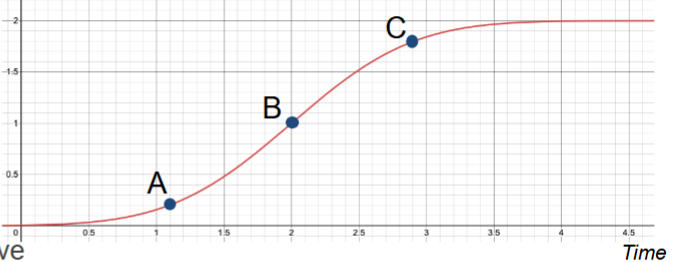
Consider the following graph of an object’s position vs. time. Which of the following statements is false?
a.) the speed at points A and C is the same
b.) the acceleration at B is zero
c.) the acceleration at A is positive
d.) the distance traveled at C is the greatest
e.) the speed at B is the least
e
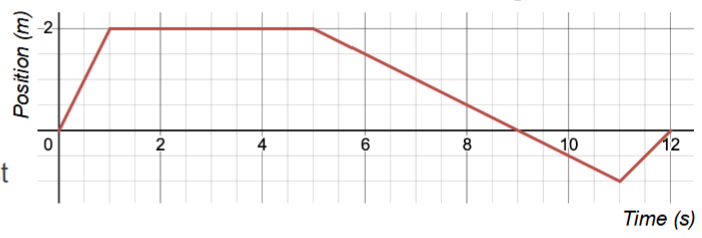
Consider the following position vs. time data. Which of the following statements is false
a.) the total distance traveled is 6m
b.) the object is moving fastest at t=0.5s
c.) the object is moving backwards (v<0) at t=6s
d.) the object is not moving at t=9s
e.) the object returns to its starting position at t=12s
d
A spring system is undergoing simple harmonic motion. Which of the following statements is false?
a.) When the object is at is maximum displacement from the equilibrium, it also has its maximum kinetic energy
b.) when the object is at its maximum displacement from equilibrium, it also experiences its maximum (magnitude of) acceleration
c.) the period of its position motion is not the same as the period of its kinetic energy
d.) there is a linear restoring force
e.) the motion can be described by a sinusoidal behavior
a
Which of the following statements is false for ideal reflection?
a.) the speed of the reflected wave is the same as the speed of in the incident wave
b.) the amplitude of the reflected wave is the same (at lease in magnitude) of the amplitude of the incident wave
c.) the width of the reflected pulse is the same as the width of the incident pulse
d.) a pulse reflected from a fixed end will have the same orientation as the incident pulse
d
Which of the following statements regarding standing waves on a string with fixed ends is false?
a.) the string is not moving
b.) nodes refer to locations on the string with no vertical displacement
c.) the pattern emerges due to both constructive and destructive interference
d.) the wavelength of the fourth harmonic is half the wavelength of the second harmonic
e.) the frequency of higher harmonics is greater than the frequency of the fundamental
a