BAH PP 1
 Call Kai
 Learn
Learn Practice Test
 Spaced Repetition
 Match
Match Flashcards
 Knowt Play
1/61

There's no tags or description
Looks like no tags are added yet.
Name | Mastery | Learn | Test | Matching | Spaced | Call with Kai | Chat |
|---|
No analytics yet
Send a link to your students to track their progress
62 Terms
What defines a folded protein in terms of structure and function
A folded protein possesses a stable native ensemble and a defined tertiary structure, and it is fully functional
How do misfolded proteins differ from folded proteins regarding structure and behavior
Misfolded proteins have a non-native structure, may form aggregates are often dysfunctional
Do intrinsically disordered proteins lack function because they do not have a single stable tertiary structure?
No, although they exist as a dynamic ensemble without a single stable tertiary structure, intrinsically disorder proteins can still be fully functional
What is an Intrinsically Discorded Protein?
An entire protein molecule that completely lacks a fixed tertiary structure, where > 95% of it amino acid residues are unstructured
What is an Intrinsically Disordered Region?
A flexible, unstructured segment or stretch located within a protein that otherwise contains stable, folded domains
What differentiates the amino acid composition of folded proteins from that of many intrinsically disordered regions (IDRs)?
Folded proteins have enough hydrophobic amino acids to form a stable core. IDRs have more charged and polar amino acids and fewer bulky hydrophobic amino acids, so they stay flexible instead of forming a stable structure.
Which specific amino acids act as structural disruptors that reduce persistent secondary structure in many sequence contexts?
Proline and Glycine
Is intrinsic disorder random, or is it encoded by the protein's primary sequence?
It is encoded by the protein's sequence. The sequence makes the protein favor many flexible shapes instead of one stable 3D structure.
How does proline's unique chemical structure force it to break secondary structures like alpha helices?
It’s side chain covalently bonds to its own backbone nitrogen to form a pyrrolidine ring, which locks its backbone angle and removes amide hydrogen needed for standard hydrogen binding
Why does glycine's lack of a bulky side chain contribute to structural flexibility and disorder?
It features only a single H2 atom as its side chain, allowing its backbone to sample a vast, unrestricted range of dihedral angles that prevent stable folding
What physical effect does increased hydrophobicity have on a protein chain?
It leads to stronger intrachain attraction, which causes compaction or possible folding.
How does a higher net charge influence the conformation of a protein chain?
It causes electrostatic repulsion, which results in expanded conformations
How does changing salt concentration affect an IDR?
Increasing salt reduces the electrical repulsion between charged residues, allowing the IDR to compact and change its long-range interactions.
What happens to an IDR when pH levels change?
Changing pH can change the charge on the amino acid side chains. This changes how strongly the residues repel or attract each other, which can change the IDR's shape, compactness, and flexibility.
Besides overall amino acid composition, what else dictates a sequence's structural behavior?
The patterning of residues along the sequence also matters.
How does macromolecular crowding affect an IDR?
A crowded cell squeezes the IDR because there is less space, causing it to adopt more compact shapes to avoid bumping into other molecules.
What is the effect of temperature changes on an IDR?
Higher temperature gives the protein more energy and movement, which can cause temporary structures like helices and turns to form, change, or disappear.
How does phosphorylation change an IDR?
Adding a negatively charged phosphate group can cause electrostatic repulsion or create new places for other molecules to bind, changing the IDR's shape and flexibility.
What does arginine methylation do to an IDR?
Adding methyl groups to arginine but doesn’t affect the charge and changes its hydrophobicity and interactions, which can change how the IDR interacts with itself or with other proteins.
What structural features and dimensions can intrinsically disordered regions (IDRs) exhibit?
IDRs can possess transient helices, turns, long-range contacts, and preferred chain dimensions.
How are different conformations distributed within an IDR?
Different conformations exist with different populations.
What factors can redistribute the conformational ensemble of an IDR?
Sequence changes, salt, pH, temperature, binding partners, and PTMs (post-translational modifications) can all redistribute the ensemble.
How does biological function arise within IDRs?
IDR has many shapes → conditions shift which shape is favored → function changes.
What does X-ray crystallography reveal about intrinsic disorder, and what is its limitation?
While lack of crystallization, unresolved density, or weak electron density can suggest structural mobility, the absence of density alone does not definitively prove disorder.
What information does circular dichroism (CD) provide regarding protein structure?
It reports on the average secondary-structure content of the protein.
How does NMR spectroscopy characterize intrinsically disordered proteins (IDPs)?
It provides residue-level structure and dynamics, with IDPs frequently displaying a characteristic narrow chemical-shift dispersion.
What parameters do SAXS and single-molecule FRET/fluorescence measure?
SAXS reports on ensemble-averaged dimensions and shape
single-molecule FRET and fluorescence measure distances, heterogeneity, and dynamics.
What is considered best practice when identifying intrinsic disorder experimentally?
Combining complementary methods.
What type of chemical-shift dispersion does a folded protein exhibit in a HSQC NMR spectrum, and why?
It exhibits broad chemical-shift dispersion because its residues experience diverse, well-defined environments.
What type of dispersion does an intrinsically disordered protein or region (IDP/IDR) display in a HSQC NMR spectrum, and why?
It displays a narrower dispersion because rapidly sampled conformations average out those local environments.
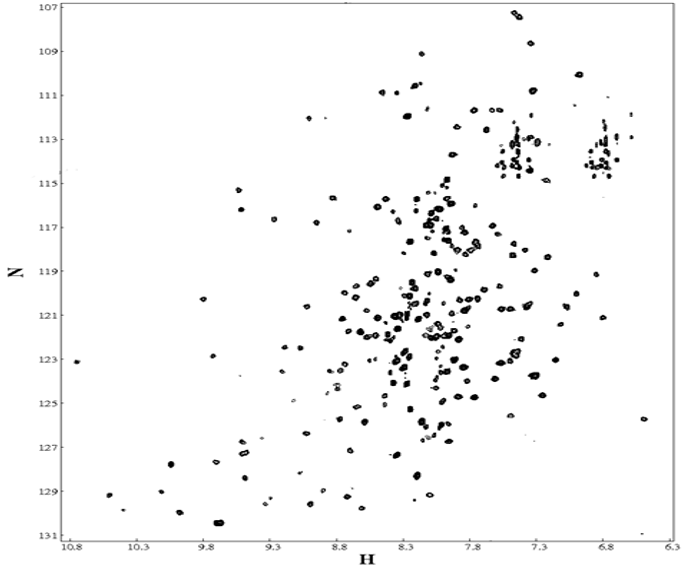
NMR FOLDED PROTEIN
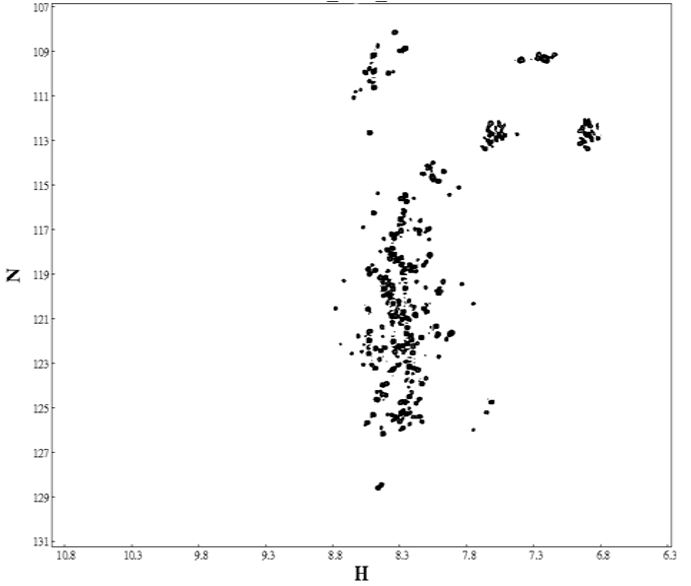
NMR IDR
How does conformational flexibility contribute to the function of intrinsically disordered proteins (IDPs)?
It allows one sequence to access many interaction-competent states.
How does conformational flexibility contribute to the function of IDPs?
Flexibility allows one protein sequence to take on many different shapes, so it can interact with different molecules.
Easy way: One sequence → many shapes → many possible interactions.
Why are short recognition motifs and PTM sites readily accessible in IDPs?
IDPs are unstructured and exposed, so recognition motifs and PTM sites are easy for other molecules or enzymes to reach.
Easy way: Unstructured = exposed = easy to access.
What role do disordered linkers play between protein domains?
They control the distance and positioning between protein domains, affecting how easily the domains can interact.
Easy way: Linkers = control spacing between domains.
What can multiple weak interactions produce in IDRs?
Many weak interactions can work together to produce strong and controllable effects.
Easy way: Many weak interactions → strong overall effect.
In which cellular processes are IDRs especially useful?
Cell signaling, gene transcription, and organizing cellular components.
What is thermodynamic coupling in IDR binding?
It occurs when an IDR binds to a partner and folds at the same time, changing from a flexible, disordered state into a defined structure.
Key idea: Binding can cause folding, but IDRs do not always fold when they bind.
What mechanisms can cause an IDR to fold when it binds?
It can happen through induced fit, conformational selection, or a combination of both.
What is an induced fit for IDR
IDR binds first, then changes shape to fit its partner.
What is a conformational selection for IDR
IDR already has different possible shapes, and the partner selects the shape that fits.
What happens to entropy and interactions when an IDR folds upon binding?
Folding reduces the IDR's flexibility, which costs entropy. This loss must be balanced by favorable interactions with the binding partner.
Easy way: Lose flexibility → costs energy; favorable interactions → compensate for that cost.
What is a fuzzy complex?
It forms when an IDR binds to a partner but remains partly disordered instead of folding completely into one fixed structure.
What happens to an IDR in a fuzzy complex?
The IDR can have multiple different shapes while it is bound, and these changing shapes can still be important for its function.
Does binding always cause an IDR to fold?
No. Binding and folding are not always the same thing. An IDR can bind while remaining flexible or disordered.
What is the spectrum of fuzziness?
Fuzziness exists on a continuum, from complexes that are mostly rigid and structured to complexes that remain highly flexible and dynamic.
Why are fuzzy complexes useful?

Their flexibility allows cells to fine-tune binding strength, specificity, and regulation.
What are SLiMs (short linear motifs)?
Are short sequences of amino acids within IDRs that act as specific binding sites for other proteins.
How does the surrounding IDR affect SLiMs?
The surrounding disordered sequence affects how accessible the SLiM is, how far it is from other motifs, and how well it can function.
Can one IDR contain multiple SLiMs?
Yes. One IDR can contain multiple different SLiMs, allowing it to interact with different proteins or binding partners.
How do SLiMs contribute to protein function?
They help IDRs perform their functions by providing specific binding sites
How do SLiMs and PTMs control IDR interactions?
SLiMs act as specific binding sites within IDRs. PTMs can turn these binding sites on or off by changing the IDR's charge or structure.
How can phosphorylation affect an IDR?
This adds a bulky negative charge to an amino acid such as serine. This can create a new binding site for another protein or disrupt an existing binding site.
How do multiple PTMs affect IDR function?
Different PTMs, such as phosphorylation, acetylation, methylation, and ubiquitination, can work together to change the IDR's shape and interactions.
What is multivalency?
It means a protein has multiple binding sites that can interact with other molecules.
How does multivalent binding work?
Each individual interaction may be weak, but having many binding sites allows multiple interactions to happen at the same time, making the overall binding stronger.
What do multiple weak interactions create?
large, organized molecular assemblies.
Folded domains = stable + precise
IDRs = flexible + regulatory
Together = versatile protein function
Key Idea
Is intrinsic disorder itself harmful or a disease?
No. Intrinsic disorder is normal and is important for many protein functions.
How can changes to an IDR cause disease?
Mutations or PTMs can change the IDR's shapes, interactions, or how it assembles, which can cause abnormal protein behavior.
How can IDRs contribute to disease?
They can cause problems by promoting abnormal interactions, protein aggregation, or inappropriate phase separation.