OTPF Competency Exam Study Material – Part I
 Call Kai
 Learn
Learn Practice Test
 Spaced Repetition
 Match
Match Flashcards
 Knowt Play
1/100

There's no tags or description
Looks like no tags are added yet.
Name | Mastery | Learn | Test | Matching | Spaced | Call with Kai | Chat |
|---|
No analytics yet
Send a link to your students to track their progress
101 Terms
Occupational Therapy Practice Framework: Domain and Process, Fourth Edition (OTPF-IV)
official document of the American Occupational Therapy Association (AOTA) that was intended for OT practitioners and students, other health care professionals, educators, researches, payers, policymakers, and consumers; presents a summary of interrelated constructs that describe OT practice
occupational therapy
therapeutic use of everyday life occupations with persons, groups, or populations (i.e., the client) for the purpose of enhancing or enabling participation
OT clients
persons (including those involved in care of a client), groups (collections of individuals having shared characteristics or a common/shared purpose), populations (aggregates of people with common attributes such as contexts, characteristics, or concerns, including health risks)
domain of OT
occupations, contexts, performance patterns, performance skills, client factors
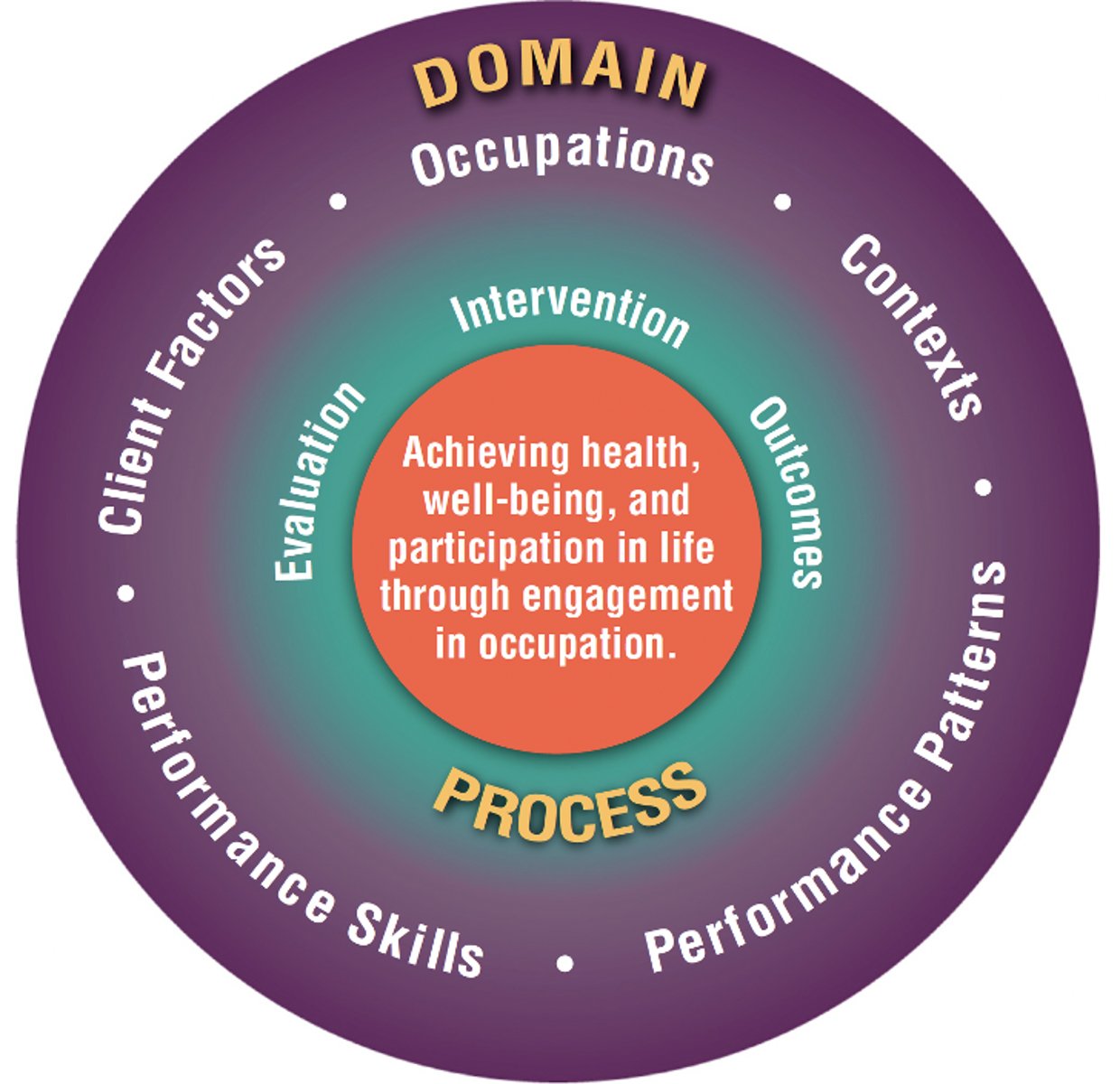
occupations
everyday activities that people do as individuals, in families, and with communities to occupy time and bring meaning and purpose to life; include things people need to, want to, and are expected to do
activities of daily living (ADLs), instrumental activities of daily living (IADLs), health management, rest and sleep, education, work, play, leisure, social participation
occupations
activities of daily living (ADLs)
(8); activities oriented toward taking care of one's own body and completed on a routine basis
bathing/showering
obtaining and using supplies; soaping, rinsing, and drying body parts; maintaining bathing position; transferring to and from bathing positions
toileting and toilet hygiene
obtaining and using toilet supplies, managing clothing, maintaining toilet position, transferring to and from toileting position, cleaning body, caring for menstrual and continence needs (including catheter, colostomy, and suppository management), maintaining intentional control of bowel movements and urination and, if necessary, using equipment or agents for bladder control
dressing
selecting clothing and accessories with consideration of time of day, weather, and desired presentation' obtaining clothing from storage area; dressing and undressing in a sequential fashion; fastening and adjusting clothing and shoes; applying and removing personal devices, prothetic devices, or splints
eating and swallowing
keeping and manipulating food or fluid in the mouth, swallowing it (i.e., moving it from the mouth to the stomach)
feeding
setting up, arranging, and bringing food or fluid from the vessel to the mouth (includes self-feeding and feeding others)
functional mobility
moving from one position or place to another (during performance of everyday activities), such as in-bed mobility, wheelchair mobility, and transfers (e.g., wheelchair, bed, car, shower, tub, toilet, chair, floor); includes functional ambulation and transportation of objects
personal hygiene and grooming
obtaining and using supplies; removing body hair (e.g., using a razor or tweezers); applying and removing cosmetics; washing, drying, combing, styling, brushing, and trimming hair; caring for nails (hands and feet); caring for skin, ears, eyes, and nose; applying deodorant; cleaning mouth; brushing and flossing teeth; removing, cleaning, and reinserting dental orthotics and prosthetics
sexual activity
engaging in the broad possibilities for sexual expression and experiences with self or others (e.g., hugging, kissing, foreplay, masturbation, oral sex, intercourse)
instrumental activities of daily living (IADLs)
(11); activities to support daily life within the home and community
care of others (including selection and supervision of caregivers)
providing care for others, arranging or supervising formal care (by paid caregivers) or informal care (by family or friends) for others
care of pets and animals
providing care for pets and service animals, arranging or supervising care for pets and service animals
child rearing
providing care and supervision to support the developmental and physiological needs of a child
communication management
sending, receiving, and interpreting information using systems and equipment such as writing tools, telephones (including smartphones), keyboards, audiovisual recorders, computers or tablets, communication boards, call lights, emergency systems, Braille writers, telecommunication devices for deaf people, augmentative communication systems, and personal digital assistants
driving and community mobility
planning and moving around in the community using public or private transportation, such as driving, walking, bicycling, or accessing and riding in buses, taxi cabs, ride shares, or other transportation systems
financial management
using fiscal resources, including financial transaction methods (e.g., credit card, digital banking); planning and using finances with long-term and short-term goals
home establishment and management
obtaining and maintaining personal and household possessions and environments (e.g., home, yard, garden, houseplants, appliances, vehicles), including maintaining and repairing personal possessions (e.g., clothing, household items) and knowing how to seek help or whom to contact
meal preparation and cleanup
planning, preparing, and serving meals and cleaning up food and tools (e.g., utensils, pots, plates) after meals
religious and spiritual expression
engaging in religious or spiritual activities, organizations, and practices for self-fulfillment; finding meaning or religious or spiritual value; establishing connection with a divine power, such as is involved in attending a church, temple, mosque, or synagogue; praying or chanting for a religious purpose; engaging in spiritual contemplation; may also include giving back to others, contributing to society or a cause, and contributing to a greater purpose
safety and emergency maintenance
evaluating situations in advance for potential safety risks; recognizing sudden, unexpected hazardous situations and initiating emergency action; reducing potential threats to health and safety, including ensuring safety when entering and exiting the home, identifying emergency contact numbers, and replacing items such as batteries in smoke alarms and light bulbs
shopping
preparing shopping lists (grocery and other); selecting, purchasing, and transporting items; selecting method of payment and completing payment transactions; managing internet shopping and related use of electronic devices such as computers, cell phones, and tablets
health management
(7); activities related to developing, managing, and maintaining health and wellness routines, including self-management, with the goal of improving or maintaining health to support participation in other occupations
social and emotional health promotion and maintenance
identifying personal strengths and assets, managing emotions, expressing needs effectively, seeking occupations and social engagement to support health and wellness, developing self-identity, making choices to improve quality of life in participation
symptom and condition management
managing physical and mental health needs, including using coping strategies for illness, trauma history, or societal stigma; managing pain; managing chronic disease; recognizing symptom changes and fluctuations; developing and using strategies for managing and regulating emotions; planning time and establishing behavioral patterns for restorative activities (e.g., meditation); using community and social supports; navigating and accessing the health care system
communication with the health care system
expressing and receiving verbal, written, and digital communication with health care and insurance providers, including understanding and advocating for self or others
medication management
communicating with the physician about prescriptions, filling prescriptions at the pharmacy, interpreting medication instructions, taking medications on a routine basis, refilling prescriptions in a timely manner
physical activity
completing cardiovascular exercise, strength training, and balance training to improve or maintain health and decrease risk of health episodes, such as by incorporating walks into daily routine
nutrition management
implementing and adhering to nutrition and hydration recommendations from the medical team, preparing meals to support health goals, participating in health-promoting diet routines
personal care device management
procuring, using, cleaning, and maintaining personal care devices, including hearing aids, contact lenses, glasses, orthotics, prosthetics, adaptive equipment, pessaries, glucometers, and contraceptive and sexual devices
rest and sleep
(3); activities related to obtaining restorative rest and sleep to support healthy, active engagement in other occupations
rest
identifying the need to relax and engaging in quiet and effortless actions that interrupt physical and mental activity; reducing involvement in taxing physical, mental, or social activities, resulting in a relaxed state; engaging in relaxation or other endeavors that restore energy and calm and renew interest in engagement
sleep preparation
engaging in routines that prepare the self for comfortable rest, such as grooming and undressing, reading or listening to music, saying goodnight to others, and engaging in meditation or prayers; determining the time of day and length of time desired for sleeping and the time needed to wake; establishing sleep patterns that support growth and health (patterns are often personally and culturally determined); preparing the physical environment for periods of sleep, such as making the bed or space on which to sleep, ensuring warmth or coolness and protection, setting an alarm clock, securing the home (e.g., by locking doors or closing windows or curtains), setting up sleep-supporting equipment (e.g., CPAP machine), and turning off electronics and lights
sleep participation
education
(3); activities needed for learning and participating in the educational environment
formal education participation
participating in academic (e.g., math, reading, degree coursework), nonacademic (e.g., recess, lunchroom, hallway), extracurricular (e.g., sports, band, cheerleading, dances), technological (e.g., online assignment completion, distance learning), and vocational (including prevocational) educational activities
informal personal education needs or interest exploration (beyond formal education)
identifying topics and methods for obtaining topic-related information or skills
informal educational participation
participating in classes, programs, and activities that provide instruction or training outside of a structured curriculum in identified areas of interest
work
(6); labor or exertion related to the development, production, delivery, or management of objects or services; benefits may be financial or nonfinancial (e.g., social connectedness, contributions to society, structure and routine to daily life)
employment interests and pursuits
identifying and selecting work opportunities consistent with personal assets, limitations, goals, and interests
employment seeking and acquisition
advocating for oneself; completing, submitting, and reviewing application materials; preparing for interviews; participating in interviews and following up afterward; discussing job benefits; finalizing negotiations
job performance and maintenance
creating, producing, and distributing products and services; maintaining required work skills and patterns; managing time use; managing relationships with coworkers, managers, and customers; following and providing leadership and supervision; initiating, sustaining, and completing work; complying with work norms and procedures; seeking and responding to feedback on performance
retirement preparation and adjustment
determining aptitudes, developing interests and skills, selecting vocational pursuits, securing required resources, adjusting lifestyle in the absence of the worker role
volunteer exploration
identifying and learning about community causes, organizations, and opportunities for unpaid work consistent with personal skills, interests, location, and time available
volunteer participation
performing unpaid work activities for the benefit of selected people, causes, or organizations
play
(2); activities that are intrinsically motivated, internally controlled, and freely chosen and that may include suspension of reality (e.g., fantasy), exploration, humor, risk taking, contests, and celebrations; complex and multidimensional phenomenon that is shaped by sociocultural factors
play exploration
identifying play activities, including exploration play, practice play, pretend play, games with rules, constructive play, and symbolic play
play participation
participating in play; maintaining a balance of play with other occupations; obtaining, using, and maintaining toys, equipment, and supplies
leisure
(2); nonobligatory activity that is intrinsically motivated and engaged in during discretionary time, that is, time not committed to obligatory occupations such as work, self-care, or sleep
leisure exploration
identifying interests, skills, opportunities, and leisure activities
leisure participation
planning and participating in leisure activities; maintaining a balance of leisure activities with other occupations; obtaining, using, and maintaining equipment and supplies
social participation
(5); activities that involve social interaction with others, including family, friends, peers, and community members, and that support social interdependence
community participation
engaging in activities that result in successful interaction at the community level (e.g., neighborhood, organization, workplace, school, digital social network, religious or spiritual group)
family participation
engaging in activities that result in "interaction in specific required and/or desired familial roles"
friendships
engaging in activities that support "a relationship between two people based on mutual liking in which partners provide support to each other in times of need"
intimate partner relationships
engaging in activities to initiate and maintain a close relationship, including giving and receiving affection and interacting in desired roles; may or may not involve engagement in sexual activity
peer group participation
engaging in activities with others who have similar interests, age, background, or social status
contexts
the environmental and personal factors specific to each client (person, group, population) that influence engagement and participation in occupations
environmental factors and personal factors
contexts
environmental factors
(5); aspects of the physical, social, and attitudinal surroundings in which people live and conduct their lives
natural environment and human-made changes to the environment, products and technology, support and relationships, attitudes, services/systems/policies
environmental factors
personal factors
(13); the particular background of a person's life and living and consist of the unique features of the person that are not part of a health condition or health state
age, sexual orientation, gender identity, race and ethnicity, cultural identification/cultural attitudes, social background/social status/socioeconomic status, upbringing and life experiences, habits and past and current behavioral patterns, individual psychological assets, education, profession and professional identity, lifestyle, other health conditions and fitness
personal factors
performance patterns
acquired habits, routines, roles, and rituals used in the process of engaging consistently in occupations and can support or hinder occupational performance
habits, routines, roles, and rituals
performance patterns
habits
"specific, automatic behaviors performed repeatedly, relatively automatically, and with little variation"; can be unhealthy or healthyr, efficient or inefficient, and supportive or harmful
routines
patterns of behavior that are observable, regular, and repetitive and that provide structure for daily life; can be satisfying, promoting, or damaging; require delimited time commitment and are embedded in cultural and ecological contexts
roles
aspects of identity shaped by culture and context that may be further conceptualized and defined by the client and the activities and occupations one engages in
rituals
symbolic actions with spiritual, cultural, or social meaning contributing to the client's identity and reinforcing values and beliefs; have a strong affective component and consist of a collection of events
performance skills
observable, goal-directed actions that consist of motor skills, process skills, and social interaction skills
motor skills, process skills, social interaction skills
performance skills
motor skills
the group of performance skills that represent small, observable actions related to moving oneself or moving and interacting with tangible task objects (e.g., tools, utensils, clothing, food or other supplies, digital devices, plant life) in the context of performing a personally and ecologically relevant daily life task
positioning the body, obtaining and holding objects, moving self and objects, sustaining performance
motor skills categories
positioning the body
(3); stabilizes, aligns, positions
stabilizes
moves through task environment and interacts with task objects without momentary propping or loss of balance
aligns
interacts with task objects without evidence of persistent propping or leaning
positions
positions self an effective distance from task objects and without evidence of awkward arm or body positions
obtaining and holding objects
(4); reaches, bends, grips, manipulates
reaches
effectively extends arm and, when appropriate, bends trunk to effectively grasp or place task objects that are out of reach
bends
flexes or rotates trunk as appropriate when sitting down or when bending to grasp or place task objects that are out of reach
grips
effectively pinches or grasps task objects such that the objects do not slip (e.g., from between fingers, from between teeth, from between hand and supporting surface)
manipulates
uses dexterous finger movements, without evidence of fumbling, when manipulating task objects
moving self and objects
(7); coordinates, moves, lifts, walks, transports, calibrates, flows
coordinates
uses two or more body parts together to manipulate and hold task objects without evidence of fumbling or task objects slipping from the grasp
moves
effectively pushes or pulls task objects along a supporting surface, pulls to open or pushes to close doors and drawers, or pushes on wheels to propel a wheelchair
lifts
effectively raises or lifts task objects without evidence of excessive physical effort
walks
during task performance, ambulates on level surfaces without shuffling feet, becoming unstable, propping, or using assistive devices
transports
carries task objects from one place to another while walking or moving in a wheelchair
calibrates
uses movements of appropriate force, speed, or extent when interacting with task objects (e.g., does not crush task objects, pushes a door with enough force to close it without a bang)
flows
uses smooth and fluid arm and wrist movements when interacting with task objects
sustaining performance
(2); endures and paces
endures
persists and completes the task without demonstrating physical fatigue, pausing to rest, or stopping to catch breath
paces
maintains a consistent and effective rate or tempo of performance throughout the entire task performance
process skills
the group of performance skills that represent small, observable actions related to selecting, interacting with, and using tangible task objects (e.g., tools, utensils, clothing, food or other supplies, digital devices, plant life); carrying out individual actions and steps; and preventing problems of occupational performance from occurring or reoccurring in the context of performing a personally and ecologically relevant daily life task
sustaining performance, applying knowledge, organizing timing, organizing space and objects, adapting performance
process skills categories