7-9
 Call Kai
 Learn
Learn Practice Test
 Spaced Repetition
 Match
Match Flashcards
 Knowt Play
1/27

There's no tags or description
Looks like no tags are added yet.
Name | Mastery | Learn | Test | Matching | Spaced | Call with Kai | Chat |
|---|
No analytics yet
Send a link to your students to track their progress
28 Terms
Distal convoluted tubule (DCT)
Shortest nephron segment connecting the thick ascending limb to the collecting duct, located in cortex close to renal corpuscle
Macula densa
Specialized tall epithelial cells at the junction of the thick ascending limb and DCT that detect tubular NaCl concentration, releases adenosine (constricts afferent arteriole) in response to high flow rates
Juxtaglomerular (JG) cells
Modified smooth muscle cells in the tunica media of the afferent arteriole that contain and release renin (starts RAAS → angiotensin formation → sodium retention/arteriole constriction) during sustained increases in RBF
Distal convoluted tubule function
Reabsorbs NaCl (5%) and Ca2+, mostly water impermeable, contributes to dilution of urine, connects thick ascending limb to collecting duct
Early DCT
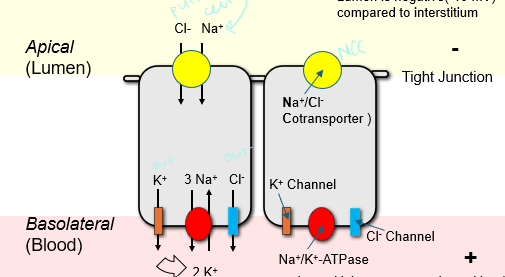
Water-impermeable segment containing Na+/Cl- cotransporters and TRPV5 calcium channels on the apical side, and pumpkins/ K+ and Cl- channels on the basolateral side
Late DCT
Contains aldosterone-responsive cells similar to principal cells
Na+/Cl- cotransporter (NCC)
Apical transporter that reabsorbs sodium and chloride in the DCT, inhibited by thiazide diuretics
DCT apical channels
NCC (Cl and Na IN from urine), TRPV5 (calcium IN from urine)
DCT basolateral channels
Pumpkins, chloride channel (Cl OUT to blood), potassium channel (recycles potassium OUT to blood)
Thiazide diuretics
Drug class that competitively inhibits the Na+/Cl- cotransporter in the DCT, used for hypertension/congestive heart failure, can lead to hyperlipidemia, decreased serum ions, dry eye, increased risk of hypokalemia with steroids
Collecting duct system
Receives urine from multiple nephrons (through multiple connecting tubules) and fine-tunes sodium (reabsorbs 5%, responds to external signals and hormones)
Principal cells
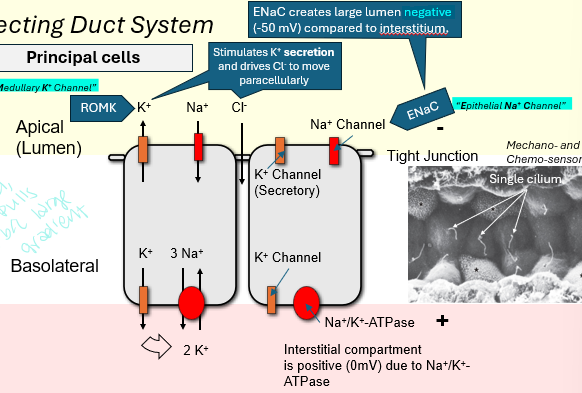
Collecting duct cells responsible for sodium and water reabsorption and potassium secretion, cilium, microvilli and small mitochondria, 60% of cells in CCD
Principal cells apical channels
ROMK (K+ OUT into urine), ENaC (Na+ IN to cell, creates large lumen negative potential difference),
Principal cells basolateral channels
Pumpkins, K+ channels (recycle K+ OUT into blood)
Intercalated cells
Collecting duct cells responsible for acid-base regulation and potassium handling, alpha and beta, microvilli and many mitochondria, 40% of cells in CCD
Alpha-intercalated cells
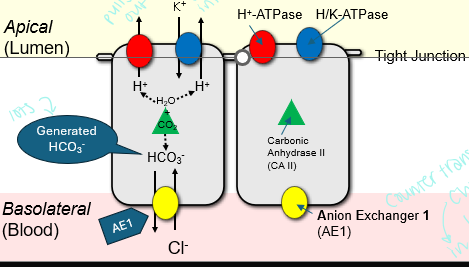
Secrete hydrogen ions via apical H+(/K+)-ATPase and reabsorb bicarbonate and potassium
Beta-intercalated cells
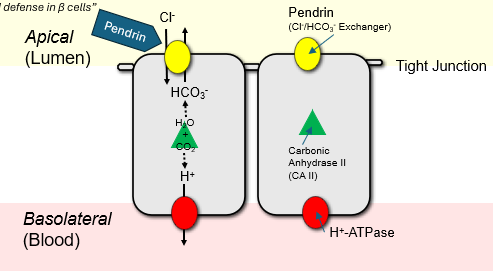
Secrete bicarbonate via apical HCO3/Cl- exchanger and reabsorb chloride
Lumen potential principal cells
Electrical gradient created by ENaC-mediated sodium reabsorption that drives potassium secretion and paracellular chloride reabsorption
Paracellular chloride reabsorption
Movement of chloride between cells driven by the lumen-negative electrical potential
Acid-base regulation in the collecting duct
Performed primarily by alpha- and beta-intercalated cells
Anion exchanger 1 (AE1)
Basolateral Cl-/HCO3- exchanger in alpha-intercalated cells
Pendrin
Apical Cl-/HCO3- exchanger in beta-intercalated cells that secretes bicarbonate and reabsorbs chloride
Potassium-sparing diuretics
Diuretics that inhibit ENaC in principal cells, reducing Na+ influx and K+ secretion (increasing serum K+ levels), include triamterene and amiloride, often combined with other therapies, SEs= hyperkalemia, metabolic acidosis and dry eye
Aldosterone
Steroid hormone produced by the adrenal cortex that increases sodium reabsorption/potassium secretion in principal cells by increasing the number of ENaC channels
Spironolactone
Aldosterone receptor antagonist that blocks aldosterone-mediated gene transcription, used for hyperaldosteronism, edema from CHF, and hypokalemia
Antidiuretic hormone (ADH)
Hormone that increases water reabsorption in the collecting duct by inserting aquaporin-2 into the apical membrane of principal cells (and aquaporin-3 into basolateral to allow water to enter interstitium)
V2 receptor
ADH receptor on principal cells that activates cAMP signaling leading to aquaporin insertion
ADH Urea effects
Increases urea permeability in inner medullary collecting duct by inserting urea transporters into the apical membrane (by activating adenyl cyclase and PKA)