Training
 Call Kai
 Learn
Learn Practice Test
 Spaced Repetition
 Match
Match Flashcards
 Knowt Play
1/150

There's no tags or description
Looks like no tags are added yet.
Name | Mastery | Learn | Test | Matching | Spaced | Call with Kai | Chat |
|---|
No analytics yet
Send a link to your students to track their progress
151 Terms
Training
Planned and systematic activity designed to facilitate learning of knowledge, skills, or attitudes that result in improved performance in another environment. Overall goal of most training is learning
Short-term, task oriented, and targeted on achieving a change in behavior via knowledge, skills, and attitude change and usually job related
Education
lifetime investment that’s knowledge-based. tend to be initiated by an individual in the area of their interest
Development
long term investment in employees’ personal growth and positive organization change
The gap concept
we need to develop programs to fill the gap between current and expected outcome.
Deficiency of knowledge: don't know what to do
Deficiency of execution: I know what I want to do, but not how to do it
Deficiency of practice: not given opportunity to practice what learned
Instructional Systems Design
formal set of approaches for developing a training system from learning theory. It provides procedures for developing training materials based on a comprehensive training needs analysis
It focuses on developing effective performance, learning required skills, and identifying what the trainee must do to learn that skill
ADDIE model is most popular
Successive Approximation Model (SAM) is shorter model of the ADDIE model. Like a mini prototype
ADDIE
Analysis: what’s the problem? What’s the learning goal? Target audience? Training needs analysis? Ex: needs analysis, interviews, objectives
Design: Learning objectives? Stakeholder alignment? Mapping of evaluation methods? Outline? Ex: Blueprint, storyboard
Development: Instruction strategies? Communication strategy? Producing learning product. Determine delivery method. Ex: slides, workbook, facilitator guide
Implementation: training delivery and participation, execution. Ex: Announcement, facilitate
Evaluation: in EACH step, continuous learning, points of improvement- it’s in every element so technically shouldn’t be last. Ex: feedback survey, assessment data
Balanced Scorecard
company’s strategic objectives into a coherent set of performance measures (Customer -time/quality/service, internal business process- influences customer satisfaction, innovation/learning- operating efficiency, employee satisfaction, continuous improvement, and financial- profitability, growth)
See where value is added in organization, helps with strategic initiative objectives
Training Needs Analysis
process where an organization’s workplace learning needs are identified and articulated
Should result in learning objectives
Assessment or analysis
Should be an intervention to show the organization cares
Diagnostic needs (what are we doing well), analytical needs (what can we do better), and compliance needs (not on quiz)
First step in instructional design process:
Should be properly conducted to reap benefits of training
SMEs, incumbents, and other stakeholders should participate in this.
Before choosing a training method, it’s important to decide
What type of training is necessary
The appropriateness of training
Performance deficiencies due to lack of knowledge, skills, and attitude
Key tasks that need emphasis
Strong link between Training Needs Analysis comprehensiveness and organizational effectiveness (r = .43). Yet it’s often overlooked and underfunded
Org, person, and task analysis
Organization Analysis
WHERE direction, manager support, resources, climate, identify future needs
Aka strategic analysis
Determine appropriateness of training
Available resources like money, time, people, support
Gather data and support for training from managers and employees
Person Analysis
WHO characteristics, input, consequences, feedback, gaps in learner
If deficiencies are because of lack of knowledge, skills, or behavior (training issue) or from a motivational or work design problem
Helps to know if employees are trainable and have basic skills/abilities/self-efficacy and transfer to workplace
Are you targeting the right people
Identify who needs training and what kind they need
Gap analysis : between actual and expected
Employee readiness for training
Task Analysis
WHAT, KSAs, working conditions, what people are doing and what they should be doing
Aka Operations analysis
Identify important tasks, knowledge, skills, and behaviors that need to be emphasized in training for employees to successfully complete tasks
Identify what actually doing and they should be doing
Team Task Analysis: identify coordination patterns and specify the teamwork-oriented learning objectives
Cognitive Task Analysis: useful when jobs are knowledge based and there’s a need to unpack the cognitive requirements
Knowledge elicitation method like verbal protocols, structured interviews, observations
Results in description of tasks and KSAOs required
Done after organization supports training program
Learning objectives
the purpose and expected outcomes of training
A statement of what the trainee will be able to do or exhibit upon successfully completing the training
Helps to identify the types of training outcomes that should be measured
Learning objectives must be specific, observable, and measurable
Has 3 components: what’s expected stated with an action verb (performance or outcome), quality or level of acceptable performance (criterion), and conditions which learner is expected to perform (conditions.)
Domains are Cognitive, Affective, and Psychomotor
What is needed for effective training?
Learning and transfer
Conditions for Learning
Active practice: cone of experience; active learning pyramid
Overlearning (learning past mastery and it’s second nature)
Massed vs spaced practice sessions. Massed can be better if not sequenced events, short amount of time (practicality), time to performance is short. Distribution of practice effect (d= .45 - .96)
Whole vs part learning
Knowledge of results or feedback
Task sequencing (engage with the easiest task first to build on self-efficacy)
Learning Styles is a …
myth. people differ in the type of instruction they prefer
Meshing hypothesis
meshing preference with presentation style
Learning Management Systems (LMs)
Used to automate the administration, development, and delivery of training programs
Like a learning portal
Propriertary, open-source, cloud-based LMS
Benefits: reduce costs, increase access, reduce time to completion, generate easy to retrieve data (talent gaps), easily linked to other HR systems
Adult Learning: aka androgongy
Adults have a need to know why they’re learning about something
Have a need to be self-directed
Bring more work-related experiences into learning situations
Enter into a learning experience with a problem-centered approach to learning
Extrinsically and intrinsically motivated
Learn best in cooperative climates that encourage risk-taking and experimentation
Reinforcement Theory
People are motivated to perform or avoid certain behaviors because of past outcomes that have resulted from those behaviors
Positive reinforcement: adding something wanted
Negative reinforcement: adding something bad
Punishment/extinction: remove desirable outcomes or withdrawing privilege so they stop bad behavior
Intrinsic vs extrinsic rewards
Schedule or pattern of reinforcement is critical to learning
Intrinsic rewards are stronger (peer recognition, need for achievement)
Trainer needs ot identify outcomes trainees find most positive or negative
Social Learning Theory
People learn by observing others (models) who they believe are credible and knowledgeable
Models’ behavior or skill that’s rewarded is adopted by observer
Learning new skills or behaviors comes from
Experiencing (either directly or observation) the consequences of using behavior or skills
Learning is influenced by person’s self-efficacy (judgement about whether they feel they can successfully learn knowledge and skills)
Self-efficacy is determinant of readiness to learn
It can be increased through verbal persuasion, logical verification, modeling, past accomplishments
Goal Orientation Theory
Goals held by trainee in learning situation.
Master/Learning Goal Orientation: increase ability or competence in a task. Learners with high learning goal orientation generally surpass performance orientation. Direct greater attention to task, learn for sake of learning
Performance Goal Orientation: focus on task performance and how they compare to others. Direct more attention to performing well, devote less effort to learning, competitive
Mastery is better
Need Theories
Explain value person places on certain outcomes. What motivates you?
Suggest that to motivate learning,
Trainers should identify trainees’ needs and communicate how training content relates to fulfilling those needs
If basic needs of trainees are not met, unlikely to be motivated to learn
Expectancy Theory
learning is better when people believe they can do it, they value they outcomes, the outcomes are tied to performance
Behavior based on
Expectancy: belief in own ability
Valence: rewards are actually valued
Instrumentality: behavior is associated with outcome
Information Processing Theory
Emphasize internal processes when content is learned and retained
Info taken in by learner undergoes several transformations in the brain
Highlights how external events influence learning
Trainers help by improving their attention by having effective learning objectives to help trainees set up expectations, and help with perceptual features of content
Fishbone Diagram
a visual tool used in root cause analysis to identify, sort, and display all potential causes of a specific problem
Enhance Motivation to Learn
Communicate to trainees the purpose of the course, objectives, prerequisites, and who else will be attending.
Assign pre-work to ensure trainees come to the program with a sense of focus and a basic understanding of training content.
Like assigning readings or questions like “Bring 3 challenges you currently have that you want addressed”
Managers should emphasize attendance/application importance, encourage attendance, and set expectations for learning
Highest level of support is when managers are the trainers
Expectancy Theory
The more effort you put in will lead to higher levels of learning and valued outcomes. EXPECTANCY, INSTRUMENTALITY, VALENCE. Help learners through this theory by eliminating obstacles and making sure that the outcomes they want (like high grades) are achievable and they’re supported
learning is better when people believe they can do it, they value the outcomes, the outcomes are tied to performance
Behavior based on
Expectancy: belief in own ability
Valence: rewards are actually valued
Instrumentality: behavior is associated with outcome
Social Learning Theory
idea that social interactions lead to higher levels of self-efficacy.
People learn by observing others (models) who they believe are credible and knowledgeable. Models’ behavior or skill that’s rewarded is adopted by observer (VICARIOUS LEARNING)
Learning new skills or behaviors comes from experiencing (either directly or observation) the consequences of using behavior or skills
Learning is influenced by person’s self-efficacy (judgement about whether they feel they can successfully learn knowledge and skills). self-efficacy is determinant of readiness to learn
AGENCY: the human capacity to exert influence over one’s own functioning and the course of events through one's actions.
Goal Setting theory
Behavior is because of a person’s conscious goals/intentions. Goals influence behavior by directing energy and attention, sustaining effort over time, and motivating the person to develop strategies. Goals lead to high performance only if people are committed to the goal and are less likely to commit if they believe it’s too difficult. IDEA THAT IF YOU SET SPECIFIC, CHALLENGING GOALS, YOU’LL BE MORE COMMITTED
GOAL ORIENTATION: goals held by trainee in a learning situation. Can include LEARNING/MASTERY ORIENTATION PERFORMANCE ORIENTATION
GOAL LEVEL: the standard of proficiency or the specific level of performance being aimed for. It is often synonymous with goal difficulty, a linear relationship between goal difficulty and performance: higher goals lead to higher performance, provided the person has the ability to reach them. high goals lead people to exert more effort, persist longer, and focus their attention more sharply than "do your best" goals or easy goals.
GOAL COMMITMENT: degree to which an individual is attached to the goal, considers it significant, and is determined to reach it even in the face of obstacles. Affected by self-efficacy
Help learners through this theory by setting goals with supervisor prior to learning and provide a MASTERY goal orientation
Performance Orientation
focus on performance compared to others, success is high performance relative to others, value high ability more than learning, error and mistakes cause anxiety and avoid them. Direct attention to performing well and less on learning)
Learning/Mastery Orientation
increase ability or competence in a task, success is showing improvement. Direct attention to task. Greater effort to learn and use more complex learning strategies. Create this by setting goals around learning and experimenting rather than trained task-performance. Deemphasize competition) or
Self-Determination Theory
theory that we act the way we do because of intrinsic and extrinsic (controlled) motivation. Idea that for a person to experience high-quality (intrinsic) motivation and mental well-being, three universal psychological needs must be satisfied: Autonomy, Competence, Relatedness
Autonomy
The need to feel in control of one’s own behaviors and goals. It is the feeling that "I am the author of my actions" rather than being a pawn moved by others. In the workplace, this means having a say in how tasks are completed.
Competence
The need to gain mastery of tasks and learn different skills. It is the feeling of being effective and capable. When a task is at the right level of challenge, it enhances the sense of competence.
Relatedness
The need to feel a sense of belonging and attachment to other people. In an organization, this is the feeling that you are supported by your team and that your work matters to the community.
Situated Cognition
people’s knowledge is embedded in context of where learning takes place.
Situated Learning
part of adult learning where, WHERE A PARTICULAR LEARNING OR ACTIVITY TAKES PLACES IS CRUCIAL FOR LEARNING OUTCOMES
Theory of psychological engagement
for training to be effective, a learner must be psychologically present—investing their physical, cognitive, and emotional energies into the learning experience.
Active Learning (Training)
approach that assigns the trainee an active role in the learning. Includes BOTH A COGNITIVE (learner mentally rehearse to restore for long term memory) AND BEHAVIORAL ACTIVITY
Traditionally, trainees are perceived as passive, but active learning is more popular with more tech advancements and learners taking proactive role in learning
Formal Training:Trainers encourage exploration and experimentation.
Error management training is part of exploration where error are a natural part of training process and useful for learning/mastery orientation. Encourage experimentation
Informal Learning: Job demand-control model (reduce strain & improves O-J Learning)
Active Learning Hypothesis: high job demands and high job control support for on-demand learning. No control and no support but high demands means higher strain and less learning
When applicable, it leads to better transfer outcomes like adaptive transfer (the process of modifying prior knowledge or skills to fit new, unfamiliar contexts, rather than just directly reapplying them)
Attribute-Treatment Interactions
one size doesn’t fit all when it comes to training. Relationship between people’s differences and training effectiveness is different across different strategies/methods
Attribute
measurable person characteristics that prepares for goal achievement. Broad and STABLE features of trainees. Different than learning styles which are preferences.
What is the finding between general cognitive ability and training structure?
General cognitive ability: when cognitive ability is high, need LESS structure. there is an interaction between training structure and general cognitive ability. One of the most robust findings
Fluid intelligence
solve novel problems, think abstractly, peak in young adulthood and declines after
Older trainees need task sequence
Crystalized Intelligence
accumulated knowledge, facts, and skills acquired through life experience and education. Increase with age
Treatments
training design features and contextual characteristics of the training environment (e.g., reward system, transfer climate, feedback, rewards, instruction strategy, training design features)
Treatment and situations either magnify or diminish certain individual difference effects
Unless treatment is clearly the best for everyone, it should be differentiated (when practical)
Person-Environment Fit
best outcomes when max fit between trainees and environment (content, delivery, context)
Complementary fit
Environment compensates individual weakness or provides something to the training environment that wouldn’t have otherwise had. An individual fills a gap in the environment by providing skills or abilities that the team/organization currently lacks. Like an instructional designer hiring an expert who’s a good model to demonstrate something.
Supplementary Fit
something the trainee already possesses. when an individual shares similar characteristics (values, personality, skills) with others in an environment, essentially "fitting in". Like encouraging the trainees to explore their high in openness.: A new hire shares the same ethical values as the rest of the company culture.
STRATEGY TO MAXIMIZE LEARNING
Error encouragement. Encouraged especially in fields like the medical field where there’s life and death
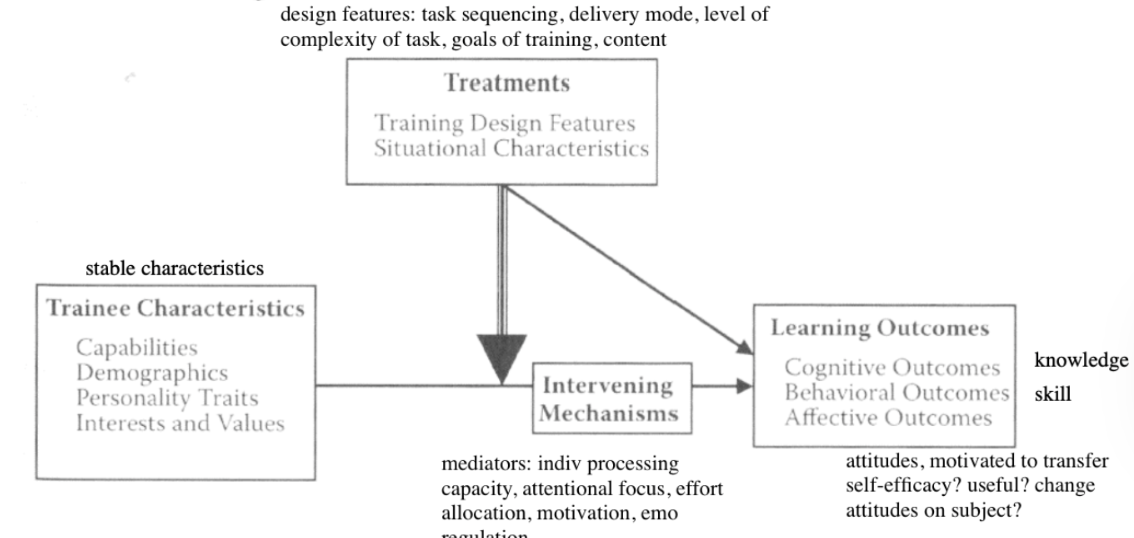
how attributes (characteristics) and treatments interact to affect learning outcomes
Trainee characteristics affect intervening mechanisms (each person’s processing capacity, focus, effort), and intervening mechanisms affect learning outcomes (knowledge, skill, self-efficacy)
Treatments (Design features like task complexity and goals of training, situational/environment features) affect (moderate) the strength of the learning outcomes
Universal Design of Learning
Research-based principles to guide program design that are effective for ALL learners
Most effective for combining learning methods. Use adaptive, blended, inclusive approaches. Blended learning is recommended because of individual differences
Reduces barriers to learning
Gives options and choices to learners
Proactive and inclusive
This is important because: learner variability and diversity, increases learner engagement, and gives learners ownership of their learning
EQUITY IS THE MAIN PURPOSE
Characteristics of well-designed training
Convey Information: trainees understand the objectives, purpose, and intended outcomes. They receive meaningful content (i.e., examples, exercises, and assignments that are relevant to the job)
Demonstration: demonstrate desired behaviors, cognitions, and attitudes through learning aids (like videos) to help them learn, organize, and recall training content
Practice: Opportunity to practice KSs in a relatively structured, safe, and supportive environment
Feedback: trainees receive feedback on learning from trainers, observers, peers, or the task itself. Learning is solidified in practice and feedback
Training Effectiveness
The benefits that the organization and the trainees receive from the training
Training Outcomes
Output measures or criteria that’s used to evaluate training programs
Training Evaluation
process of collecting the outcomes needed to determine if training was effective
Assessment FOR learning
An ongoing process used during instruction to provide feedback, guide teaching, and improve student learning
Formative
Assessment OF learning
(summative) occurs at the end of a unit to measure, grade, and certify student achievement against standards
Alpha Change
true change. Changes in responses accurately reflects changes in reality. Change in the level in the measure
Beta Change
changes in responses result from a subjective recalibration of the measurement scale (aka instrument bias). Change in the calibration of measure
Trainees have recalibrated their own interpretation of the likert scale. They initially thought they were smart but realized how much they don’t know. Has nothing to do with changing the construct in their head. It has to do with training exposure and realized their actual skill level
GAMMA CHANGE
changes in responses results from a reconceptualization of the variable (construct validity issue). New meaning of construct like new meaning of peer support, new vocab words, different dimensions. Change in the meaning of the construct
This is why it’s important to keep dimensions at a facet level, not a global level (because when they learn new concepts, not confused)
Mental Model
the "internal map" a person uses to understand how concepts relate to each other. important when team needs to know how to approach a certain task
Kirkpatrick’s Framework of Evaluation
further away from the training program, the more precise the data is. The levels mean the proximity to the training interventions and precision of data. That’s why reactions is Level 1 and closest to the training intervention
Level 1: Reactions.
Immediate. What did you like about it? Do you plan to use it? Utility, Affective and Purpose/use reactions
Level 2: Learning - Cognitive, Behavioral/Skill, Affective Outcomes
Immediate (depending on collection). In training room right after program. Affective outcomes (self-efficacy, more motivational aspects)
Level 3: Transfer Behavior/Skill Outcomes
Back at work, results may not always show good behavior of employees
Level 4: Results
Data
Level 5: Return on Investment
Financial Impact
Net Promoter Score
who is a promoter and a detractor. Mechanism to know what sources of data to pay attention to and used for marketing
Utility Analysis
assessing the dollar value of training based on estimates of:
The difference in job performance (etc) between trained and untrained employees
Number of individuals trained
Length of time training is expected to influence performance
Variability in job performance of the untrained employees
Use when you can’t get ROI directly but to communicate financial impact
It tends to be inflated and believability is low, so in process gain as much buy-in as possible
Training Validity
extent to which training programs enhance trainees’ knowledge and skills. Did the trainees master what they were supposed to learn?
Transfer validity
extent training lead to improvements in job performance? Are the trainees able to do better on the job as a result of training?
Intraorganizational Validity
Extent training program works for other workers in the same company. Does the training work across groups of people in other organizations?
Interorganizational Validity
extent to which training program works in other organizations. Does the training work for people in other organizations?
Internal referencing strategy
We create 2 comparison groups (ask about what you trained and nothing about what you trained - bogus items)
This is a clever way to create a "control group" within the same person. How it works: You give a pre-test and post-test that includes two types of items:
Trained Items: Content actually covered in your 4 modules (e.g., "The 3 Ds of Delegation").
Untrained (Bogus) Items: Content that sounds professional and relevant but was not in your curriculum (e.g., "The 5-Step Synergy Protocol").
The Logic: If the managers’ scores go up on everything, they probably just got better at taking tests or were influenced by outside factors. If their scores only go up on the Trained Items, you have proof that your specific modules caused the change.
Hawthorne Effect
the idea that people improve simply because the organization is paying attention to them.
Transfer of Training
trainees effectively and continually applying what they learned (KSs) in training on their jobs. a continuous process, not just an outcome
Scrap learning
learning acquire through training that isn’t retained or transferred. Learning that didn’t end up getting used. Wasted time or wasted dollars and often expressed as a percentage.
Typical is 45%. Sometimes even 80% or more. Idea that it’s inevitable in organizations because we can’t tailor training to each individual
Some causes: training at wrong time, too much content, lack of follow up, training isn’t what’s needed, AVOID by investing time in program design, interactive learning methods, action planning (set expectation before/during/after training)
Forms of Transfer
Horizontal and Vertical
Horizontal Transfer
focuses on the individual taking a skill and applying it to similar situations at the same level of complexity.
highly sensitive to the environment. Even if a manager learns the skill, a "top-down" lack of support from senior leadership can kill the transfer.
Primary Objective: To ensure the person can do their specific job better across different but similar contexts.
Vertical Transfer
This is a "bottom-up" effect where individual learning scales up to benefit the entire team or organization.
Strategic Outcome: It explains the why behind training—how one person’s growth moves the needle for the entire organization's mission.
Transfer of Training Theories
Identical Elements, Stimulus Generalization, Cognitive Theory
Identical Elements
Training environment is identical to work environment (e.g. fire drills). Training should focus on closed skills (a motor skill performed in a stable, predictable environment where the performer dictates the pace and timing, allowing for pre-planned movements), work environment features are predictable and stable. NEAR transfer
Stimulus Generalization
general principles are applicable to many different work situations. Training should focus on open skills (movements performed in dynamic, unpredictable, and constantly changing environments) and the work environment is unpredictable and highly variable. FAR transfer where you apply training to different context. Ex: training interpersonal skills
Cognitive Theory
meaningful material and coding schemes enhance storage and recall of training content. All types of training and environments. NEAR and FAR transfer
Near Transfer
Applying learned skills or concepts to a context that is very similar or tightly related to the original learning environment.
Far Transfer
Applying learned skills or principles to a context or domain that is very different and loosely related to the original training
Skill Decay
Loss or decay of training or acquired KSs after periods of nonuse. Not simply a matter of nonuse. More of a matter of interference where there are other things that are taking priority and interfere with the learning and are becoming obsolete. Likely a function of training and task factors
Desirable difficulties in training
when overall transfer increases but initial skill acquisition is inhibited
Retrieval process and retention and transfer go up, speed of acquisition goes down
Transfer Interventions
Pretraining
Improve self-efficacy: persuasion, emphasize learning outcomes
improve transfer climate: communicate transfer value, remove inhibitors, promote a learning organization
Improve motivation: goal setting, info review, managerial support
During Training
Improve acquisition and retention: Context-dependent learning, Provide many examples, Overlearning and desirable difficulties
Improve adaptive expertise: discover based learning: inquiry based, error-based learning, develop meta-cognitive skills
Improve transfer intentions: goal setting, improve training reactions, leaverage training cohort, positive training climate, self-management skills
Posttraining
Improve transfer climate: work environment, positive task cues, positive reinforcement
Improve retention: similarity of conditions means context dependent learning, job aids, guided reflection, micro-refresher training
improve Vertical Transfer: deliver training at the team level when members have critical roles
Metacognition
thinking about your own thinking so you can plan, monitor, and evaluate your learning process
Performance Appraisal
using a standardized rating form to assess employee/group. Goal is to try to obtain reliable info about the performance of an employee. Object is the employee. more retrospective. Backward looking (what did you do last year? Giving appropriate sanctions and rewards)
Job-relevant strengths and weaknesses
Assign ratings to each performance dimension
Typically conducted annually
Lacks ongoing feedback because it’s once a year
It’s NOT a performance measurement and NOT job evaluation: Object of job evaluation: the job itself
PA as a developmental and futuristic perspective
As a social and communication process (2 parties - supervisor/employee. Must agree on performance. An exchange)
As a political tool (sometimes judgement might not always be ratings)
Shifts in thinking
Now seen as a rationalist, psychometric perspective.
Viewed as a rational measurement process. This is partially because research for court cases like equal employment emphasized need for thorough assessment, the form requires substantial research (what and how Qs are asked)
Research on scaling formats
PA as an information-processing perspective.
May be seen as a complex memory task. It’s now shifted to emphasize cognitive processes where PA was now seen as a complex memory task (supervisor now has to encode PA info, then retrieve for a later date, wait and combine it with info into overall performance judgement)
emphasizes a top-down strategy where a handful of leaders making decisions
Performance Management
continuous process of identifying, measuring, and developing the performance of employees’ teams in congruence with organizational goals. Never ending process of setting goals, observing, giving feedback, individual development. PM creates direct link between employee performance and organizational performance
more prospective: Forward looking, using feedback as a tool to change future behavior. It’s an ongoing process of performance improvement. It’s more likely to emphasize informal feedback
Emphasis on the role of the appraiser as that of a helper (coach) and not a judge
Emphasis on participative action plans that foster implementation
Its main focus is on improving the employee’s effectiveness of contribution to the organization.
built on a consultative strategy, emphasizes employee participation and engagement
Talent Management
Broader activity. Full journey of an employee through recruiting, training, upskilling, and promotions. Helps HR managers recruit, retrain, and upskill employees
Three Perspectives of Performance Management
A system for managing organizational performance
Organization mission strategy
A system for managing employee performance
Broader than PA
Forward-looking; backward-looking assessment; feedback-giving element; ongoing
A system for integrating the management of organizational and employee performance
Alignment of individual performance goals with the organization goals
Integrating Performance Management with other HR processes and procedures
Motivation Theories
Need Theory: need for achievement, affiliation, and power
Expectancy Theory: Expectancy, Instrumentality, Valence
Social Learning Theory:
Equity Theory: nature of what works that’s given and compensable outcomes, would accommodate employees that need accommodations with equipment for their needs and keep motivated
Reinforcement Theory: what doesn’t get reinforced doesn’t get repeated and what doesn’t get repeated doesn’t get done
Agency Theory
examines organizational context and how that shifts performance mgmt practices. Could be how work is delegated or job title gives employees. This theory suggests that greater info sharing
explains the relationship and potential conflicts between principals (such as shareholders) who delegate work, and agents (such as managers) who perform it. reduce "agency loss," which occurs when agents act in their own self-interest rather than the principal's
Signaling Theory
suggests that people need tangible information to understand or interest or future prospects. Make inferences about what’s important to organizations and what behavior I should be demonstrating. Formal practices should have important signaling function so employees can sense what organizations expect and value which facilitates good behavior. Ex: organization/company wide Performance Management software. Signals organization is moving toward more structured, transparent and data driven approach would mean making it easier to keep track of job descriptions and keep track of what the employee can track and what they’re excelling at. Organizations should signal what they care about so employees know what they need to focus on.
Purposes of Performance Systems
Strategic- to help top management achieve strategic business objectives
Administrative: to furnish valid and useful information for making administrative decisions about employees. Most frequently used purpose
Informational: To inform employees about how they are doing and about the organization’s customers’, and supervisors’ expectations
Developmental: to allow managers and peers to provide coaching to their employees. Most frequently used.
Organizational Maintenance: to create a talent inventory and provide information to be used in workplace planning and allocation of HR
Documentation: To collect useful information that
Distal Context
National Culture
Legal Environment
Economic Environment: recession, determines level of seriousness and breadth for PM system
Technical Environment
Physical Environment
Proximal context
Organizational culture (most likely to affect PM system when focus on things like goal orientation, organization culture is goal oriented, classified as easy going culture, open system, determines who they set up PA-PM
Organizational Strategy
Work group composition
Supervisor-subordinate relationships
Defamation
info disclosed that’s untrue and unfavorable and inhibits employees to get another job or promotion. Untrue and Unfavorable
Misrepresentation
Disclosure of information that’s untrue and favorable likely lying. Ex: give good recommendation to employee you fired means you are misrepresenting, especially when company encounters damage or harm because of that individual. Future employee/consulting agencies/customers are the ones that sue and who are harmed as person is hired under false pretenses
Characteristics of Legally sound PA-PM Systems
Ensure content and procedures used to assess employee is legally sound
Use objective, not subjective criteria
Be job-related or based on job analysis
Based on behaviors, not traits. Important: shouldn’t appraise on what they’re like. Don’t rate them because they’re a jerk, more of the things they’ve done
Be within control of the ratee: don’t rate poorly on something our of their control like disabilities
Relate to specific job functions (not be global). What we can do to minimize being sued is include blended approach with objective data and subjective ratings
Recommendations for legally sound PA procedures
Standardize for all employees within a job group
Should be formally communicated
Use, multiple, unbiased raters
Provide instructions for training raters
Provide thorough documentation
Allow employees to appeal results
Should allow employees to correct deficiencies- give employees opportunity to improve before big decisions like promotion/demotion
Cascading Goals
Idea is to ensure that the next level has goals that align with the next hierarchy they are reporting to
FeedForward Interview
a strengths-based performance appraisal and development method that focuses on future goals and peak experiences instead of past mistakes or failures