1.1 Cells and movement across membranes
 Call Kai
 Learn
Learn Practice Test
 Spaced Repetition
 Match
Match Flashcards
 Knowt Play
1/33

There's no tags or description
Looks like no tags are added yet.
Name | Mastery | Learn | Test | Matching | Spaced | Call with Kai | Chat |
|---|
No analytics yet
Send a link to your students to track their progress
34 Terms
What are the components of both plant and animal cells?
1. Nucleus
-contains DNA of the cell
2.Cytoplasm
- contains organelles, enzymes, dissolved ions and nutrients
-site for cellular reactions
3.Cell membrane
-controls the entry and exit of materials into and out of the cell
4.Mitochondria
-Site of aerobic respiration
-releases energy
Which organelles are found in only plant cells?
1.Cell wall
-made out of cellulose
-provides strength
-prevents cell bursting when water enters by osmosis
2.Vacuole
-contains cell sap (solution of salts & sugars)
-Supports the cell and maintains turgidity
3.Chloroplasts
-site of photosynthesis
-contain green pigment called chlorophyll
What piece of equipment is used to observe both plant and animal cells?
Light microscope
How does a light microscope work?
Passes a beam of light through a specimen which travels through the eyepiece lens, allowing the specimen to be observed.
What is the function of the eyepiece and objective lens?
The eyepiece lens magnifies the image.
-has fixed magnification of x10.
The objective lens magnifies the image.
-has interchangeable magnifications.
What is meant by cell differentiation?
The process by which a cell becomes specialized in order to perform a specific function
Why is cell differentiation important?
It enables the formation of specialised cells with specific functions e.g. red blood cells.
Define tissue.
A group of similar cells working together to perform a specific function e.g. muscle tissue.
Define organ.
A group of similar tissues working together to perform a specific function e.g. heart.
Define organ system.
group of organs that work together to perform a specific function e.g. circulatory system.
Define organism.
A living thing that is able to function independently.
What are enzymes?
They are biological catalysts that increase the rate of chemical reactions without being used up in the reaction itself.
What is an advantage of enzymes in the body?
They enable cellular reactions to take place at lower temperatures.
What group of chemicals do enzymes belong to?
Proteins
Describe how DNA controls the production of a specific enzyme.
1.DNA codes for a specific sequence of amino acids
2.The order of the amino acids determines how the enzyme folds and its structure
3. The shape of the enzyme determines its function
What is the chemical an enzyme works on called?
Substrate
What is the active site of an enzyme?
The region on the enzyme where the substrate binds and the reaction takes place.
Why are enzymes described as having a 'high specificity' for their substrate?
Only substrates with a specific, complementary shape can fit into an enzyme's active site.
What must happen between an enzyme and substrate for a reaction to occur?
Enzyme and substrate must collide.
Describe the lock and key model.
1. Substrate collides with the active site of an enzyme
2. Substrate binds, enzyme-substrate complex forms
3. Substrate converted to products
4. Products released from the active site which is now free to bind to another substrate
What factors affect the rate of enzyme-controlled reactions?
1.Temperature
2.pH
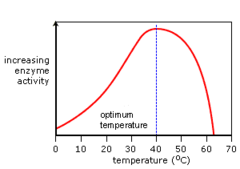
How does increasing temperature initially affect the rate of an enzyme-controlled reaction?
1.As temperature increases, molecules have more kinetic energy
2.Movement of molecules increases
3.Probability of successful collisions increases
4.More enzyme-substrate complexes form
5.Rate of reaction increases
How does increasing temperature above the optimum affect the rate of an enzyme-controlled reaction?
1.Temperature increases above optimum
2.Increased vibrations break bonds in enzyme's structure
3.Active site changes shape, enzyme is denatured
4.No more enzyme-substrate complexes can be form
5.Rate of reaction decreases
Explain how pH affects enzyme activity.
1.Enzymes have optimum pHs
2.pH shifts from optimum
3.Bonds in the enzyme's structure are altered
4.Active site changes shape, enzyme is denatured
5.Rate of reaction decreases

Why can substances pass through cell membranes?
They are partially permeable, enabling some substances to pass through
State the 3 methods different substances can pass through a cell membrane.
1.Diffusion
2.Osmosis
3.Active Transport
What is diffusion?
the net movement of particles from an area of high concentration to an area of low concentration down a concentration gradient.
Why is diffusion described as a passive process?
No energy is needed for it to occur.
What substances can pass through cell membranes via diffusion?
Small molecules e.g. carbon dioxide, oxygen.
What two factors affect the rate of diffusion?
1.Temperature
-The higher the temperature, the more energy possessed by molecules and the faster the rate of reaction.
2.Concentration gradient
-The steeper the gradient, the faster the rate of reaction.
What is osmosis?
The net movement of water molecules from an area of high water(low solute) concentration to an area of low water(high solution) concentration across a semi-permeable membrane.
Describe what happens to an animal cell if placed in a more dilute solution?
1.Higher concentration of water surrounding the cell
2.Water enters into the cell by osmosis
3.Pressure inside increases, cell bursts.
Describe what happens to an plant cell if placed in a more dilute solution?
1.Higher concentration of water surrounding the cell
2.Water enters into the cell by osmosis
3.Cell wall resists increase in pressure, cell turgid.
What is active transport?
The movement of molecules across a cell membrane from an area of low concentration to an area of high concentration, against a concentration gradient, requiring energy.