Pharma Trans 1,2,6
 Call Kai
 Learn
Learn Practice Test
 Spaced Repetition
 Match
Match Flashcards
 Knowt Play
1/64

Earn XP
Description and Tags
- Into to basic pharmacology - "Rational Drug Therapy / Ethical Consideration in Drug Prescribing - Nature and Sources of Drugs and Dosage forms
Name | Mastery | Learn | Test | Matching | Spaced | Call with Kai | Chat |
|---|
No analytics yet
Send a link to your students to track their progress
65 Terms
WHO definition of Rational Drug Therapy
Medication appropriate to clinical needs
Doses meet their own individual requirements (for a period of time)
Lowest cost
Considerations in Ethical Prescribing
Evaluate and define the patients problem + Give a diagnosis
Determine the therapeutic objectives of drug therapy
Prescribing decisions should be based on the primary
diagnosis and relevant secondary diagnosis.
primary diagnosis
relevant secondary diagnosis.
pharmacokinetic vs pharmacodynamic
Pharmacokinetics (PK): What the body does to the drug.
Pharmacodynamics (PD): What the drug does to the body.
Process of rational drug prescribing
identifying the problem/diagnosis
establishing the therapeutic goals
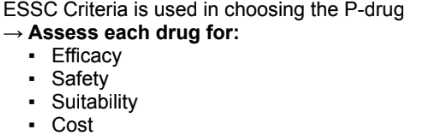
choosing the drug using the ESSC criteria,
writing the correct prescription, counseling and monitoring the patient.
Involved in compounding, preparation, collection, standardization and dispensing of the drugs
Pharmacy
Study of crude drugs, proper horticulture, harvesting and uses of materials derived from nature
physical and chemical properties of the drugs with the description and identification of their sources and nature
Pharmacognosy
Study of how the chemical structure of the drug is related to physiological, biological, and biochemical effects
Biochemorphology
Study of the harmful effects of drugs and other chemicals on human, animals, and plants
Toxicology
Deals with dosage of the drug required to produce a therapeutic response
Posology
Studies the mechanism of action of a drug at the enzymatic level
Molecular Pharmacology
T or F? Substitutions within the chemical structure of the drug may lead to either low toxicity or lethal toxicity
True
Factors affecting biochemorphology:
○ Protein-Binding
○ Drug Solubility
○ Acidity / Alkalinity
Also known as Clinical Therapeutics
● Deals with rational development of drugs, their safe and effective use, and other proper evaluation of drugs in humans for prevention, diagnosis, treatment, alleviation or cure of a disease.
● Refers to rational drug prescribing
Clinical Pharmacology
What is the average amount of time it takes for an experimental drug to travel from the lab to the medicine chest?
12 years
Out of 5,000 preclinical compounds evaluated
how many typically make it to human clinical trials?
How many get approved?
5 enter human trials; only 1 gets approved.
What are the sample sizes for the three primary phases of clinical trials?
Phase I: 20 to 80 healthy volunteers.
Phase II: 100 to 300 patient volunteers.
Phase III: 1,000 to 3,000 patient volunteers.
What application must be submitted to the FDA before human testing can begin, and what is filed after Phase III is successful?
IND (Investigational New Drug application) before human testing
NDA (New Drug Application) after Phase III.
Which phase of clinical trials experiences the highest rate of drug failure?
Phase II (only 25% of innovative drugs move on to Phase II).
What is the primary purpose of Phase IV trials, and who reports the findings?
Post-marketing surveillance to detect rare/long-term toxicities, patterns of drug utilization, or new indications. It is done by all physicians.
What does EUA stand for, and what is its purpose?
Emergency Use Authorization; it allows for the use of unregistered drugs or vaccines during public emergencies (without skipping strict safety standards).
Define the term "Placebo."
A substance or treatment with no active therapeutic effect used as a methodological tool in medical research.
True or False: A placebo response can only lead to psychological changes, not objective physiological or biochemical changes.
False. The placebo response may involve objective, physiologic, and biochemical changes in addition to changes in subjective complaints.
What action do Cathartic drugs do?
increase bowel movement (stronger than laxatives)
entire evacuation of entire colon
Phase 4 of clinical trials establishes the drug's:
a. Over-all safety
b. Additional unusual side effects
c. Short term side effects and risks
d. Efficacy in patients with the disease
Short term side effects and risks
Generally, the duration for an experimental compound to be studied and
be out in the market for public use takes:
a. 1 year
b. 3 years
c. 6 years
d. 12 years
d. 12 years
12. Which is part of the pharmacokinetics phase of a drug?
a. Biotransformation
b. Tablet disintegration
c. Mechanism of action
d. Drug-drug interactions
Biotransformation
The strength of a drug required to produce effect is:
a. Efficacy
b. Potency
c. Effectiveness
d. Bioavailability
Potency
For a prescription with several ingredients, this is used as the solvent of a
solution to increase the bulk of a mixture:
a. Basis
b. Vehicle
c. Adjuvant
d. Corrective
b. Vehicle
Drugs that need prescription by licensed physicians
Opioids
Hallucinogens
Stimulants
Depressants
Anabolic steroids
Outline of P-drug selection
Diagnosis
Therapeutic objectives
Non-drug measure
inventory of effective drug groups
📌The ___ total score (drug group 2) would be your P-drug group.
highest
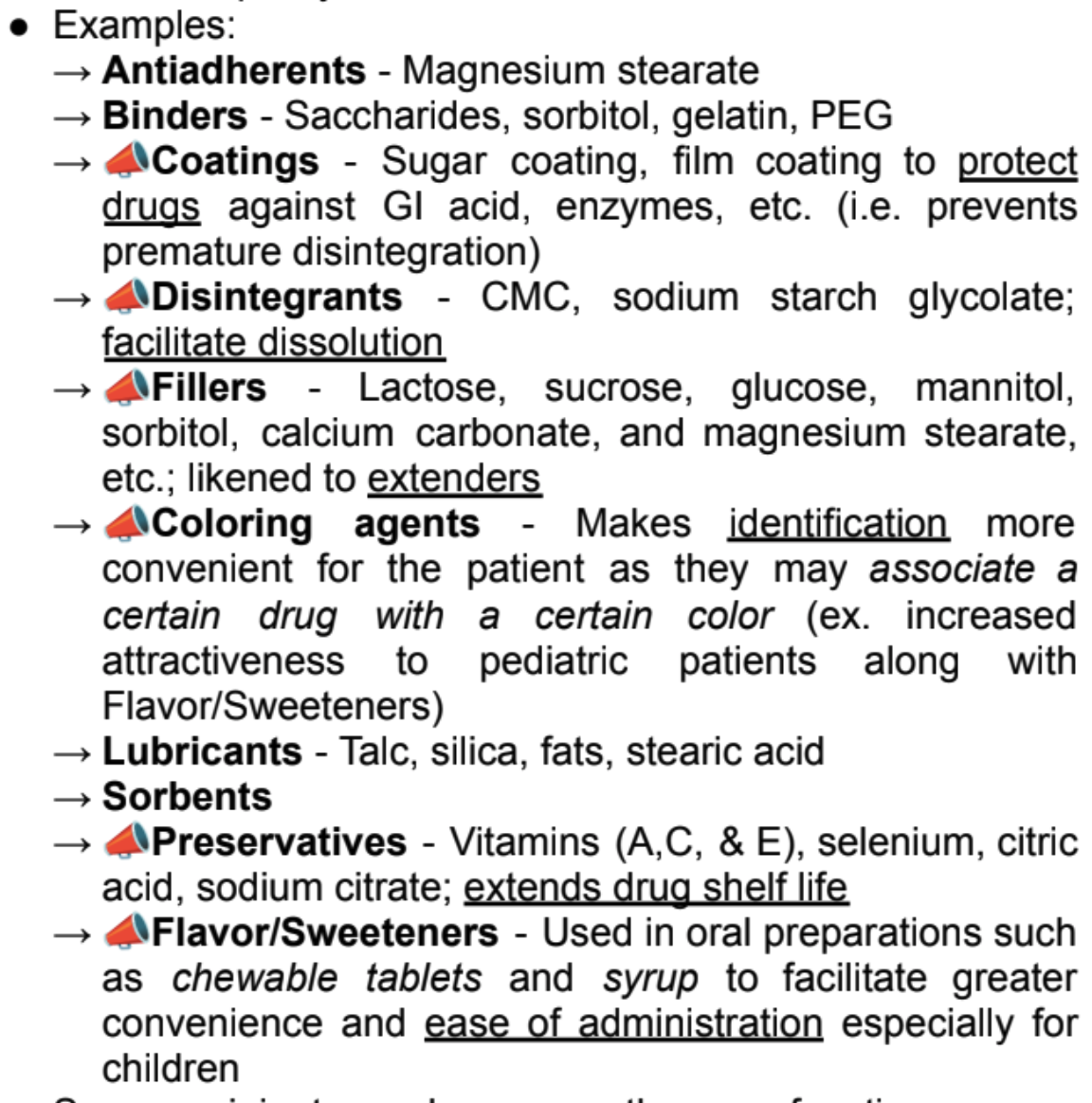
T or F? Excipients has NO physiologic or pharmacologic effect on patient.
T
What do you call inactive substances that help bulk-up formulations that contain active ingredients.
Excipients
T or F? Drugs > 1000 Mw in size can diffuse readily
False!
drugs must @ least be 1000 MW
Any more than 1000 do NOT DIFFUSE
T or F? Most useful drugs are CHIRAL (enantiomers) molecules
T
what is the fundamental requirement for a drug's shape to produce a pharmacological effect?
Complementary to receptor site
Based on the structural diagrams in Figure 3 of the notes, how many distinct diastereomers exist for the drug Ephedrine?
4
How does the potency of dextromethamphetamine compare to its levo counterpart in inhibiting noradrenaline reuptake?
10x more
What proportion of clinically useful drugs are described as chiral molecules in the provided material?
More than half (NOT ALL)
Which specific pharmacological mechanism is inhibited by dextromethamphetamine?
Noradrenaline reuptake
the difference between Ephedrine and Pseudoephedrine is based on their status as:
Diasteromers
have multiple chiral centers
NOT mirror images of each other
what is a regulated substance in the Philippines but OTC in the United States?
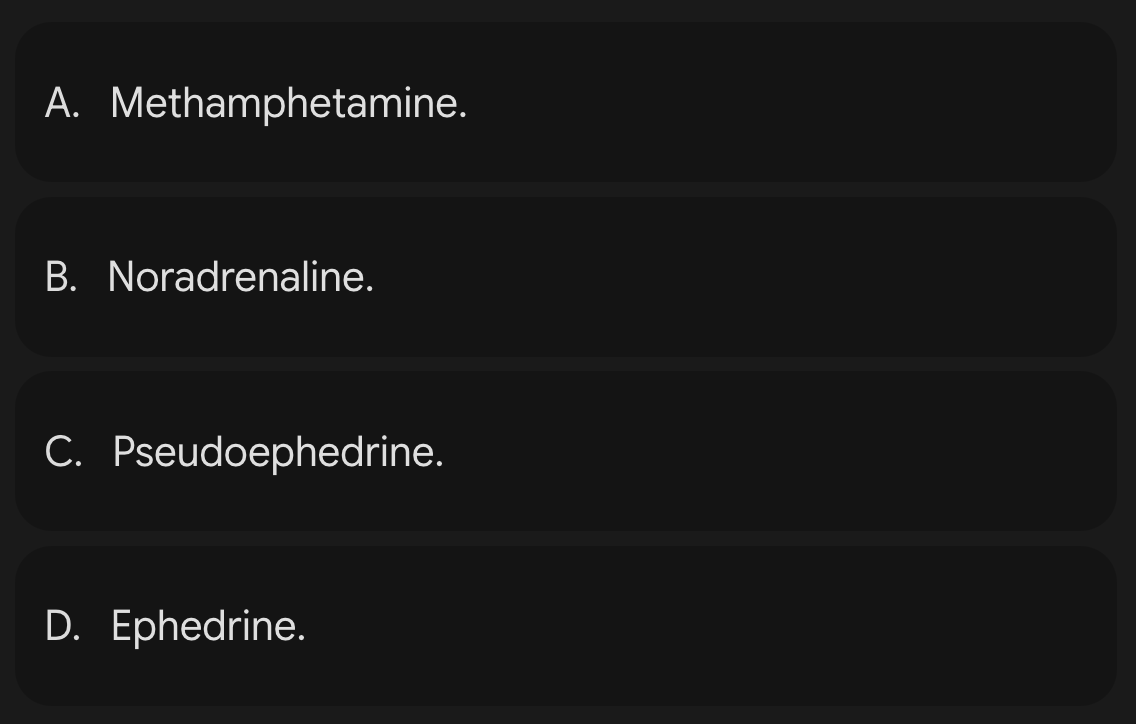
D. Ephendrine
Atropine, vinblastine, vincristine, quinine,
colchicine, and morphine are all examples of?
Alkaloids
Where is Lanolin obtained from?
Sebaceous gland of wool bearing animals
Where is Cyanocobalamin obtained from?
Animal liver
Streptomycin is derived from which microorganism?
Streptomyces gryceus
Chloramphenicol is derived from which microorganism?
Streptomyces venezuelae
T or F? Microorganisms play an integral role in genetically engineered drugs
True
_ is used as Laxatives
Magnesium sulfate
magnesium trisilicate
Magnesium sulfate
_ is used as antacids
Magnesium sulfate
magnesium trisilicate
magnesium trisilicate
_ drugs are more inexpesnive and can be mass produced.
Synthetic drugs
Aspirin is a synthetic derivative of ?
Salicyclic acid
Can be used to diagnose bone, heart or other organ
problems
Technitium Tc99
Iridium-192
Technitium Tc99
Can be inserted inside or near a tumor to kill cancer
cells while sparing neighboring cells.
Technitium Tc99
Iridium-192
Iridium-192
Para sa Bobo:
PKinetics is the journey the medicine takes to move in, around, and out of your body!
PDynamics is the magic action the medicine does to make your fever go away or stop your tummy from hurting!
___form is considered by default as the gold standard for having a 100% bioavailability,
Intravenous
What is Bioavailability?
Fraction (percentage) of an administered drug that successfully reaches the systemic circulation (bloodstream) in its unchanged, active form.
3 major classes of Routes
Enteral (via GI tract)
Parenteral ( injections)
Topical / Localized
Route | Onset | Bioavailability | Key Characteristic / Trade-off |
IV | Fastest | 100% (Gold Standard) | Directly enters bloodstream; no absorption step needed. |
Oral (PO) | Slow | Variable (5 to <100) | Most convenient; subject to significant first-pass liver metabolism. |
IM / SC | Moderate | High (75 to <100%)) | IM allows larger volumes than SC; both can cause pain. |
Inhalation | Very Rapid | Variable | Hits lung blood supply almost instantly. |
Transdermal | Very Slow | High (80 to < 100%) | Avoids first-pass effect; long-lasting, steady drug delivery. |
For oral medication, which organ reduces bioavailability?
Liver
Which route is the slowest BUT avoids the first-pass effect and lasts a long time?
Transdermal
T or F? Sterile solutions can initially be in powder form
because they are unstable when reconstituted.
T
What is the preferred route for gaseous and volatile
drugs (anesthetics)?
Pulmonary