Final Exam Sumbria
 Call Kai
 Learn
Learn Practice Test
 Spaced Repetition
 Match
Match Flashcards
 Knowt Play
1/54

There's no tags or description
Looks like no tags are added yet.
Name | Mastery | Learn | Test | Matching | Spaced | Call with Kai | Chat |
|---|
No analytics yet
Send a link to your students to track their progress
55 Terms
Drug development is a process by which entities, such as pharmaceutical companies, develop promising drug candidates for _______ in humans. The _______ regulates the drug approval process in the United States.
safe and effective use, FDA
5 Key Stages for Drug Development
_______
_______
_______
_______
_______
Drug Discovery, Preclinical Research, Clinical Research, Government Review, Post-Marketing Safety Monitoring

KNOW IMAGE
_______: This is the 1st step in the drug development process
Drug discovery may include the following:
_______ an existing drug
_______ of an existing drug
Identifying a _______ that acts on a specific disease pathway.
For e.g., the development of statins to inhibit HMG-CoA reductase which is the key enzyme involved in cholesterol synthesis.
Drug Discovery and Development, repurposing, producing variants, new therapeutic target
1. Drug discovery and development:
If a new target is being identified or a new compound is being researched, the workflow is as shown below:
Target _______ → Assay _______ → _______ Screening → _______ Selection → _______
After target identification, screening methods are developed using cells, tissue, or animal models to discover “hit” or compounds
During the _______ stage, further studies are performed in various pharmacological models to predict the safety and efficacy in humans. These studies can include: pharmacokinetic studies, determination of _______ and _______, _______ and _______ studies in animal models.
Identification + Validation, Development + Screening, High Throughput, Hit to Lead, Lead Optimization, lead optimization, dose-response, route of administration, efficacy, ADE
2. Preclinical research:
After the selection of the _______ compound, the compound is tested to determine its safety and efficacy _______ human testing. Preclinical research or testing mainly involves in vitro studies or in vivo studies in non-human models.
In vitro → outside the _______ and vivo → _______.
For e.g., the use of cells derived from rodents, or humans (in vitro), or testing in rodents and non-human primates (in vivo) are all part of preclinical testing.
The main goal of the preclinical testing is to file for the _______ application with the _______ to allow for subsequent testing in humans.
lead, before, living organism, living organism, IND, FDA
3. Clinical Research (DLO 2):
Once an _______ application is approved → _______ can begin.
The _______phase(s) → BEFORE FDA approval is granted to the drug candidate.
The _______ phase(s) → AFTER FDA approval.
IND, clinical trials, First 3, 4th
Phase | Purpose | Length of Study | Participants | Success Rate |
1 (first-in-human studies) | To establish the _______ of the drug candidate. | Several _______ | 20 to 100 healthy volunteers or people with the disease/condition. | Need ~__% of the drugs |
2 (Proof-of-concept studies) | _______. ______ sample size —> DO NOT give a definitive indication of efficacy / beneficial effect. The data produced provides the basis for deciding to move forward to phase 3. Data generated from this phase CANNOT be used to ______. | Several _______ | Up to several _______ people with the disease/condition. | Need ~__% of the drugs |
3 | To confirm the _______ demonstrated in the phase 2 studies but more importantly to provide comprehensive _______ that may have been undetected in the shorter and smaller phase 2 studies. | _______ | _______ volunteers who have the disease or condition | Need ~__% of the drugs |
safety and dosing regimen, months, 70, SEs and Efficacy, Small, make clinical decisions, months to 2 years, hundred, 30, efficacy, safety data, 1-4 years, 300-3000, 30
FDA review and new drug application (NDA):
After a successful phase 3 study, the sponsor (agency paying for the clinical trials) submits an _______ to the _______.
All drug information from _______ → included in NDA.
The FDA then has _______ to review the NDA and make a decision to approve the drug. Apart from the data, the FDA review committee also visits the clinical study sites
NDA, FDA, preclinical and clinical research, 6-10 months
Labeling: _______, the FDA works with the applicant to refine the prescribing information for the drug product to provide clarity on how to best use the approved drug.
after FDA approval
5. Post-marketing safety studies:
Phase | Purpose | Length of Study | Participants | Success Rate |
4 (post-marketing studies) | Confirm _______ in larger population after _______ treatment and to confirm clinical _______ in a larger population. | _______ | Several _______ volunteers who have the disease/condition | NA (drug is already approved) |
safety, long-term, efficacy, months to years, thousand
Accelerated approval program provides _______ of certain drugs and is used:
For drugs for _______
For conditions for which there is _______ medical need
Approval is based on a _______: a marker, ex. laboratory measurement, radiographic image, physical sign, or other measure that is thought to _______ but is NOT itself a measure of clinical benefit.
For e.g., amyloid beta plaque in the brains of Alzheimer’s disease patients is a surrogate endpoint but the clinical endpoint → cognitive function.
_______ trials are still required after market approval. If there is no confirmation of efficacy and safety → the drug can be removed from the market.
earlier approval, serious health conditions, unmet, surrogate endpoint, predict clinical benefit, Confirmatory

The _______ in drug A is proportional to the amount of drug A raised to a certain power, depending on the order of the chemical reaction.
The order of a reaction determines the _______ of the rate of a chemical reaction on the _______ or _______ of the drug. 𝑇ℎ𝑒𝑟𝑒𝑓𝑜𝑟𝑒, −𝑑𝐴/𝑑𝑡 𝛼 𝐴𝑛, where A is the amount of drug A and n is the order of the chemical reaction. The equation is read as, the _______ in A is proportional to the An.
rate of decrease, dependency, concentration, amount, rate of decline

Zero-Order Reactions:
If the rate of a reaction is _______ of the concentration or the amount of the drug
Expressed in the units of _______ 𝑒. 𝑔. 𝑚𝑔/𝑚𝑖𝑛 𝑜𝑟 (𝑚𝑔/𝑚𝐿)/𝑚𝑖𝑛. Hence, for a zero-order reaction, the rate _______.
independent, mass/time, = rate constant
𝐴 = −𝐾0𝑡 + 𝐴0
Zero-Order Reaction Equation
Zero-Order Reactions:
__ is the zero-order rate constant. Y = mX+b, → slope is __ and the Y-intercept is __.
K0, -K0, A0
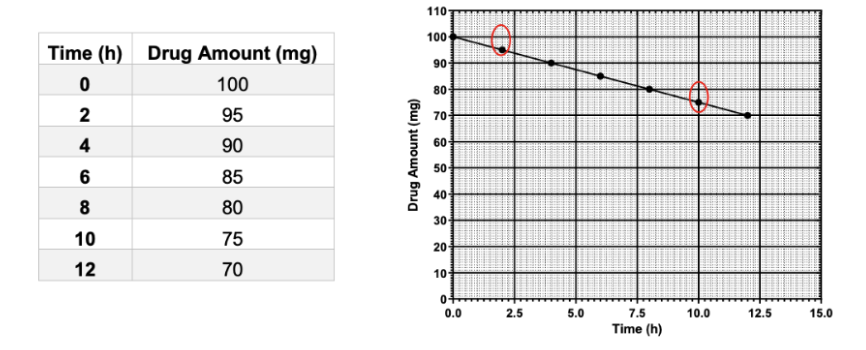
What type of reaction is this?
Zero-Order Reaction
Half-life and shelf-life for Zero Order Reactions
For pharmacists, it may be important to know the time it takes to reach 50% (t50; half-life) or 90% (t90; shelf-life) of the initial drug concentration. The time to reach a certain drug amount or concentration for a drug that follows zero-order kinetics can be determined using the graph above. Alternatively,
𝐴 = −𝐾0𝑡 + 𝐴0 can be rearranged and solved for 𝑡
𝑡50% = (𝐶0 − 0.5𝐶𝑜) / 𝐾0
𝑡90% = (𝐶0 − 0.9𝐶𝑜) / 𝐾0
KNOW
First-Order Reactions
If the rate of a reaction is _______ to the amount or concentration of the drug, then the reaction is a first-order reaction.
𝑑𝐴/𝑑𝑡 = ___1 = −___ where K is the first-order rate constant and is expressed in units of _______
𝐴 = 𝐴0𝑒−𝐾t
C = C0𝑒−𝐾t
ln 𝐴 = −𝐾𝑡 + ln 𝐴0
log 𝐴 = −(𝐾 / 2.303𝑡) + log𝐴0
Therefore, if we plot ___versus time on a linear graph, a straight line will be obtained with a slope of -k/2.303 and Y intercept of ___.
proportional, -KA, -KA, time-1, logA, -K/2.303, logA0

What type of reaction is this?
First-Order Reaction
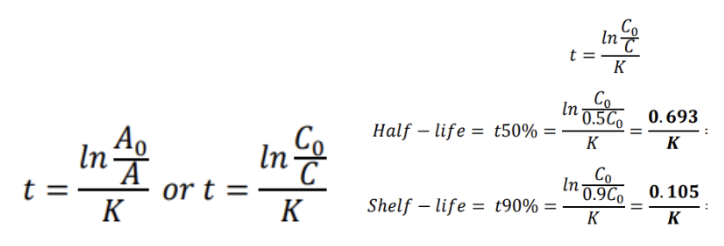
These equations are used in ______ reactions
First-Order

KNOW IMAGE
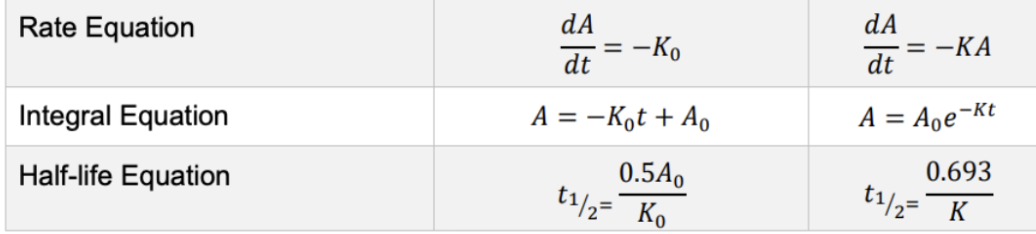
Which one is zero or first order?
Zero-order, First-Order
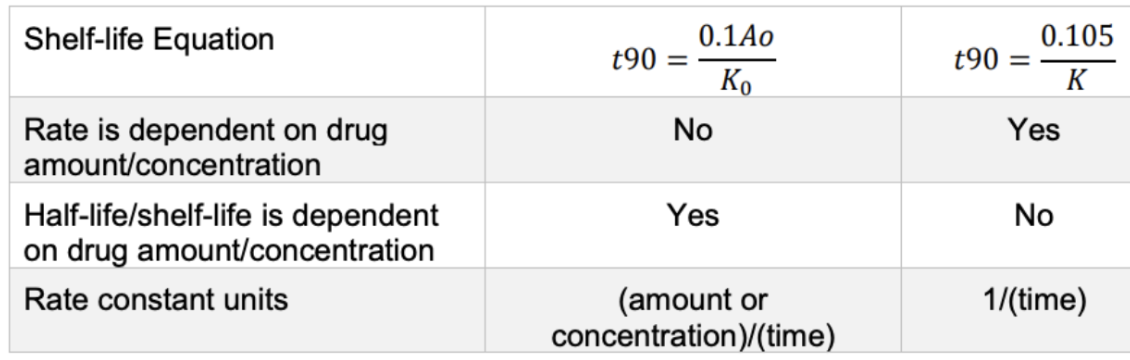
Which one is zero or first order?
Zero-order, First-Order
Driving Forces for Diffusion
______
______
______
Concentration Gradient, Pressure, Electrical Potential
______: The most widely seen driving force for diffusion is the concentration gradient. ______ diffusion relies on a concentration gradient.
Passive diffusion is the process of movement of molecules from a ______ —> ______ concentration w/o expending energy
______ also relies on a concentration gradient: GI lumen can diffuse across the GI barrier and reach the blood circulation
Concentration Gradient, Passive, high, low, Drug dissolution
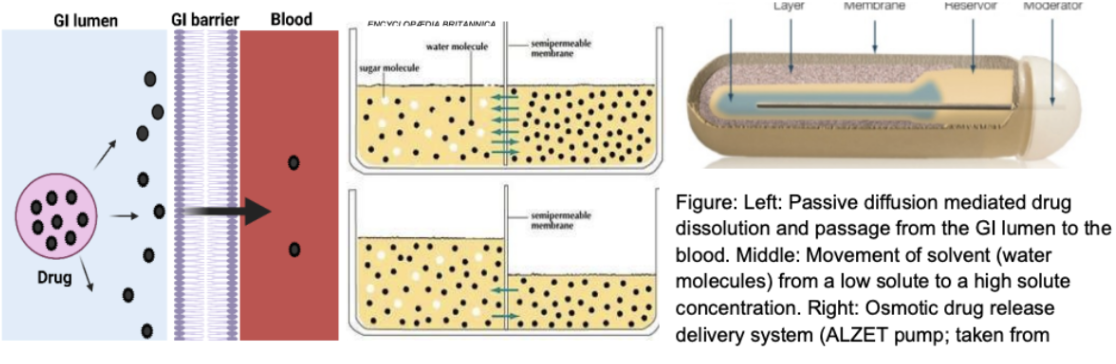
KNOW IMAGE
Pressure: ______ relies on osmotic pressure as a driving force to control the release of drugs. Other drug delivery systems including jets for drug delivery, rely on pressure from compressed air or compression spring for drug delivery.
Osmosis
Movement of ______ (______) across a semipermeable membrane
Direction: ______ solute → ______ solute concentration
No external pressure required
Osmotic Drug Release
Uses ______ to generate pressure for ______ release
Components: ______ (agent), an ______ (with high solute concentration), and a ______
Mechanism: Water ______ → osmotic layer ______ → pressure ______ → drug is ______
Ultrafiltration (UF)
Driving forces: ______
Function: Separates molecules by ______
Outcome:
Small molecules → pass through membrane
Large molecules → retained
Use: Separate ______ drug from macromolecules
Hemodialysis
Purpose: Remove ______ + ______ (renal failure)
Membrane: Semipermeable
Driving forces for Removal of:
Solutes → ______ (______)
Excess Water → ______
osmotic drug release, solvent, water, low, high, osmosis, controlled, drug, osmotic layer, high, semipermeable membrane, water, expands, builds, pushed out, pressure + concentration gradient, size, free, waste, excess water, concentration gradient, diffusion, hydrostatic pressure
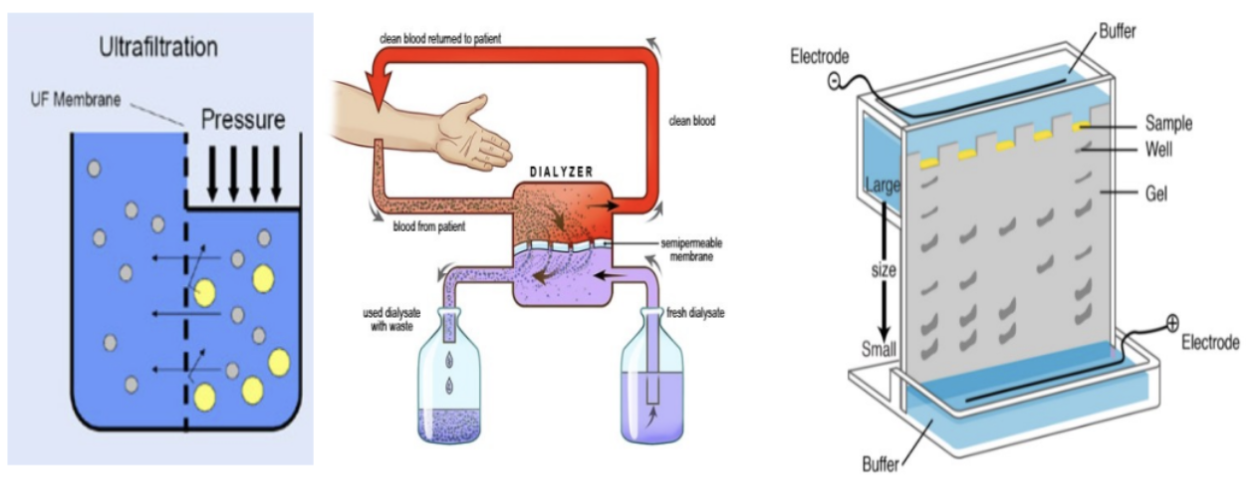
KNOW IMAGE
Electrical potential: Electrophoresis is a technique that utilizes electrical current as a driving force to separate ______ molecules (e.g., proteins, DNA, RNA) on a gel based on the ______ + ______ of the molecule. The ______ acts as a sieve through which the proteins can migrate. The driving force for the migration of the molecules is the applied electric current and the molecules migrate towards the electrode with the ______ charge (______ electrode in this case). Smaller proteins migrate quickly towards the ______ of the gel and the larger proteins migrate slower + stay towards the ______ of the gel.
large, size, charge, gel, opposite, positive, bottom, top
The rationale for direct delivery to lungs for a locally acting drug include:
Advantages:
______ doses
Reduced ______
______ onset of action
______
low, systemic SEs, rapid, self-administered
The rationale for using the pulmonary route for systemic drug delivery includes:
Advantages:
______
______ patient compliance
Pulmonary epithelium is ______, allowing for easy ______
Drugs provide a ______ for drug absorption
______ → ______ proteolytic degradation in the GI tract
Disadvantages:
Deposition in the ______ region
Specialized devices needed
Appropriate device ease by patient
Mucociliary ______
needle-free, increased, thinner, diffusion, large surface area, no first-pass effect, decreased, oropharyngeal, clearance
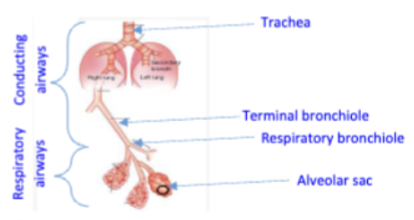
KNOW IMAGE
Which of the following is/are the most appropriate for mucociliary clearance?
The tracheobronchial airways are lined by a non-ciliated epithelium. ______
Cilia are hair-like structures that beat in a coordinated manner to move the mucus towards the alveoli. ______
The cilia increase as we move from the upper airways to the alveolar regions. ______
Mucociliary clearance moves deposited particles from the conducting airways to the oropharyngeal space. ______
Mucociliary clearance is a significant barrier to pulmonary drug delivery. ______
ciliated epithelium, goes to the throat and NOT the alveoli, decreases, true, true
Particle Size | Airways where deposition is likely to occur | Mechanism of deposition |
5-10 μm (larger particles) | ______ | ______ (inability of these large particles to change course of flow while passing through the angulations of the upper airways |
1-5 μm (smaller particles) | ______ | ______ (using gravity sedimentation for ______ airstream velocity seen in the lower airways |
<0.5 μm | ______ | ______ (particles move ______, settle very ______ where the airflow velocity is ______. Very uncommon, particles are generally expelled upon exhalation) |
Oropharynx and upper airways, inertial impaction, smaller bronchioles and alveolar regions, sedimentation, low, alveolar region, brownian diffusion, randomly, slowly, lower
Which of the following is/are the most appropriate for pulmonary drug delivery devices?
Both the pressurized metered-dose and dry powder inhalers have the medication under pressure. ______
Depression of the canister into the actuator is the mechanism of drug aerosolization and release for a dry powder inhaler. ______
Pressurized compressed air is the mechanism of aerosolization for jet nebulizers. ______
High-frequency vibrations are used for drug aerosolization while using a pressurized metered-dose inhaler. ______
Spacers eliminate the need for coordination of inhalation and actuation while using dry powder inhalers. ______
false, false, true, ultrasonic nebulizers, PMDI
Which of the following is/are the most appropriate for nasal drug delivery?
Nasal drug delivery is used only for local (nasal) drug delivery. ______
The nasal vestibule is the primary area of drug absorption in the nasal cavity. ______
The olfactory region is the largest region in the nasal cavity and is the most important for nasal drug delivery. ______
The nasal vestibule connects to the CNS via the trigeminal and olfactory nerves. ______
also for systemic and CNS, least important and not rich in blood supply, olfactory is 10% of the nasal cavity, nasal cavity
Which of the following is/are the most appropriate advantages of nasal drug delivery?
Increased surface area for drug absorption compared with the pulmonary or the oral route. ______
No interference of mucociliary clearance. ______
Small doses are needed for local nasal effects. ______
Protection against first-pass hepatic metabolism and degradation by systemic proteases. ______
Higher patient compliance than the parenteral route of administration. ______
disadvantage, there is an interference and it’s a disadvantage, True, True

KNOW IMAGE
Pressurized metered-dose inhalers (pMDIs):
Advantages:
______
______
______ for many medications
______ needed
Hard to ______
Disadvantages:
Delivery is dependent on the ______
______ not available for all devices
Need to ______ before use
Results in ______ of the medication (only 10-20% of the labeled dose is deposited in the lungs)
______ are needed
______ is needed and inhalation-______ coordination needed
portable, quick delivery, available, no drug prep, contaminate, technique, dose-counter, shake and prime, high oropharyngeal deposition, propellants, breath-holding, actuation
Dry powder inhalers (DPIs):
Advantages:
______
______ available on most devices
______ for many medications
______; no inhalation and actuation coordination needed
______
Disadvantages:
Since breath-actuated, delivery depends on the ______ —> ______
For ______ devices, medication has to be loaded before use hence not suitable for ______
Some devices are ______
______ allergy
Portable, dose-counters, available, breath-acutuated, propellant free, inspiratory flow, age limitation, single-dose, emergency use, susceptible to moisture, lactose
Nebulizers:
Advantages:
Easy to use as they do not need ______ and ______ coordination or breath actuation
______ can be delivered
Suitable for ______
Disadvantages:
Treatment ______
Relatively ______
Frequent device ______
More ______ than inhalers
inhalation, actuation, large doses, all ages, times are longer, less portable and bulkier, cleaning, expensive
What is the rationale for using a spinning disc in a ______ inhaler?
The spinning disc is used for ______ (breaking up particles) or deagglomerate from the ______ turbulence.
dry-powdered, deagglomeration, inspired air
Which of the following is/are the most appropriate about targeted drug delivery?
The aim of targeted drug delivery is to deliver the therapeutic to the healthy cells. ______
Targeted drug delivery minimizes drug-related adverse effects. ______
The aim of targeted drug delivery is to deliver the therapeutic to the diseased cells. ______
Targeted drug delivery protects target cells from drug exposure. ______
diseased cells, True, True, non-target cells
Which of the following is/are the most appropriate regarding the barriers to drug delivery?
The first barrier to drug delivery after intravascular administration is the diffusion across the extracellular matrix to reach the target site. ______
The endothelial cells lining the blood vessels rarely impact drug delivery to the target site. ______
Drugs taken up by endocytosis can be subjected to endosomal degradation or entrapment, which increase drug delivery to the target cell. ______
Once in the blood circulation, therapeutics can be degraded by proteases and nucleases. ______
endothelial barrier, mostly impacts, decreases drug delivery, True
Which of the following is/are the most appropriate for passive and active drug targeting?
Passive drug targeting involves the use of a targeting ligand to increase localization and retention of the drug at the target site. ______
The enhanced permeation and retention (EPR) mechanism results in the accumulation of small molecules at the target site. ______
Passive drug targeting mechanisms include EPR, which relies on increased vascular permeability, and reduced lymphatic drainage with disease, to retain drugs at the target site. ______
Active drug targeting is more cost effective compared to passive drug targeting due to ease of conjugation of a targeting ligand. ______
Active, large molecules, True, Active is more complex and less expensive than passive
Small molecule targeting ligands | Large molecule targeting ligands |
Smaller molecular weight ______ kDa | Large molecular weight (e.g., Abs have a MW of ______) |
______ compared to large molecules used for drug targeting. Easy to ______ | Ab manufacturing is ______ Peptides can be engineered ______ |
______ from the blood circulation | Since Abs + peptides are larger in size, these have a ______ circulation time in the body. |
Small molecules have ______ interactions with their targets | Abs + peptides interact with their antigens or receptors with ______ |
Immune response is ______ | Abs → ______. Peptides → ______. |
Increased ______ within the target tissue due to small size | Abs are large in size (150kDa), which limits their ______ within the target tissue. |
E.g., ______ , galactose | E.g., Abs (antibodies) + peptides |
<1, easy to manufacture and cost-effective, conjugate, rapidly cleared, weak, not an issue, diffusion and distribution, folic acid, 150 kDa, more complex and expensive, more easily and are less expensive, longer, higher affinity and specificity, triggers an immune response, non-immunogenic, diffusion
Which of the following is/are the most appropriate regarding endosomal entrapment and escape?
Endosomal pH increases as we move from the early endosome to the lysosome. ______
Therapeutics are degraded in the lysosomes. ______
Release of endosomal contents into the cytosol is known as endosomal entrapment. ______
Effective endosomal escape is critical to effective drug delivery. ______
pH decreases, True, lysosome, True
You develop an antibody-drug conjugate (ADC) for brain drug delivery by conjugating the drug with an antibody targeting a receptor expressed on the BBB. You notice that the ADC is binding to the receptor, is taken up onto endosomes, but is not released within the cytosol. Which of the following is/are the most appropriate for the condition described above:
The ADC may be subjected to endosomal entrapment. ______
Redesigning the ADC to include polymers with a buffer capacity can increase endosomal escape by decreasing the endosomal pH, increasing water efflux from the endosome, and shrinking the endosome. ______
The ADC may be degraded within the lysosome. ______
Redesigning the ADC to include polymers with a buffer capacity can increase endosomal escape by preventing a decrease in endosomal pH, increasing water influx into the endosome followed by swelling and bursting of the endosome. ______
True, water influx and rupturing, True, true
Small Molecule: a ______ with a molecular weight less than 1000 Da (1 kDa).
Endosomal escape: the release of the therapeutic from the ______ compartment into the ______
Active: a drug targeting approach that uses targeting ______ to localize the drug at the target site
Passive: a drug targeting approach that relies on increased ______ and ______ under certain pathological conditions
Blood-brain barrier: the ______ lining the blood vessels of the brain
Targeted: a drug delivery approach to ______ the drug to the site of action to minimize off-target SEs and exposure
targeting ligand, endosomal, cytosol, ligands, blood vessel permeability, reduced lymphatic drainage, endothelial layer, direct
Which of the following is/are the most appropriate about radioactive decay?
α particles are negatively charged. ______
With respect to ionizing capacity: α particles > β particles > γ rays ______
With respect to penetrating capacity: α particles > β particles > γ rays ______
α particles can cause the greatest harm even when present outside the body. ______
Beta, true, Opposite, gamma (alpha is more harmful inside)
Positron Emission Tomography (PET) | Single Photon Emission Computed Tomography (SPECT) |
Uses ______ emitting radioisotopes | Uses ______ emitting radioisotopes |
Have ______ radioactive half-life | Have ______ radioactive half-life compared to PET isotopes |
Very ______half-life → ______ PET radiotracers very ______ | Comparatively ______ because an ______ is not needed |
______ contrast + spatial resolution than SPECT | ______ contrast + spatial resolution than PET |
E.g., ______ | E.g., ______ |
positron, shorter, short, onsite cyclotron making, expensive, better, 18F, gamma rays, longer, cheaper, onsite cyclotron, poorer, 123I and 99mTc
Which of the following is/are the most appropriate while using radiopharmaceuticals for therapy?
Targeted radiotherapy delivers high energy radiations from outside the body to the primary tumor site. ______
γ rays are the preferred radionuclide for targeted radiotherapy. ______
Targeted radiotherapy is designed to target the diseased cells specifically to leave the healthy cells intact. ______
Targeted radiotherapy is mainly administered by the IV route of administration. ______
External Radiation Therapy, not preferred bc it increases penetration capacity, True, True
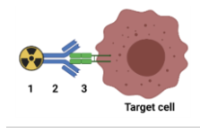
Identify the 3 components of a radioimmunotherapy:
1:
2:
3:
Radioisotope, Targeting Ligand/Ab to take the radioisotope to the target cell, Target receptor/antigen (spares the healthy cells)
Radionuclide: species of the ______ that have ______ in their ______
Radiopharmaceutical: a molecule that consists of a ______ attached to a pharmaceutical for ______ in humans for ______
Radiopharmacy: a specialty area of pharmacy practice dedicated towards safe and effective use of radiopharmaceuticals
Radioactive Decay: the process of ______
Radioactive Half-Life: the time it takes 50% of the ______ to undergo ______
Curie: the basic unit of ______
same element, excess energy, nucleus, radioisotope, safe use, diagnosis or therapy, shedding radiation, unstable atoms, radioactive decay, radioactivity