Lecture 6: Detoxification
 Call Kai
 Learn
Learn Practice Test
 Spaced Repetition
 Match
Match Flashcards
 Knowt Play
1/37

There's no tags or description
Looks like no tags are added yet.
Name | Mastery | Learn | Test | Matching | Spaced | Call with Kai | Chat |
|---|
No analytics yet
Send a link to your students to track their progress
38 Terms
what is detoxification?
To improve the safety of different foods and crop species
what are the risks in all kinds of food?
All eating include certain risks:
- Contamination by microorganisms: Bacteria, fungi, viruses, nematodes
- Contamination by chemicals: Herbicides, insecticides, fungicides, Heavy metals, salts, organic substances
- Endogenous production of harmful substances: Diverse organic substances, Allergenic proteins, Non-healthy lipids
how can the risk of contamination by microorganisms be adressed with biotechnology?
- Better pathogen tolerance—> Less toxins (from bacteria and fungi)
- Better storage properties—> Less toxins (from bacteria and fungi)
how can the risk of contamination by chemicals be adressed with biotechnology?
- Reduce chemical use (herbicide resistance, Bt)
- Introduce activities that metabolize or block the chemical
- Introduce activities that block chemical uptake in the plant
name some harmful endegenous (“natural”) substances produced by plants?
- Thousands of toxic chemicals have been identified in plants
- Alkaloids, secondary metabolites
- Fatty acids (e.g erucic acid), trans-fatty acids (formed during processing) and lipids
- Proteins and peptides
- Various pigments
- Phenolic compounds
- Allergens
- Other biologically active substances
how come we are not regularly poisoned?
- Life experience
- GRAS (Generally Regarded As Safe)- A system of evaluating what foods are safe to eat (regulated by the American Food and Drug Administration – FDA)
explain GRAS. What is the EU equivalent?
GRAS= Generally Recognized As Safe, a US Food and Drug Administration (FDA) designation for chemical additives or substances added to food.
- A chemical or substance added to food that is considered safe by experts.
- If a food has been a familiar component of the human diet for some time without any known adverse effects:
- ”Substantial equivalence” to already known plants—> The starting point to achieve GRAS status in the US- it is enough that the “new” food is substantially alika another already accepted species- After that, possible problems can be defined by comparison to the already accepted species and eliminated. —> basically trial and error process where the food that has been successfully introduced and accepted without reppercusions is allowed- but also if a new food is similar enough to one of these it is allowed from the beginning as well.
EU Novel Food Regulation (equivalent to GRAS) has more strict requirements (compared to the FDA)
what are some products of classical breeding that are potentially harmful- does the GRAS system and traditional breeding mean that they are harmless because they are natural?
- Potatoes- Glycoalkaloids, e.g. solanine (neurotoxin), lectins- these chemicals are why we do not eat green parts of potatoes- other types of changes in potatoes (through plant breeding for instance can inedvertadly cause an increase in these)
- Celery- Psoralen (skin rashes, carcinogenic)
- Carrots- Produce Nerve poison, hallucinogens in small amounts
- Nuts- Allergenic substances, aphlatoxins (carcinogenic)
- Kiwi / Strawberries- Allergenic substances
- Wheat and other cereals- Gluten (causes celiac disease), lectins
—> sometimes variations of these compounds among new strains of species can cause spikes in these poisonous chemicals through classical plant breeding- but because of the new variations similarity to the traditional species they do not need to be tested before commercialisation and can quickly become available on the market- and consequences of the toxins are first discovered when people actually get sick from it.
give three examples of harmful substances that have/can be reduced by breeding
- Erucic acids: Rape seed (40-60% to ca. 0.2% in present varieties)- seen that these cause heart disease in rats (however these symptoms are not directly translated in humans)- Present in Canola (Canadian Oil Low Acid)
- Glycoalkaloids (α-solanine, α-chaconine)- Below 0.2 mg/g. However, induced by high light and pathogens and can then reach dangerous levels- Potato, tomato, eggplant
- Cyanogenic compounds- compounds that have as an active part of it cyanide- extremely potent toxin- the levels have been bred down over long time (through traditional plant breeding) making the levels in potatoes safe- Potato
what are cyanogenic glycosides? what species have them?
toxic when ingested
Species synthesise these cyanogenic glycosides
Many important crops are cyanogenic, including sorghum, almond, barley, lima beans and white clover, cassava- a lot of these have been extensively bred to lower the concentration of these- however still present
which crop containing cyanogenic glycosides, is the most agronomically important?
The agronomically most important cyanogenic crop (with significant levels still present in the plant) is the tropical root crop Cassava (Manihot esculenta, Crantz)
- Over 153 million tons of cassava root are harvested annually in the tropics, primarily for human consumption
- The most abundant kind of cyanide in cassava is the group linamarin. However there are four major groups that are all synthesised in different degrees in different cassava species.
what importance does cassava have? what is it used for, where?
Cassava= Third largest source of starch in the tropics and sub-tropics (after rice and maize)
- More than 0.5 billion people globally use Cassava as their main source of carbohydrates => staple food (main source of calories in diet)
- Africa, South America and SE Asia are the largest centres of production (nigeria- the largest producer)
- Substitute for potatoes and grain flour- Tapioca (dried powdery or pearly extract), Garri (fermented, flaky form)
- Also used as a thickening agent (soups, sauces, stews)
what are the advantages with cassava as a food source?
Can endure tough environmental conditions- grow quite well in poor soils (nutrient poor) and has good recovery from damage by pests and disease (can survive extensive periods of drought and heat) etc
- Average harvest is 9.6 tonnes per hectare worldwide and 7.7 tonnes per hectare in Africa (still very good compared to cereals like maize because of the harsh environment and nutrient poor soil- if they were to try and plant other crops it would result in lower yield due to the conditions)
- Produced mainly by small farmers- suitable because it is very easy to grow
- Rich in carbohydrates, vitamin C, carotenes, minerals (Ca2+ and K+) However, contains very little protein. No gluten
- Consumed in various forms - boiled, baked, fried, and as flour
what kind of cyanoglucoside is most common in cassava. How does it work?
Cassava roots contain significant levels of cyanoglucosides:
- Linamarin most abundant
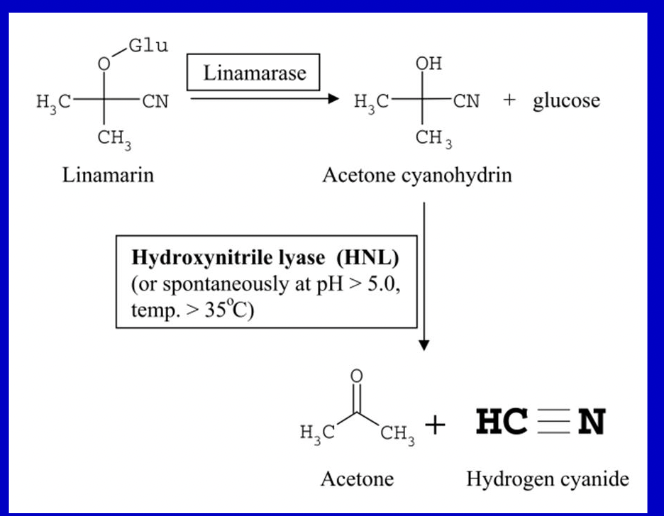
- Upon chewing or processing, root enzymes beta-D-glucosidases (e.g. linamarase) are released, which hydrolyse the sugar and free the cyanide in the linamarin cyanoglucosides- toxic
- if the root is eaten raw and the cell walls break it causes cyanides to be released/synthetisised in sometimes lethal amounts
- Different varieties of Cassava contain different amounts of cyanoglucosides- some have very low and others very high
Sweet and bitter:
- Sweet contains less than 20 mg/kg fresh roots. Bitter can contain more 50 times as much.
- One dose of pure cassava cyanogenic glucoside (40 mg) is sufficient to kill a cow
what is konzo?
a disease related to cassava cyanides.
- An upper motor neuron disease of sudden onset due to large intakes of cassava cyanide over a fairly short period- affect nervous system particularly in the upper body- due to large consumption of cassava cyanogenic compounds during a short amount of time- burst of cyanogenic compounds in the body
- General symptoms include deafness, blindness, aggravated goitre, paralysis of arms and cranial nerves, and acute cyanide
- intoxication which appears 4-6 h after consumption and consists of vomiting, collapse and in some cases death
- An irreversible paralysis of the legs that occurs mainly in children and women of child-bearing age
when does konzo increase? why and to what group mostly?
Epidemics may occur as a result of drought and war
- Endogenous levels go up in drought
- Optimal preparation not possible during war
- Affect mostly the most vulnerable- children and women. Most common among children- permanent ie irreversable paralysis
- During drought- synthesis of cyanogenic compounds in cassava increases- this in combination with associatied societal problems such as war and starvation cause insufficient preparation of the root (eating it raw for instance due to lack of time and resources- desperation) has caused major epedemics of Konzo.
what is Tropical ataxic neuropathy (TAN):
a disease related to cassava cyanides
- Occurs mainly amongst older people who have consumed a continuous cassava diet over many years
- Typical symptoms are unsteady walking, blindness, deafness, weakness and loss of feeling in hands and feet
- TAN is common in West Africa (particularly Nigeria), Tanzania, Uganda, Kenya, the West Indies and tropical Asia.
- Garri (the most popular form of processed cassava in Nigeria) has an average total cyanide content of 15-20 ppm
Many people who eat cassava do not get sick. Why? And why do they continue eating it?
- The food can be made relatively safe- mainly through experience- they have eaten cassava for hundreds of years and learned how to prepare it through generations- women have the knowledge of how the root should be prepared (and hence detoxified)- the knowledge is passed on between the women and usually there are not major outbreaks of the poisonings- only under certain conditions these breakouts happen- often due to other factors such as civil war
- The women know how to sufficiently prepare the root
- Female growers are familiar with the degree of toxicity of different cassava varieties
- They also know how to detoxify the roots before processing (e.g. flour)
- Cyanide consumption therefore occurs mostly in areas of deep poverty and food shortage
- Less stringency in the traditional methods when hunger persist
what is the classical detoxification of cassava? what are the downsides to the different techniques
- Prolonged cooking of roots to degrade the cyanides: Sometimes difficult to find wood. Often insufficient- it needs to be boiled for a very long time and with lack of wood this can be insufficient for detoxificaiton.
- Crushing, grinding and drying is an effective detoxification method- especially compared to the more unreliant boiling method:crushing the cassava cause the Cyanides to be converted to HCN- which then evaporate when cooking
- Mixing cassava flour to a thin dough and leaving in shade for 5 hr- Can reduce cyanide content 3-6 fold. —> However, Needs knowledge- and is practiced only in some cultures
- Fermentation: Reduced cyanides and increased protein content- Needs knowledge and is very bound by tradition
Transgenic strategies to reduce cyanide compounds—> Two principally different ways are possible which?
– Increase metabolism or breakdown of the cyanides
– Decrease biosynthesis of the cyanides
explain how the cyanide metabolism look like in cassava, why is traditional breeding less efficient potentially than biotechnology?
- The pathway of the metabolisation is known- induced by two enzymes: linamarase and hydroxynitrile lyase. The HNL enzyme (crusial for metabolisation of the cyanogenic compounds) are only present naturally in the leaves and not in the roots causing the metabolisation to not take place in the roots naturally (hence cyanide accumulating in the roots- toxic)- the cassava plant is somewhat difficult to breed however and therefore make modification through traditional plant breeding difficult.
- Acetone cyanohydrin is broken down by the cassava enzyme hydroxynitrile lyase (HNL)- However, HNL is only expressed in leaves
- Cyanide toxicity of cassava food products can be reduced by expressing HNL in the roots of transgenic cassava
Cassava normally produces few seeds and has a long life-cycle (one year seed-to-seed). Therefore difficult to use traditional breeding and selection strategies to identify plants expressing HNL in roots—> therefore gene technology could be very beneficial
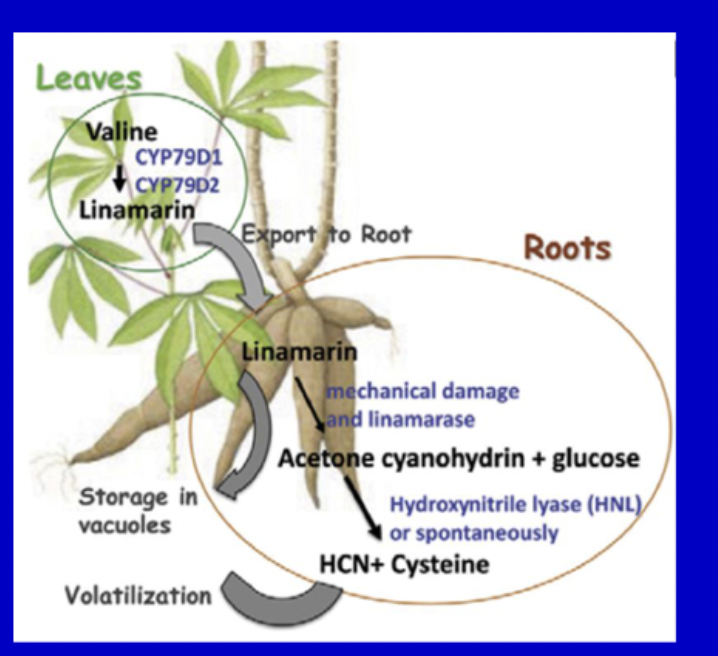
how has cassava been transformed to increase cyanide metabolism- explain very short, what gene was used and what was the outcome?
Agrobacterium was used to transform a cassava cDNA (version of a gene that encodes HNL) encoding HNL into somatic embryos to produce transgenic cassava plants:
- HNL activities in transgenic plants doubled in leaves and increased the HNL amounts 13 times in roots.
- Another benefit with the transformation was that: Since HCN (hydrocyanide gas) was produced and released (as the rest product in the metabolization process) these plants were more resistant to diverse pathogens than acyanogenic cassava
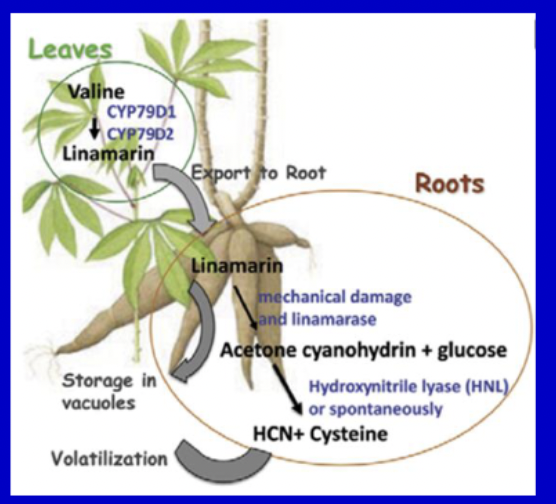
how can detoxification of cyanogenic crops occur by decreased cyanide biosynthesis? what method is used? what gene is inhibited in cassava and why?
Approach that use antisense.
Antisense= method where expression of certain gene is inhibited- you can essentially eliminate the expression of entire genes. Goal in the transformation was to use selective inhibition of CYP79D1/D2 gene expression- using antisense technology
- CYP79D1/D2 enzymes catalyze the first step in cyanogen synthesis
- Tissue-specific inhibition of CYP79D1/D2 expression in leaves leads to 99% reduction in root cyanogen levels, indicating that the cyanogenic glycoside, linamarin, is synthesized in leaves and then transported to the roots where they accumulate
- antisense techniques is used to eliminate the expression of the genes in the leaves which inhibit the synthesis of the enzymes and almost completely eliminated all cynaogenic compounds in the roots→ extremely successful
what are the major obstacles for GM cassava commercialisation?
the GMO brand inherently bring a range of obstacles- need support from government with financial support and most difficult- overcome regulatory obstacles- in Africa the anti GM legislation is extremely strict- and various types of regulations need to be overcome and the crop need to be accepted in the society which could be very difficult due to widespread public concerns
- Financial: Governmental or private capital needed
- Regulatory: Regulations for GMOs have to be in place
- Acceptance: Politicians have to make decisions- Heavy lobbying against from NGOs, Corruption.
- The transformation cannot interfere with traditions: Color, smell, taste, etc can not be altered because of long lived food traditions.
why is it that many farmers still want to grow the cyanogenic cassava, despite the risks?
- Many people grow the most toxic variety of the cassava. This because the crop was so toxic that the root is lethal to eat raw- prohibiting apes, unknown men and other animals to steal and eat the crop. Because the knowledge of the preperation of the root is passed down among generations of women- the women hold a lot of power over the food.
—> Because the roots are inedible without processing this keeps apes, wild boars and other thieves away. In addition, this also prevents other family members from chewing them when they are not supposed to
—> Women get the controlling power of food and can decide when to harvest. Since they can detoxify the roots, they prefer it this way
what does castor bean contain, what is it used for?
Castor bean: Crop grown not for human consumption- rather a product used in extraction of oil used in manufacture.- the oil has high levels of ricinoleic acid (ricin).
- Castor oil extracted from seeds is a valuable export crop (high proportion of ricinoleic acid)
- Used in the manufacture of lubricants, plastics, soaps, pharmaceuticals, cosmetics, paints, dyes, varnishes, ethanol and biodiesel
- Major producers are India, Mozambique, China and Brazil
what is ricin? explain dangers etc?
the oil extracted from the castor bean (bla) contain the toxin ricin.
- Seeds of castor plants produce the highly potent toxin Ricin (storage protein 7S lectin)
- Type-2 ribosome-inactivating protein (blocks protein synthesis)
- Very toxic when inhaled, ingested or injected (Symptoms vary depending on type of exposure, hours to days to appear)
- Severe gastrointestinal bleeding, multiple organ failure, death!
- Significant risks for farmers and industrial workers harvesting and processing castor beans
- Danger to livestock when used as animal feed (castor cake- made from the rest products from the oil extraction? Contain a certain amount of ricin and be toxic)
what was the markov assasination
: ricin has been used as poison. Georgi markov was assassinated through injection of ricin by jabbing him with the top of an umbrella.
explain how detoxification of ricin in castor bean can be performed- who are the main beneficiaries of the detoxification?
Genome sequencing of castor bean revealed the ricin gene family (8 genes)
- Sequenced the entire genome of castor bean- could identify 8 genes encoding for the ricin synthesis: multigene family of eight makes it very difficult to modify and knock out the expression of all the genes.
- They found that not all, but some of the transformants where modified successfully
- Recent study (2017) used the RNAi approach to silence the ricin-encoding genes in castor bean seeds- (By designing the transgene to match a highly conserved region shared by multiple family members, a single RNAi construct can induce silencing across the entire family.)
- Ricin was undetectable in several of the transformed lines in the F1 generation- Protein extracts from the transformed lines had no effect on laboratory mice when injected (NT – wild type control)
- Even though the plant itself is not eaten- the plant can be made much safer for the farmers as well as the personell involved in the oil extraction and overall handling of the crop.
what are food allergies? what is “the Big Eight”?
: Immune response against certain components in food
- The allergen is usually a protein or protein fragment (peptide)
- Wide range of foods that can cause an allergic response
- Milk, eggs, wheat, tree nuts, peanuts, soy, seafood, shellfish: “The Big Eight” (the eight most common food to cause allergic reactions)
what is gluten? what is it used for
A composite protein present in many cereal grains (wheat, barley and rye, but not oats and maize):
- Gluten intolerance- by far the most common intolerance that occur in our society
- Wheat gluten enhance properties
- Gluten enhances certain baking properties (especially for bread)- the Elasticity increase in the dough and increase rising properties- making the bread fluffy and less dense
- Gluten is also added in other food as a stabilizing agent such as beer, ice cream, ketchup. Also used as imitation meat (vegetarian meals)
how common is gluten intolerace, what are the symptoms? how many have celiac disease?
: About 1% of the population eating wheat products have symptoms of gluten intolerance (GI)
- Irritable bowel, abdominal bloating, excess gas formation, vomiting, diarrhea, migraine, joint pain
- About 0.1% (1/10 of the people having gluten intolerance) have developed celiac disease (CD) at different stages
what is celiac disease?
Celiac disease (CD): Autoimmune disorder of the small intestine
- Microvilli in the small intestine (where the main absorption of nutrients take place) are irritated by an autoimmune response to the gluten and cause the microvilli to die -making the nutrient absorbtion insufficient- cause symptoms of starvation
- Symptoms triggered in genetically predisposed individuals by abnormal immune response to ingested wheat gluten proteins (gliadins)
- Clinical symptoms: Failure to thrive, Weight loss, Growth retradation, Weakness, GI symptoms, Skin rash (Dermatitis herpetiformis), Neurological symptoms
what is gliadin?
- Gluten is a composite of the two seed storage proteins Gliadin and Glutenin in association with starch (prolamins)
- It is the immune reaction to gliadin that causes GI and celiac disease- gliadin is the protein in gluten that cause reactions
The aminoacid sequences mostly responsible for the Autoimmune response and GI in the Gliadin have been identified
is the reduction of gluten in wheat possible through traditional breeding?
- Very hard to breed for low gluten wheat: Several different gluten proteins
- Reduction in gluten compromises baking properties: CO2 is not trapped
- Difficult to completely avoid gluten: Oats and other gluten-free food often contaminated
- The gluten levels in wheat have already been reduced (compared to the wild type) however only to a certain extent since we actively aim to preserve the properties of wheat gluten
how can gluten-reduced wheat be engineered?
research has been made in order to lower gluten levels in wheat. Wheat has been transformed with RNAi technique was used to suppress the expression of the DME gene (inhibiting the enzyme responsible for the expression of the gliadins and glutenins in the seed endosperm)
- Suppress the expression of the Demeter (DME) gene by RNA interference
- DME encodes a 5’-methylcytosine DNA glycosylase responsible for expression of gliadins and glutenins in the seed endosperm
- results: 76% reduction of gluten in wheat seeds- impressive but still not enough- people with celiac disease will still probably react to these levels
can gluten be completely eliminated from wheat?
no.
using techniqes to inhibit genes in crops is only successful if the complete inihbition of the gene lead to decrese in the viability of the plant- ie if the gene has other vital functions to the survival of the crop- you can not completely knock out that gene- wheat is one example of this—> gluten is needed to some degree for the crops viability