pH and pKa
 Call Kai
 Learn
Learn Practice Test
 Spaced Repetition
 Match
Match Flashcards
 Knowt Play
1/16

There's no tags or description
Looks like no tags are added yet.
Name | Mastery | Learn | Test | Matching | Spaced | Call with Kai | Chat |
|---|
No analytics yet
Send a link to your students to track their progress
17 Terms
dissociation of water
molecules of water or H2O can disassociate into a negatively charged hydroxide ion represented by OH- And a positively charged hydrogen ion or proton represented by H+.

The dissociation constant of water
K_w is defined as the concentration of hydroxide multiplied by the concentration of H+ divided by the concentration of H2O.
The value of K_w is a constant that describes the ratio of hydroxide ions, hydrogen ions and water at equilibrium.

pH and pOH Derivation
Here is the same equation from the previous slide but the sides are switched, before computers were available to do complex calculations, the log system was used for simplicity.
Taking the minus log of each term in the equation leads to the equation minus the log of the hydroxide concentration, plus the log of the proton concentration equals 14.
To simplify things even more, the minus log of the hydroxide concentration was called pOH. And the minus log of proton concentration was called pH.
Substituting in pOH and pH into this equation leads to the simplified equation stating that the sum of pH and pOH equals 14.

definition of pH

To simplify things even more, the minus log of the hydroxide concentration was called pOH. And the minus log of proton concentration was called pH.
Substituting in pOH and pH into this equation leads to the simplified equation stating that the sum of pH and pOH equals 14.
pH Scale and Acidic/Basic Solutions
This graph provides a visual representation of the relationship between the concentration of OH- represented by the red line, and the concentration of H+ ions represented by the blue line, and the pH on the X axis.
At a relatively low pH such as three, the concentration of protons is high and the concentration of hydroxide ions is low, this is considered an acidic solution.
At a high pH such as 11, the concentration of hydrogen ions is low and the concentration of hydroxide ions is high, this is considered a basic solution.
A solution at pH seven, when the concentration of hydrogen ions and hydroxide ions are equal is considered neutral in terms of pH.
Acid and Base Forms of Biomolecules
Biomolecules like the nitrogenous based guanine shown here can contain chemical groups that can be protenated or deproteinated.
protenated form (left) is acid, can act as a proton donor.
deprotenated form (right) is base, can act as proton acceptor.
A proton can be considered a ligand that binds to base form of a molecule to generate the acid form of the molecule.
The dissociation constant for the acid, or Ka is a constant, describes the ratio of acid and base forms present at equilibrium. The Ka is equal to the product of the concentration of the base and the concentration of the protons divided by the concentration of acid.

Ka

a constant that describes the ratio of acid and base forms present at equilibrium. The Ka is equal to the product of the concentration of the base and the concentration of the protons divided by the concentration of acid.
A proton
can be considered a ligand that binds to the base form of a molecule to generate the acid form of the molecule.
The dissociation constant for the acid
or Ka is a constant that describes the ratio of acid and base forms present at equilibrium.
The Ka is equal to the product of the concentration of the base and the concentration of the protons divided by the concentration of acid.
Henderson-Hasselbalch Equation
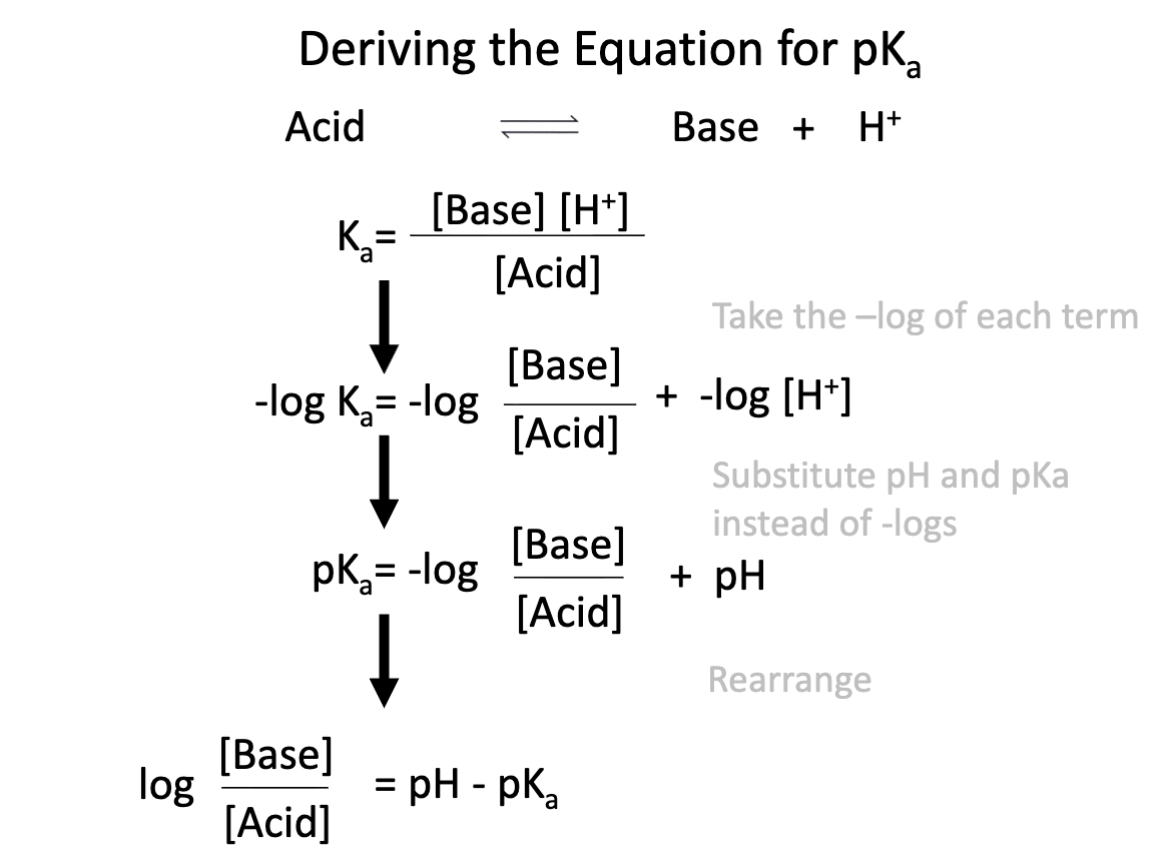
Again, for the simplicity of calculation, the log system was used, taking the minus log of each term and substituting the log terms with pH and pKa yields the equation for pKa.
A helpful rearrangement of this equation shows that the log of the concentration of the base divided by the concentration of the acid is equal to pH-pKa.
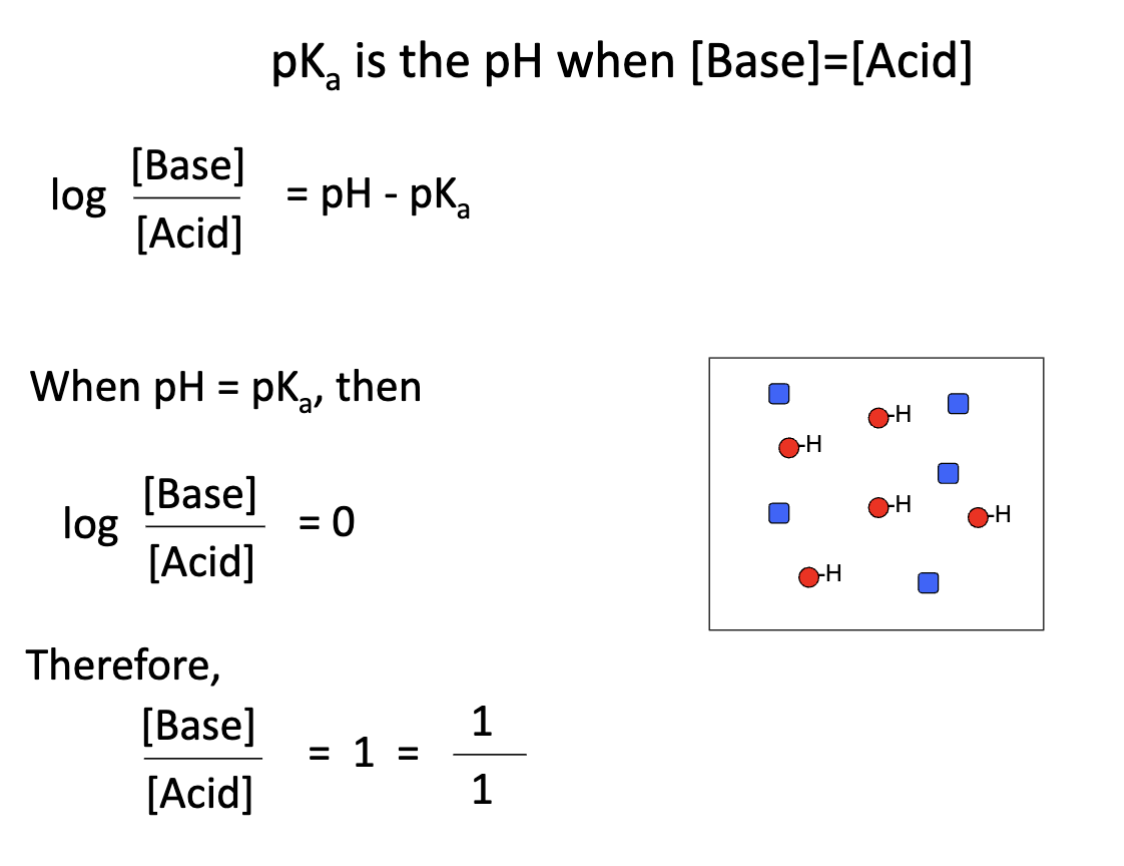
This equation makes it easy to see how the relationship between pH and pKa affects the ratio of the base to acid. When pH equals pKa, then the log of the concentration of the base divided by the concentration of the acid equal zero. The log of one is zero, so the ratio of based asset is equal to one or 1 to 1.
This calculation shows that the pKa is the pH and the concentration of the base is equal to the concentration of acid in a population of molecules. This can be visualized in the form of a panel, the base is represented by blue squares, and the acid is represented by red circles. Note that the water molecules and free protons, which are also present in solution, are not represented in this pane

dissociation of water derivation

Definition of pH

pH and Ion Concentration

Acidic and Basic Forms of Biomolecules

Deriving the Equation for pKa
pKa is the pH when
[Base]=[Acid]