Opioids
 Call Kai
 Learn
Learn Practice Test
 Spaced Repetition
 Match
Match Flashcards
 Knowt Play
1/25

There's no tags or description
Looks like no tags are added yet.
Name | Mastery | Learn | Test | Matching | Spaced | Call with Kai | Chat |
|---|
No analytics yet
Send a link to your students to track their progress
26 Terms
Differentiate between Narcotic, Opiate and Opiod
Narcotic
a drug with addictive properties that can produce analgesic and sedative effects.
Opiate
a drug naturally derived from opium (morphine and codeine)
Opioid
a drug, natural or synthetic, with morphine- like qualities
List the indications for opiods
Indications for Opioids
Analgesic
Anesthetic
Antitussive
Antidiarrhea
List the Strong Opioid Agonists
List the Moderate Opioid Agonist
List the Combination Meds
List the Weak Opioid Agonists
Other?
List the Mix Acting opioids
List the Opioid Antagonists
Strong Opioid Agonists
Fentanyl (Sublimaze, Duragesic)
Alfentanil, Remifentanil, Sufentanil
related to Fentanyl but use for anesthesia
Hydromorphone (Dilaudid)
Meperidine (Demerol)
Methadone (Methadose, Dolophine)
Morphine sulfate (MS Contin)
Oxycodone (Oxycontin)
Heroin
Moderate Opioid Agonists
Codeine (Robitussin AC)
Hydrocodone
Combination Meds
Tylenol #2, 3, 4
(acetaminophen/codeine)
Vicodin, Lortab
(acetaminophen/hydrocodone)
Vicoprofen
(ibuprofen/hydrocodone)
Percocet
(acetaminophen/oxycodone)
***class II schedule***
Weak Opioid Agonists
Loperamide (Imodium)
Diphenoxylate – (Lomotil)
Combined with atropine
Propoxyphene (Darvon)
Combined with acetaminophen
marketed as Darvocet
(acetaminophen/propoxyphene)
Dextromethorphan (Delsym, Robitussin DM)
Other
Tramodol (Ultram)
Tapentadol (Nucynta)
Opioid Agonist / Antagonist (Mixed-Acting)
Pentazocine (Talwin)
Nalbuphine (Nubain)
Butorphanol (Stadol)
Opioid Antagonist
Naloxone (Narcan)
Naltrexone (Revia)
List the Opioid receptors and their functions
Opioid Receptors
mu “REAP”
Respiratory depression
Euphoria
Analgesia
Physical dependence
kappa “SAM”
Sedation
Analgesia
Miosis
Others:
delta
(epsilon)
(sigma)
List the Endogenous Opioids and their functions
Endogenous Opioids
Endorphins
neurohormones (ACTH)
Function:
mediates pain
Appetite
(thirst, hunger, sex)
memory
mood
Dynorphins
neurotransmitters
Enkephalins
neurotransmitters
List the Opioid Receptor locations in the CNS (most to least [])
List Opiod’s 3 Sites of Actions and their function:
What is the MOA of opioids
Opioid Receptor locations in the CNS (most to least [])
cerebral cortex
amygdala
septum
thalamus
hypothalamus
midbrain
spinal cord
Opiod’s 3 Sites of Actions and their function:
SC:
inhibit release of NTs from afferents
Thalamus and limbic system
Block pain perception/reaction
Brain Stem
Act. descending inhibitory systems to modulate pain
MOA of Opioids
Gi -> ↓ cAMP -> Inhibition of pre/post synaptic firing in SC and brain (respectively) -> Hyperpolarization -> Diminished/blocked pain perception
Describe Morphine
Clinical Uses
CI
AE
Psycho?
eyes?
CV?
skin?
Pulmonary?
GI?
Biliary tract
Bladder?
Uterus
Metabolism/Excretion
Morphine
Clinical Uses
PAIN
Severe
Chronic
acute pulmonary edema
Palliative measures
Contraindications
respiratory compromise
asthma
intracranial injuries
(increased ICP)
paralytic ileus
AE:
Psychological:
euphoria and dysphoria
Anxiety
Sedation
Miosis
CV
Vasodilation,
Decreases BP
Negative inotropic response
Skin
Histamine -> Itchy
Pulmonary
Bronchospasm
respiratory depression
GI
decreases secretions + gut motility
Nausea
Constipation
biliary tract
10 fold increase of pressure
b/c contraction of Sphincter of Odi
urinary bladder
detrusor muscle tone increased
Increased Urgency
Urinary retenion
increased muscle tone where sphincter closed off
Uterus
Reduced uterine tone
-> prolong labor
Metabolism:
Conjugation -> Active Metabolites
morphine 6β glucoronide
morphine 3β glucoronide
Excretion:
Renally
Describe Fentanyl (Sublimaze, Duragesic)
Comparison to Morphine
Drug course
Clinical Usages/Forms
Fentanyl (Sublimaze, Duragesic)
Comparison to Morphine
80 to 100 times more potent
Drug Course:
Rapid Onset ((peaks in 5 min))
Short Acting ((30 min))
Clinical Usage
preoperative medication
IV Form
Epidurals
Chronic Pain
Transdermal form
– Onset of action is 12 hours
– replace patch every 72 hours
Describe Meperidine (Demerol)
What does it synthesized into? Consequence of this?
Avoid in?
Meperidine (Demerol)
Synthesized -> normeperidine
Seizures
Excessive accumulation
Serotonin syndrome
inhibits serotonin reuptake
Avoid in:
renal dysfunction patients
Describe Methadone (Methadose, Dolophine)
Comparison to Morphine
Clinical Usage
Course
Absorption
Methadone (Methadose, Dolophine)
Comparison to morphine:
pharmacological activity + potency similar
less addiction liability
Clinical usage:
maintenance program for narcotic dependence treatment
powerful pain reliever
Course:
long duration of activity,
half life of up to 24 hours
Absorption:
absorbed well orally
Describe Heroin:
Comparison to Morphine
Clinical Usage
Absorption
Heroin
Comparison to Morphine:
diacetyl derivative
3x more potent
Clinical Usage:
No medicinal value
recreational drug
Absorption:
Most lipophilic -> enhanced capability to enter brain
Describe Codeine
Comparison to Morphine
Clinical Usage
Synergy
Abuse
Codeine
Comparison to Morphine:
1/10th the potency
Clinical Usage:
excellent antitussive
good analgesic
Synergy:
usually combined with acetaminophen
Abuse:
low potential for abuse and rarely produces dependence


Describe Propoxyphene
Derivative of?
Comparison to Morphine?
Clinical Usage
Synergy
Propoxyphene
Derivative of?
methadone
Comparison to Morphine:
1/20th potency
Clinical Usage:
analgesic effect similar to aspirin
If given alone
Synergy:
Usually combined with acetaminophen (Darvocet)
Describe Dextromethorphan
AKA
MOA
Clinical Usage
Other Opioids for cough treatment
AKA:
(Delsym, Robitussin DM)
MOA:
mu, kappa, sigma receptor activity
Clinical Usage:
Antitussive
Other Opioids for cough treatment:
codeine
hydrocodone
hydromorphone
Describe Antidiarrheals
Drugs and effects
AE
Antidiarrheals
Drugs:
Loperamide
(Imodium)
GI effects only
Diphenoxylate
(Lomotil)
Combine w/ atropine
GI and CNS effects
AE
Little analgesic properties @ therapeutic dose
no antitussive effect
respiratory depression + euphoria
at high doses
List the Opioid Agonist / Antagonist and Partial Agonist
What are their clinical usage and benefits
Opioid Agonist / Antagonist
Pentazocine (Talwin)
Nalbuphine (Nubain)
Butorphanol (Stadol)
Partial Agonist
Buprenorphine (Subutex )
Clinical Usage:
Outpatient opioid detoxification
Benefits:
Does not cause serious respiratory depression
Describe Opioid Antagonists
Drugs
MOA
Opioid Antagonists
Drugs:
Naloxone (narcan)
Naltrexone (Revia)
MOA:
high affinity Binding to opioid receptors
Displaces opioids
Completely + dramatically reverses opioids effects
Describe Naloxone (Narcan)
Administration
MOA
Clinical Usage
Why do repeat doses have to be used?
Naloxone (Narcan)
Administration:
IV push
MOA:
Rapidly displaces all bound opioid molecules
Binds to mu, kappa, and delta receptors
10 fold affinity to mu
Clinical Usage:
Respiratory depression + sedation reversed
<30sec
Repeat doses may have to be used:
b/c of longer durations of opioid agonists
Narcan duration = short (1-2 hrs)
Describe Naltrexone
Comparison to Naloxone
Clinical usage
AE
Naltrexone (Revia)
Comparison to naloxone
Same pharmacodynamics; Slightly different pharmacokinetics
Longer Half Life
***One 100mg dose -> block heroin effects -> 48 hours.***
Clinical Usage
negative reinforcement for Heroin
Patient gets no euphoric effect from heroin
alcoholism
AE:
Highly hepatotoxic
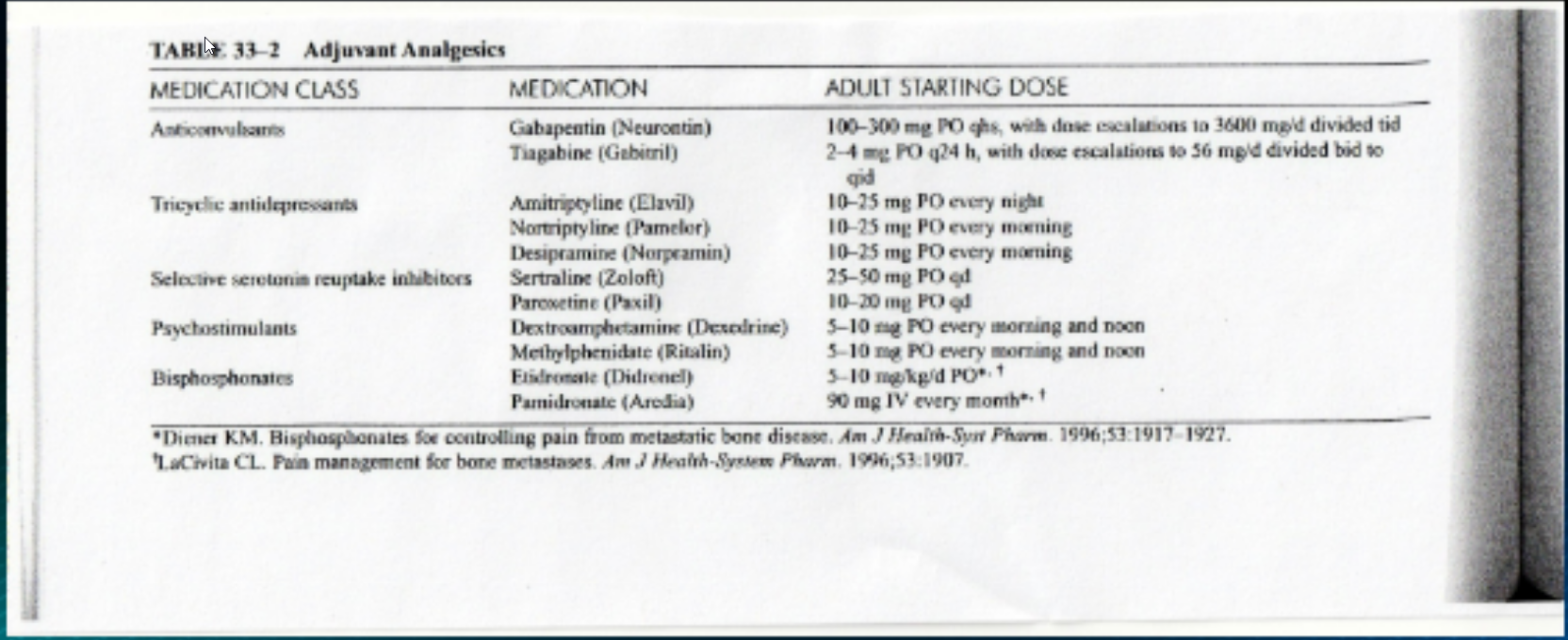
List the Pain Management Treatment Options
Pain Management Treatment Options
Non-opioids
Opioids
Antidepressants
Anticonvulsants
Cognitive Behavioral Therapy
CAM
Describe Fibromyalgia
Symptoms
Pathogenesis
Management
Fibromyalgia
Symptoms:
Widespread pain: > 3 months
Location:
Bilat
above + below waist
Axial skeletal pain
Pathogenesis:
CNS neuroplastic changes -> Stimuli hypersensitivity -> ↓Serotonin levels + impaired serotonin metabolism -> ↓IGF 1 & function of hypothalamic-pituitary axis -> ↓ Serum androgen
Management:
Pregabalin
Duloxetine/Gabapentin
Tizanidine
Trazodone (sleep disturbance)
Amitriptyline/Nortriptyline
Describe Migraine
Symptoms
Management
List out the triptans
Migraine
Symptoms:
Pressure in frontal region -> periorbital and retroorbital region
Nausea and light sensitivity
Nasal stuffiness
Management:
Antiemetic
Triptains
NSAIDS
Triptans:
Zolmitriptan
Naratriptan
Almotriptan
Rizatriptan
Sumatriptan
Describe Neuropathic Pain
What is it?
Description of Pain
Management
Diabetic peripheral neuropathy:
Post-herpetic neuralgia:
Trigemnial neuralgia
Neuropathic Pain
What is it?
Pain initiated by lesion or neural dysfunction:
Peripheral neuropathy
Trigemnial neuralgia
Central post-stroke pain
Spinal cord injury
Description of pain:
Burning sensation
Cold
Tingling/Prickling
Shooting/Stabbing
Itching
Management
Diabetic peripheral neuropathy:
Pregabalin/Duloxetine
Post-herpetic neuralgia:
Gabapentin/Pregabalin
Trigemnial neuralgia
Carbamezapine
how do you manage cancer pain
Management:
Modifying source of pain
Altering pain perception
Blockade of pain transmission