Injury Evaluation Process: Lower Extremity Assessment & Differential Diagnosis
 Call Kai
 Learn
Learn Practice Test
 Spaced Repetition
 Match
Match Flashcards
 Knowt Play
1/26

There's no tags or description
Looks like no tags are added yet.
Name | Mastery | Learn | Test | Matching | Spaced | Call with Kai | Chat |
|---|
No analytics yet
Send a link to your students to track their progress
27 Terms
What is the primary goal of the injury examination process?
To diagnose injuries systematically.
What does differential diagnosis (DD) involve?
Considering all possible diagnoses that have not been ruled out with a physical exam.
What does the acronym HOPS stand for in injury evaluation?
History, Observation, Palpation, Special Tests.
What does the acronym SOAP represent in clinical documentation?
Subjective, Objective, Assessment, Plan.
What is the significance of the kinetic chain in injury evaluation?
Impairments in one body region can affect other areas.
What is the purpose of bilateral comparison in injury assessment?
To use the uninjured side as a reference for normal function.
What is the role of the clinician during the history-taking phase?
To communicate effectively and establish a comfortable atmosphere.
What are the components of a good patient history?
Past medical history and present medical condition.
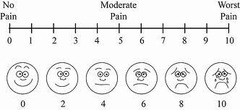
What is the Visual Analog Scale (VAS) used for?
To quantify pain levels.
What does the observation phase of the examination process entail?
Inspecting the patient for gait, posture, function, and signs of injury.
What is palpation in the context of injury evaluation?
The process of touching and feeling to detect tissue damage or change.
What are the three types of range of motion assessments?
Active range of motion (AROM), Passive range of motion (PROM), Resistive range of motion (RROM).
What does Manual Muscle Testing (MMT) assess?
Muscle strength and pain aggravation by isolating the muscle.
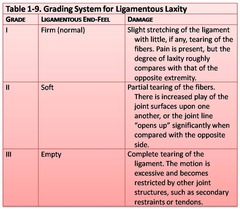
What is the purpose of joint stability tests?
To assess the integrity of noncontractile tissues, ligaments, and capsules.
What is the grading system for ligamentous laxity based on?
The amount the joint opens and the endpoint during stress testing.
What is the difference between stress testing and joint play?
Stress testing identifies joint laxity, while joint play assesses accessory motion.
What does neurological screening evaluate?
Sensory and motor function, as well as deep tendon reflexes.
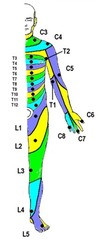
What is a dermatome?
An area of skin innervated by a spinal nerve root.
What does myotome refer to?
The muscles innervated by a single nerve root.
What is the purpose of reflex testing in neurological screening?
To assess the integrity of cervical nerve roots.

What are the major pulses assessed in vascular screening?
Femoral, posterior tibial, dorsal pedal, brachial, radial, ulnar, and carotid.
What is the importance of cultural competence in injury evaluation?
To respect and understand patients' diverse backgrounds and health beliefs.
What should be considered when using an interpreter during patient evaluation?
Speak and make eye contact with the patient, not the interpreter.
What are the signs of infection to look for during observation?
Deformity, swelling, ecchymosis, and other signs of infection.
What should be documented during the history-taking process?
Subjective information such as pain and previous medical history.
What is the significance of understanding the mechanism of injury?
It helps determine the underlying pathology and impact on the patient's life.
What is the purpose of special tests in injury evaluation?
To apply specific procedures to selected tissues to assess their condition.