Lecture 3: Fate and exposure
 Call Kai
 Learn
Learn Practice Test
 Spaced Repetition
 Match
Match Flashcards
 Knowt Play
1/25

There's no tags or description
Looks like no tags are added yet.
Name | Mastery | Learn | Test | Matching | Spaced | Call with Kai | Chat |
|---|
No analytics yet
Send a link to your students to track their progress
26 Terms
Partition coefficient
The ratio of a chemical that is dissolved in two different phases at equilibrium, used to predict the environmental distribution of chemicals at this equilibrium and thus evaluate potential risks
What is partitioning?
How the distribution of chemicals in the environment (air, water, soil biota) is governed by physio-chemical properties, and can be described by their partition coefficients (K)
List different partition coefficients
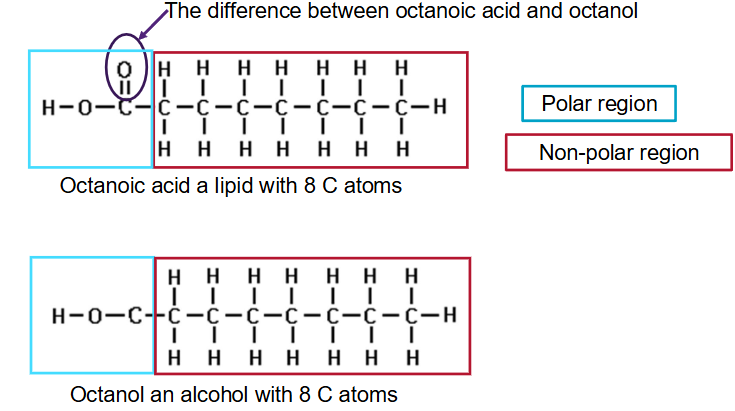
Kow is distribution between octanol (fatty alcohol lipid) and water
K’H is Henry’s Law Constant, the distribution between air and water
Koc is distribution between soil organic carbon and water
Why do we use octanol instead of lipid?
Structure of octanol is very similar to the lipid octanoic acid and they share many physico-chemical properties
The octanol – water partition coefficient is used as a
surrogate for lipid – water
Logging partition coefficients
Partition coefficient values are converted to log 10 values
e.g.
Acetone is polar due to CO
molec wgt = 59.08 amu
aq. sol. 100, 000 mg/L

Octanol-water partition coefficient (Kow)
The ratio between the concentration of a substance in octanol (nonpolar) and water (polar) at equilibrium
Kow is a measure of lipophilicity (solubility of chemical in lipid)
Higher Kow suggests greater tendency to bioaccumulate in organisms and sorb to solids (e.g. soils)
range from <0.001 to >10,000,000 (log Kow: -3 to 7)
The mass of a chemical in octanol (Moctanol) and water (Mwater) depends on the volume of each phase (Voctanol and Vwater)
Rule of thumb (log Kow)
< 2.7 = low bioaccumulation
2.7 - 3 = moderate
> 3.0 = high
Henry’s Law Constant (K’H)
Ratio between the concentration of s substance in air and its concentration in water at equilibrium (neutral dilute solutes)
Higher K’H suggests the chemical readily volatises from water
Increased temperature generally increases K’H (Cwater decreases)
Increased pressure decreases K’H (Cwater increases)
Phys-chem properties affecting the fate of chemical in the environment
Air (photolysis, biodegradation, oxidation)
volatility
adsorption
solubility
half-life
Water (biodegradation, hydrolysis)
solubility
adsorption
volatility
half-life
Soil (hydrolysis, oxidation)
adsorption
solubility
volatility
half-life
Environmental factors affecting the fate of chemicals in environment
Air
temperature
pressure
humidity
light (UV)
wind
rainfall,
particles (dust)
Water
temperature
particles (turbidity)
pH
light (UV)
Soil
temperature
light (UV)
O2 (aerobic/anaerobic)
pH
H2O
Eh
composition
Spatial and temporal impacts
Temporal (secs to millenia)
Source volume and continuity of use/release
Persistency
Spatial (local to global)
Type of source and propensity to disperse in air, water, soil
Persistency
Sorption
The sorption partition coefficient (Kd) is the distribution between solid and water (affinity of chemicals to be sorbed)
Sorption in soil/sediment predominantly due to organic carbon (Koc)
Sorption governs the potential for chemical to leach through soil into ground water
Sorption influences the potential for partitioning of chemical between water and suspended solids and sediment
Transport in water and volatilisation from water (Cw and CA)
Sorption affects bioavailability
What factors affect chemical sorption?
Physico-chemical properties
hydrophobicity (nonpolar & uncharged polar
species)pKa (ion species)
Environmental conditions
soil organic carbon content
particle size
surface area,
soil composition – functional groups, cation
exchange capacity, temperature, pH
What is bioavailability?
Measure by which substances in the environment enter into living organisms; it is commonly the limiting factor in the production of crops (due to solubility limitation or absorption of plant nutrients to soil colloids) and in the removal of toxic substances from the food chain by microorganisms (due to sorption to or partitioning of otherwise degradable substances into inaccessible phases in the environment).
Arsenic bioavailability as a case study
Pathogen rich surface water, partially as a result of high population density, results in high infant mortality due to water borne diseases
Solution is sourcing water from groundwater (via 40 mio wells), which reduced infant mortality
However, ~50 mio rely on groundwater > 50 ug/L arsenic (WHO guideline = 10 ug/L); ~20 mio people poisoned (many mild-moderate)
~3000 deaths/year and the long-term effects and extent of exposure are poorly understood
Eh
Redox potential; tendency of a chemical species to acquire electrons (to be reduced). This depends on the species’ affinity for electrons (increased Eh means increased affinity for e-).
Oxidation of chemicals
Oxidation is the loss of electrons. It can involve the incorporation of oxygen or increase the oxidation state of the chemical (e.g. 4Fe + 3O2 → 2Fe2O3 rusting).
Oxidants
Chemicals with elements of:
High oxidation state (e.g. H2O2, MnO4−, CrO3,)
Highly electronegative elements (O2, F2, Cl2, Br2) that gain extra electrons by oxidizing other substances
Mineral surfaces also catalyze many oxidative reactions (clays and oxides of silicon, aluminum, iron, and manganese provide surface active sites that increase oxidation)
The Grasshopper Effect
Several volatilisation and deposition cycles across the globe causing global distillation (travel distance according to phys-chem properties and temp gradient).
Photolysis of chemicals
Initiated by the absorption of a photon; energy required for
excitation and reaction are characteristic for each molecule. Dependent on light intensity (at specific λ)° and time (day / year), location, weather.
Direct and indirect photolysis
Direct photolysis
The reactive molecule directly absorbs light
Indirect photolysis
A light absorbing molecule transfers its excess energy to an acceptor molecule
Acceptor molecule reacts
Hydrolysis of chemicals
The chemical reaction of a compound with water (e.g. CO2 + H2O → H2CO3 (carbonic acid) → H+ + HCO3- (bicarbonate ions) → H+ + CO32- (carbonate ions)
What mechanisms allow hydrolysis to occur?
H2O (neutral hydrolysis)
Depend on pH, require less energy, can accelerate reaction and give different products
H+ acid catalysis
OH- base catalysis
Hydrolysis can occur in surface waters, groundwater, atmosphere, soil and biota
Exposure
The amount of a chemical at the outer boundary of the body available for exchange. Exposure routes can be oral, inhaled or dermal.
Factors influencing exposure
Concentrations in air, water, or soil, combined with estimates of the frequency and duration of human contact with the contaminated media:
Infants
consume breastmilk or formula (lactational and gestational exposure)
Toddlers
eat dirt, are near ground, hand-to-mouth behaviour, high food consumption per body weight
Fishermen
high consumption of local seafood compared to general population
Industry workers and their families
can be exposed to contaminated fumes, dust, clothing
Vegans
less exposed to chemicals that accumulate in meats, dairy, seafood
Home farmers
can be exposed to localised contamination (e.g. free-range eggs)
Exposure assessment
Biomonitoring measures contaminants within the human body (e.g. blood, urine)
concentrations dependant on bioavailability and t1/2
Biomarkers of exposure measures the product of an interaction between a chemical and target molecules or cells in the human body (e.g. metabolites in urine, receptor activity in liver)
needs good information on mechanisms