BIO125 Cumulative Final Exam
 Call Kai
 Learn
Learn Practice Test
 Spaced Repetition
 Match
Match Flashcards
 Knowt Play
1/247

There's no tags or description
Looks like no tags are added yet.
Name | Mastery | Learn | Test | Matching | Spaced | Call with Kai | Chat |
|---|
No analytics yet
Send a link to your students to track their progress
248 Terms
Evolution
The process by which species change over time through genetic variation and natural selection, leading to adaptation and diversification of life forms.
Genetic mutations
random changes in DNA that introduce NEW TRAITS
gene flow
TRANSFER of genes between populations
genetic drift
RANDOM changes in gene FREQUENCIES, especially in small populations
founders effect, bottleneck
strongest in small populations
natural selection
The process by which organisms better adapted to their environment tend to survive and produce more offspring. Advantageous traits become more common. Acts on phenotypes (observable traits) but relies on genotypes (genetic makeup) for inheritance. Examples: peppered moths, Darwin’s finches
two sources of genetic variation in a population
mutations and sexual reproduction (recombination)
mutations
Random chances in the DNA sequence of an organism. Ultimate source of all genetic variation
sexual reproduction (recombination)
the mixing of genetic material from two parents during reproduction, creating unique combinations of genes in offspring
describe Darwin’s postulates about natural populations
individuals in a population vary (differ in traits)
some trait differences are heritable
more offspring are produced than can survive (overproduction leads to competition for resources)
survival and reproduction are not random (individuals with advantageous traits are more likely to survive and reproduce, passing those traits to next gen)
species
Group of organisms that can interbreed and produce fertile offspring under natural conditions. Reproductively isolated from other such groups
how scientists identify different species
biological
morphological
ecological
phylogenetic
reproductive isolation
two ways species are formed
allopatric speciation
sympatric speciation
allopatric speciation
geographic isolation
population is physically separated by a geographic barrier (mountain, river)
separated groups evolve independently thru mutation, natural selection, and genetic drift
over time, groups become different —> forming different species
sympatric speciation
no geographic isolation
new species arise within same area, often thru genetic changes or ecological differences
polyploidy
behavioral isolation
ecological isolation
behavioral isolation
changes in mating preferences
ecological isolation
populations exploit different resources
polyploidy
common in plants
an error in cell division doubles chromosome numbers
creates reproductive isolation
prezygotic barriers
prevent mating/fertilization from occurring in the first place
act before a zygote is formed
more efficient (no wasted reproductive effort)
isolation barriers
ex: behavioral isolation in birds
zygote
fertilized egg
habitat isolation
populations live in different habitats
two species of snakes: one lives in water, the other on land
temporal isolation
breed at different times
skunks that mate in the summer vs winter
behavioral isolation
differences in mating behaviors or courtship rituals prevent mating
ex: birds of paradise with elaborate dances
mechanical isolation
physical incompatibility
snails with shells that spiral in opposite directions cannot mate
gametic isolation
sperm and egg cannot fuse due to biochemical or molecular incompatibility
ex: sea urchins: sperm of one species cannot fertilize eggs of another species
postzygotic barriers
act after fertilization and prevent the hybrid offspring from surviving or producing
reduce fertility/hybrid viability
less efficient (energy spent on non-viable offspring)
hybrids…
hybrid inviability
hybrid offspring fail to develop or survive to adulthood
some salamander hybrids die before birth or shortly after
hybrid sterility
hybrid offspring survive but are sterile
mules (horse + donkey) are sterile
hybrid breakdown
first-gen hybrids are viable and fertile, but their offspring are weak or sterile
adaptive radiation
a single ancestral species rapidly diversified into many new species
each adapted to exploit different ecological niches/environments
rapid speciation
common ancestry
ecological diversity
morphological and behavioral adaptations
Darwin’s finches
rapid speciation
multiple new species arise in a relatively short geological time
common ancestry
all new species share a recent common ancestor
ecological diversity
species evolve to occupy a variety of niches (different habitats, food sources, or behaviors)
morphological and behavioral adaptations
new species develop distinct physical traits or behaviors suited to their environments
why variation is necessary for evolution
This is the raw material of evolution
it provides the raw differences that natural selection can act upon
without this, populations would lack the diversity needed to adapt to changing environments, leading to potential extinction
importance:
enables natural selection
drives adaptation
prevents extinction
facilitates speciation
maintains population health
sources of variation
mutations
sexual reproduction (recombination)
gene flow
horizontal gene transfer
polyploidy
three modes of natural selection
directional selection
stabilizing selection
disruptive selection
directional selection
favors individuals at one extreme of a trait’s distribution, shifting the average toward that extreme
the mean (average) of the trait changes
ex: peppered moths
stabilizing selection
favors intermediate traits and acts against extreme phenotypes, reducing variation in the population
less diversity in the trait
ex: human birth weight (average birth weights have higher survival than very low or very high)
disruptive selection
favors both extremes of a trait’s distribution while acting against intermediate phenotypes
can lead to bimodal distribution and over time, speciation
more diversity in the trait increases
often occurs in heterogeneous environments where different extremes are advantageous in different contexts
ex: lizard coloration
allele frequency
how common that allele is in the whole group
allele
specific version of a gene
genotype frequency
how common that genotype is in the whole group
genotype
genetic makeup of an organism, the specific combination of alleles
hierarchical organization of classification names (most inclusive to exclusive)
domain (most inclusive)
kingdom
phylum
class
order
family
genus
species/specific epithet (most exclusive)
“Dear King Phillip Came Over For Good Soup”
human classification (most inclusive to exclusive)
Eukarya
animalia
chordata
mammalia
primates
hominidae
homo
homo sapiens
“Every Active Caveman Must Protect His Hairy Hands”
phylogeny
the evolutionary history and relationships among species or groups of organisms
shows how species have descended from common ancestors over time
tracing trait evolution
studying biodiversity and speciation
prediction of characteristics
understanding disease evolution
phylogenetic tree
diagram that represents species’ relationships
branches
nodes
branch lengths
sister taxa
branches
shows lineages evolving over time
nodes
representing common ancestors
branch lengths
sometimes indicating genetic change or time
sister taxa
two groups that share an immediate common ancestor
each other’s closest relatives
branch off from the same node on the tree
evolutionary history of prokaryotes
spans over 3.5 billion years
the oldest and most abundant life forms
origin of them (no oxygen)
photosynthetic and oxygen revolution (cyanobacteria)
endosymbiotic theory and rise of eukaryotes (2.0 billion years ago)
diversification and adaptation (complexity)
prokaryotic cell
no nucleus
small size
no organelles except ribosomes
circular, no histones
binary fission
peptidoglycan (bacteria) cell wall
simple flagella
ex: bacteria, archaea
eukaryotic cell
membrane-bound nucleus
large in size
organelles (mitochondria, ER)
linear structure, wrapped in histones
mitosis/meiosis
cell wall: cellulose (plants), chitin (fungi), none (animals)
complex, microtubule flagella
ex: animals, plants, fungi, protist
Four structures that all living cells possess
DNA
ribosomes
cytoplasm
plasma (cell) membrane
different shapes of bacteria cells
coccus (spherical)
bacillus (rod-shaped)
spirillum (spiral-shaped)
Di, Strepto, Staphlo
Di (pairs)
Strepto (long chains)
staphlo (grape-like clusters)
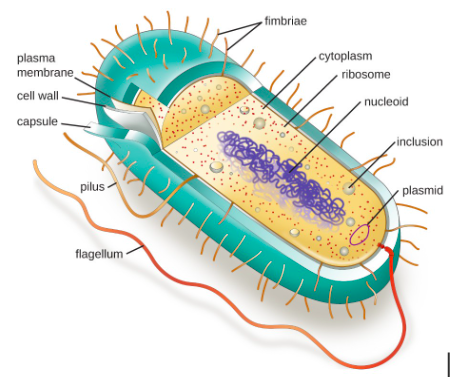
fimbriae (pili)
hair-like, filamentous structures found on the surface of many bacteria
shorter than flagella
flagella
long, whip-like structures (movement)
cell wall
structural support, shape, protection
DNA
carrier of genetic information
sex pili
hair-like, long, attachment for reproduction
capsule
protective gelatinous layer, composed of polysaccharides/polypeptides
endospore
resistant asexual spore that develops inside cell
plasmid
small, extrachromosomal DNA molecule
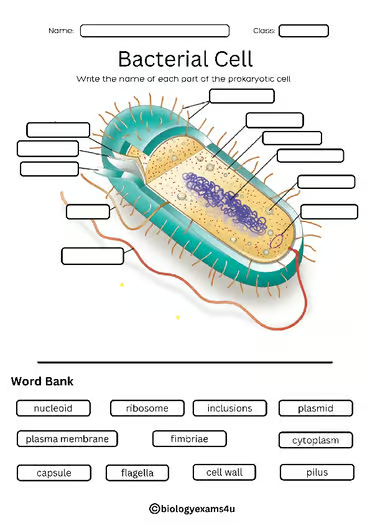
bacteria cell
Three primary functions of the cell wall
protection against external stress
structural support and shape
regulate cell growth and division
Gram-positive bacteria (+)
thick peptidoglycan layer
teichoic acids
stains purple/blue
ex: staphylococcus, streptococcus, bacillus
Gram-negative bacteria (-)
thin peptidoglycan layer
outer lipid membrane
lipopolysaccharides (LPS)
stains pink/red
more resistant to antibiotics
ex: E.coli, salmonella
binary fission
asexual reproduction by prokaryotic organisms
splitting into 2 identical daughter cells
Phototrophs
use sunlight as energy source
chemotroph
use chemical compounds as energy source
autotroph
use inorganic carbon (CO2) as carbon source
heterotroph
use organic carbon (glucose, amino acids) as carbon source
aerobic
oxygen-RICH environments
ex: soil, human body
anaerobic
oxygen-POOR environments
ex: deep soil, stagnant water
obligate
strict oxygen rules
must have specific conditions, otherwise cannot adapt
ex: this aerobe must have oxygen
ex: this anaerobe oxygen is toxic to them
facultative
can adapt to varying conditions
ex: this anaerobe can grow with or without oxygen
3 domains of life
bacteria
archaea
eukarya
“BAE”
kingdoms found within domain Eukarya
animalia
plantae
fungi
protista
APFP
characteristics of the Eukaryotic cell
true, membrane-bound nucleus
membrane-bound organelles
complex cytoskeleton
mitosis and meiosis
linear chromosomes
sexual reproduction (in most)
larger cells
contains cell wall (in some)
endosymbiotic theory
ex: humans, mushrooms, amoeba, yeast, oak trees
endosymbiont theory
free-living prokaryotic organisms were engulfed by larger host cell
engulfed prokaryotes lost independence and became permanent residents
evolved into organelles, then into mitochondria
later, a cell already had mitochondria absorbed cyanobacterium thru phagocytosis
symbiotic relationship
cyanobacterium provided glucose and oxygen, benefitting host
over time, cyanobacteria lost independence
evolved into plastid, chloroplast
evidence (5) for evolution of mitochondria and chloroplasts in eukaryotes
own circular DNA (like bacterial DNA)
double membrane structure
independent reproduction (like bacteria)
ribosomes (like bacterial ribosomes)
gene transfer and shared genes (HGT)
derived traits of land plants
cuticle
stomata
multicellular, dependent embryos
alternation of generations
sporangia
apical meristems
vascular tissue
secondary compounds for chemical defenses
protected gametes, pollen, seeds, flowers, and fruits
cuticle
waxy outer layer
stomata
pores on leaves
sporangia
spore-producing structure
spores found on the underside of fern leaves
spores are dispersed by wind
vascular tissue
xylem and phloem
alternation of generations
life cycle that alternates between two multicellular phases:
gametophyte
sporophyte
gametophyte
haploid
produces gametes (sperm and egg) via mitosis
sporophyte
diploid
produces spores via meiosis
apical meristems
root - roots growing downward into soil
shoot - stems and leaves growing upward toward light
gametangia
antheridia - produce and release sperm
archegonia - produce and protect the egg
flagellated sperm
sperm have whip-like tails
require water to swim to the egg for fertilization
seed plants do not have flagellated sperm, instead produce pollen
leading phylogenetic hypothesis about relationship between all plant groups
transition from green algae to land plants (bryophytes)
evolution of vascular tissue (seedless vascular plants)
evolution of seeds (seed plants: gymnosperms and angiosperms)
evolution of flowers and fruits (angiosperms)
non-vascular plants
bryophytes (mosses, liverworts, hornworts)
pioneer species
moisture retention prevents soil erosion
no vascular tissue (lack xylem and phloem)
no true roots
seedless vascular plants
ferns, club mosses, horsetails, whisk ferns
habitat creation (shelter)
soil stabilization (prevent erosion)
has xylem and phloem (plants grow tall)
has true roots, stems, leaves
sporangia on leaves
spores no seeds
has rhizomes (horizontal underground stems)
Gymnosperms
seed plants (naked seeds)
pine trees, spruce, fir, conifers
seeds not enclosed in fruit, no flowers
produce pollen and wood
needle-like or scaly leaves
wind pollination
resin production
cones are female
well-developed xylem and phloem
forest ecosystems, carbon storage, wildlife habitat
Angiosperms
flowering plants
seeds enclosed in fruit
most diverse and dominant group of plants
roses, oak trees, grasses, sunflowers, maple trees, fruit plants
petals, stamens (male), and pistils (female)
double fertilization
short generation times (annual plants)
coevolution with pollinators
seeds contain…
embryo - the young plant
endosperm - a food supply for the embryo (formed thru double fertilization)
seed coat - protective outer layer