Hyponatremia Lecture Notes
 Call Kai
 Learn
Learn Practice Test
 Spaced Repetition
 Match
Match Flashcards
 Knowt Play
 Podcast
1/24

Earn XP
Description and Tags
Comprehensive vocabulary flashcards covering the definitions, causes, classifications by osmolality, symptoms, and treatment protocols for Hyponatremia based on the lecture notes.
Name | Mastery | Learn | Test | Matching | Spaced | Call with Kai | Chat |
|---|
No analytics yet
Send a link to your students to track their progress
25 Terms
Hyponatremia
A condition where the blood sodium level goes below 135mEq/L.
three types of hypotonic (<280) hyponatremia
hypovolemic, euvolemic, and hypervolemic hyponatremia.
indication for renal cause of hypotonic hyponatrmia
U Na+ > 20meq/L
renal cause of hypotonic hyponatremia
renal salt loss: Diuretics, ACE inhabitors, mineralocorticoid deficiency.
other casuse for hypotonic hyponatremia (UNa+>20mEq/L)
dehydration, Diarrhea, vomiting. third space fluid losting (eg: pancreatitis)
Cerebral salt-wasting syndrome
A cause of hypovolemic hyponatremia characterized by increased brain natriuretic peptide.
Hypervolemic Hyponatremia (hypotonic) uninary sosium < 20 mEq/ L
Heart failure, cirrhosis, nephrosis, hypoalbiuminemia, which leads to an increase in total body water relative to sodium, causing diluted serum sodium levels.
Hypervolemic Hyponatremia (hypotonic) uninary sosium > 20 mEq/ L
renal failure, causing an inability to excrete free water, resulting in diluted serum sodium levels.
Euvolemic Hyponatremia
A subtype involving drugs (vasopressin, SSRIs, thiazides, carbamazepine ACE inhabitor), SIADH, Addison’s disease hypothyroidism, or high fluid intake (primary polydipsia, beer potomania).
Isotonic hyponatremia
Hyponatremia occurring with a normal serum osmolality of 280-290 msOm/kg ,pseudohyona often due to hyperproteinemia or hyperlipidemia.
Hypotonic hyponatremia
Hyponatremia occurring with low serum osmolality (<280mOsm/kg).
Hypertonic hyponatremia
Hyponatremia occurring with high serum osmolality (>290\,mOsm/kg caused by hyperglycemia, mannitol, sorbitol, glycerol, maltose, or radiocontrast agents.
Extrarenal salt loss
Hypovolemic condition characterized by a urinary sodium concentration of UNa+<10mEq/L, seen in dehydration, diarrhea, and vomiting.
Renal salt loss
Hypovolemic condition characterized by a urinary sodium concentration of UNa+>20mEq/L, seen with diuretics, ACE inhibitors, nephropathies, and mineralocorticoid deficiency.
SIADH (Syndrome of inappropriate antidiuretic hormone)
A cause of euvolemic hyponatremia which can be triggered by CNS disorders, ectopic ADH production (small cell carcinoma of the lung), drugs( Carbamazepine), HIV, pulmonary diseases, or postoperative pain medication.
Ectopic production of ADH
A cause of SIADH most commonly associated with small cell carcinoma of the lung.
Hyponatremia Clinical Symptoms
Nausea, vomiting, headache, confusion, fatigue, low blood pressure, loss of energy, muscle weakness, twitching, cramps, seizures, coma, and restlessness.
Severe Hyponatremia Treatment
Defined as values <120mmol/L; requires hypertonic 3% saline in the first-hour.
Moderately severe hyponatremia
Defined as values between 120-130 mmol/L; treated with hypertonic 3% saline while limiting the increase in serum sodium concentration. Limited the increase in serum concentration to avoid associated complications such as osmotic demyelination syndrome.
Osmotic demyelination syndrome
A risk associated with the rapid correction of sodium levels or fluid shifts, manifesting as dysarthria, dysphagia, tetraparesis, behavioural disturbances, lethargy, confusion, and coma.
under which sodium level the patient start having symptom
< 120 mmol/L
reason for SIADH
Neurosurgical or neurological :Guillain-Barré syndrome
Subarachnoid haemorrhage
Subdural haemorrhage
Infective: Meningitis, scarcoidosis
Respiratory: TB, pneumonia, pneumothroax asthma
Medications – increased ADH release:
Antidepressants (eg sertraline)
Anticonvulsants (eg carbamazepine, leveteiracetam)
Antipsychotics (eg haloperidol)
Anti-inflammatory drugs: trimethoprim
Ecstasy
Cyclophosphomide
Malignancy – ectopic ADH production:
Nasopharyngeal
Mesothelioma
Pancreatic
Gastrointestinal
Lymphoma
Sarcoma
investigation for SIADH
biochemistry looking at serum sodium level
serum osmolality
urine osmolality (random sample collected at same time as serum sample)
thyroid function tests
morning cortisol level if hyponatraemia is potentially related to Addison’s disease
computed tomography (CT) of the head if a neurosurgical condition is suspected (eg subarachnoid haemorrhage, subdural haematoma)8
chest X-ray if pulmonary causes of SIADH are suspected.
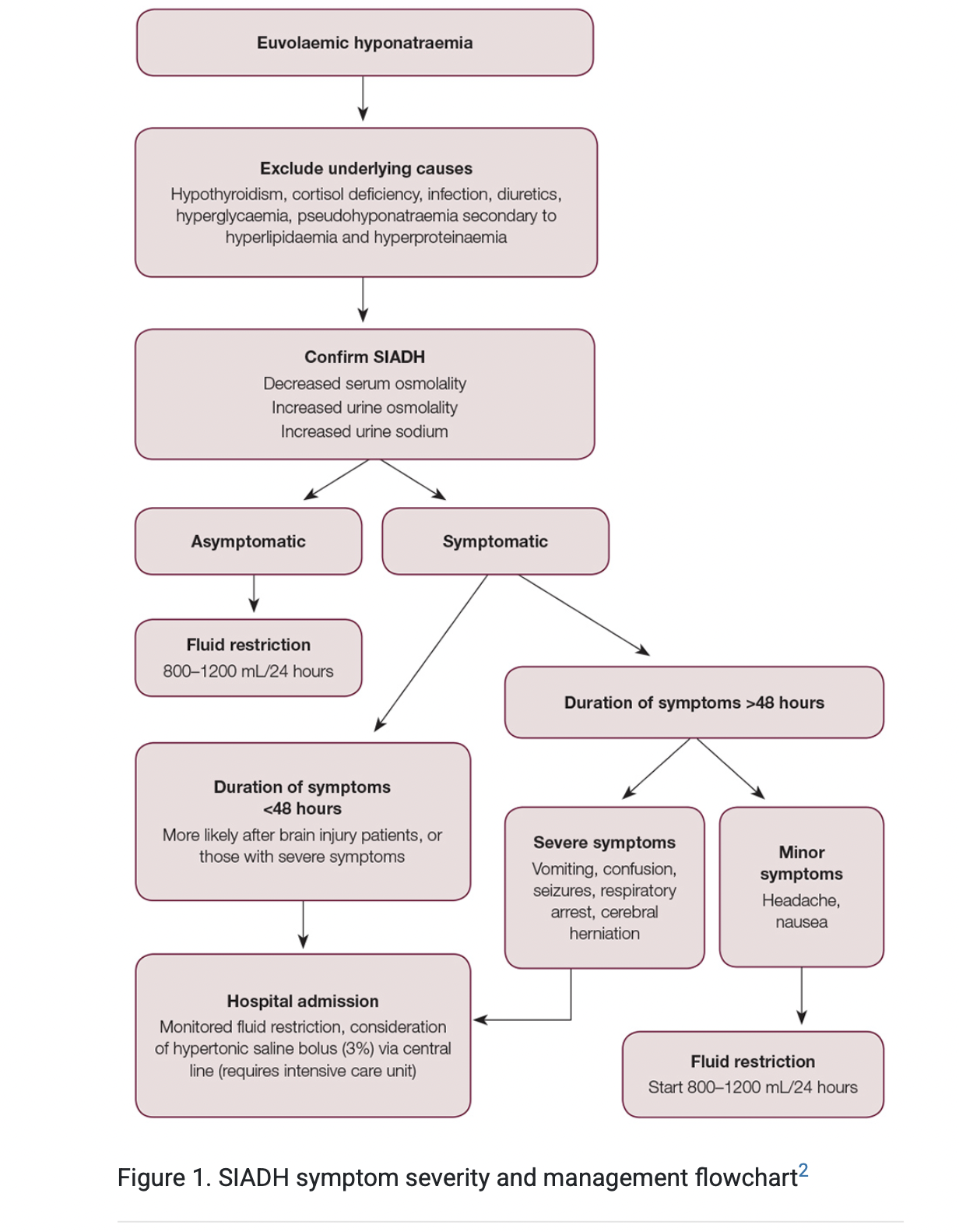
Diagnosis of SIADH
decreased serum osmolality (<275 mOsm/kg)
increased urine osmolality (>100 mOsm/kg)
euvolaemia
increased urine sodium (>20 mmol/L)
no other cause for hyponatraemia (no diuretic use and no suspicion of hypothyroidism, cortisol deficiency, marked hyperproteinaemia, hyperlipidaemia or hyperglycaemia).
treatment for SIADH
Asymptom: symptom (duration )