(Midterms) Chapter 2: Non-preemptive Scheduling
 Call Kai
 Learn
Learn Practice Test
 Spaced Repetition
 Match
Match Flashcards
 Knowt Play
1/11

There's no tags or description
Looks like no tags are added yet.
Name | Mastery | Learn | Test | Matching | Spaced | Call with Kai | Chat |
|---|
No analytics yet
Send a link to your students to track their progress
12 Terms
Non-preemptive Scheduling
This method id used by Microsoft Windows and Apple.
Non-preemptive Scheduling
It is the only method that can be used on certain hardware platforms, because it does not require any special hardware, such as a timer.
First Come First Serve Scheduling
Where a new process enters through the tail of the queue, and the scheduler selects process from the head of the queue
Arrival, Execution, Repeat
Three steps of FSCS
Arrival
Processes enter the system and place on a queue
Execution
The CPU takes the first process and executes it for completion
Repeat
The CPU takes the next process, repeating the execution
Shortest Job First (Non-Preemptive)
Also known as Shortest Job Next; selects the process with the smallest execution time
Longest Job First Scheduling
Where the largest burst time is processed first, preferably in a descending order from the ready queue
Highest Ration Response Next
One of the most optimal scheduling algorithms, as it gives priority to the processes that have been waiting longer, by creating balance in the execution processes
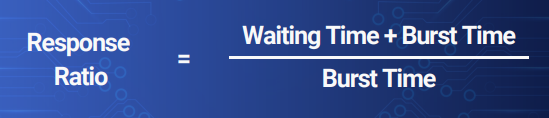
Response Ratio
Calculated to improve the simple approach of FirstCome, First Serve and Shortest Job First, by balancing both the waiting time and the bursttime
Response Ratio Formula