Art History: Etruscans & Rising Rome
 Call Kai
 Learn
Learn Practice Test
 Spaced Repetition
 Match
Match Flashcards
 Knowt Play
1/66

There's no tags or description
Looks like no tags are added yet.
Name | Mastery | Learn | Test | Matching | Spaced | Call with Kai | Chat |
|---|
No analytics yet
Send a link to your students to track their progress
67 Terms

Biconial impasto ware urn with inverted lid, 8th century BCE (Early Iron)
Biconical - flares wide as it goes up
Geometric decor (lines and dots)
Many uses—>fancy=cremation

Hut urns, Latium and Etruria, 9th century BCE (Early Iron)
Only found in Etruria/Latium (first Latium, spread N)
Looks like simple waddle-daub hut w/ round roof
Ovular or square, may replicate specific homes (never identical)
Ridge poles, spirits/birds, openable door
Usually buried w/ men (possibly paterfamilias—>power)

Forum necropolis, Rome, 10th–9th centuries BCE (Early Iron)
Early settlement on Palatine Hill, bury dead between hills (marshy)
Cremation + inhumation

Orange
Etruria

Pinkish, Near Rome
Latium
Impasto Ware
Unrefined clay, brownish color, simple patterns, handmade
Necropolis
City for the dead
Cremation
Burning the dead and saving their ashes
Kin Groups
Familial groups headed by paterfamilias
Paterfamilias
Head of family group
Holds power over family
Early Iron - Villanovans (Early Etruscans)
1000-750 BCE
Distinctive burials, Etruria + Latium, Wealth/Status differentiation
Handmade pottery (no wheel, impasto ware), metalwork (bronze, iron)
Villanovan Cemeteries
Outside village (on hilltops)
Cremation urns, Grave goods
Arranged by family groups
Villanovan Settlements
On volcanic tuffa hilltops
Wattle+daub oval huts, thatch roofs, small porch, hearth
Organic growth

Bucchero krater, 6th century BCE (Archaic)
Large vessel, pointed foot, flares w/ wide mouth, handles
Greek body, Etruscan style/decor
Used to mix wine at parties (elite)
Stamps for decor, no stories (just creatures)

Regolini-Galassi Tomb or Tomb of Lartha Velthurus, Sorbo necropolis, Caisra (modern: Cerveteri, Latin: Caere), c. 670 BCE (Archaic)
Early attempt at monumental tomb, man+woman (woman laid on floor)
Unknown relationship
Extremely rich, tons of elite objects (masterwork gold fibula)
Small window looks into burial chamber, corbelled vault (arching walls)
Bronze bed, 33 figurines, incense burner, Bucchero ink pot (writing)

Banditaccia necropolis, Caisra: Tomb of the Shields and Chairs, 600 BCE (Archaic)
Tomb looks like a home, tumulus has multigenerational chambers
5 burial chambers, dead/urn laid on beds/klinai (elite)
Stone shield carvings, rafters, chairs

Banditaccia necropolis, Caisra: Villa Giulia Sarcophagus, 520 BCE (Archaic)
Man and woman on klinai, life-sized, teracotta (4 pieces)
Less expensive than metal, but teracotta art in prime
Reclining/banqueting, Etruscan dress, Greek hair/face (stylized)
Likely both inside (intimate, equality)

Monterozzi Necropolis, Tarquinia: Tomb of the Bulls (or Tomb of Arnath Spuriana), c. 530 BCE (Archaic)
Multiple burials, covered by tumulus (two burials chambers)
Most of painting in antechamber/burial chamber wall
Pediment: deer chased by lions
Bulls by people having sex (protecting passage to Underworld)
Sex might be apotropeic (to lead the eye away from true importance)
Trojan War (prince Troilus killed by Achilles—>unholy sacrifice)
Name: Arnath Spuriana

Monterozzi Necropolis, Tarquinia: Tomb of the Augurs, c. 520 BCE (Archaic)
Wall separations, thick ceiling line, lifesize figures, painted ‘door’
Figures by door likely monsters, augurs, or relatives
Funerary games, augur or referee, Phersu scene (Underworld deity)
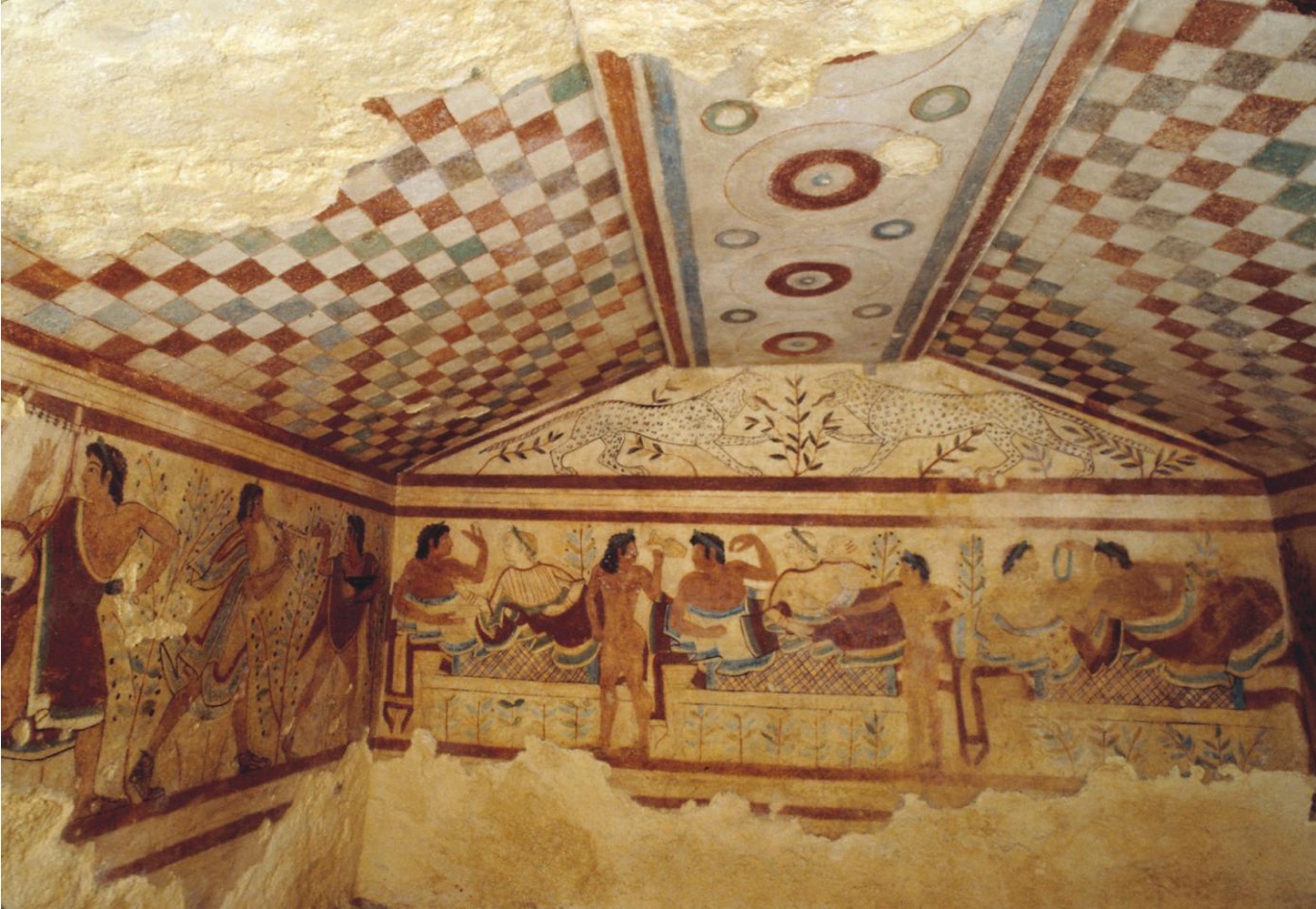
Monterozzi Necropolis, Tarquinia: Tomb of the Leopards, c. 480 BCE (Archaic)
Dead have endless party (male+female)
Colorful ceiling (like funeral canopy)
Two leopards on pediment, nude slaves/servers, entertainers

Marzabotto, early 5th century BCE (Archaic)
Orthogonal (grid) planning (from Greeks?)
Large main streets (N-S and E-W)
Cemeteries just outside city
Zone for temples in N
Walled city (warfare present)

Portonaccio Temple (Temple of Minerva), Veii, c. 500: Temple model, Terracotta Roof Statue of Apulu, Terracotta Roof Statue of a Goddess Carrying a Child (Archaic)
Close to Rome, similar to Greek temple, painted Tuscan Order
Portico (covered entry), 3 cellas (rooms), tiled pitched roof
Teracotta, wood (columns), brock (walls), stone (podium)
Elevated, frontal emphasis
Apollo sculpture-Drapery, long trussed hair, almond eyes, archaic smile (Greek); also not nude, not static, supporting object (Etruscan)
Bucchero
Developed from impasto
Shiny, black surface fired to dark grey
Wheel-made, fine, thin-walled
Symposium
Eat/drink/entertain
Reclining banquet, status display
Spirit of conquest/competition
Etruscan: association w/ afterlife, men+women
Tumulus
Mound-like structure containing tombs
Repousse
Metalworking using sheets that are hammered into shape (on reverse)
Granulation
Decor using dots of metal added on
Kline
Elite, reclining couch
Divination, Augur, Augury
Finding the will of the gods through ritual, etc
Official that practices augury
Interpreting omens
Phersu
Masked deity in wall painting (Underworld)
Funerary Games
Contests held at funerals for prizes
Orthogonal Planning
Grid planning
Tuscan Order
Simple round columns
Sarchophagus
Stone coffin inside tomb
Magna Graecia
Western Greek colony (near Cumae—>upper ankle of boot)
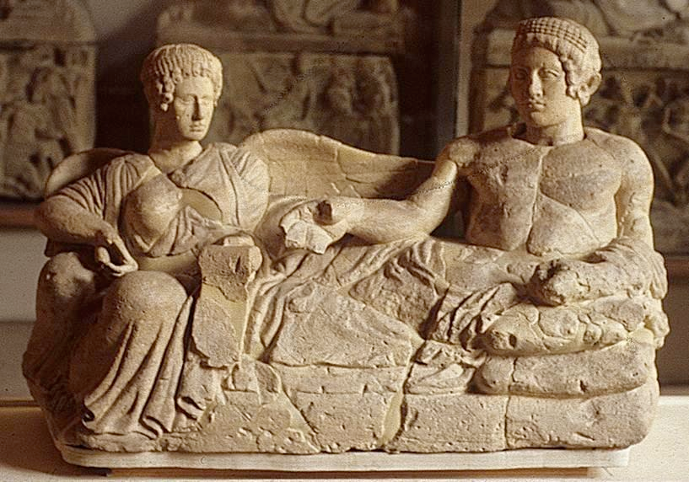
Cinerary Urn with Banqueting Man and Vanth, Chiusi, c. 400 BCE (Classical)
Teracotta; man reclining, woman upright (w/ wings—>Vanth)
Man holding something (wine, pomegranite?)
Short, simple hair (Greek), idealized/naturalistic faces (Greek)

Mars of Todi, c. 400 (Classical)
Bronze (metal-rich), life-size, Etruscan workshop
Struck by lightning and buried—>preserved
Lost hollow-cast tech.
Inscription in Etruscan alphabet, Umbrian language, Celtic name (merceneries—>mix of cultures)

Bronze Chimaera, Arezzo, early 4th century BCE (Classical)
Lion head, goat on back, snake tail biting goat
Inscription: belongs to sky god (votive dedication)
Lots of motion, goat bleeding
Lost sculpture group? (Bellerophon)

Ficoroni Cista, late 4th century BCE (Classical)
Women’s box for toiletries, 3 pedestals (lion paw on frog), given as dowry
Greek myth: Jason+Argonauts (status symbol)
Deity statues
Roman workshop

Mirror, Vulci, 4th century BCE (Classical)
One side polished, other etched
Mirrors are reflective/magical—>cross boundaries (often inside graves)
Related to divination

Tomb of the Reliefs, Cerveteri, 4th–3rd centuries BCE (Classical)
Tombs less common now, underground w/ tumulus
Painted and reliefs, stone pillars, stucco reliefs (domestic)
Niches even in antechamber for people
Central niches w/ special reliefs (tomb founder?): Cerberus (guards Und.), Chairon? (ferryman)

Inghirami Tomb, Volterra, 2nd century BCE (Classical)
Conquered by Rome, extremely wealthy family
Plain tomb, intricate sarcophagi
Fat, reclining dead (opulent)

Aule Metele, Cortona, c. 90–70 BCE (Classical)
Etruscan man, look like Roman senator
Lost wax tech., Etruscan workshop
Wide hem on toga—>Senator/important person
Aristocratic ring, Senatorial bots
(Assimilation)
Vanth
Guide to Underworld
Lost Wax Technique
Make a wax copy, make cast using wax, melt wax, replace with molten metal
Votive
Object dedicated to something/someone

Palatine Hill settlement (and "Hut of Romulus"), Rome, 9th–8th centuries BCE (Regal)
Loosely spaced huts (no planning), waddle+daub, pitch/thatch roof, reed/wood frame
Hut visible into Imperial Period on Palatine
Rulers tried to preserve (link to tradition)

Forum Romanum (civic buildings), Rome, early 6th century BCE: Cloaca Maxima (great sewer), Rome, begun 6th century BCE (Regal)
Attributed to Tarquin (Etruscan) kings
Open-air canal, drained marsh and cleared waste from forum to Tiber R.
Later a barrel vault

Forum Romanum (civic buildings), Rome, early 6th century BCE: Lapis Niger (Black Stone), Sanctuary of Vulcan, Rome, 6th century BCE (Regal)
Archaic Latin inscription in boustrophedon (as ox plows), earliest monumental Latin inscription
Says it’s a sacred area, do not defile
Presence of foot road, judicial system, slavery, kingship
Tuffa pillar, white stone base
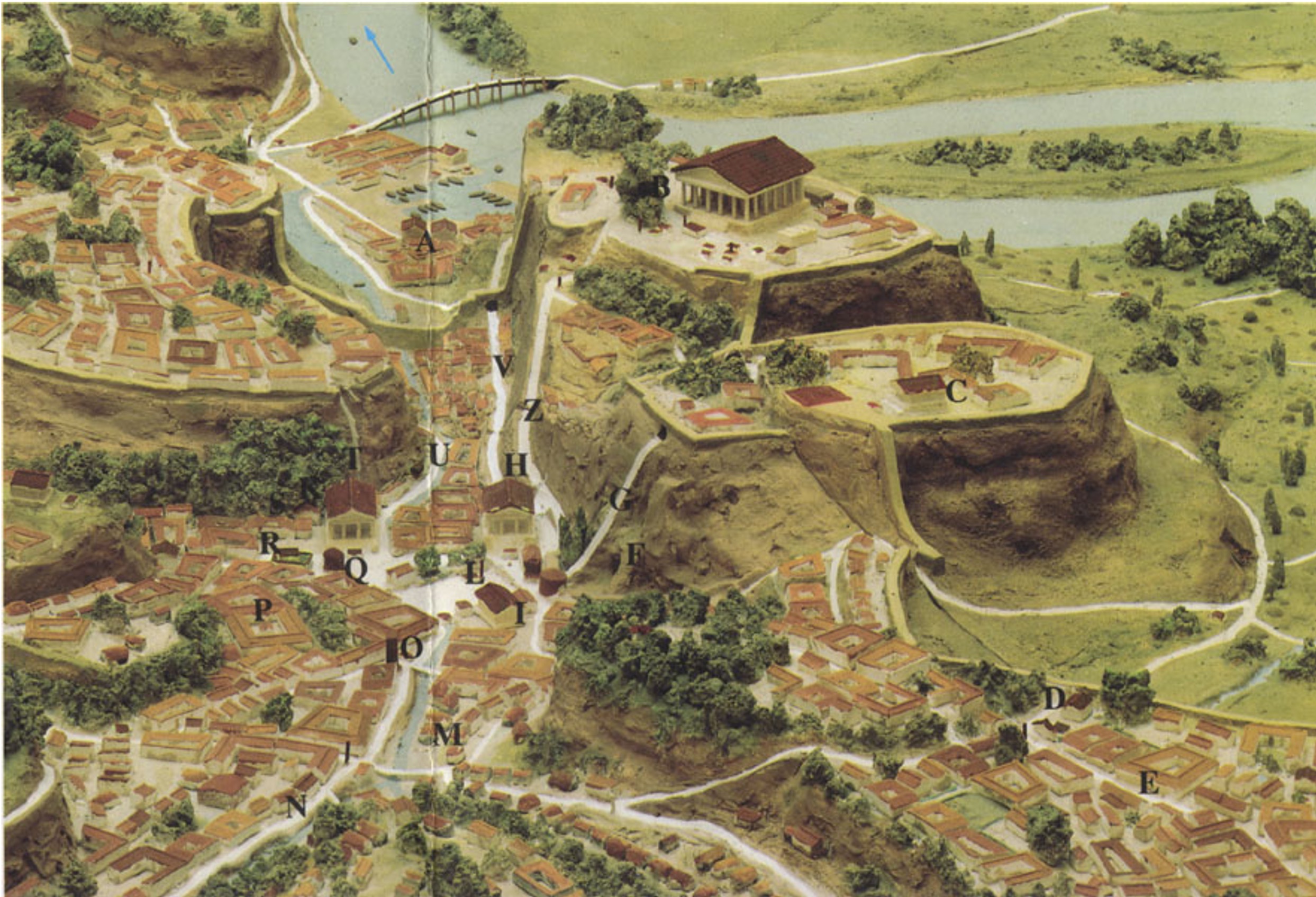
Temple of Jupiter Optimus Maximus, Capitoline Hill, Rome, dedicated 509 BCE (Regal)
Capitoline vowed to be built by Tarq. Priscus, actually built by Tarq. Superbus
Etruscan architects (local workers), largest building in Rome
Found decapitated, bleeding head while digging (omen, shall be head of world)
Dedicated for Capitoline Triad (Jupiter, Juno, Minerva) (by first consuls of Rome)
Set precedent of generals offering spoils to gods/state
State temple, bridge monarchy+republic
Stone foundation, mudbrick/wood siding, tile roof, Tuscan Order (later marble)
Central stairs, large porch w/ columns, 3 cellas, pitched roof+pediment (Etruscan)
Free-standing columns on sides (Greeek)
Teracotta statues on roof, storage rooms in back
Lots of labor (many people, military, wealthy), on level of Superpowers
Tiber River
River from Appenines to Tyrrhenian Sea
Connects Rome to Sea, protects from pirates
Pomerium
Sacred boundary of the city
Arch, Barrel Vault
Hall/entrance w/ arched ceiling
Forum
Political/religious center of Rome
Symbolic center of Rome
Boustrophedon
Written as the ox plows
Triumphal Procession
Parade in which victorious general is celebrated throughout Rome

Servian Wall, Rome, mid-4th century BCE (Republic)
Not fully uncovered (people live in Rome)
Built by King Servius (according to tradition)
Large ashlar blocks (tuffa) from Veii (must have already been conquered), 4th C. masonry (at earliest)
Surrounds ‘7’ hills of Rome (likely rxn to Gaul’s atack)

Flamininus gold stater, 196 BCE (Republic)
Greek influence (live face on coin is outlawed in Rome)
Flaminius portrait w/ Victory and his name
Nike gives crown to him on other side (copying Alexander and Hellenistic kings)

Monument of Aemilius Paullus, Delphi, Greece, 167 BCE (Republic)
Paullus acts Greek (visits sanctuary), offers thanks for victory
Famous oracle (esp. for politics/war)
Monument was built by Perseus, he steals it and puts it outside sanctuary
Inscription said he took it from Perseus (gloating)
Equestrian general atop, relief frieze shows Battle of Pydna (accurate, Greek style→local artists, Roman dress, rearing horse according to oracle/history)
Marble, proportionate, naturalistic (but not nude)

Temple of Hercules Victor, Rome, c. 150 BCE (Republic)
In Forum Boarium, Corinthian Order (very fancy, Greek), first to use imported pentelic marble
Dedicated to (unknown) military victory, top is missing

Sanctuary of Fortuna, Palestrina (ancient Praeneste), late 2nd century BCE (Republic)
First non-utilitarian concrete usage (covered by brick/stone/plaster—>looks too cheap)
Cut into hillside, many terraces/levels, actual temple is small in back
Round arch, barrel vault, groin vault
Use coffers to relieve weight and add design
Lucius Junius Brutus, Alexander the Great
‘The Dullard’, nephew of Tarq. Superbus, led revolt over Lucretia, founded Republic, first consul, minted coins
Ruled Macedon (overthrew Persia), created massive empire, dies and generals split his land (not amiably)
Ager, Fossa
Wall with ditch behind and dirt in front, extra barier and defender ramp, labor intensive (political power)
Punic Wars, Macedonian Wars
Cathage v Rome (Sicily—>Province), Africanus v Hannibal, N. Africa—>Province
Flaminius defeats Philip of Macedon (‘liberates’ Greeks from Macedonian control), mints gold staters (like Greek kings), celebrates triumph
Marcus Claudius Marcellus, Flaminius, Aemilius Paulus
‘Sword of Rome’, captures Syracuse (Sicily), brought back loot (Greek art), started craze
Macedonian War, does not make it a province (returns), emanates Greek-ness and Alexander
3-4 day long procession (too many statues/art)
Hellenistic Kingdoms
Seleucid Empire-largest
Ptolemaic (Egypt)-Ptolemy, wealthy, stable
Antigonid
Landscape Architecture
Uses location to make most of building
Generals want building on parade path to get ephemeral victory