Human Anatomy Ch. 2 Review
 Call Kai
 Learn
Learn Practice Test
 Spaced Repetition
 Match
Match Flashcards
 Knowt Play
1/48

There's no tags or description
Looks like no tags are added yet.
Name | Mastery | Learn | Test | Matching | Spaced | Call with Kai | Chat |
|---|
No analytics yet
Send a link to your students to track their progress
49 Terms
Fill in the blanks:
___ are the smallest ___ units in the body
Obtain nutrients
Make molecules needed to survive
Dispose of wastes
Maintain their shape
Replicate itself
cells, living
Fill in the blanks:
Organelles
Subunits of cells with ___ ___
Most cells contain the same basic organelles
Not all cells have all organelles in the same abundance
specific functions
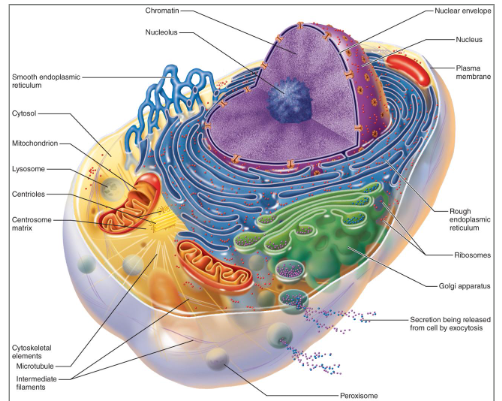
Fill in the blanks:
Cells have three main components
___ ___ —the outer boundary
___ —contains most organelles
___ —controls cellular activities
plasma membrane, cytoplasm, nucleus
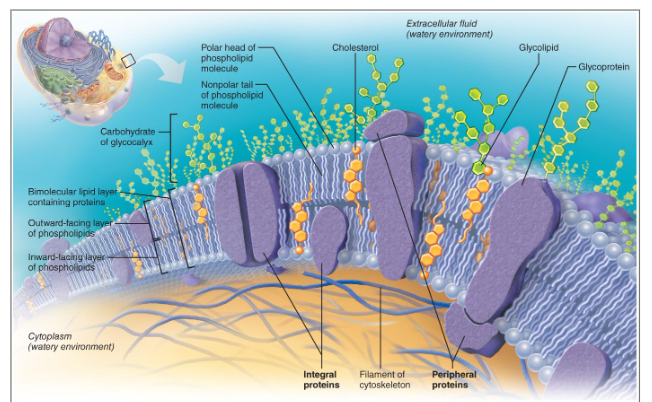
Fill in the blanks:
Structure of membrane
Fluid mosaic model (lipid bilayer)
Types of membrane proteins
___ proteins—firmly imbedded in or attached to lipid bilayer
Short chains of ___ attach to integral proteins
Form the ___ (allows for cells to stick, unique to each person)
___ proteins—attach to membrane surface (inside or outside)
Support plasma membrane from the cytoplasmic side
integral, carbohydrates, glycocalyx, peripheral
Fill in the blanks: The Plasma Membrane
Functions—relate to location at the interface of cell’s exterior and interior
Provides barrier against substances outside cell
Some plasma membranes act as ___
Determines which substances enter or leave the cell
Membrane is ___ ___
receptors, selectively permeable
Fill in the blanks: Membrane Transport
___ ___ —tendency of molecules to move down their concentration gradient (high -> low)
___ —diffusion of water molecules across a membrane (follows solutes)
simple diffusion, osmosis

Reminder: Membrane Transport Mechanisms
Active Recall Exercise: Try to describe each type of mechanism by memory
Okay
Fill in the blanks: Membrane Transport Mechanisms
___ ___ —movement of molecules down their concentration gradient through an integral protein
___ ___ —integral proteins move molecules across the plasma membrane against their concentration gradient (requires help)
facilitated diffusion, active transport
Fill in the blanks: Endocytosis
Endocytosis
Mechanism by which particles enter cells
Phagocytosis—“cell ___”
Pinocytosis—“cell ___”
eating, drinking
Fill in the blanks:
Receptor-mediated endocytosis
Plasma proteins bind to certain molecules
Invaginates and forms a ___ ___
Pinches off to become a ___ ___
This is the method by which insulin, other hormones, enzymes, and low-density lipoproteins enter cells
coated pit, coated vesicle
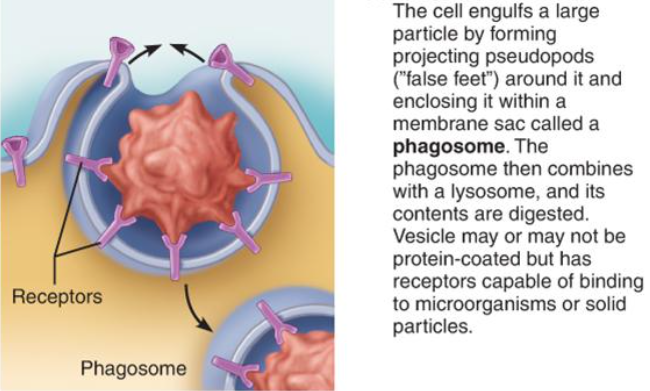
This the process of?
Phagocytosis
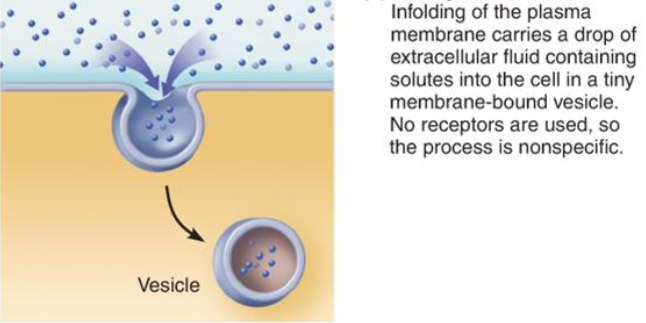
This is the process of?
Pinocytosis

What is this process?
Receptor-mediated Endocytosis
Fill in the blanks:
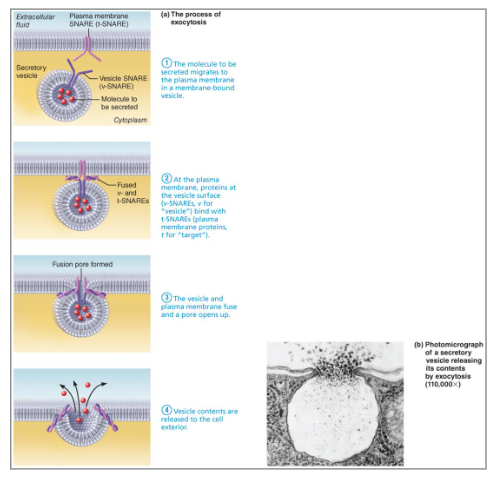
Exocytosis—a mechanism that moves substances out of the cell
Substance is enclosed in a ___
The ___ migrates to the plasma membrane
vesicle
Fill in the blanks:
___
Lies internal to plasma membrane
Consists of cytosol, organelles, and inclusions
___
Jellylike fluid in which other cellular elements are suspended (ie regulatory proteins)
Consists of water, ions, and enzymes
Cytoplasm, cytosol
Fill in the blanks: Cytoplasmic Organelles
Ribosomes—constructed of ___ and ___ RNA; not surrounded by a membrane
Site of protein synthesis
Assembly of proteins is called ___
Are the “assembly line” of the manufacturing plant
proteins, ribosomal, translation
Fill in the blanks:
Ribosomes
Free ribosomes function within the ___
Ribosomes attached to ER [Attached to the rough ER (ribosomes make it rough)]
Make proteins to ___ plasma membrane
Make proteins that are ___ from the cell
(General fate of ribosomes: plasma membrane, secreted, and the defective are destroyed)
cytosol, renew, exported
Fill in the blanks: Cytoplasmic Organelles
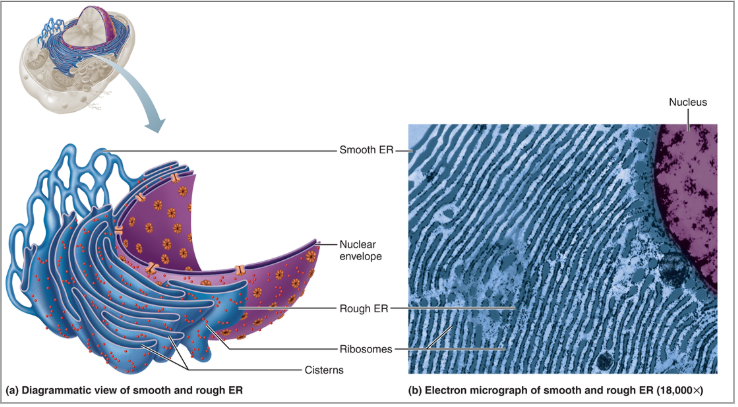
Endoplasmic reticulum—system of membrane-walled ___ and ___ throughout cytoplasm
Rough E R—ribosomes stud the external surfaces
Smooth E R—consists of tubules in a branching network
No ribosomes are attached; therefore, no ___ ___
envelopes, tubes, protein synthesis
![<p>Fill in the blanks: Cytoplasmic Organelles</p><ul><li><p><span style="background-color: transparent;"><strong>Golgi apparatus</strong>—a stack of ___ to ___ disc-shaped cisterns</span></p><ul><li><p><span style="background-color: transparent;">Sorts products of ___ ER and sends them to proper destination</span></p></li><li><p><span style="background-color: transparent;">Products of rough ER move through the Golgi from the ___ (___) to the ___ (___) side [ie gets tagged for shipping]</span></p></li><li><p><span style="background-color: transparent;">Is the “packaging and shipping” division of the manufacturing plant [think amazon]</span></p></li></ul></li></ul><p></p>](https://assets.knowt.com/user-attachments/0b222daf-3a10-4e20-b5c0-78e266b5d393.png)
Fill in the blanks: Cytoplasmic Organelles
Golgi apparatus—a stack of ___ to ___ disc-shaped cisterns
Sorts products of ___ ER and sends them to proper destination
Products of rough ER move through the Golgi from the ___ (___) to the ___ (___) side [ie gets tagged for shipping]
Is the “packaging and shipping” division of the manufacturing plant [think amazon]
3, 10, rough, convex (cis), concave (trans)
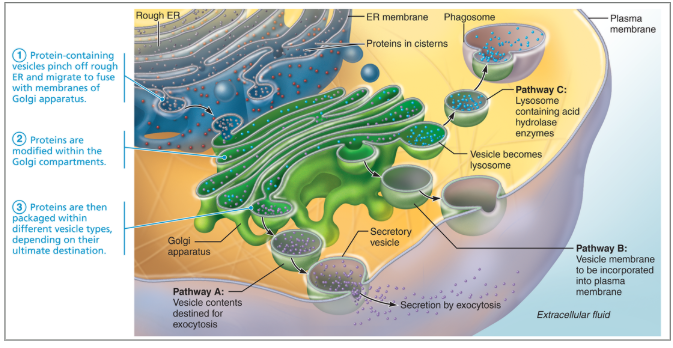
Re: The Sequence of Events from Protein Synthesis on the Rough ER to the Final Distribution of these Proteins
Okay
Fill in the blanks:
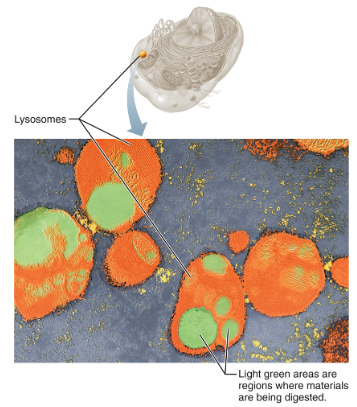
Lysosomes—membrane-walled sacs containing ___ ___
Digest ___ substances
Are the cell’s “demolition crew”
digestive enzymes, unwanted
![<p>Fill in the blanks:</p><ul><li><p><span style="background-color: transparent;"><strong>Mitochondria</strong>—surrounded by ___-___ membrane</span></p><ul><li><p><span style="background-color: transparent;">Generate most of the cell’s energy</span></p></li><li><p><span style="background-color: transparent;">“Power plant” of the cell</span></p></li><li><p><span style="background-color: transparent;">Release energy stored in chemical bonds and transfer energy to produce ATP [energy comes from last ___ of ATP]</span></p></li><li><p><span style="background-color: transparent;">Cells with high ___ requirements have more mitochondria—for example, muscle cells (and spermatozoa)</span></p></li><li><p><span style="background-color: transparent;">Most complex organelle</span></p><ul><li><p><span style="background-color: transparent;">Contain some ___ inherited DNA</span></p></li><li><p><span style="background-color: transparent;">Believed to have arisen from ___</span></p></li></ul></li><li><p>FYI:</p><ul><li><p><span style="background-color: transparent;">Ribosomes and the mitochondrial DNA are within the inner membrane.</span></p></li><li><p><span style="background-color: transparent;">The electron transport chain also occurs in the inner membrane</span></p></li></ul></li></ul></li></ul><p></p>](https://assets.knowt.com/user-attachments/65399bd9-365b-41d2-8328-417da72155fb.png)
Fill in the blanks:
Mitochondria—surrounded by ___-___ membrane
Generate most of the cell’s energy
“Power plant” of the cell
Release energy stored in chemical bonds and transfer energy to produce ATP [energy comes from last ___ of ATP]
Cells with high ___ requirements have more mitochondria—for example, muscle cells (and spermatozoa)
Most complex organelle
Contain some ___ inherited DNA
Believed to have arisen from ___
FYI:
Ribosomes and the mitochondrial DNA are within the inner membrane.
The electron transport chain also occurs in the inner membrane
double-walled, phosphate, energy, maternally, bacteria
Fill in the blanks: Peroxisomes
Peroxisomes—membrane-walled sacs of ___ or ___ ___
Enzymes neutralize ___ ___ and break down ___
Break down long chains of ___ ___
Are numerous in the ___ and ___ [both can make ATP from new substances]
Are the “toxic waste removal system”
oxidase, catalase enzymes, free radicals, poisons, fatty acids, liver, kidneys
Fill in the blanks: Cytoplasmic Organelles
Cytoskeleton—“cell skeleton”—an elaborate network of ___
Contains three types of rods:
Microfilaments—filaments of contractile protein ___
___ filaments—protein fibers (rope-like)
___ —cylindrical structures made of proteins (column-like)
rods, actin, Intermediate, Microtubules
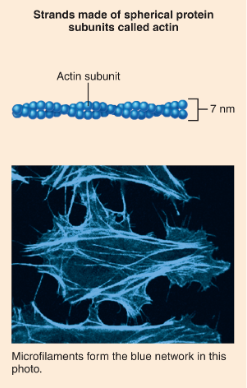
What structure is shown?
Microfilaments
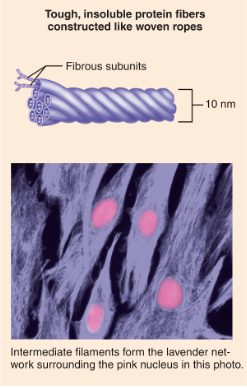
What structure is shown?
Intermediate filaments
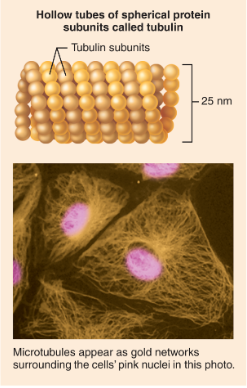
What structure is shown?
Microtubules
Fill in the blanks:
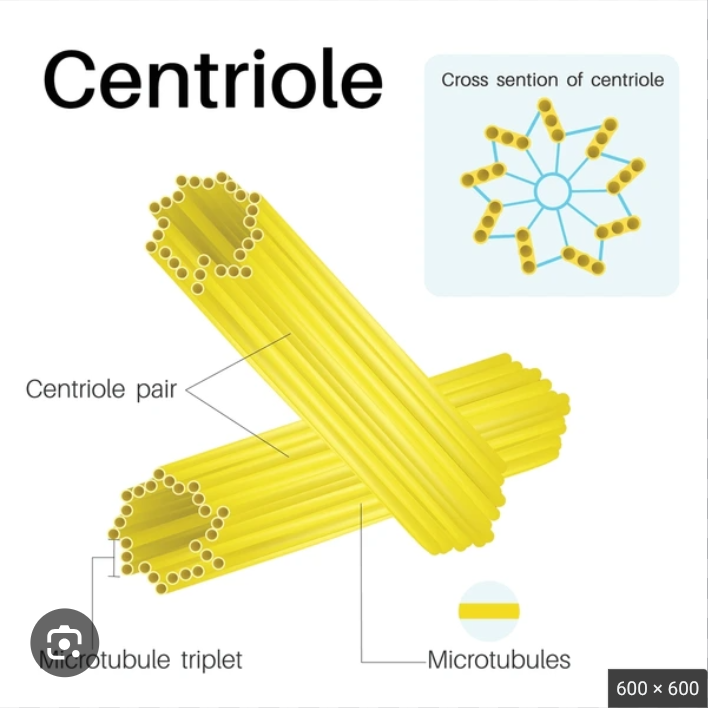
Centrosomes and centrioles
___—a spherical structure in the cytoplasm
Composed of ___ ___ and centrioles
Centrioles—paired cylindrical bodies
Consists of ___ short microtubules (magic number + 1?)
Act in forming cilia, flagella, and the ___ ___
Centrosome, centrosome matrix, 27, miotic spindle
Fill in the blanks: Cytoplasmic Inclusions
Temporary structures
Not present in all cell types
May consist of pigments, crystals of protein, and food stores (also perhaps junk that hasn’t been processed by lysosomes yet)
___ ___ —found in liver cells and fat cells
___ —store sugar in the form of glycogen
Lipid droplets, Glycosomes
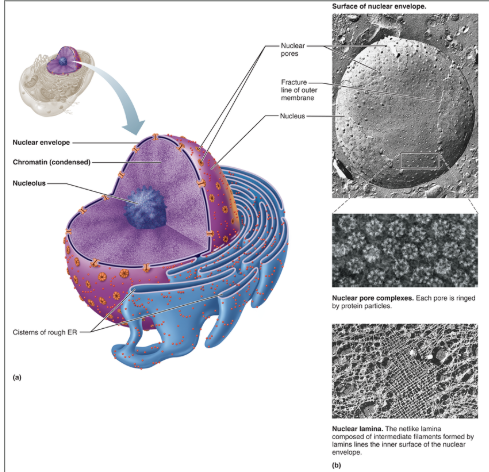
Fill in the blanks:
The nucleus
Control center of the cell
D N A directs the cell’s activities
Provides instructions for protein synthesis
Nucleus is approximately ___ µm in diameter
Nuclear envelope— ___ ___ membranes separated by fluid-filled space
Nuclear pores penetrate the nuclear envelope
Pores allow ___ molecules to pass in and out of the nucleus
5, 2 parallel, large
Fill in the blanks:
Nucleolus—“little nucleus”—in the ___ of the nucleus
Contains parts of several ___
Site of ___ ___ assembly
center, chromosomes, ribosome subunit
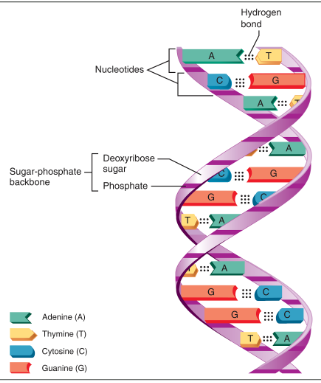
Fill in the blank: Chromatin and Chromosomes
DNA double helix is composed of four subunits:
Thymine (T), adenine (A), cytosine (C), and guanine (G)
DNA is packed with protein molecules
DNA plus the proteins form ___
Each cluster of DNA and ___ histone proteins is a nucleosome
Extended chromatin
Is the ___ region of DNA where DNA’s genetic code is copied onto mRNA in transcription
Condensed chromatin
Tightly coiled nucleosomes
___ form of chromatin
chromatin, 4, active, inactive
Fill in the blanks:
Chromosomes—highest level of organization of ___ (has an X shape)
Each part of the chromosomal X is a ___
Contains a long molecule of DNA
A typical human cell contains ___ chromosomes total
A pair of ___ from each parent
chromatin, chromatid, 46, 23

Review of Chromatic and Chromosome Structure
Active recall exercise: Cover the captions and quiz yourself on each one
Okay
Fill in the blanks: The Cell Life Cycle
The cell life cycle is the series of changes a cell undergoes
Interphase
G1 phase—growth 1, or Gap 1, phase
The ___ part of interphase
Cell metabolically ___
Makes proteins and grows rapidly
___ in length from hours to years (egg cell)
___ begin to replicate near the end of G1
first, active, variable, centrioles
Fill in the blanks: The Cell Life Cycle
S (synthetic) phase—DNA replicates itself
Ensures that daughter cells receive ___ copies of the genetic material (___ extended)
G2 phase—growth 2, or Gap 2
___ finish copying themselves
___ needed for cell division are synthesized in G2
During all three phases (G1, S, & G2), the cell carries out its normal metabolic activities
identical, chromatin, centrioles, enzymes
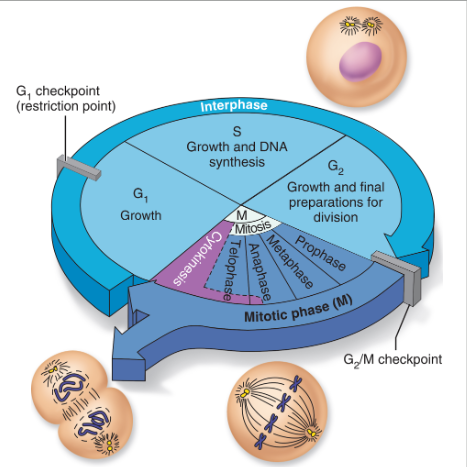
Reminder: The Cell Cycle
Active Recall Exercise: Try to redraw the diagram from memory or simply recall the order
Okay
Fill in the blanks: The Cell Life Cycle
Cell division
M (mitotic) phase—cells ___ during this stage
Follows interphase (G1, S, and G2)
Cell division involves:
Mitosis—division of the ___ during cell division
___ are distributed to the two daughter nuclei
Cytokinesis—separation of one cell into two
Occurs after the nucleus ___
divide, nucleus, chromosomes, divides
Fill in the blanks: The Stages of Mitosis
Prophase—the first and ___ stage of mitosis
Early prophase—chromatin threads ___ into chromosomes
Chromosomes are made up of two threads called chromatids (sister chromatids)
Chromatids are held ___ by the centromere
Centriole pairs (forming the centromere) separate from one another
The ___ ___ forms
longest, condense, together, mitotic spindle
Fill in the blanks: The Stages of Mitosis
Prophase
Late prophase—centrioles continue moving ___ from each other
Nuclear membrane ___
away, fragments

Review: Mitosis
Active Recall Exercise: Cover the captions and quiz yourself on them.
Okay
Fill in the blanks: The Stages of Mitosis
Metaphase—the ___ stage of mitosis
Chromosomes cluster at the middle of the cell
___ are aligned along the equator
Anaphase—the third and ___ stage of mitosis
Centromeres of chromosomes ___
second, centromeres, shortest, split

Review: Mitosis
Active Recall Exercise: Cover the captions and quiz yourself.
Okay
Fill in the blanks: The Stages of Mitosis
Telophase begins as chromosomal movement ___
Chromosomes at opposite poles of the cell ___
Resume threadlike extended-___ form
A new nuclear ___ forms
Cytokinesis completes the division of the cell into ___ daughter cells
stops, uncoil, chromatin, envelope, two
Fill in the blanks: Developmental Aspects of Cells
Specialized functions of cells relate to:
___ of cell
Arrangement of ___
Different cells have different ratios of organelles. For example, cells that move more require more mitochondria (ie heart cells and spermatazoa)
shape, organelles

Fill in the blanks: Cellular Diversity
Cells that connect body parts or cover organs
Fibroblast—makes and secretes ___ component of fibers
Epithelial cell—the shape allows ___ number of epithelial cells to pack together
Erythrocyte—concave shape provides surface area for ___ of the respiratory gases
Increase of surface area = more ___ efficiency
protein, maximum, uptake, functional

Fill in the blanks: Cellular Diversity
Cells that move organs and body parts
Skeletal and ___ muscle cells
Elongated and filled with actin and ___
Shorten ___
FYI: Contracts quickly, but relaxes slowly, so (ie GI) pain lasts longer.
smooth, myosin, forcefully
![<p>Fill in the blanks: Cellular Diversity</p><ul><li><p><span style="background-color: transparent;">Cells that <strong>store nutrients</strong></span></p><ul><li><p><span style="background-color: transparent;"><strong>___ ___</strong>—shape is produced by large fat droplet in its cytoplasm</span></p><ul><li><p><span style="background-color: transparent;">Identifiable by presence of one nuclei per cell</span></p></li></ul></li></ul></li><li><p><span style="background-color: transparent;">Cells that <strong>fight disease</strong></span></p><ul><li><p><span style="background-color: transparent;"><strong>___</strong>—moves through tissue to reach infection sites</span></p><ul><li><p><span style="background-color: transparent;">FYI: can squeeze through epithealial tissue and take up residence elsewhere</span></p></li></ul></li></ul></li><li><p><span style="background-color: transparent;">Cells that <strong>gather information</strong></span></p><ul><li><p><span style="background-color: transparent;"><strong>___</strong>—has long processes for receiving and transmitting messages</span></p></li></ul></li><li><p><span style="background-color: transparent;">Cells of <strong>reproduction</strong></span></p><ul><li><p><span style="background-color: transparent;"><strong>___</strong> (male)—possesses long tail for swimming to the egg for fertilization [and to burrow into egg]</span></p></li></ul></li></ul><p></p>](https://assets.knowt.com/user-attachments/ab809db3-1402-4cb8-86da-ba3e3ee665cc.png)
Fill in the blanks: Cellular Diversity
Cells that store nutrients
___ ___—shape is produced by large fat droplet in its cytoplasm
Identifiable by presence of one nuclei per cell
Cells that fight disease
___—moves through tissue to reach infection sites
FYI: can squeeze through epithealial tissue and take up residence elsewhere
Cells that gather information
___—has long processes for receiving and transmitting messages
Cells of reproduction
___ (male)—possesses long tail for swimming to the egg for fertilization [and to burrow into egg]
fat cell, macrophage, neuron, sperm
Fill in the blanks: Aging
Aging—a complex process caused by a variety of factors
Free ___ theory
Damage from by-products of cellular metabolism
Radicals build up and damage essential molecules of cells
___ theory
A decrease in production of energy by mitochondria weakens and ages our cells
Genetic theory proposes that aging is programmed by genes
___ —structures that limit the maximum number of times cells can divide
___ —prevents telomeres from degrading
FYI: Determined by genes, those with more telomerase or telomeres that can divide more times can extend how many times telomeres can divide and can ultimately live longer.
radical, mitochondrial, telomeres, telomerase