8.2 Analysis of Organic Substances
 Call Kai
 Learn
Learn Practice Test
 Spaced Repetition
 Match
Match Flashcards
 Knowt Play
1/28

There's no tags or description
Looks like no tags are added yet.
Name | Mastery | Learn | Test | Matching | Spaced | Call with Kai | Chat |
|---|
No analytics yet
Send a link to your students to track their progress
29 Terms
Analytical chemistry
branch of chemistry which deals with the indentification and quantification of substances:
Qualitative
Quantitative
Qualitative analytic chemistry
what is present?
Quantitative analytical chemistry
how much is present?
Bromine water test
for unsaturation — used to identify the presence of double or triple bonds
electrophilic species (bromine water is an electrophilic reagent) will add across double or triple bonds.
distinct decolourisation of bromine water (from orange/brown to colourless) of the reagent when unsaturation is present
electrophilic species
electron-loving species
can add across double bonds
Identification of alcohols
have the hydroxyl (OH) group as their primary functional group
Primary and secondary can be oxidised using strong oxidant (e.g. acidified potassium dichromate)
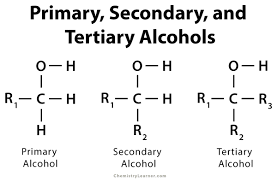
oxidisation by strong oxidant
(potassium dichromate, acidified postassium permanganate)
tests for presence of primary or secondary alcohols
NOTE: aldehydes will also give a positive result
primary alcohol → aldehyde → carboxylic acid
secondary alcohol → ketone
orange dichromate ion (Cr2 O72-) will reduce to the green chromium (II) ion, Cr2+
purple permanganate ion (MnO4 -) will reduce to the colourless manganese (II) ion, Mn2+
NOTE: tertiary alcohols cannot be oxidised and thus will not change colour to any oxidants
Lucas test
distinguishes between the three classes of alcohols based on the difference in their reactivity with hydrogen halides
primary alcohols have no visible reaction after several minutes
secondary alcohols form an oily layer after several minutes
tertiary alcohols form an oily layer immediately
litmus tests, carbonate, metal tests
tests for carboxylic acids
as they are acids, they turn blue litmus paper red
produces CO2 gas (fizzing) when a carbonate is added
Hydrogen gas (fizzing) when reacted with sodium or magnesium metal
AgNO3 (aq) tests on haloalkanes
Fluoroalkanes do not react
Chloroalkanes form a white precipitate (AgCl) after several minutes
Bromoalkanes form a cream precipitate (AgBr) within a minute
Iodoalkanes form a yellow precipitate (AgI) within seconds
Infrared (IR) spectroscopy
used as a quantitative test of organic compounds to determine the presence of functional groups
wet chemical tests
classical laboratory methods that use liquid solutions, reagents, and basic glassware to identify or measure the amount of a substance
essentially limited to qualitative investigation
nature of an organic compound can give misleading results if more than one functional group is present.
they can:
identify each individual functional group present
identify the molecular formula of a compound
distinguish between structural isomers
analyse mixtures of organic compounds
quantify the amount of each organic compound present
mass spectrometer
an analytical instrument that identifies and quantifies molecules by converting them into ions and measuring their mass-to-charge ratio
ionisation chamber
here, the sample is bombarded by a high energy electron beam, which knocks a valence electron of the molecule to form a molecular ion (M+)
mass analyser
molecular ions are accelerated by an electric field which is curved, then deflected by a magnetic field. ions with different m/z (mass to charge) ratios are deflected to different extents
results in ‘sorting’ of ions according to their mass to charge ratio
detector
detects and quantifies the separated ions, producing a mass spectrum
base peak
most common fragmentation peak (mass spec) - highest relative intensity
parent peak
the signal that represents the complete, unfragmented molecule with a single electron removed (mass spec)
mass spectrometer
plot of relative intensity vs m/z
relative intensity assigns the molecular fragment with the highest abundance - a value of 100
NMR (nuclear magnetic resonance spectroscopy)
technique used to determine a compound’s unique structure
it identifies the carbon-hydrogen framework of an organic compound
HNMR spectroscopy or proton NMR - analyses the hydrogen-1 nucleus
CNMR spectroscopy - examines carbon-13 nucleus
magnetic moment
measure of a magnet's overall strength and the direction it tries to point inside an external magnetic field
resonance
the exact moment when an atomic nucleus in a magnetic field absorbs radio-frequency energy and flips its spin state
superconducting magnets
produce a very strong magnetic field
radio frequent (RF) generator
excites the nucleir causing a flip-spin
chemical environment
____ of a specific atom within a molecule includes the atom and its surrounding electrons
electron shielding
the way surrounding electron clouds protect a nucleus from an external magnetic field - reduces the experienced field. since the magnetic field experienced at the nucleus defines the energy between different spin states, it also defines what the chemical shift will be for the nucleus
signal splitting
many single peaks on a low-resolution spectrum will consist of multiple peaks on a high resolution spectrum (HNMR)
the division of a single NMR signal into multiple peaks caused by the magnetic influence of neighboring, non-equivalent nuclei
indicates with the n+1 rule how many hydrogens are on the neighbouring carbon for each environment
n+1 rule
predicts the number of peaks (multiplicity) a signal will split into based on the number of neighboring equivalent protons
e.g. if there are three peaks → the environment has two hydrogens on the neighbouring carbon (2 adjacent hydrogens)
relative peak area
HNMR - tells you how many hydrogens are in the environment that cluster of peaks represents - NOTE: THIS IS A RATIO (between the different environments)