Lecture 3d: Eye Movements Part 2 - Saccades Quiz
 Call Kai
 Learn
Learn Practice Test
 Spaced Repetition
 Match
Match Flashcards
 Knowt Play
1/51

There's no tags or description
Looks like no tags are added yet.
Name | Mastery | Learn | Test | Matching | Spaced | Call with Kai | Chat |
|---|
No analytics yet
Send a link to your students to track their progress
52 Terms
Saccades
The fast eye movements that place the retinal image of the object of interest on the fovea.
Reading Eye Movements
Typical eye movements made while reading, showing
fixational pauses (F), interfixational saccades (S) and a
regressional movement (R).
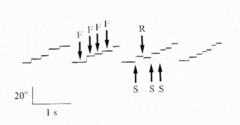
fixational pauses
Typical eye movements made while reading
what is F?
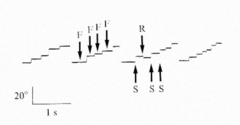
regressional movement
Typical eye movements made while reading
what is R?
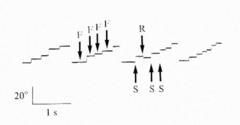
interfixational saccades
Typical eye movements made while reading
what is S?
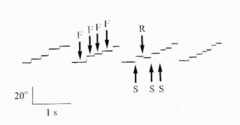
saccades
Amplitude and frequency of what depend on the skill of the reader and the difficulty of the reading matter?
amplitude, frequency
What of saccades depend on the skill of the reader and the difficulty of the reading matter?
Developmental Eye Movement Test (DEM)
Comparison data for children aged 6-13 yr. Use if suspect decreased reading skills are due to eye movement problem.
Task: say the numbers out loud, down a line, then across the line
The time to complete the task is timed; any errors made add to the
time score (there is a formula for this)
saccades
What is the Developmental Eye Movement Test (DEM) testing?
at least 100-200ms
what is the latency of the Saccades?
decreased
How is the latency of saccades affected by anticipation?
from anticipation
How is the latency of saccades decreased?
1 degree
What is the minimum amplitude of a saccade?
~100 degrees
What is the maximum amplitude of a saccade?
~15 degrees
What amplitude do most saccades occur in?
20 degrees
Greater than what amplitude usually results in 2 saccades and/or head movement?
a
Greater than 20 deg movements, there are 2 saccades where the first saccade is...
a) 90% of movement
b) 10% of movement
b
Greater than 20 deg movements, there are 2 saccades where the second saccade is...
a) 90% of movement
b) 10% of movement
~7-900deg/sec
the peak velocity of a saccade is?
50ms
the maximum duration of a saccade is?
b
The duration of a saccade is longer for...
a) smaller saccades
b) larger saccades
a
The duration of a saccade is shorter for...
a) smaller saccades
b) larger saccades
Retinal blurring
What is not noticed during a saccade?
Elevation of visual threshold by ~0.5 log units (visual suppression)
~0.5 log units
Retinal blurring is not noticed during a saccade, elevation of visual threshold by how much (visual suppression)?
motion blur
There is an absence of a perception, namely not perceiving your own saccades under normal circumstances. This mechanism is used to suppress what during saccades?
15 degrees
More than 85% of saccades have amplitudes greater than what?
85%
More than what percent of saccades have amplitudes greater than 15 degrees?
amplitude
Saccade duration increase as what increases?
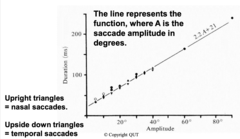
large saccades
Peak velocity starts to level off for what?
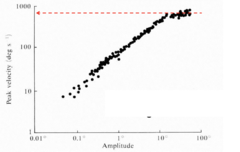
automatic
Voluntary eye movements (we can choose to look at something or not), once initiated their execution is...
vision
Saccade is so fast there is no time to use what to guide the eye to its final position?
Saccades
What is so fast there is no time to use vision to guide the eye to its final position?
they are very fast, they are fast,
For saccades, there is no time to use vision to guide the eye to its final position because?
final position
Saccade is so fast there is no time to use vision to guide the eye to its...?
Saccade control system must calculate in advance the muscle activation required.
Slight over shoot, small corrections (corrective saccade)
Saccade is so fast there is no time to use vision to guide the eye to its final position. Saccade control system must calculate in advance the muscle activation required.
Resultant movement is pre-programmed or ballistic therefore what is common for saccades?
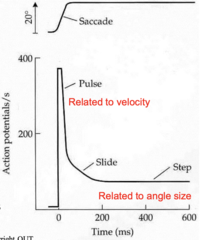
overcome eye's inertia (orbital viscous drag)
Saccades are produced by burst of neural activity, then train of impulses. The initial burst is for what?
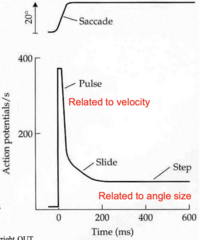
velocity required
Pulse related to what of the saccade?
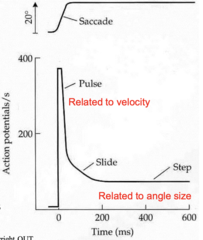
pulse
what related to velocity required for the saccade?
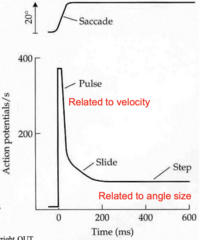
saccade amplitude
Size of step determines what?
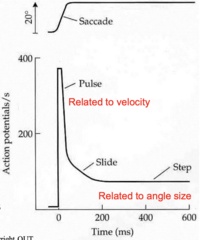
burst neurons (in the brain stem)
Each saccade is associated with a burst of activity initiated from?
step
The size of what determines saccade amplitude?
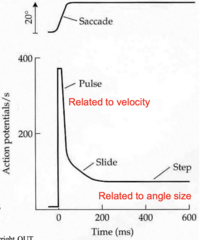
tonic neurons (in the brain stem)
At the new position there is a tonic position-related discharge, controlled by?
duration of saccade
Duration of pulse determines what?
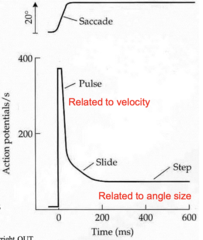
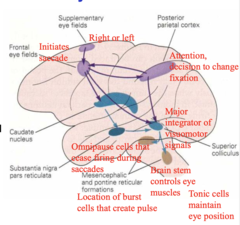
Frontal cortex
Saccades Are Controlled by the?
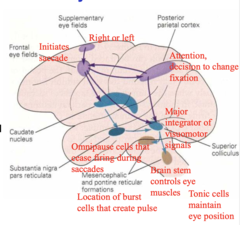
duration of pulse
What determines duration of saccade?
frontal cortex
The saccades are driven by what?
A decision and choice is required to initiate the saccade.
superior colliculus
Cortex controls saccadic system through the?
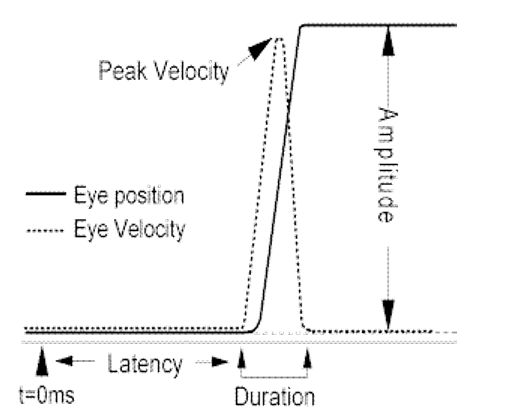
Amplitude
The size of the saccade, measured in degress or min of arc.
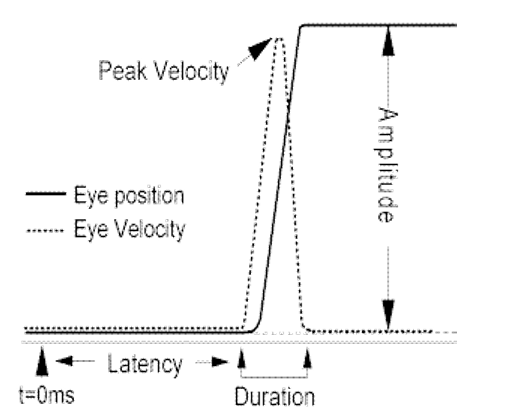
Peak Velocity
The highest velocity reached during the saccade. Saccade velocity profiles are usually symmetrical at least for small and medium size saccades.
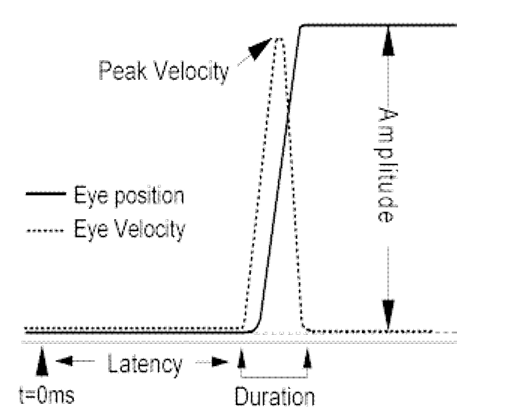
Duration
Time taken to complete the saccade. Partly because of the high velocities involved, most saccades are complete within a few tens of milliseconds.
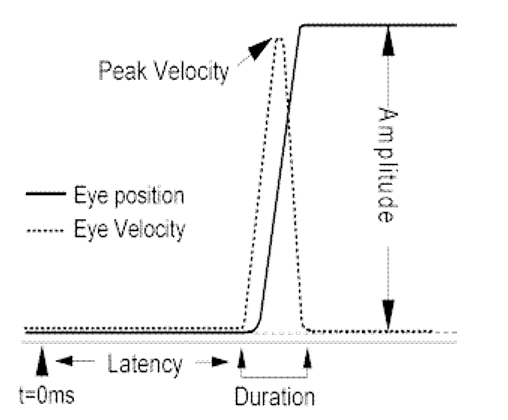
Latency
Time taken from the appearance of a target to the beginning of a saccade in response to that target.
Saccadic Suppression
The phenomenon where the brain selectively blocks visual processing during rapid eye movements.