Lecture 4: Concepts and Mathematic Methods for Economics
 Call Kai
 Learn
Learn Practice Test
 Spaced Repetition
 Match
Match Flashcards
 Knowt Play
1/14

There's no tags or description
Looks like no tags are added yet.
Name | Mastery | Learn | Test | Matching | Spaced | Call with Kai | Chat |
|---|
No analytics yet
Send a link to your students to track their progress
15 Terms
SECTION 1) MRS and Price Ratio

Example: Suppose MRS=4 and the price ratio=2 what does this tell us about how the consumer could optimize preference? What rule does this reveal?
The consumer is willing to give up 4 units of y for 1 unit of x. The market allows for 2 units of y to be given up for one unit of x. The consumer is willing to trade off more units of good y for good x than what the market requires, therefore the consumer should increase consumption of good x.
Rule revealed: when MRS > price ratio then consume more of good x.
Example: Suppose MRS=1 and price ratio =2 what does this tell us about how the consumer should optimize preference? What rule does this reveal?
The consumer is willing to give up one unit of y for one unit of x. The market requires that 2 units of y be given up for one unit of x. Since the consumer values good x less than the market does, they should consume less og good x.
Rule: When MRS < price ration then consume less of x.
SECTION 2] OPTIMUM BASICS
What is the optimum formula
slope of indifference curve (MRS) = slope of budget constraint (price ratio)
MRS= mux/muy = Px/Py
This is only true at the optimum, whereas MRS= mux/muy is true everywhere.
MRS= mux/muy = Px/Py can be rearranged as mux/Px= muy/ Py what does this remind you of?
The equal marginal principle!
Note: the optimum point satisfies the equal marginal principle and thus is the point where utility is maximized.
Graphing Optimums example: Consumer has an income of 500 dollars to spend on gas and all other goods. the price of gas was initially $2 but increases to 2.5. What happens to the quantity of gas? What happens to expenditures on gas?

What happens if mux/muy never equals Px/Py
Corner solutions!

SECTION 3) OPTIMUM MATHMATICALY
Where is the optimum of any function f(x)
Either at a minimum or a maximum.
where f’(x)= 0
Individual economic decisions typically involve maxima (utility/profit) and minima (cost/ependiture), and constrains (income)
The derivative and studying marginal relationships

Derivative Review. What does a derivative < > = 0 mean in the function profit (pie)=f(quantity) where would this be on a graph
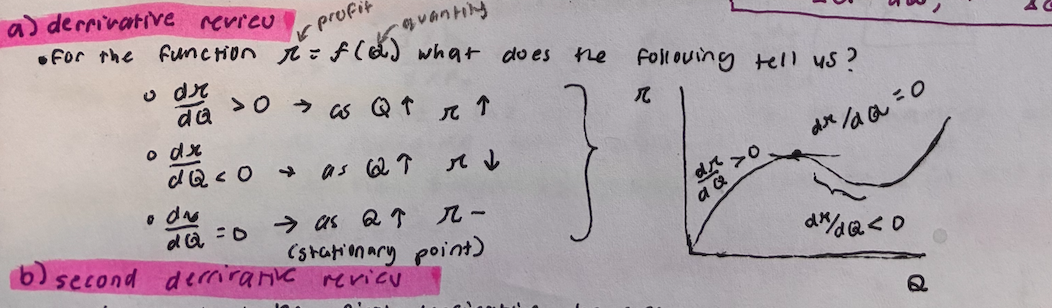
Second Derrivative Review: what does a positive, negative and zero second derrivative tell you about the same function above?

How do you optimize a single variable funciton?

optimizing a 2 variable function
