CHAPTER 2: COGNITIVE PSYCHOLOGY (BOOK 6TH EDITION)
 Call Kai
 Learn
Learn Practice Test
 Spaced Repetition
 Match
Match Flashcards
 Knowt Play
1/118

There's no tags or description
Looks like no tags are added yet.
Name | Mastery | Learn | Test | Matching | Spaced | Call with Kai | Chat |
|---|
No analytics yet
Send a link to your students to track their progress
119 Terms
Cognitive neuroscience
Field of study linking the brain and nervous system to cognitive processing and to behavior.
Brain
Organ of our bodies that directly control our thoughts, emotions, and motivation.
Localization of functions
refers to the specific areas of the brain that control specific
skills or behaviors.
Nervous system
is the basis for our ability to perceive, adapt to, and interact
with the world around us
forebrain
mid brain
hindbrain
3 major regions of the brain
forebrain
in embryo this is refers to the farthest region of the brain
Cerebral Cortex
Basal Ganglia
Limbic System
Thalamus
Hypothalamus
The forebrain composes of what part of the brain?
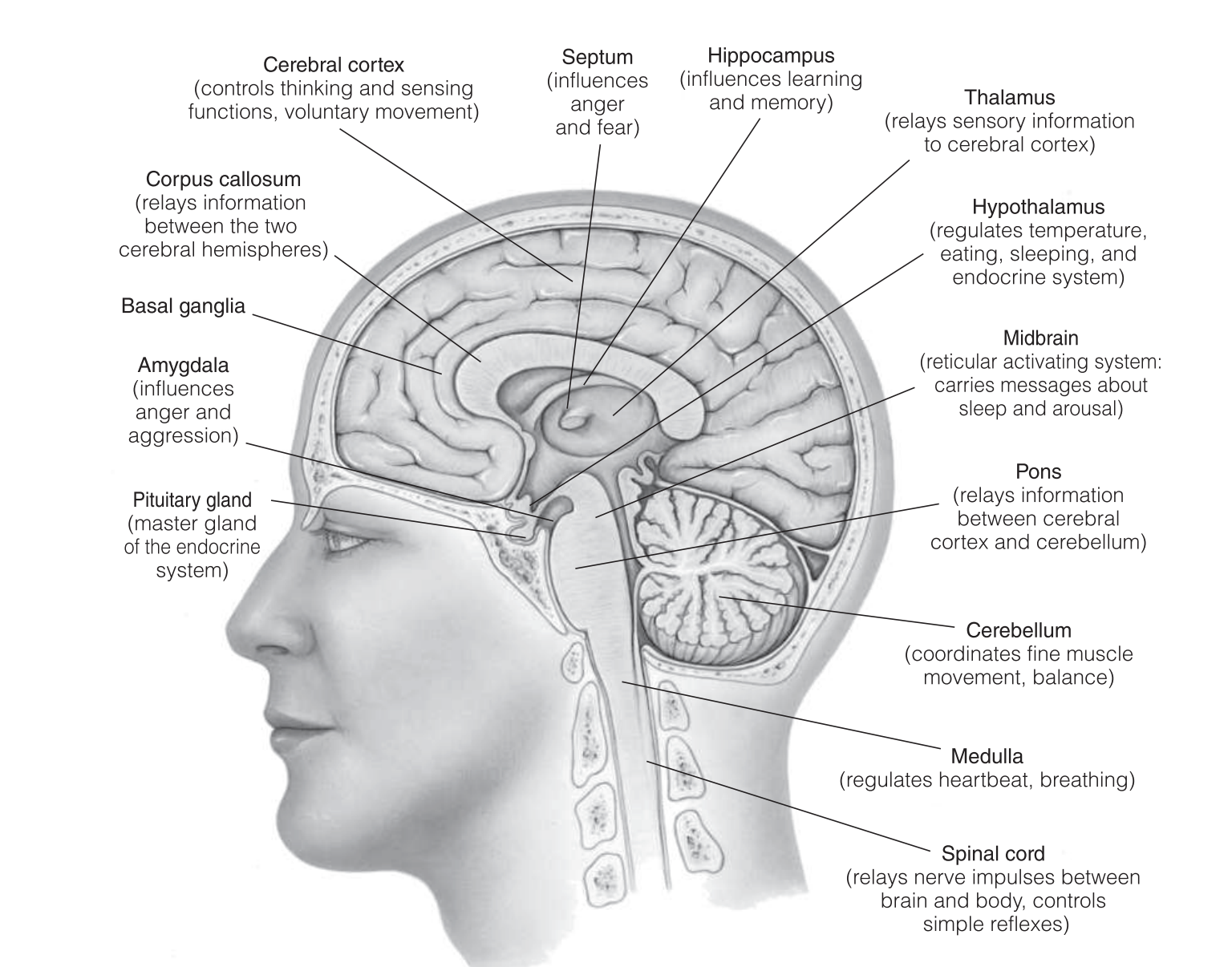
Pituitary Gland
(master gland
of the endocrine
system)
Amygdala
(influences anger and aggression)
Corpus Callosum
(relays information
between the two
cerebral hemispheres)
Cerebral Cortex
(controls thinking and sensing
functions, voluntary movement)
Septum
(influences
anger
and fear)
Hippocampus
(influences learning
and memory)
Thalamus (sensory information)
(relays sensory information
to cerebral cortex)
Hypothalamus
(regulates temperature,
eating, sleeping, and
endocrine system)
Midbrain (SA)
(reticular activating system: RAS carries messages about sleep and arousal)
region of the brain
Pons (cerebellum to cerebral cortex)
(relays information between cerebral cortex and cerebellum)
Cerebellum
(coordinates fine muscle
movement, balance)
Medulla Oblongata
(regulates heartbeat, breathing) (blood and heart related)
Spinal Cord
(relays nerve impulses between
brain and body, controls
simple reflexes)
Basal Ganglia
Part of the forebrain
This are collection of neurons for motor function.
Parkinson’s disease
Huntington’s disease
what are the deficit or disease when there is a damage to basal ganglia?
Emotion
Motivation
Memory and Learning
What is limbic system for?
Instincts
Fish and reptiles have undeveloped limbic system so they depend solely on their?
Suppress Instinctive responses
Our limbic system allows us to ___ ____ ____ (e.g., the impulse to strike someone who accidentally causes us pain)
Septum (emotion → anger & fear)
Amygdala (emotion → anger and aggression)
Hippocampus (motivation, learning, memory)
Limbic system composes of 3 central interconnected cerebral structures.
Amygdala
Stimulation to this can cause fear
Causes: palpitations, fearful hallucinations, or frightening flashbacks in memory.
emotional stimuli
amygdala also has an enhancing effect for the perception of ___ ____
Autism Spectrum Disorder
Deficit in amygdala results in what disorder?
Cannot recognize face and its emotions
Difficulty evaluating people’s trustworthiness
What are the diagnosis for ASD or Autism?
Anterograde Amnesia
what amnesia can if hippocampus is removed?
Korsakoff Syndrome
disease as known as loss of memory function
Related to hippocampus
Apathy
Paralysis of the muscle of the eye
Tremor
what are the diagnosis for Korsakoff syndrome?
Deterioration of Hippocampus
Lack of Vitamin B1 or Thiamine
Excessive Alcohol use
What are the causes why there is a Korsakoff syndrome?
Declarative Memory (yes)
Procedural Memory (not)
If you have damage in your Hippocampus what memory is primarily affected? and what is not
Thalamus
center of the brain about eye level
relay station for the sensory
Nuclei
as we know thalamus is the relay station for the sensory information by it, it is divided into a number of ___ for that for each senses to received an information.
Waking
Sleeping
What are the other functions of thalamus where it controls by thalamus? (WS)
Disruption of waking and sleeping
Pain
Tremor
Amnesia
Impairment of language
What are the result when damaged to Thalamus?
Reticular Activating System (RAS)
Part of the midbrain that is for sleep and arousal
Schizophrenia
Abnormal changes to thalamus can result to?
Hypothalamus
regulates behavior related to species survival: fighting, feeding, fleeing, and mating.
Regulating emotions
Reaction to stress
Hypothalamus is also interacting with limbic system, what hypothalamus can contribute?
Thalamus
Ang tala dugay ni sleep og ni wake
Narcolepsy
Hypothalamus is also for sleep; what disorder is related to hypothalamus damage?
A person often sleep at unpredictable times
Define what is narcolepsy
Growth Hormone Oxytocin (Bonding process and Sexual Arousal)
Since the hypothalamus is for hormones what hormones is likely to regulate by hypothalamus?
Midbrain
Helps to control eye movement and coordination
Control for visual and auditory information
for nonmammals the Midbrain for them is primarily for?
Reticular Activating System (RAS)
This is a network of neurons that is for regulation of consciousness (such as sleep, wakefulness, arousal, attention)
Cerebral Cortex
Involved in receiving and processing sensory information, thinking, other cognitive processing, and planning and sending motor information
Can easily remember it is the “Process Entirely”
Basal Ganglia
Crucial to the function of the motor system
Ganglia
Collection of neural fibers
Limbic System
Involved in learning, emotions, and motivation
Cerebellum (balance and equilibrium)
to the primary motor cortex, permitting us to sense physical balance and equilibrium
Hypothalamus
Controls the endocrine system; controls the
autonomic nervous system, such as internal
temperature regulation, appetite and thirst
regulation, and other key functions
Superior Colliculi
Involved in vision (especially visual reflexes) → part of midbrain
Inferior colliculi
Involved in hearing → part of midbrain
Cerebellum
Essential to balance, coordination, and
muscle tone
Pons
Involved in consciousness (sleep and
arousal); bridges neural transmissions from
one part of the brain to another; involved
with facial nerves
Medulla oblongata
Serves as juncture at which nerves cross
from one side of the body to opposite side
of the brain; involved in cardiorespiratory
function, digestion, and swallowing
Thalamus (wake & sleep & consciousness)
Hypothalamus (regulating sleep)
RAS (sleep & arousal & consciousness)
What are the three parts that is important for Sleeping?
Brain Stem
connects the forebrain to the spinal cord.
Thalamus (part of forebrain)
Mid brain
Hind brain
What are the part of the brain stem?
Periaqueductal Gray (PAG)
The region in the brain stem that is essential for certain kinds of adaptive behavior.
Injections of small amounts of excitatory amino acids or, alternatively, electrical stimulation of this area results in any of several responses: an aggressive, confrontational response; avoidance or flight response; heightened defensive reactivity; or reduced reactivity as is experienced after a defeat, when one feels hopeless
Medulla Oblongata
The place at which nerves from the right side of the body cross over to the left side of the brain and nerves from the left side of the body cross over to the right side of the brain.
Pons
serves as a kind of relay station because it contains neural fibers that pass signals from one part of the brain to another. I
ts name derives from the Latin for “bridge,” as it serves a bridging function.
Cerebellum
controls bodily coordination, balance, and muscle tone, as well as some aspects of memory involving procedure-related movements
Cerebral Cortex
Plays an extremely important role in human cognition.
It forms a 1- to 3-millimeter layer that wraps the surface of the brain somewhat like the bark of a tree wraps around the trunk.
Sulci
Fissure
Gyrus
Cerebral cortex comprise of:
Small Groove
Large Groove
Bulges
80%
how many percent the cortex comprises the human brain?
Corpus Callosum
is a dense aggregate of neural fibers connecting the two cerebral hemispheres
Cerebral Hemisphere
what do you call the left and right hemisphere?
Aphasia
Loss of speech (sPeeCh)
Marc Dax
Who is the doctor treated 40 patients suffering from aphasia? and found out the damage are on left hemisphere?
Brocas Area (Paul Broca)
Cerebral left hemisphere that contribute to speech → part of the brain and area.
Wernicke’s Area
Part of the brain that is for language comprehension (WLW)
Karl Spencer Lashley
described as the father of neuropsychology, started studying localization in 1915. He found that implantations of crudely built electrodes in apparently identical locations in the brain yielded different results.
Gray matter (surface)
White matter (interior)
surface of the cerebral cortex
interior of the cerebral cortex
Nostril goes to the right nostril and process by the right brain (Ipsilateral idea)
As we know our body’s nerve is composed of contralateral ideas, like for the left eye process by the right brain, but what part of the brain that process Ipsilateral?
Roger Sperry
who did discover and won a Nobel Prize for discovering that Cerebral Hemispheres left & right have both different and separate abilities?
Donal Hebb
He was known for the cell assemblies; that neural structure coordinate when there is a frequent stimulation.
Karl Spencer Lashley
he was known for saying the brain is Active.
Jerry Fodor
he said mind has distinct modules → The modularity of mind (TMOM)
Franz Joseph Gall
He said the pattern of bumps and swells on the skulls determined the cognitive abilities.
Epilepsy
When you severe the corpus callosum what it can prevent?
Split Brain Patients
what do you call those patients who severed their corpus callosum?
right hemisphere retains phonetic and semantic abilities but they lack syntactic competence
In people who lack left-hemisphere processing, language development in the right hemisphere retains ____ and _____ abilities, but it is deficient in ______ ______ (Gazzaniga & Hutsler, 1999).
Movement
Despite of language what is the other important things that the left hemisphere is important to?
Apraxia (disorder of skilled movements)
what is the disorder that is related to left hemisphere?
Difficulty following conversation and stories
Difficulty making inferences
Difficulty understanding metaphorical humorous speech.
What are the 3 deficits if have a damage in right hemisphere?
Language
Movement
Examination of past experiences to find patterns
What are the abilities of the Left Hemisphere?
Spatial Visualization
Spatial Orientation
Semantic Knowledge
Practical Language
Self Recognition
What are the abilities of Right Hemisphere?
Left hemisphere
What hemisphere controls the verbal processes of the visual information?
Right Hemisphere
What hemisphere controls the spatial processes of the visual information?
Gazzaniga
Who state the believe that brain is not independent function but a complementary function from each other.
Found out that that before the split brain surgery is that patient can draw 3D cube and after the split brain surgery they can only draw a Reasonable cube from the “left hand”.
Right Hemisphere → outside the Conscious Awareness
→ Left hemisphere
This hemisphere organize in independent units that work in parallel; operates independently of others.
These operation are often outside the ____ ____
______ this hemisphere try to assign that interpretations to this operation.
Right process → Holistically
Left process → Analytically
The right and left hemisphere distinction to process
Frontal Lobe
is associated with motor processing and higher thought processes, such as abstract reasoning, problem solving,
planning, and judgment.
Speech
Frontal lobe is critical for producing?