SOES 2006 - Understanding phytoplankton distributions in time and space. DCM, fronts and eddies.單詞卡 | Quizlet
 Studied by 0 people
 Call with Kai
 Learn
Learn Practice Test
 Spaced Repetition
 Match
Match Flashcards
 Knowt Play
1/42

There's no tags or description
Looks like no tags are added yet.
Name | Mastery | Learn | Test | Matching | Spaced | Call with Kai |
|---|
No study sessions yet.
43 Terms
There would be high chlorophyll in high temperature regions but there isn't- there must be something else going on such as high chlorophyll pulses because of the seasonal cycle (sun getting higher and lower latitude through the year is reflected in surface chlorophyll) or eddies on a smaller scale.
How is it evident that chlorophyll varying across the globe isn't just due to temperature?
Bottom up factors:
- Availability of key resources such as light and nutrients, temperature and pCO2
Growth is controlled by ___ factors such as:
Top down factors:
- grazing, sinking and viral infection or just loss by cell lysis (end of their life cycle).
Loss is controlled by ___ factors such as:
Some phytoplankton develop evolutionary defences against grazing - silica frustules of diatom shells make them harder to graze.
(Viruses tend to be species specific btw).
How can phytoplankton protect themselves from loss by top down factors?
Loss and Growth.
What 2 things dictate overall biomass and net growth of phytoplankton populations?
dP/dt = P (µ - (g + m))
Rate of change of phytoplankton (P) = Amount of phytoplankton (growth rate - ( grazing + mortality (basically any kind of loss rate))
What is the formula for modelling phytoplankton dynamics?
Multiple nutrients, multiple types of phytoplankton and zooplankton.
Models aren't perfect. Phytoplankton have different growth rates and loss terms.
What might more complex models for phytoplankton dynamics include?
Higher.
What latitudes do diatoms dominate in?
When phytoplankton are trapped in a layer depth SHALLOWER than critical depth
(Have nutrients and enough light).
When do we have net growth?
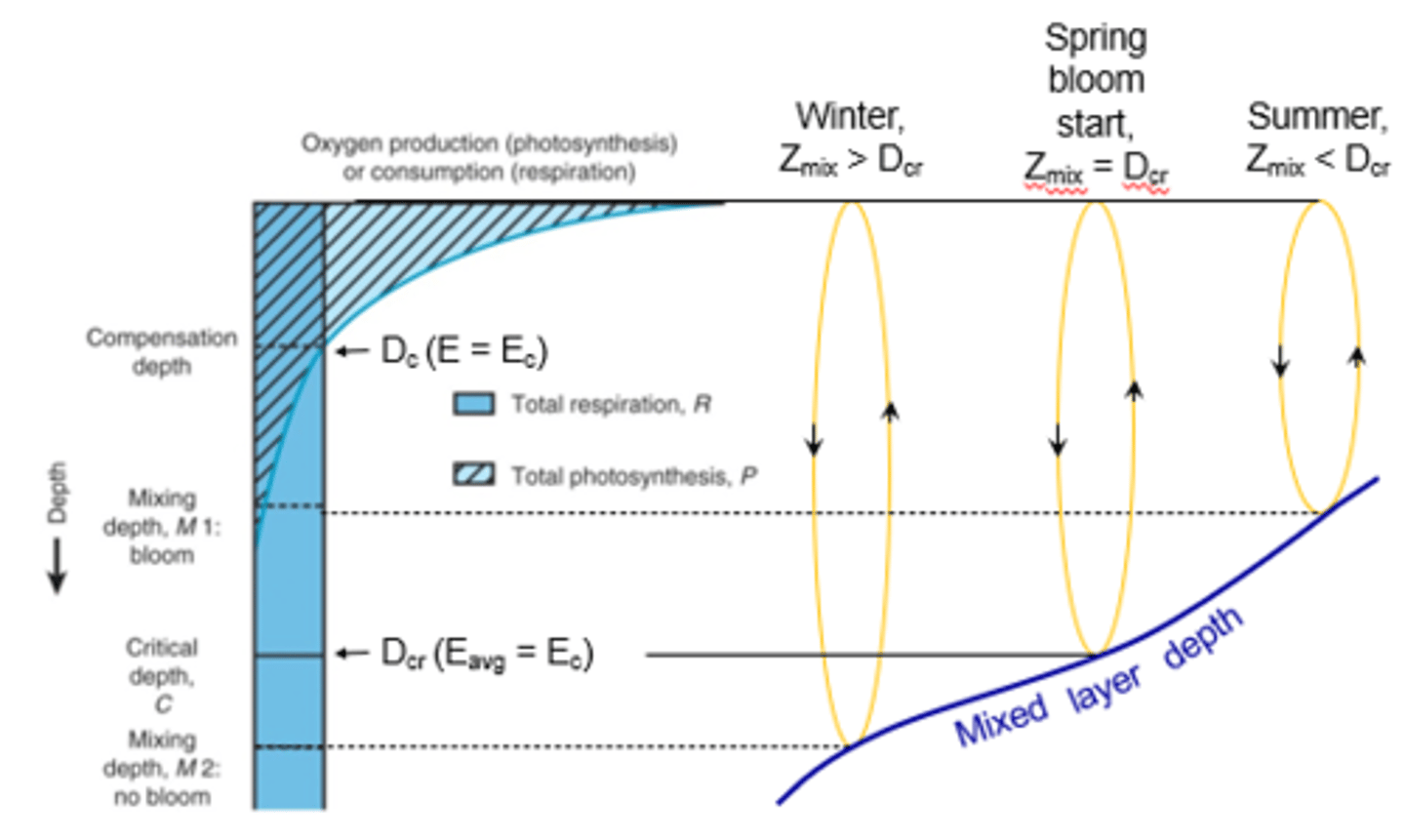
When phytoplankton are trapped in a layer below critical depth.
When do we have net loss?

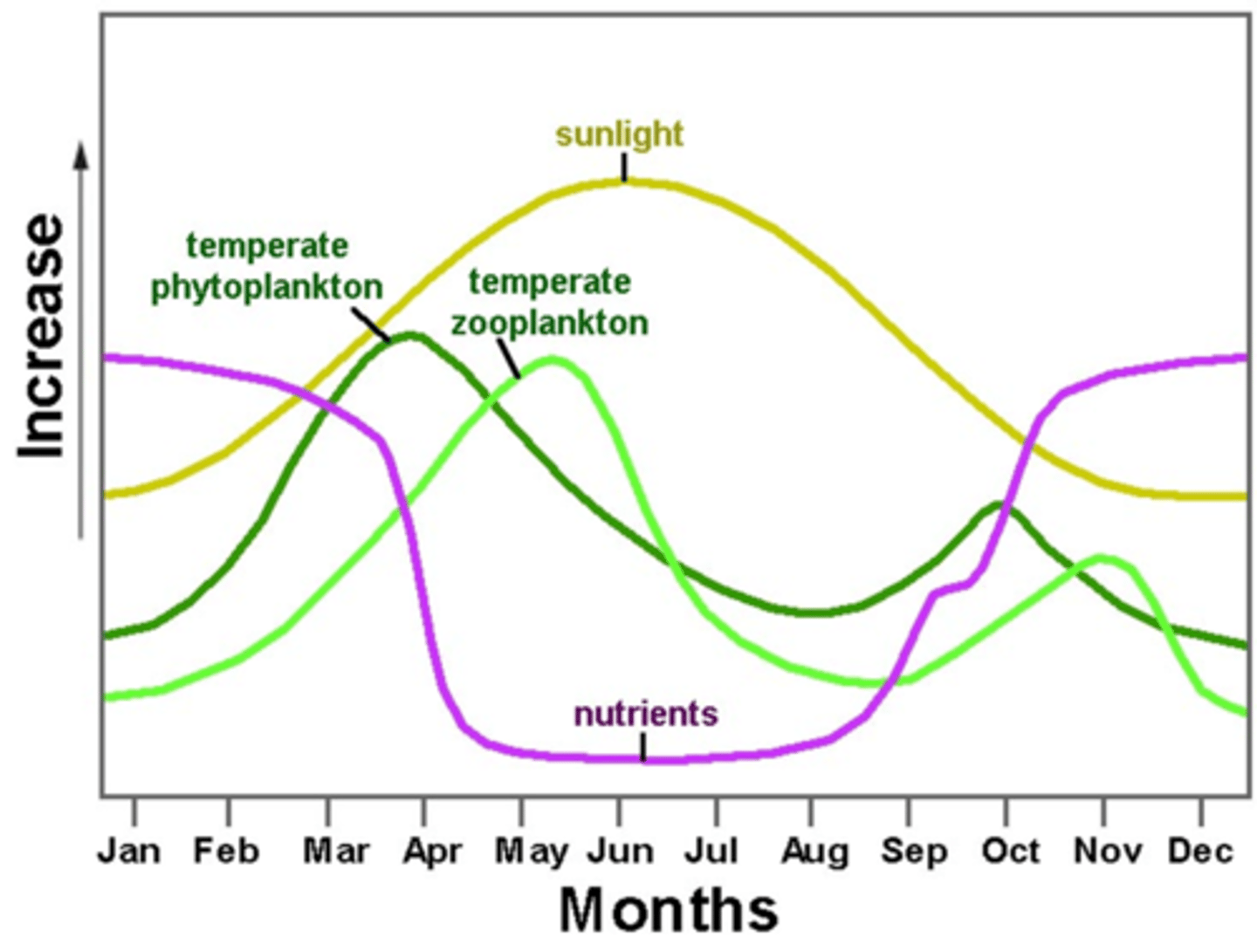
There is more wind mixing and convective overturning. Phytoplankton may be exposed to light near the surface but are circulated deeper into the water column, not having light to grow so that respiration is generally greater during mixing than photosynthesis that may occur just at the surface. Therefore the mixed layer is greater than the critical depth.
What occurs in the winter?
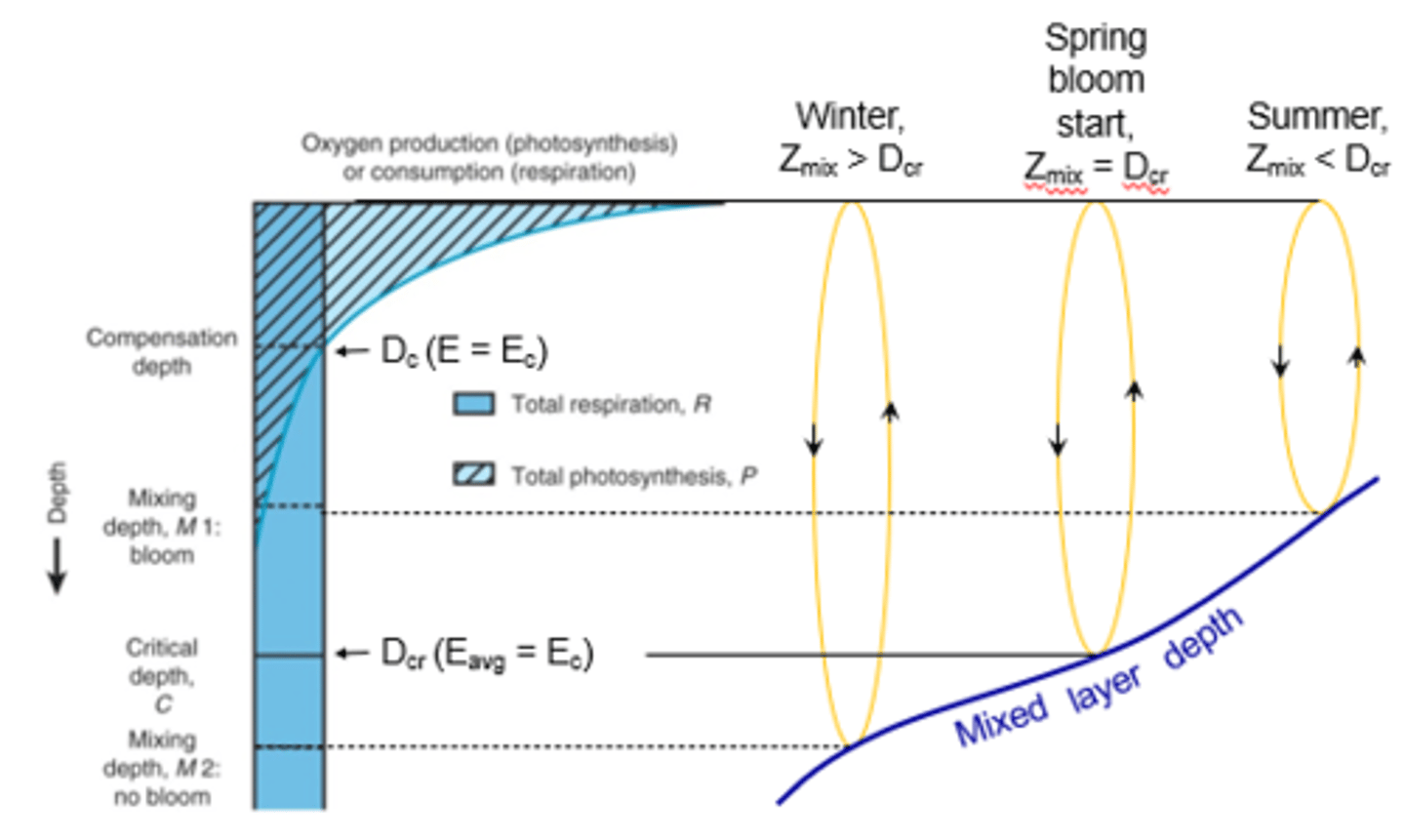
Wind mixing decreases so that the mixed layer shallows. Light availability increases. When the mixed layer gets to the critical depth, there can be net phytoplankton growth in the surface layer, overrunning respiration. Nutrients that were replenished but couldn't be used in the winter can now be used because of the light, causing a bloom.
What occurs in the spring?
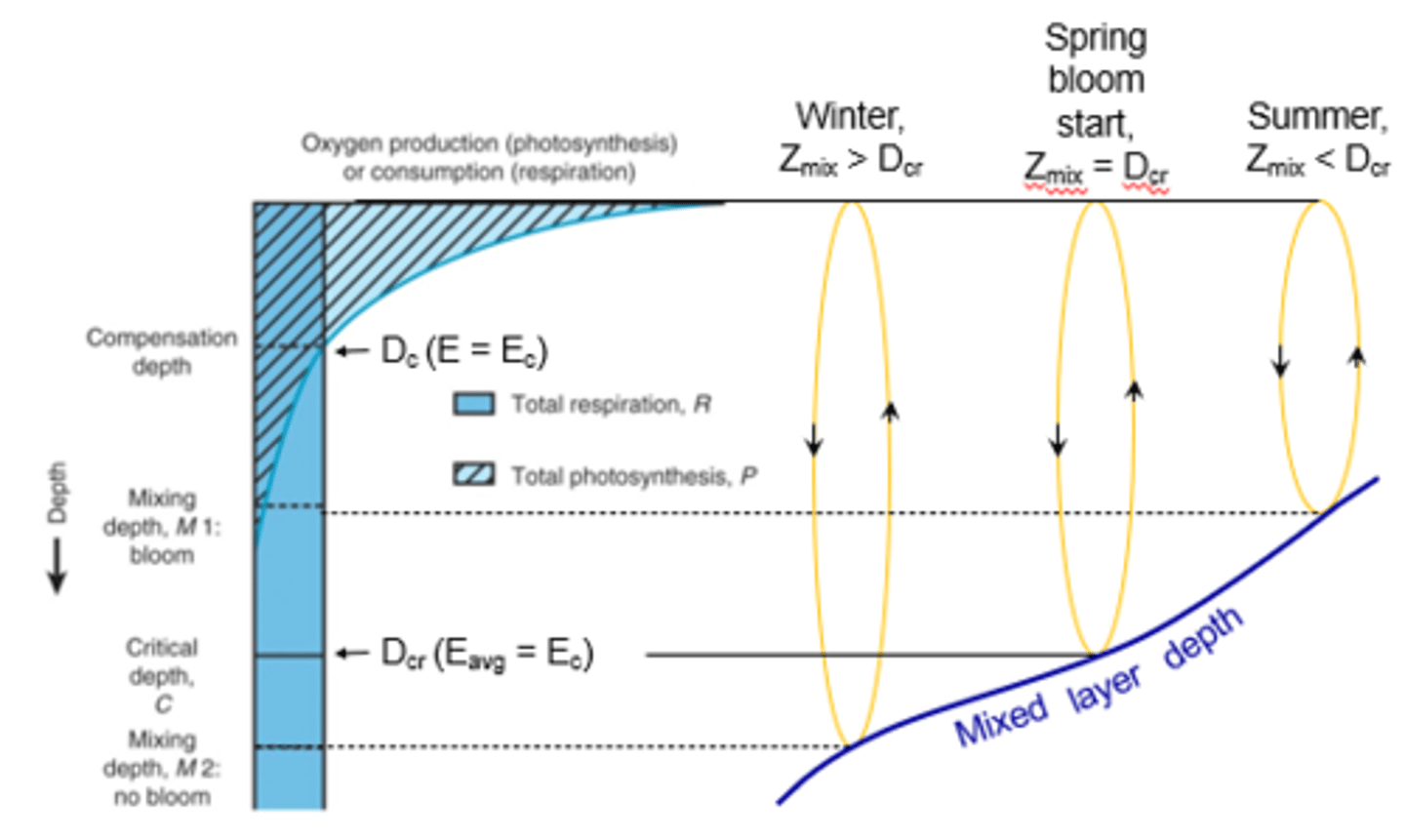
High light as the mixed layer becomes higher however, the nutrients have been used up during spring meaning that the bloom drops off (low production).
The critical depth is greater than the mixed depth.
What occurs in the summer?
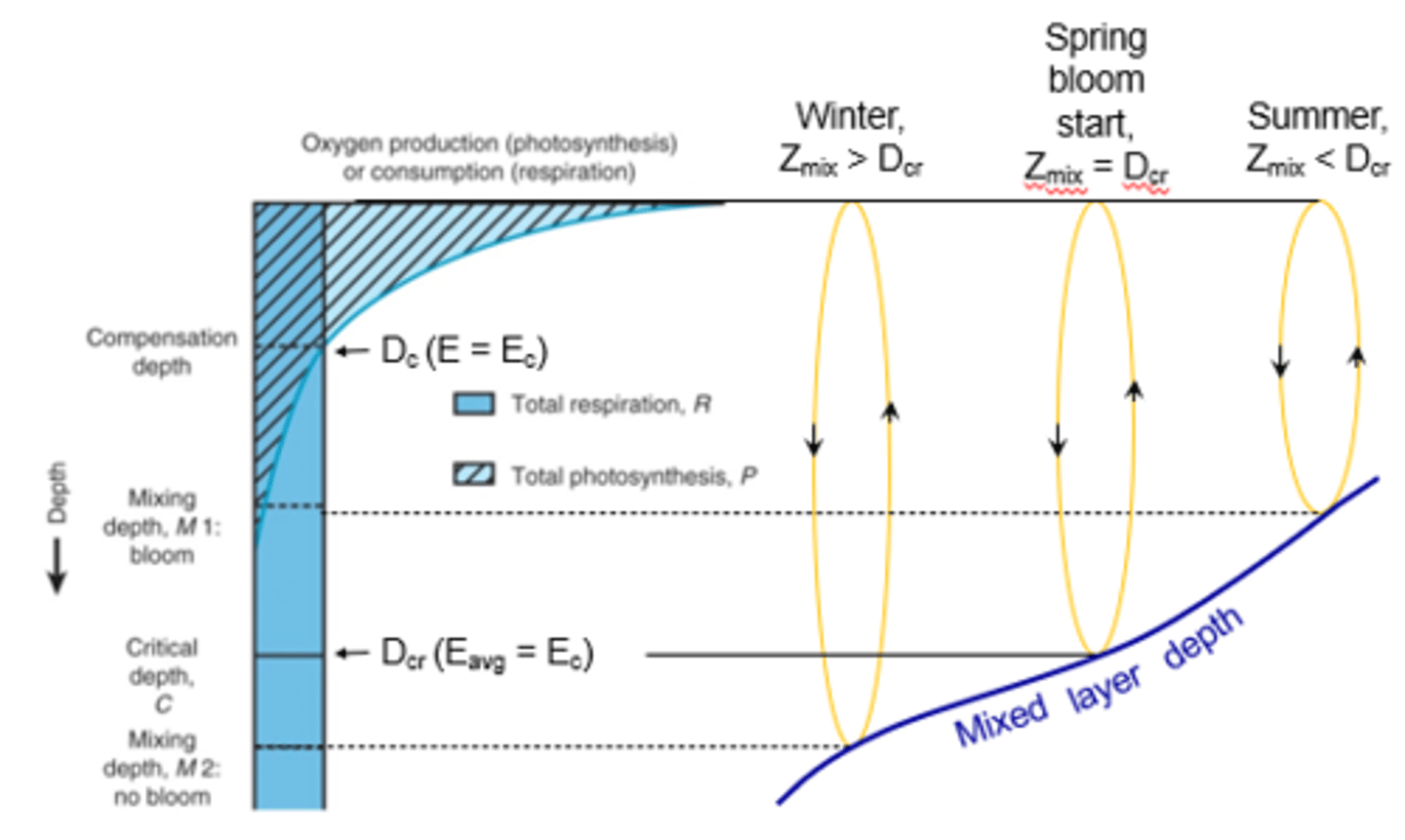
They take a while to catch up, lagging because of the phytoplankton being their food source. These phytoplankton can then cause the drop/end of the bloom.
What does this show about zooplankton?
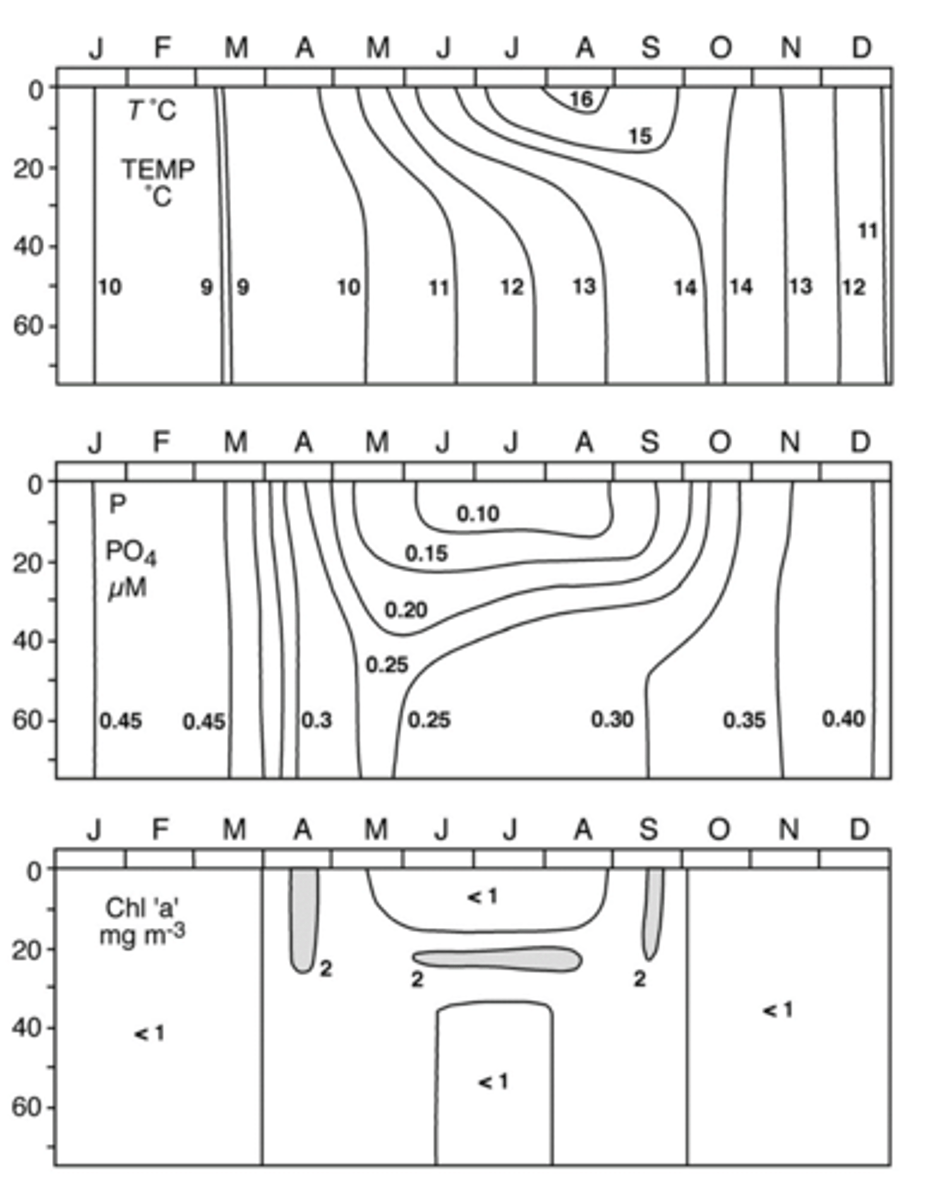
The water column is fully mixed in winter but becomes stratified in the spring/summer (strong thermocline in the summer).
What occurs in terms of stratification through the year?
Diatoms bloom first in spring because they are fast growing and need high nutrients - they can outstrip grazers and have defences against them.
As nutrients are used up, there is a shift to smaller cells because they can survive better in low nutrient environments (Greater surface area to volume ratio).
Diatoms will them dominate in an autumn bloom as high nutrients are upwelled again.
Describe the seasonal succession of phytoplankton populations.
The way that phytoplankton species can be plotted on an axis of turbulence against nutrients as they are adapted to different levels of nutrients and turbulence.
What is Margalefs Mandala?
Phytoplankton growth is also affected by factors other than nutrients and turbulence:
- Light and nutrient availability are generally the first order controls.
- Temperature will alter growth rates but not as significantly.
- Size of the cells affecting how they can take up the nutrients
- The kind of nutrients that these phytoplankton will be using.
- It's defences against grazers (require higher nutrient needs).
What is it important to note about Margalefs Mandala?
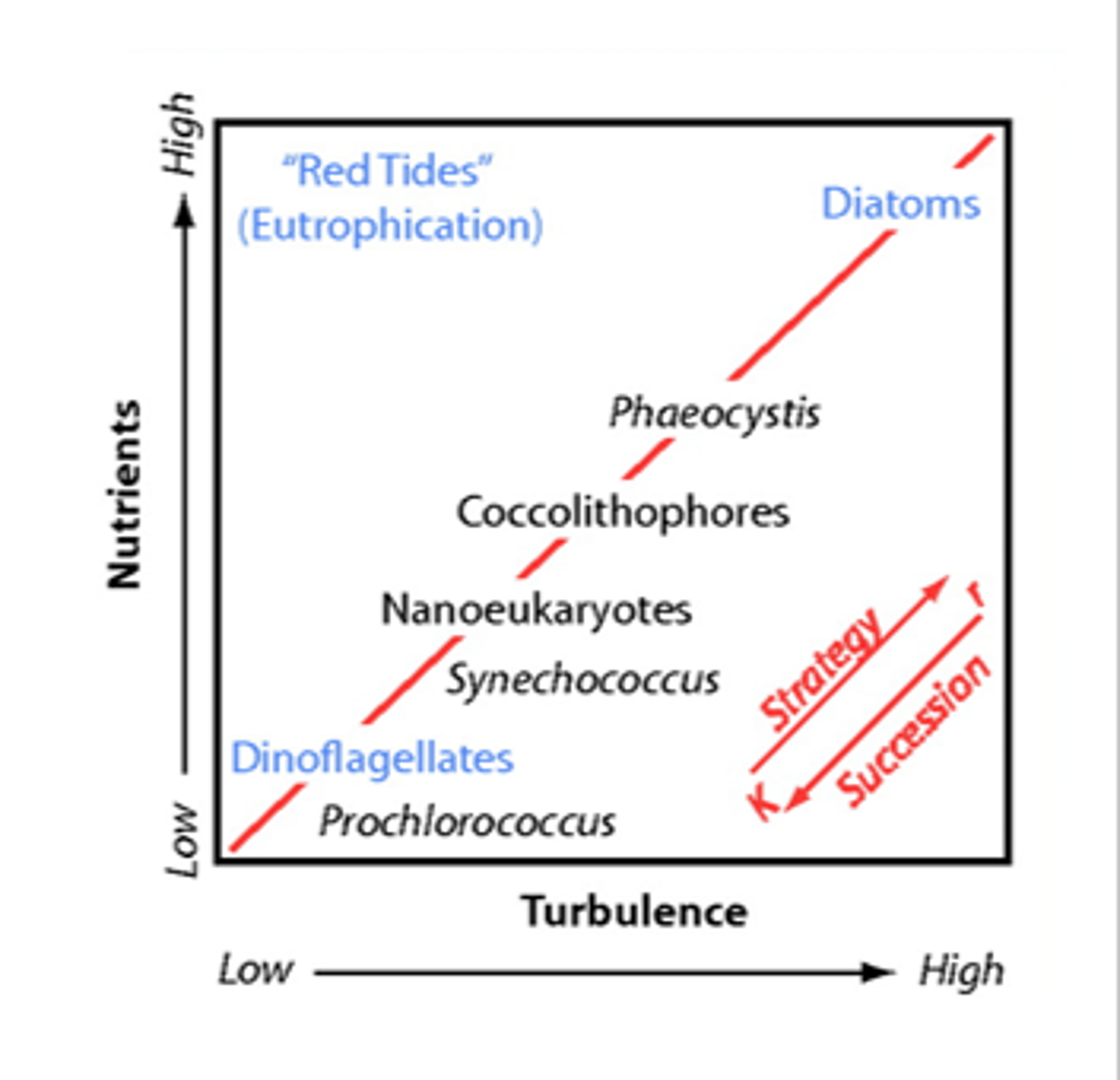
Large cells with high maximum growth rates and grazer defences such as diatoms.
According to Margalefs Mandala, what phytoplankton will live in High Nutrient, High turbulence waters?
Small cells with low KN (saturation constants) so that they have reduced cellular nutrient requirements and can therefore effectively compete for resources. EG: Prochlorococcus.
According to Margalefs Mandala, what phytoplankton will live in low nutrient, low turbulence waters?
Generally red tide dinoflagellates with mobility and toxicity to retain in the bloom and deter competitors and grazers.
According to Margalefs Mandala, what phytoplankton will live in high nutrient, low turbulence waters?
The Bermuda Atlantic has an important seasonal cycle but is slightly less compared to the North Atlantic.
What is the difference between the Bermuda Atlantic and the North Atlantic?
- High nitrate is associated with the high primary production - nitrate getting to the surface in winter.
- The station is stratified all year round - base of the productive layer is similar to where the nitracline is.
- At certain times of year there are pulses in primary production associated with this high nitrate at the surface.
During winter, the mixed layer deepens because of mixing. This re-entrains nitrate from the nitracline (mixed layer penetrates the nitracline). Because it's at the lower latitude, there is still enough light at this point, strongly stratified all year so that phytoplankton are above the critical depth all year, making use of the winter nitrates straight away. Goes back to being nutrient limited for the rest of the year once they have been used in the winter (there is an oligotrophic summer stratified period).
Why is production greatest in the Winter months at the Bermuda Atlantic Time Series station?
- Eukaryotes during the bloom(diatoms, coccolithophores)
- Prokaryotes after (Synechococcus, Prochlorococcus).
What is the seasonal succession of phytoplankton species at the Bermuda Atlantic Time Series station?
It is a highly stratified oligotrophic system. It has low surface chlorophyll and nitrate. There is a hint of a seasonal cycle with the mixed layer and nitracline move slightly but generally:
- the nitracline is deep and stays low
- Stratification remains all year.
- Mixing never really gets strong enough to erode the nitracline.
There is no strong winter or spring bloom - mixing from the surface never reaches the thermocline/nitracline. Any nitrate that may arise is used up instantly.
Explain the system at the Hawaii Ocean Timeseries (HOT).
Because there are low nutrients all year round, smaller cells dominate - Prochlorococcus and its dependence on regenerated nitrogen (eg: NH3) - some can't even utilise nitrate anymore because they aren't adapted to use it as a result of its levels being so low.
Explain the seasonal succession at the Hawaii Ocean Timeseries (HOT).
New (nitrate) production / total production
What is the f-ratio?
Low because they are mainly using regenerated nitrogen (NH4+ etc).
What kind of f-ratio will the oligotrophic system at HOT have?
Some have lost the ability to grow on new nitrogen sources, only using ammonia etc.
What is interesting about Prochlorococcus ecotypes?
NH3
NO2
NO3.
What nitrogen sources will marine Synechococcus use?
NH3 and NO2 (lack nitrate reductase)
What nitrogen sources will low-light adapted Prochlorococcus use?
NH3 (lack nitrate and nitrite reductase)
What nitrogen sources will high-light-adapted Prochlorococcus use?
Deep Chlorophyll Maximum.
Maximum chlorophyll concentration generally found at the base of the surface mixed layer and the top of the nutricline.
Very common in stratified system where it isn't mixed and erased.
What is the DCM?
Because it is at the base of the mixed layer meaning that the phytoplankton still have light to grow (about 1% irradiance of the surface value) and at the top of the nitracline so that they still have nutrients to grow.
The phytoplankton basically sit on the thermocline.
Why does the Deep Chlorophyll Maximum occur where it does?
Where the thermocline is stronger.
Where is there a stronger Deep Chlorophyll Maximum? (thicker basically).
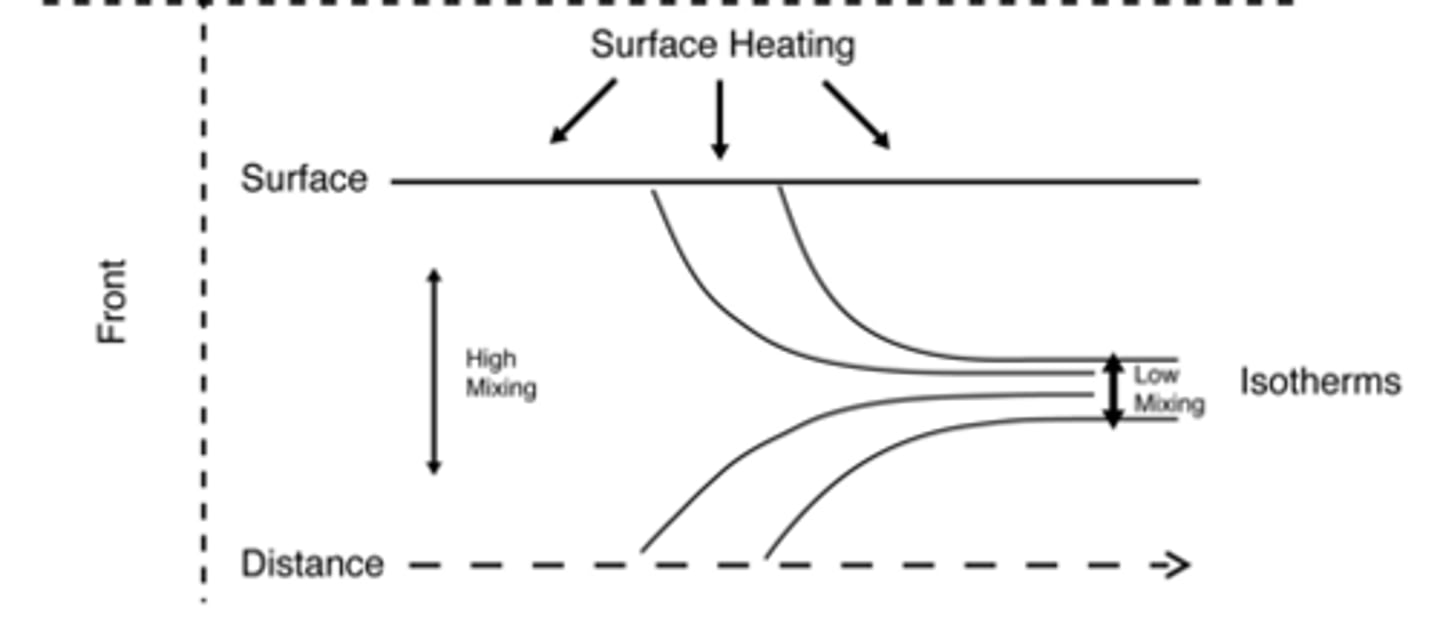
Basically there are cold regions where mixing is maintained so that there are nutrients but light limits phytoplankton growth.
There are warm regions where there is sunlight but a lack of nutrients limit phytoplankton growth.
However, the (tidal mixing) fronts on shelf seas linking these regions have high phytoplankton as there is the overlap of nutrients and light availability.
What is occurring here?
Because they are so large and moving in live time so boats don't pick up the large scale patterns and measurements can change quickly because of the system moving.
Why do we look at mesoscale eddies via satellite ocean colour as well as in situ measurements?
Move with the rotation of the Earth.
Anti-clockwise in the Northern Hemisphere.
Ekman deflection leads to surface water moving away from the centre of the eddy.
Causes upwelling (thermocline and nutricline shoal).
What are cyclonic eddies?
Move against the rotation of the Earth.
Clockwise in Northern Hemisphere.
Ekman deflection leads to surface water mving towards the centre of the eddy.
Causes downwelling (thermocline and nutricle deepen).
What are anti-cyclonic eddies?
Upwelling bring nutrients upwards towards the light nutrient limited layers so that phytoplankton growth is increased - more diatoms less of the smaller Prochlorococcus Synechococcus cells.
What effect do cyclonic eddies in the Northern Hemisphere have on the phytoplankton growth and dynamics?
Downwelling drawns nutrients down away from the light nutrient limited layers so that phytoplankton is decreased - more smaller cells like Prochlorococcus and Synechococcus because they are adapted to low nutrients,
What effect do anticyclonic eddies in the Northern Hemisphere have on the phytoplankton growth and dynamics?
Because phytoplankton may increase chlorophyll per cell if they are in low light to ensure that enough photosynthesis is performed so chlorophyll per biomass may be higher in different areas.
How does the Deep Chlorophyll Maximum not necessarily indicate biomass?
Even though there may be a peak at depth, it is likely that primary production is greatest at the surface (may just be smaller cells adapted to the low nutrients).
How does Deep Chlorophyll Maximum not necessarily indicate a primary production maximum?