Lesson 19 - Castration and Spay Procedures
 Call Kai
 Learn
Learn Practice Test
 Spaced Repetition
 Match
Match Flashcards
 Knowt Play
1/90

There's no tags or description
Looks like no tags are added yet.
Name | Mastery | Learn | Test | Matching | Spaced | Call with Kai | Chat |
|---|
No analytics yet
Send a link to your students to track their progress
91 Terms
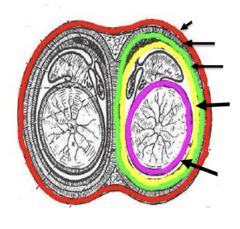
What does the red outline represent?
skin
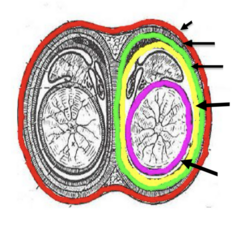
What layer is between the red and green layers?
subcutaneous
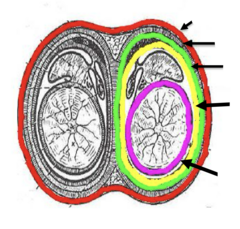
What does the green outline represent?
spermatic fascia
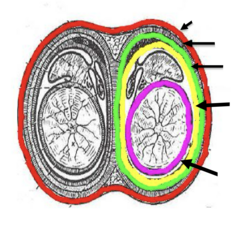
What does the yellow outline represent?
vaginal tunic
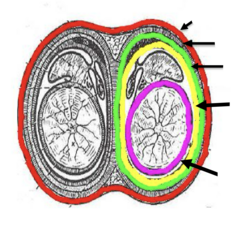
What does the pink outline represent?
tunica albuginea
How are dogs prepared for castration?
1. Aseptic technique
2. Clip hair CAREFULLY
3. Avoid rough scrubbing
4. Chlorhexidine prep
How are cats prepared for castration?
1. Usually "clean" procedure
2. pluck hair from scrotum •
3. Chlorhexidine prep
What tissues are desensitized with a testicular block?
spermatic cord and associated structures
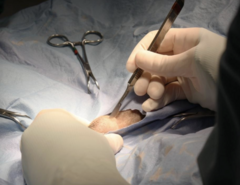
What is happening here?
skin incision
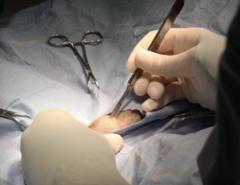
What kind of grip is the surgeon using to hold the scalpel?
pencil grip
What side of the patient should a right handed surgeon stand on for a castration?
left side
Which hand should a right handed surgeon use to push the testicle into the prescrotal area?
left (nondominant) hand
Which hand should a right handed surgeon use to incise over the testicle?
right (dominant) hand
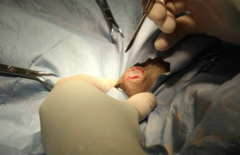
Which layer is being incised in this step?
subcutaneous
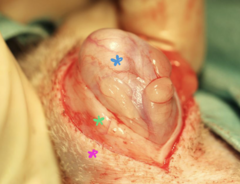
What is the pink star?
incised skin
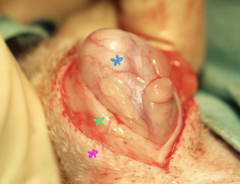
What is the green star?
incised subcutaneous
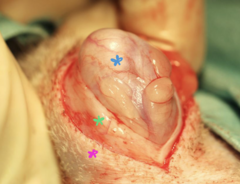
What is the blue star?
intact spermatic fascia
Why does the spermatic fascia need to be incised?
to exteriorize the testicle
How much pressure does it take to incise the spermatic fascia with a scalpel?
very light touch
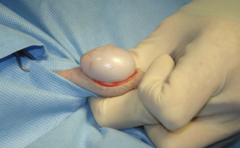
What step of a closed castration is this?
testicle being pushed through skin, subcutaneous and spermatic fascia, up to the level of the parietal vaginal tunic
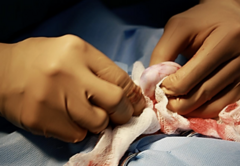
What step of a closed castration is this?
manual detachment of the scrotal ligament (caudal) with the surgeons non-dominant hand
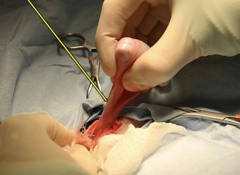
What is the yellow arrow pointing to?
intact scrotal ligament
How can the scrotal ligament be broken down?
manually or slightly incised with Metzenbaum scissors
How can you release the connective tissue attachments around the spermatic cord?
move dry gauze 360 degrees around the spermatic cord
What is an important consideration when using the 3 clamp technique?
1. need to adapt the size of the hemostats to the size of the patient
2. make sure not to clamp too tight (only go to the 1st or 2nd ratchet)

What step of a closed castration is being shown?
three clamp technique

What kind of ligature is the arrow pointing to?
circumferential
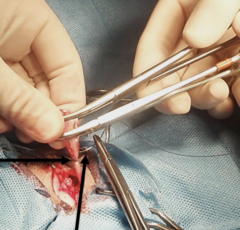
What kind of ligature is being placed above the circumferential?
transfixing
What is important to remember when placing your ligatures?
1. flash the middle hemostat on the first two throws
2. do thumb to thumb technique to tighten the first two throws
3. place a "safety line" hemostat on your circumferential ligature
Why is it important to place a "safety line" hemostat on your circumferential ligature?
easy retrieval of the pedicle
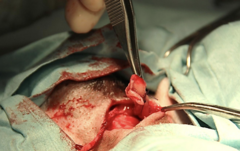
What step of a closed castration is being shown?
checking the ligated pedicle for bleeding
What extra layer is incised in an open castration?
parietal vaginal tunic
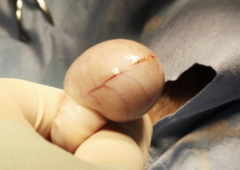
What layers have been incised in this picture of an open castration?
1. skin
2. subcutaneous
3. parietal vaginal tunic
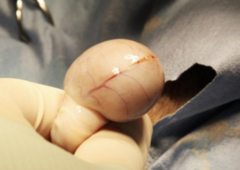
What layer is still intact in this picture of an open castration?
tuncia albuginea
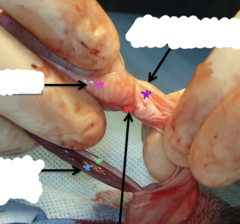
What is the pink star?
epididymis
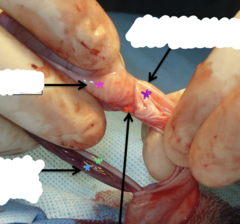
What is the red star?
ligament of the tail of the epididymis
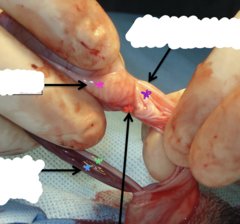
What is the purple star?
parietal vaginal tunic
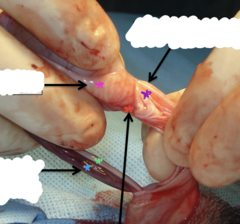
What is the green star?
ductus deferens
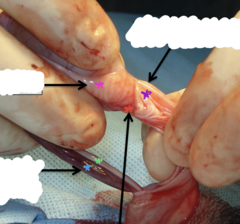
What is the blue star?
pampniform plexus
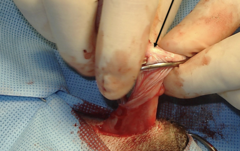
What step of an open castration is being shown?
tearing the attachment of the vaginal tunic to the tail of the epididymis
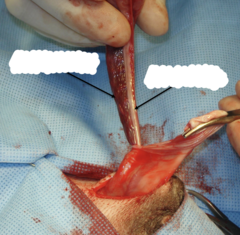
What is the left arrow pointing to?
pampiniform plexus
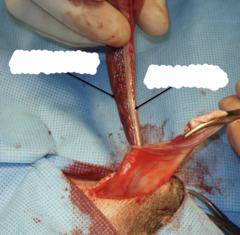
What is the right arrow pointing to?
ductus deferens
What steps of an open castration are the same as a closed one?
1. three clamp technique
2. circumferential ligature
3. transfixing ligature
4. checking the pedicle
5. pushing the pedicle back in the scrotum
Where do you cut when removing the testicle?
between the middle and distal hemostats
What is the ligament that gets torn in a closed castration?
scrotal ligament
What is the ligament that gets torn in an open castration?
ligament of the tail of the epididymis
Is the parietal vaginal tunic incised for a closed castration?
no
Which castration technique takes less time?
closed
Which castration technique has less risk of abdominal infection?
closed
Which castration technique allows for more secure ligations?
open
Which castration technique communicates with the abdominal cavity?
open
Which castration technique is used in most puppies?
closed
Which castration technique is used in most large dogs?
open

What is 1?
subcutaneous
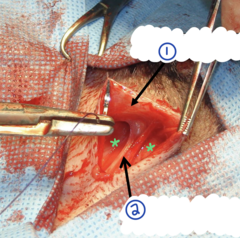
What is 2?
median raphe

What do the green stars represent?
the windows where the testicles used to be
What direction do you close the subcutaneous layer in?
caudal to cranial
Why should you be very careful with how you manipulate the caudal end of the incision?
excessive pressure with thumb forceps will cause trauma, irritation and delayed healing
What is the first step to close the subcutaneous layer?
deep to superficial bite on the surgeons side of the incision
What is the second step to close the subcutaneous layer?
superficial to deep bites towards the surgeon on opposite side of surgeon (include median raphe on this bite)
What is the third step to close the subcutaneous layer?
tie the knot making sure short-end and needle-end are on the same side
What side should you take your first bite on to help keep the knot buried?
on your side
How should you continue to suture once you have successfully buried the knot when closing the subcutaneous layer?
simple continuous pattern including the median raphe
How do you bury the end knot when closing the subcutaneous?
1. begin this knot before the end of the incision to allow the intradermal buried knot some space
2. first, take a dive bite from superficial to deep
3. second, take a deep to superficial bite on the surgeons side and keep the loop
4. third, take a superficial to deep bite on the opposite side of surgeon and pull the loop through
What direction should you close the skin in?
cranial to caudal
What pattern should you use to close the skin?
intradermal with initial buried knot and aberdeen knot to end
What are some complications of castration?
1. Hemorrhage/bleeder
2. Scrotal irritation, bruising
3. Scrotal hematoma
4. Infection
Are castration complications more common in cats or dogs?
dogs
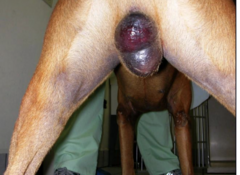
What complication is this?
scrotal swelling/hematoma
How much more likely is a cryptorchid testicle to become neoplastic than a descended testicle?
14 times

What is being shown here?
excision of a retained testicle
What are the indications for feline castration?
1. Sterilization
2. Urethral obstruction (as part of perineal urethrostomy)
3. Testicular or scrotal trauma
4. Elimination of male characteristics
What is the surgical technique for feline castration?
1. Pluck hair from scrotum
2. Scrub area
3. Scrotal incision/s
4. Place caudal traction on testicle until scrotal ligament breaks
5. Open or closed castration
What are the ligation techniques for feline castration?
1. Ductus Deferens/ Pampiniform plexus Tie
2. Absorbable ligature or hemoclips
3. Overhand technique (autoligation)
What is a ductus deferens tie?
separate ductus deferens and tie to vessels with two square knots

What ligation techniques for feline castration is being shown?
hemoclips
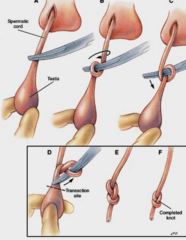
What ligation techniques for feline castration is being shown?
overhand/figure 8 technique
What is the proper post-op care for a feline castration?
1. Leave scrotal incisions open to drain and to heal by second intention
2. Instruct owner to use shredded paper or un-popped corn instead of kitty litter for a few days
What is the most commonly used surgical approach for spaying a female dog?
ventral midline
What grip should you use on the skin to stretch it before incising during a spay?
modified violin grip

modified violin grip
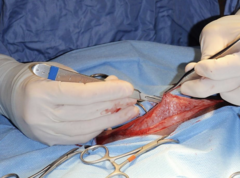
What step of an OVH is shown here?
use forceps to pick up the linea alba and lift the abdominal wall, face the blade at a 45-degree angle, and pierce carefully into the abdominal cavity
How do you use your spay hook to externalize the ovary and uterine horn?
insert hook along the abdominal wall, then rotate 180 degrees and" scoop up" vertical (90-degree angle from incision)

What step of an OVH is shown here?
piercing through the "window"
What ligature techniques do you use on the ovarian pedicles?
three clamp with circumferential and transfixing ligatures
During a routine ovariohysterectomy in a dog, what is the structure that must be ligated to prevent hemorrhage?
ovarian pedicle
What do you break away once both ovaries are free?
broad ligament
How do you close the linea alba in an OVH?
simple interrupted pattern with surgeon's knots
What is the holding layer?
external rectus sheath
How do you close the subcutaneous layer in an OVH?
simple continuous pattern from cranial to caudal with buried knots
How do you close the skin layer in an OVH?
intradermal pattern from caudal to crania with an initial buried knot ending with an aberdeen