1BB3 Macroeconomics Final Exam Study
 Studied by 14 people
 Call Kai
 Learn
Learn Practice Test
 Spaced Repetition
 Match
Match Flashcards
 Knowt Play
1/102

Earn XP
Description and Tags
Covers all information from chapter 4-12 VIDEOS ONLY
Name | Mastery | Learn | Test | Matching | Spaced |
|---|
No study sessions yet.
103 Terms
Chapter 4: GDP
Market value of all final goods and services produced in a region in a given period during a year
Measures of how much stuff a country produces
Based off market value
Only legal things considered in this metric
Attempts to capture all things produced
Only accounts for final goods, this avoids double counitng
Chapter 4: Forms of GDP calculation
Income method: Adds incomes earned from production.
Expenditure method: Adds spending on final goods and services.
Chapter 4: GDP calculation, expenditure method
Y=C+I+G+NX
Adds
C consumption
I investment
G government spending
NX exports minus imports
To find
Y, total GDP
Chapter 4: Housing in the GDP
New housing included as investment spending the year it is built because it lasts a very long time and provides a flow of services each year
Sale of an existing home is NOT included as part of GDP, this just transfers asset nothing new is made
Chapter 4: Rent vs Owner in GDP
Both provide services to families
Both are included in consumption services
Owner occupied housing is a rare example of something included in GDP even if there is no market transaction, owner operated housing is included by estimated rental value
Chapter 4: Gross National Income (GNI) & Gross National Product (GNP)
Market value of all final goods and services produced by a country’s factors in given period
To be included in Canadian GNP, the factors of production used to make good or service must be Canadian owned
GNI and GNP are the same thing
Chapter 4: GDP vs GNI
Ford makes a car in Oakville that costs 30k
20k is cost of labor
10k is profit to ford
Canadian GDP increases by 30k, but GNI is only increased by 20k (labor cost)
GDP includes all goods or services produced in Canada
GNI includes all goods and services produced with Canadian owned factors of production, regardless of where it takes place
Chapter 4: GDP theory
Calculated by adding up price times quantity over all goods and services produced each year
GDP rises if prices rise or if we make more
Chapter 4: Nominal vs Real GDP
By holding prices constant in some “base” year and re calculating GDP, we arrive at real GDP
Once we have nominal GDP and real GDP, we can use these to calculate the overall price level in an economy
Chapter 4: GDP Deflator
Measure of the price level
Nominal GDP divided by Real GDP times 100
Inflation rate is the percentage change in the price level from one year to the next
Chapter 5: How unemployment is determined (CONCEPT)
Stats Canada divides the working non institutional civilian adult population into 3 mutually exclusive categories
Determined by phone survey
Unemployed is when you have no job BUT are looking for work
Chapter 5: Calculations related to employment/unemployment
Unemployment rate is the number of unemployed divided by labor force times 100
Labor force participation rate is labor force divided by adult population times 100
Employment rate is number of employed divided by adult population times 100
Employment rate is NOT equal to 100 minus the unemployment rate because of division factor
Chapter 5: Circle example of categorizing Canadians
Imagine the whole population as one big circle for this explanation
Outermost circle, whole population
Then one layer in is the adult population (15+)
Then another layer in is the non institutional civilian adult population (does not include prisoners, military, or hospital workers)
In the non institutional civilian adult population circle it gets split into three, employed, unemployed, and not in labor force
Chapter 5: Unemployment compensation
Benefits paid to workers who find themselves unemployed
Reduces the negative impact on family income in case of unemployment
Increases the opportunity cost of going to work
Cost of working:
Direct cost (lunch out, parking, gas)
Opportunity cost (not collecting E.I)
Chapter 5: Unemployment diagram
E.I Shifts the labor supply curve left changing equilibrium
Minimum wage above equilibrium wage is binding, market is not in equilibrium, but this is justified and reasoned which is why its done
Labor market: Firms are buyers, workers are sellers
Chapter 5: Calculating CPI
Consumer Price Index, measures the overall cost of goods and services for typical Canadian households
Begins calculation by deciding which goods are included in the “basket” then they find the cost of it
CPI is the cost in current year divided by cost in base year times 100
CPI is a measure of the overall price level of economy
Most used price index for reporting the inflation rate, the rate of change of the price level from one year to next
Chapter 5: Inflation with CPI
Inflation rate = (CPI this year − CPI last year) ÷ CPI last year × 100
Chapter 5: CPI vs GDP Deflator
Both measure of the price level
Different “basket of goods”, the GDP deflator is all goods produced in Canada while the CPI is all goods bought by typical households
Chapter 5: Unanticipated inflation example
Mortgage is a loan on a house, bank agrees on interest rate and loan term
Real interest rate is nominal interest rate minus inflation rate
A problem with unanticipated inflation is the unexpected transfer of wealth between borrowers and lenders
Inflation greater than expected, wealth moves from lenders to borrowers
Inflation less than expected, wealth moves from borrowers to lenders
Chapter 6: Per capita GDP, is it accurate for what we use it for?
Accounts for all goods and services produced in country
Higher per capita GDP typically means other development metrics improve
Used to see how a country is evolving over time
GDP per capita = GDP ÷ population
To find year over year do ((future-initial)/initial)x100
Chapter 6: Calculating average annual growth rate over a period
AAGR = (growth rate year 1 + growth rate year 2 + …) ÷ number of year
Chapter 6: Rule of 70
How many years does it take for real GDP per capita to double
Calculated by dividing 70 by growth rate in order to find doubling time
Chapter 6: Sources of growth
Labor productivity: Output per worker or hour worked
Increasing capital: Each worker hour has more access to capital to produce
Technological improvements: Directly increases output per worker for given amount of capital
Property rights: Ensures private firms are more likely to invest in a company converting to extra money for growth
Chapter 6: Closed economy GDP calculation
Y=C+I+G
No NX term here, so this must be a _____ economy
Chapter 6: Types of savings
Savings by households are private savings
S to p (private savings) = Y+TR-T-C
Earned income plus transfer payments minus taxes and collections
S to g (government/public savings) = T-TR-G
Taxes collected minus transfer payments minus government spending
Chapter 6: Government budget position
Budget surplus if T>G+TR
Budget deficit if T<G+TR
Government debt is an accumulation of past deficits
T = Taxes…G = Gov spending…TR = Transfer payments
Chapter 6: National income accounting identity
Y=C+I+G same as I=Y-C-G
Definition of savings is private and public combined
National savings equals investment, found through algebra
Typically, only equal in closed economy
Chapter 6: Loanable funds diagram model
Supply and demand for loanable funds brings savers and borrowers together
Axis: Real interest rate on vertical axis and quantity of loanable funds on horizontal axis (measured in dollars)
Chapter 6: Reality vs course assumption
Reality: Households, governments, and firms all both borrow and save
Course assumption: All borrowing is done by firms who want to invest and all savings are done by households and governments whose income is greater than their current spending
For simplicity treat government borrowing as negative savings (makes model easier to understand)
Chapter 6: Demand for LF
Firms borrow to invest (purchase new capital)
Slope: higher interest rates means higher cost of borrowing, negative relationship between interest rate and investment (demand for LF)
Shift factors:
When firms need/want to purchase more capital at any given interest rate, demand for LF increases
When firms need/want to purchase less capital at any given interest rate, demand for LF decreases
Chapter 6: Supply for LF
Households and governments save when their inflow of funds is greater than their spending, they supply this saving to the market for LF
Slope:
Household’s, at higher interest rates, holding everything else constant, more savings now leads to higher consumption later… higher interest rates households are incentivized to save more
Positive sloped S curve due to private savings
Governments, no relationship between public savings and interest rate
Shift factors:
When households/governments save more at any given interest rate, supply of LF increases
When households/governments save less at any given interest rate, supply of LF decreases
Chapter 6: Market for LF diagram
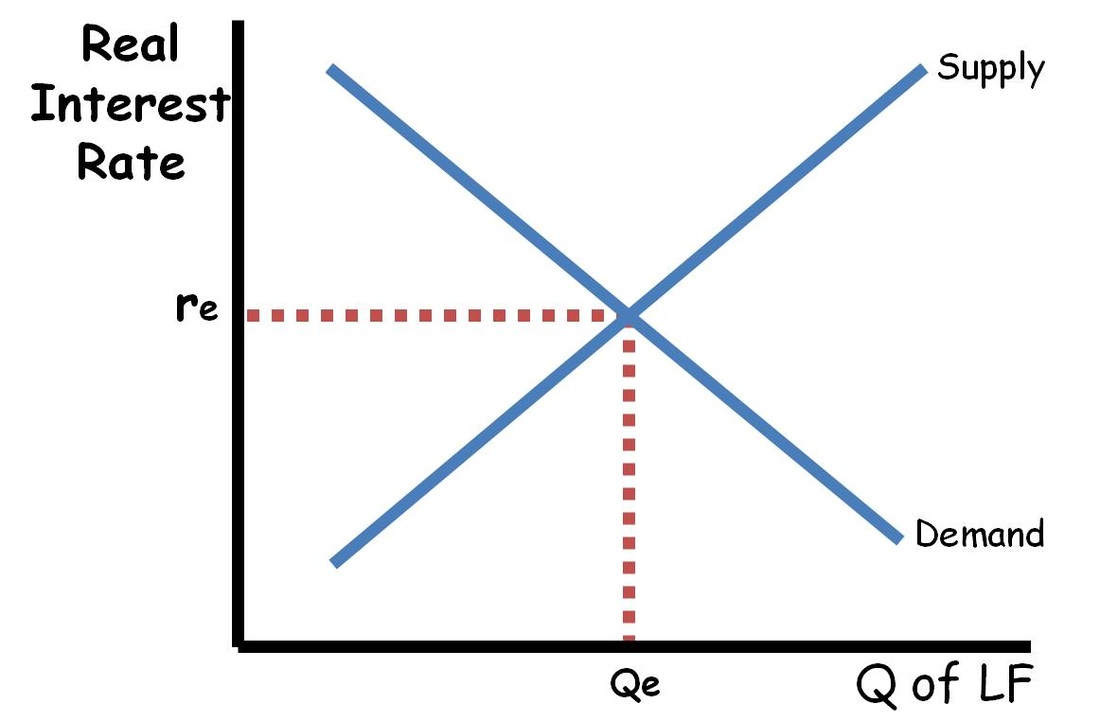
Chapter 6: Analyzing and understanding shocks
Example 1
Uncertainty about the future causes firms to decrease investment in capital goods, demand curve shift left, if increase shift right
Look at vertical axis to see interest rate
Look at horizontal axis to see investment spending, ivestment spending equal to saving
Private savings go down because lower interest rate indicates so
Public savings feels no effect if focus is on firms
Example 2
The government decreases spending, holding taxes and transfers constant, this moves supply right due to government savings increasing
Remember that when one curve shifts, there is always movement along the other curve, it is HIGHLY unlikely both will move from one factor
Chapter 7: Economic growth in the PPF diagram
(Production Possibility Frontier)
PPF: Consumer/capital goods diagram
Capital goods are machinery and robots, things used this year to produce goods and services
Technological growth pushes out PPF curve outwards
Closer to left of graph is more consumer goods, closer to right is more capital goods
This graph shows where society chooses to dedicate our production/consumption, this will affect the next year
Todays decisions affect tommorow’s possibilies
Chapter 7: PPF diagram
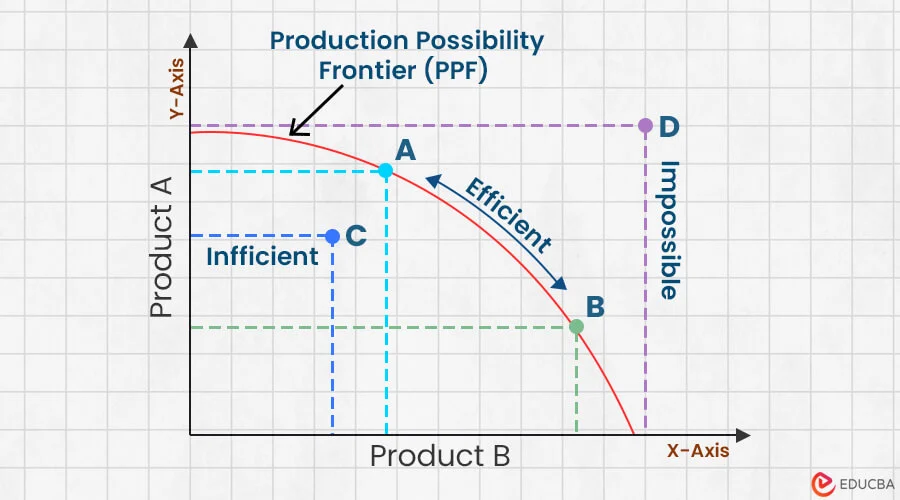
Chapter 7: Productivity
The quantity of goods and services a worker can produce in an hour
This is determined by physical capital, natural resources, human capital, and technological knowledge
Production function shows how we combine inputs to produce products
Chapter 7: Production function formula
Y = A x F(K,L,H,N)
Y is output
A is technology
K is physical capital
L is labor
H is human capital
N is natural resources
Chapter 7: Return to scale
If all inputs double, output doubles. Constant returns to scale.
If output more than doubles, increasing returns to scale.
If output less than doubles, decreasing returns to scale.For simplicity of course we will assume constant returns to scale
Chapter 7: Marginal product
Product = output
Marginal = extra
Marginal product is output produced with one extra unit of an input
Diminishing marginal product means the additional output produced by adding an extra unit of labor (19th unit) is smaller than the additional output produced by the unit of labor before (18th unit) (this explains the shape of the PPF diagram)
Chapter 7: Production function and policy
Anything that increases on the left side of equation raises left side
Policies
Protecting intellectual property incentive to increase A
Support of R&D incentive increases A
Subsidizing education increases in H or L
Chapter 8: Aggregate expenditure
Total planned spending on final goods and services in an economy
AE = C + I + G + NX
Chapter 8: Consumption
Spending by households on goods and services
Consumption function is the relationship between consumption and income
Marginal propensity to consume (MPC) is the fraction of change in income that is spent on consumption… slope of the consumption function
Chapter 8: Consumption function
Disposable income on horizontal axis and consumption spending on vertical axis
Vertical intercept dictates the piece of consumption that does not depend on disposable income
Things that shift curve up or down is net wealth, price level, interest rate, expectations
Consumption is positively related to disposable income
MPC tells us how much households increase consumption in response to 1 dollar increase in disposable income
Chapter 8: Consumption function diagram
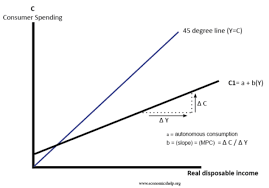
Chapter 8: Aggregate expenditure simple model
Shows spending at various levels of GDP for a given price level where spending is given by C+I+G+NX
In equilibrium Y=AE
Chapter 8: Aggregate expenditure = real GDP
Horizontal is real GDP and aggregate expenditure is vertical
Will only be equal to real GDP at one value, at intercept
Output is the 45-degree line, if AE is higher or lower over time the gap will close until equilibrium is reached
Chapter 8: Conclusion thoughts
Inventories are the adjustment mechanism when spending does not equal output
If spending is higher than output inventories must be drawn down in order to fill the spending orders
If spending is lower than output inventories build up
Chapter 8: Autonomous spending
Planned spending independent of current income or GDP, determined by firms, government, or foreign buyers, such as investment, government purchases, and exports.
Chapter 8: Simple spending multiplier
Found by doing 1/(1-MPC)
When any autonomous component of spending rises by 1$, real GDP rises by multiplier
Chapter 8: Multiplier intuition
The 1 dollar increase in spending causes household income to rise by 1 dollar, people increase both consumption and savings, the higher consumption spending causes a further increase in income
Chapter 8: Shifts in aggregate expenditure
If autonomous consumption, investment, government spending, or net exports change, the AE curve shifts.
Inventories adjust to the gap between output and spending.
Y changes until the economy returns to macro equilibrium.
Chapter 8: Spending Multiplier – Concept
A change in government spending (ΔG = change in G) triggers multiple rounds of income and consumption:
Round 1: ΔG → initial increase in income
Round 2: MPC × ΔG → households spend part of Round 1 income
Round 3: MPC² × ΔG → households spend part of Round 2 income
Total change in income: ΔY = ΔG (1 + MPC + MPC² + …)
Chapter 8: Spending Multiplier – Formula & Reason
Total change in income ÷ initial change in spending:
ΔY / ΔG = 1 / (1 − MPC)
Reason: Each round of spending triggers more consumption.
The repeated rounds form an infinite geometric series because MPC < 1.
Chapter 8: Using AE to derive AD
Start with a point on AD (Y₁, P₁)
If P rises, planned spending falls
Drag a line down from AE equilibrium to see new Y
Repeat to trace the AD curve
AE diagram shows how changes in P affect Y and derive AD.
Chapter 8: Shifts in AD curve
Begins with a point on the initial AD curve
Suppose investment spending increases what happens to the AD curve
Increase causes shift out this shift causes shift in the AD curve
Chapter 8: Calculating Y and MPC – Closed Economy Example
Closed economy: NX = 0 → Y = C + I + G
Example: Y = 30 + 0.8(Y + 20 − 30) + 35 + 40
Simplify: Y = 105 + 0.8(Y − 10)
Solve: Y − 0.8Y = 105 − 8 → 0.2Y = 97 → Y = 485
MPC = 0.8 (from consumption function coefficient)
Chapter 8: Solving for Equilibrium Income (Y) – Concept
Start with Y = C + I + G (closed economy).
Plug in consumption as C = autonomous consumption + MPC × disposable income (Y − T + TR).
Add autonomous investment (I) and government spending (G).
Combine terms with Y on one side and constants on the other.
Solve for Y: Y = total autonomous spending ÷ (1 − MPC).
Key idea: The economy’s equilibrium income depends on total autonomous spending and how much households spend out of extra income (MPC).
Chapter 8: Consumption function deep dive
Slope of consumption function is the MPC
This function will shift if non income determinants of consumption change such as net wealth, price level, interest rate, expectations
e.g of function C=30+0.8(Y+TR-T) *30 is y int and 0.8 is slope
Solve for C+I+G to find slope of AE
Shifts in AD Curve:
Begin with a point on the initial AD curve
Suppose autonomous consumption spending increases, what happens to the AD curve
MPC times the increase in Y int is the horizontal distance change
Chapter 9: Overview
Aggregate demand and aggregate supply model
Involves 3 curves
Need to understand how slopes are determined
Need to understand what causes shifts
2 concepts of equilibrium
Automatic adjustment equilibrium
Many variables show up in this diagram
Real GDP and Price Level axis
Unemployment does not show up on diagram but it's a key part
Chapter 9: Slope of AD
The AD curve has a negative slope
Wealth effect, how consumption changes when price changes
Interest rate effect
International trade effect, deals with net export change to price lvl
Anything that causes any component on left side of Y=C+I+G+NX will cause curve to shift
Chapter 9: Aggregate Demand
Demand has to do with buyers
We have an equation that divides real output (GDP = Y) into categories according to who purchases the goods Y=C+I+G+NX
Chapter 9: Aggregate Supply
Supply has to do with production
Real GDP and price level from the production side of equation
Long run = economic growth = production function
Y= A*F (K, L, H, N)
Chapter 9: Long Run Aggregate Supply
Slope A, K, L, H, N do not depend on price
LRAS is vertical
Any change on left hand side variable will cause the LRAS curve to shift
Chapter 9: Short Run Aggregate Supply
In the long run, there is no relationship between P and Y on the supply slide, this is not true in the short run
Reasons for a positive relationship between P and Y on the supply side
Sticky wages
Menu costs
Shift factors
Short term supply shock
Expected price level
Chapter 9: Sticky wage theory
Nominal wages are “sticky” they are fixed in the short run, flexible in the long run (firms and workers usually agree to contract with fixed time period)
What firms and workers really care about is real wage, for firms when real wage rises they are worse off but workers are better off
Chapter 9: Real wages, Nominal wages, and “P”
Real wage = W ÷ P.
W is nominal wage. P is price level.
If P rises and W stays fixed, real wages fall.
Lower real wages make labor cheaper.
Firms hire more labor and produce more.
Y rises.
Chapter 9: Equilibrium
When SRAS and AD touch there is equilibrium
When SRAS, AD, and LRAS touch there is long ruin equilibrium
Long run equilibrium is also referred to as y hat, the potential real GDP
Chapter 9: Shocks on the AD AS model
AD
Slope of AD curve has to do with how consumption, investment spending, and net exports change
Increases in any components cause shift right, decrease causes shift left
AS
Supply shock that effects inputs into production that we think are temporary will cause shift
Oil cost can shift SRAS curve
Expected price level causes shifts
Chapter 9: Definitions
Recession, any time output is below potential (left side)
Expansion, any time output is greater than potential (right side)
Chapter 9: Away for LR equilibrium
If Y is below potential Y, economy is in recession which leads to unemployment rates being high which leads to excess labor supply which leads to workers willing to take lower wages which leads to production costs falling which leads to firms producing more which leads to SRAS shifts right
If y is above potential Y economy is in expansion which leads to unemployment rates low which leads to excess labor demand which leads to firms paying more wages which leads to production costs rising which leads to firms producing less which leads to SRAS shifts left
When economy not in LR equilibrium automatic function exists to push economy back to LR equilibrium
This mechanism works through labor markets, SRAS curve will shift, restoring long run equilibrium
Chapter 9: Dynamic AD AS Model
Used to explain economic fluctuations and long run growth.
Over time LRAS shifts right due to tech progress and growth in K and L.
LRAS pulls SRAS right as capacity expands.
Population and income growth raise C, I, and G.
Higher spending shifts AD right over time.
Chapter 10: What is money
Something that is regularly used to buy goods and services
Money does not equal income or wealth
Chapter 10: Functions of money
Must be a medium of exchange
Must be a unit of account - how we measure prices
Must store value - asset
Standard of deferred payment
Standard of deferred payment means money is used to settle debts in the future.
Chapter 10: Money in the Canadian economy
M=C+D
C is the currency in the hands of the public, not money in vaults but with the public
D is demand deposits, demand means payable on demand and is another term for chequing accounts
Money is an asset that is regularly used to buy goods and services, this does not include credit cards
Chapter 10: Money creation
Current banking system makes money come from thin air, this is because there are two main components to money, currency in hands of public and chequing accounts
If money were just a commodity, then banks would not have the ability to create money
Chapter 10: Reserves
Reserve ratio: the fraction of total deposits that the banking system holds in reserve
Reserves: the currency held in the bank vault waiting to be taken out
T account: Shows the total amount held at a point in time.
The numbers are actual balances, not how much they changed. Changes get shown by updating the balances, not by adding plus or minus signs.
Chapter 10: Money multiplier
The total amount of deposits the banking system generates with each dollar of reserves
Calculated as 1/reserve ratio
Chapter 10: More about money and deposits
1st way of thinking
How much does a bank need in reserve, if there is a given amount of deposits
2nd way of thinking
How much can the bank loan out, and how much in deposits can it support, for a given amount of reserves
Bank creates money through lending out excess deposits they take in
Textbook explanation is unrealistic, banks do not call up loans they simply slow loaning rate till reserve is built up
Chapter 10: Monetary policy
This is increasing and decreasing the money supply to achieve specific goals for economy
Primary tool is the open market operations > buying (selling) government bonds/securities from (to) the public
(brackets is whats actually happening)
Chapter 10: Open market operations, sale and purchase
Purchase
This causes bonds to go from public to BoC and then the bank gives people money, leads to increase in money supply
Sale
- This causes bonds to go from bank to public and then the people give the bank money, leads to decrease in money supply
Chapter 10: Interest rates
Prime rate, overnight rate, policy interest rate, bank rate
Prime rate is the commercial rate banks charge their best customers
Overnight rate is the rate commercial banks charge each other for 24 hour loans
Policy interest rate is the BoC target for overnight rate
Bank rate is the rate BoC charges commercial banks
Chapter 10: Course assumption
Assume the BoC can completely control money supply
Reality is they can not because households have control as to how much they choose to save and commercial banks can choose to keep excess reserves
Chapter 10: Quantity theory of money
The quantity of money in the economy determines the price level in the economy
Rate of growth of the money supply determines the inflation rate in the economy
Chapter 10: Velocity
Rate at which money changes hands/circulates
Divide spending by amount of current to find velocity
Chapter 10: Quantity equation
M*V=P*V
M is money, V is velocity, P is price level, Y is real GDP, P*Y is nominal GDP
Chapter 10: Quantity equation growth rates
Product rule

Chapter 10: Price level
Price level is nominal GDP over real GDP
Chapter 10: Barter economies
Double coincidence of wants – a major shortcoming of barter economies that for barter to occur, each person must want what the other person has
Chapter 11: Income/Money “decision tree”
Earn income (flow)
Save
Adds to wealth (stock)
Financial assets
Money
Non-monetary assets (stocks, bonds, etc.)
Physical assets
Consume
As income goes down the flow everything else receives a bit of the flow
Chapter 11: Money markets in the short run
Assume that the economy has only two financial assets, money and bonds
Assume that money does not pay interest, but bonds do pay interest
Opportunity cost of money is the interest you could earn by financial wealth in the form of bonds
At low interest rates, people hold more of their wealth as money, at high interest rate more is held in bonds
Chapter 11: Money market diagram
Demand for money has negative slope, higher interest rate means less quantity of money demanded
Money supply “set” by BoC (course assumption)
Change in money demand affects interest rate
Chapter 11: Money market diagram shocks
If income rises, consumption goes up which leads to money demanded curve shifting right
If banks conduct open market sale of bonds, public purchases bonds with money, resulting in money supply curve shifting left
Chapter 11: Monetary policy
Recession
High unemployment
BoC wants to shift AD out to the right
Expansion
Risk of coming inflation
BoC wants to shift AD into the left
Chapter 11: Monetary policy diagram
Supplying more money shifts AD curve right pulling out of recession
Supplying less money shifts AD curve left slowing spending pulling out of hasty expansion
Central banks want to help eliminate high unemployment and reduce risk of inflation
Can use monetary policy to shift AD to restore LR equilibrium sooner than waiting for automatic mechanisms to kick in
Chapter 12: Fiscal policy
Typically when we use this term we are referring to discretionary fiscal policy which is changes in government spending, taxes, or transfers designed to impact economic variables such as GDP, the unemployment rate, or the price level
In recession use expansionary fiscal policy and in expansion use contractional fiscal policy
Chapter 12: Automatic Stabilizers
“Automatic” in the sense that changes in taxes and transfers that kick in when income fluctuates
When GDP falls, income taxes falls and transfers rise which leads to income falling by less than if these taxes and transfers were not in place, thus mitigating the swings in aggregate demand that result from economic shocks
Chapter 12: Automatic stabilizers and the stylized business cycle
Wavy line on a 45-degree line gets tighter because of automatic stabilizers
Automatic stabilizers reduce fluctuations in AD
Can see this in either the stylized business cycle diagram or AD-AS diagram
Chapter 12: Stylized business cycle diagram
Make note of PEAK and TROUGH placement
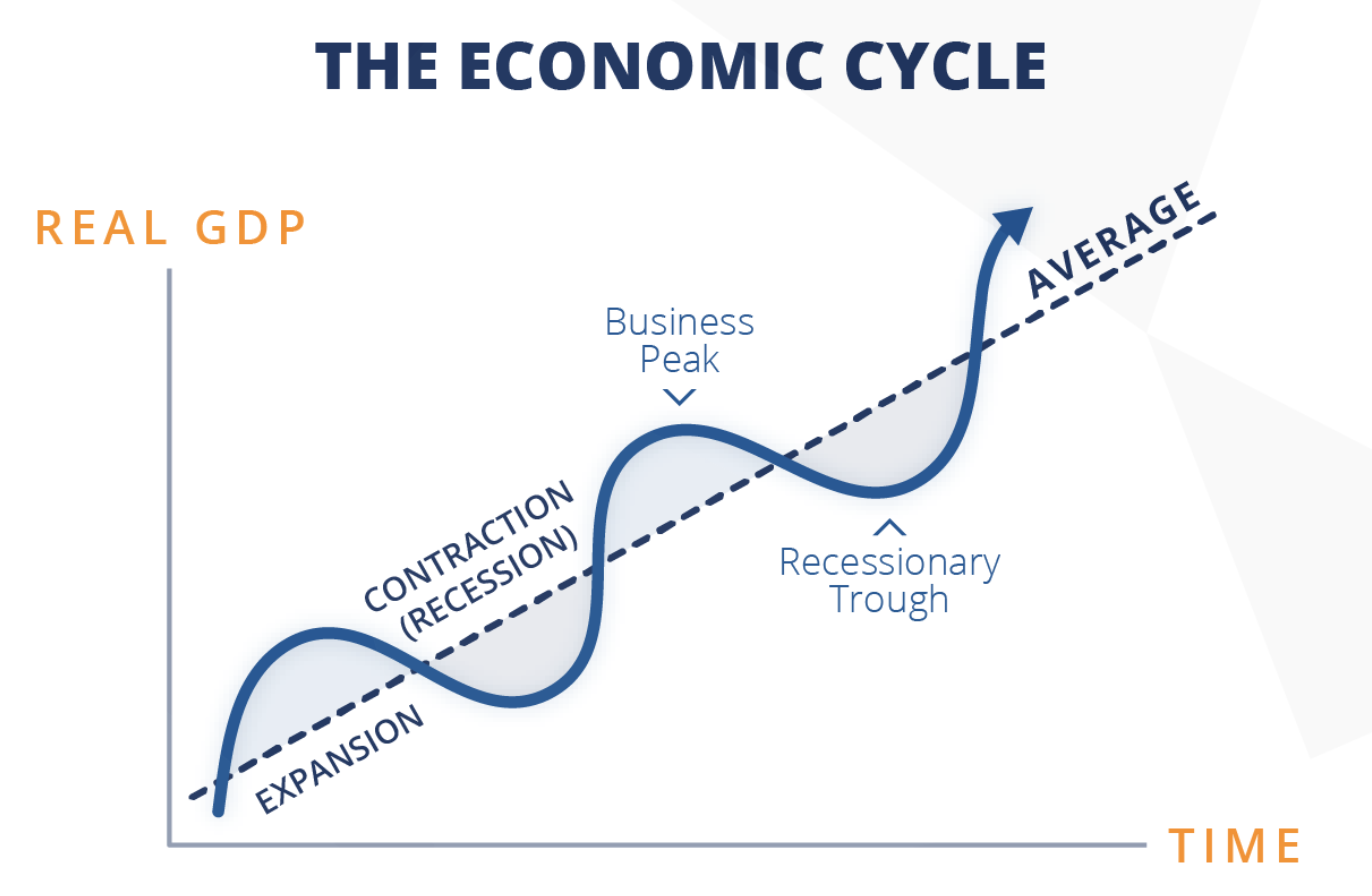
Chapter 12: Spending multiplier
Simple Spending Multiplier = 1 / 1-MPC
When government spending rises by 1-dollar real GDP rises by SSM
Chapter 12: Simple Spending Multiplier Intuition
The 1 dollar increase in spending causes household income to rise by 1 dollar; people increase both consumption and saving which leads to the higher consumption spending causes a further increase in income