CHAPTER 8: NERVOUS SYSTEM
 Call Kai
 Learn
Learn Practice Test
 Spaced Repetition
 Match
Match Flashcards
 Knowt Play
1/63

There's no tags or description
Looks like no tags are added yet.
Name | Mastery | Learn | Test | Matching | Spaced | Call with Kai | Chat |
|---|
No analytics yet
Send a link to your students to track their progress
64 Terms
SIM - SENSORY, INTEGRATION, MOTOR
3 MAJOR FUNCTIONS
● Maintaining homeostasis
● Receiving sensory input
● Integrating information
● Controlling muscles and glands
● Establishing and maintaining mental activity
FUNCTIONS OF THE NERVOUS SYSTEM
Central Nervous System (CNS), Peripheral Nervous System (PNS)
2 ANATOMICAL DIVISIONS
Central Nervous System (CNS)
a. Spinal cord
b. Brain
Peripheral Nervous System (PNS)
All the neural tissue outside the CNS (spinal nerves, cranial nerves)
Afferrent Division, Efferent Division
2 SUBDIVISIONS
afferent division
sensory input (pasok)
efferent division
sensory output (labas)
SNS, ANS - somatic nervous system and autonomic nervous system
two types of efferent division
SD, PD - sympathetic division, parasympathetic division
Autonomic nervous system two types
sympathetic division
most active during physical activity
parasympathetic division
regulates resting functions
Somatic sensory
anything outside/external
Visceral sensory
internal
neurons, neuroglia
CELLS OF THE NERVOUS SYSTEM
neurons (nerve cells)
For processing, transfer, and storage of information
neuroglia (supportive cells)
For support, regulation, and protection of neurons
GLIA = glue
neurons
Receive stimuli transmit action potentials to other neurons or to effector organs
CAD - cell body, axon, dendrites
3 parts of neurons
neurons
Organized Network - Performs the function of the nervous system
dendrites
Stimulated by the environmental changes of the activities of other cells
cell body
Contains the nucleus, mitochondria, ribosomes, and other organelles and inclusions
axon
Conducts nerve impulse (action potential) toward synaptic terminals
synaptic gland
Affect another neuron or effector organ (muscle or gland)
Nissl Bodies
Neurofilaments separate abundant rough ER
i. Primary site of protein synthesis in neurons
DENDRITES
Short , Often highly branched cytoplasmic extensions
Dendrite Spines
Small extensions where axons of other neurons form synapses with the dendrites
axons
Nerve fiber, Conducts electrical impulses away from the neuron’s cell body
(MA,BP) - multipolar, anaxonix, bipolar, pseudo-unipolar nueron
STRUCTURAL TYPES OF NEURONS
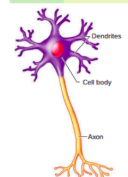
multipolar neurons
Many dendrites, Single axon and Most common type
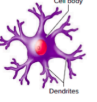
anaxonic neurons
No axon and no anatomical clues to determine axons from dendrites
bipolar neuron
One dendrite, One axon

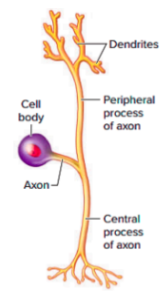
pseudo-unipolar neurons
An axon, No dendrites, Single process extending from the cell body
SMI - sensory neurons, motor neurons, interneurons
FUNCTIONAL TYPES OF NEURONS
sensory neurons (afferent neurons)
Conducts action potential toward the CNS
interneurons
Conducts action potential from one neuron to another within the CNS
motor neurons (efferent neurons)
Conducts action potential away from the CNS toward muscles or glands
CNS NEUROGLIA, PNS NEUROGLIA
NEUROGLIA (GLIAL CELLS)
AMOE - astrocytes, microglia, oligodendrocytes, ependymal cells
CNS NEUROGLIA:
SS - schwann cells (neurolemmocytes), satellite cells
PNS NEUROGLIA:
schwann cells
Wraps around axons
myelin sheath
■ Insulating layer
■ Forms around nerves
satellite cells
Surround neuron cell bodies in sensory and autonomic ganglia
Protect neurons from heavy-metal poisons
astrocytes
Star look-alike and Creates a supportive framework for neurons
EPENDYMAL CELLS
○ Lines ventricles of brain & central canal of spinal cord
○ Produce, monitor, and help circulate CSF (cerebrospinal fluid)
microglia
○ Brain macrophages
○ Phagocytize cellular wastes & pathogens
○ Cell-eating
astrocytes
Creates “blood-brain barrier” BBB and monitor & regulates interstitial fluid
surrounding neurons
OLIGODENDROCYTES
Cytoplasmic extensions that can surround axons
myelin sheath
Most axons of the nervous system are surrounded by a ___ (myelinated axon)
“white matter."
Regions of the nervous system containing groupings of myelinated axons make up the ___
gray matter
mainly comprised of groups of neuron cell bodies, dendrites, and synapses (connections between neurons)
myelin sheaths
Presence of myelin speeds up the transmission of action potentials along the axons
Nodes of Ranvier
spaces/gaps
Gray Matter
Consists of groups of neuron cell bodies and their dendrites
White Matter
Consists of bundles of parallel axons with their myelin sheaths
synapse
Site at which neurons communicate
pp = presynaptic neuron, postsynaptic neuron
type of cells in synapse
presynaptic neuron
Conducts impulse toward the synapse
postsynaptic neuron
Conducts impulse away from the synapse
electrical synapse, chemical synapse
TWO MAJOR TYPES OF SYNAPSE
Electrical Synapse
Not common in the nervous system
Chemical Synapse
Most common type due to many neurotransmitters
psp = presynaptic terminal, synaptic cleft, postsynaptic membrane
components of Chemical Synapse
Synaptic vesicles, Diffusion, Postsynaptic membrane
Neurotransmitters release by action potential in presynaptic terminals