B1 : Cell Biology
 Call Kai
 Learn
Learn Practice Test
 Spaced Repetition
 Match
Match Flashcards
 Knowt Play
1/92

Earn XP
Description and Tags
All of Cell Biology (Practicals Included)
Name | Mastery | Learn | Test | Matching | Spaced | Call with Kai |
|---|
No analytics yet
Send a link to your students to track their progress
93 Terms
What is a Prokaryotic Cell/Prokaryote?
A cell which does not have a nucleus (genetic material enclosed in a nucleus)
What is a Eukaryotic Cell/Eukaryote?
A cell which does have a nucleus (genetic material enclosed in a nucleus)
Give an example of a prokaryotic cell
Bacteria Cell
Give an example of eukaryotic cell (2)
Animal Cell
Plant Cell
Which type of cell is bigger
Prokaryotic
Eukaryotic
Eukaryotic cell
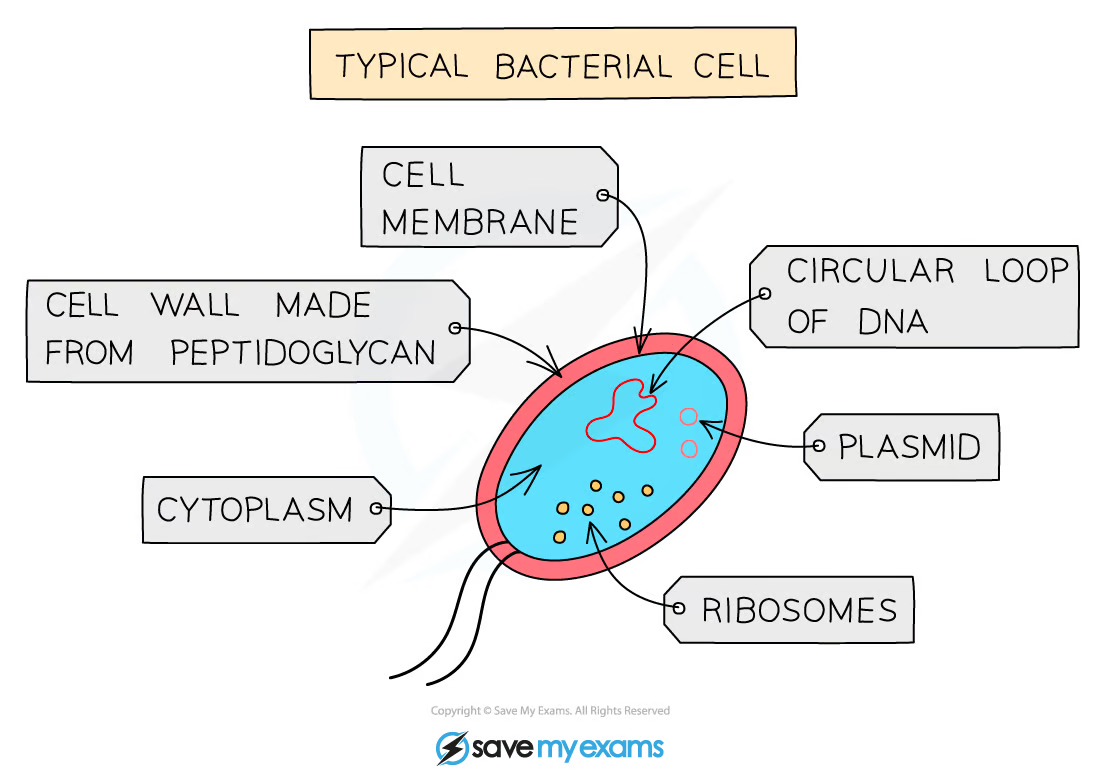
How many subcellular structures does a bacteria cell have?
6
Name all the subcellular structures in a bacteria cell
Cell membrane
Cell wall
Ribosomes
Cytoplasm
Singular strand of DNA (that floats freely)
Plasmids (small rings of DNA)
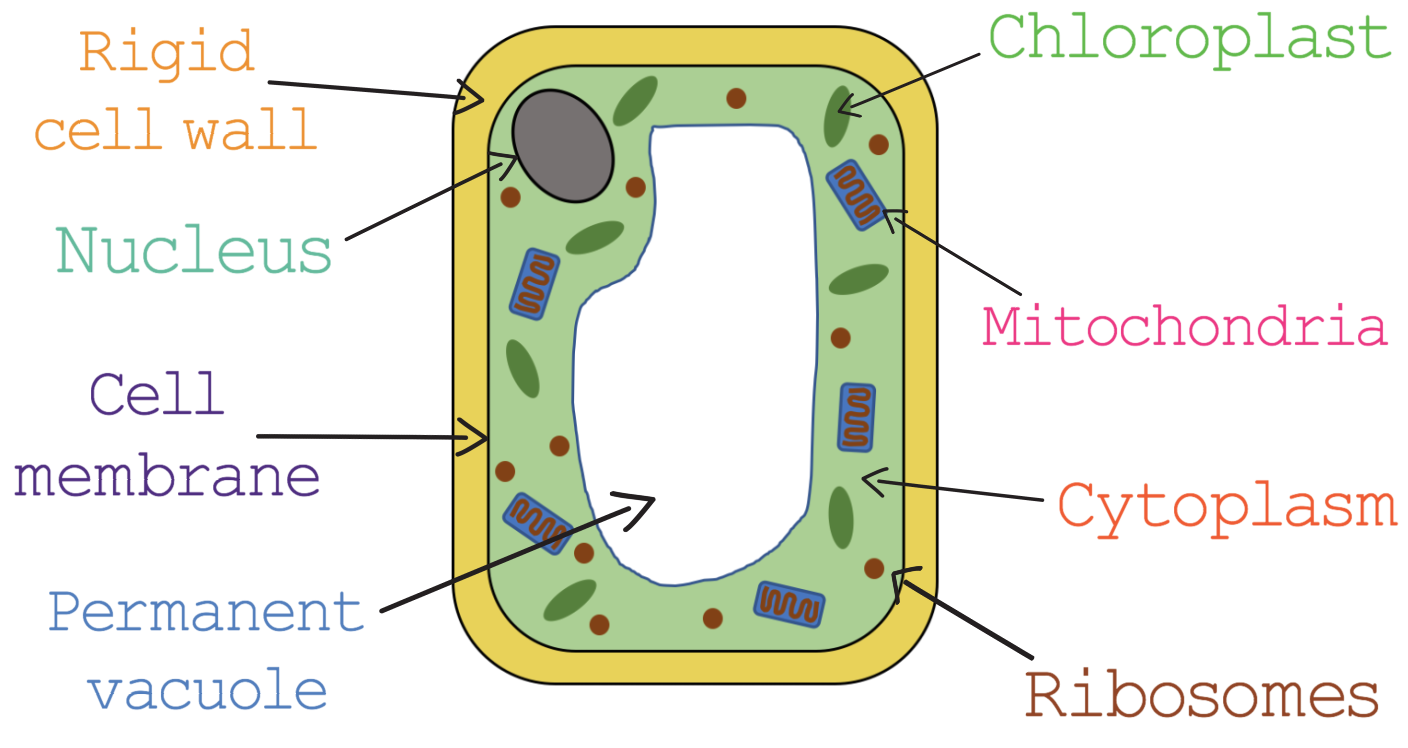
How many subcellular structures does a plant cell have?
8
Name all the subcellular structures in a plant cell
Cell membrane
Cell wall
Ribosomes
Mitochondria
Cytoplasm
Nucleus
Permanent Vacuole
Chloroplast
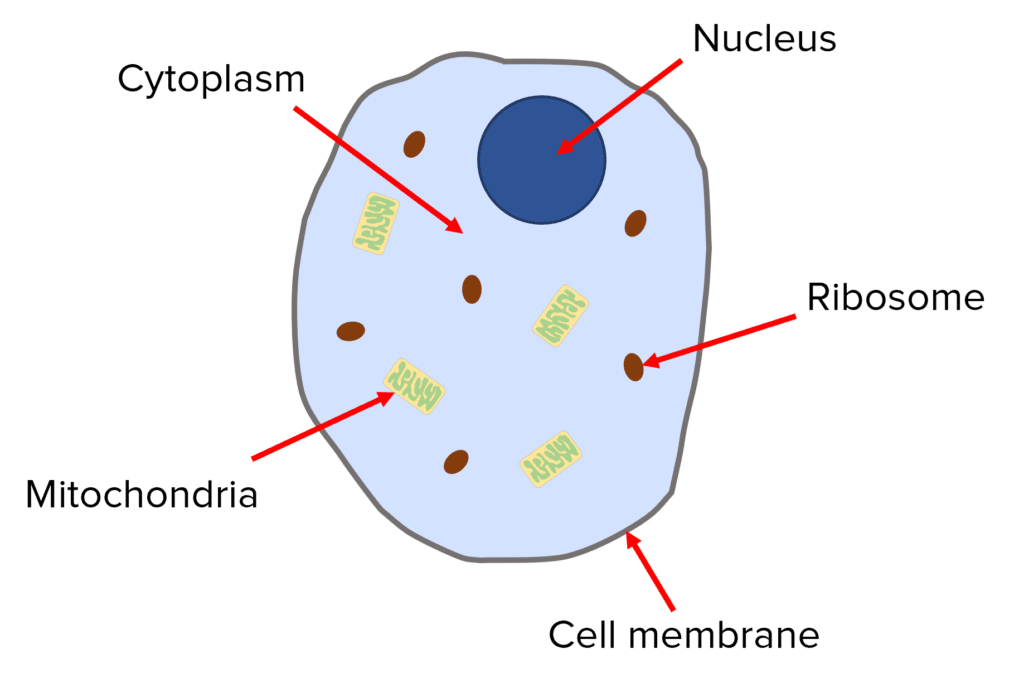
How many subcellular structures does an animal cell have?
5
Name all the subcellular structures in an animal cell
Cell membrane
Mitochondria
Ribosomes
Cytoplasm
Nucleus
What is the function of the cell membrane?
Controls what goes in and out of the cell
What is the function of the cell wall + what is it made out of?
It is rigid, made out of cellulose and supports and strengthens the cell
What is the function of the mitochondria?
Site of aerobic respiration, releases energy via glucose
What is the function of the cytoplasm?
Jelly like substance, contains enzymes, where all chemical reactions take place
What is the function of the permanent vacuole?
Contains cell sap, a weak solution of salts and sugars
What is the function of the chloroplast?
Site of photosynthesis, contains chlorophyll, a green pigment which absorbs light
What is the function of the nucleus?
Contains genetic material, controls the activities of the cell
What is the function of the ribosomes?
Site of protein synthesis
Light Microscopes : Pros + Cons (4)
Relies on light to produce an image
Easy to use
Cheap
Can see large subcellular structures (nuclei)
Electron Microscopes : Pros + Cons (6)
Relies on electrons to produce an image
Hard to use
Expensive
Can see smaller subcellular structures (ribosomes)
Have higher resolution compared to a light microscope
Have higher magnification compared to a light microscope
Define magnification
How many times bigger the image size is compared to the real size
Define resolution
The ability to distinguish between two points (higher resolution gives clearer image)
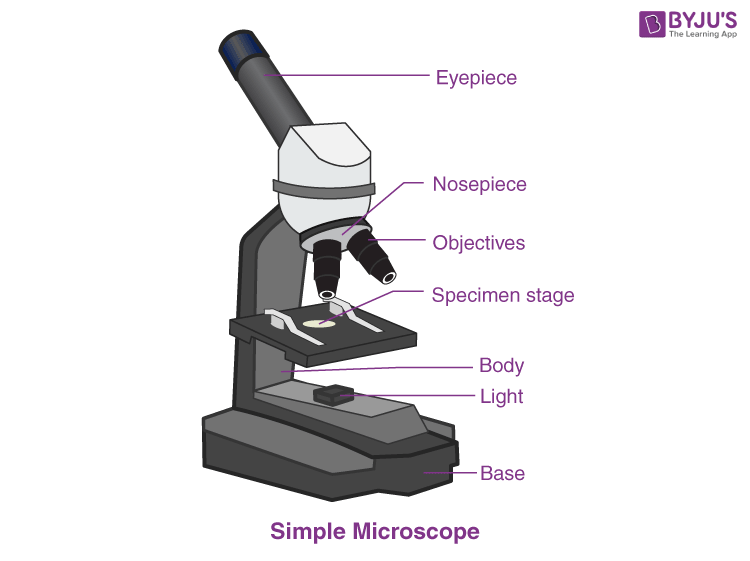
What is the function of the eye piece?
What you look through
What is the function of the stage
Where you place your slide
What is the function of the Coarse adjustment knob?
Moves the stage up or down + allows for rough focusing
What is the function of the fine adjustment knob?
Allows for precise focus when seeing smaller subcellular structures
What is the function of the high and low power objective lenses?
Magnification, start off with the lowest → wider field of view
What is the function of the light?
So you can see the slide
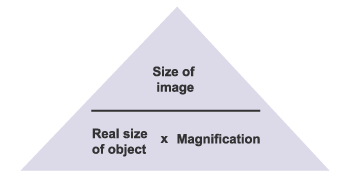
What is the equation for calculating magnification?
Magnification = image size/ real size
How do you prepare the microscope slide? (5)
Add a drop of water to the middle of a clean slide
Cut an onion and separate it into layers
Use tweezers to peel off the epidermal tissue and place it in the water
Add a drop of a stain (e.g. iodine solution) which is used to highlight objects by adding colour to them
Place a cover slip on top, make sure not to get any air bubbles as it will obstruct your view of the specimen
How do you prepare the light microscope to see the specimen? (6)
Clips the slide onto the stage
Select the lowest power objective lens (this will give you the widest field of view)
Look down the eyepiece and use the coarse adjustment knob to move the stage until the image is in rough focus (do not hit the objective lens)
Adjust focus with the fine adjustment knob until you get a clear image
Increase magnification and refocus to see different features
How do you draw your observations effectively? (8)
Subcellular structures in proportion
Label important features with straight, uncrossed lines
drawn with clear, unbroken lines
Include the magnification used
Use sharp pencil
Include the title of what you observed
Drawing takes up at least half of the space
No colouring/shading
What is cell differentiation?
When a cell changes to become specialised
What happens as cells change?
They gain different subcellular structures that help carry out specific functions
When do animal cells differentiate?
At an early stage, they lose the ability to differentiate after becoming specialised
When do plant cells differentiate?
Throughout their life span, plant cells do not lose the ability to differentiate
Why would mature animals differentiate?
For repair and replacement
What is the function of the sperm cell?
Reproduction → carry male DNA to the female DNA
How is the sperm cell adapted for its function? (3)
Has a long tail and streamlined head for swimming to the egg
Has many mitochondria to release energy for swimming
Has enzymes in its heads to digest through the egg cell membrane
What is the function of the nerve cell?
Rapid signalling → send electrical signals from one part of the body to another
How is the nerve adapted for its function? (2)
are long to cover more distance in the body
have branches at the end of the cells to be able to join with other nerve cells and form a network throughout the body
What is the function of the muscle cell?
Contraction → to be able to contract quickly
How is the muscle cell adapted for its function? (3)
are long which gives space for contraction
contain many mitochondria to release energy for contraction
contain protein fibres which allow it to change shape
What is the function of the root hair cell?
Absorbing water and minerals
How is the root hair cell adapted for its function? (2)
Have long hairs which stick into the ground, these increase the surface are for maximum absorption
Have no chloroplasts
What is the function of the phloem cell?
Transporting substances
How is the cell phloem adapted for its function? (2)
Long tubes joined from end to end
Has few subcellular structures which allows for maximum transportation
What is the function of the xylem cell?
Transporting substances
How is the cell xylem adapted for its function? (3)
Thick walls made from lignin to strengthen and support the cell
Long tubes joined end to end
No subcellular structures (is a hollow tube) which allows for maximum transportation
What form of genetic material does the nucleus contain?
Chromosomes
What are chromosomes?
Coiled up lengths of DNA
How many chromosomes does a human body have?
46 chromosomes
23 from the mother + 23 from the father
What is mitosis a part of?
The cell cycle
Why does mitosis occur?
To repair or replace damaged cells
What are the stages of mitosis? (5) (do not mention the end result)
Cell grows and increases its subcellular structures (mitochondria and ribosomes)
DNA duplicates (each chromosomes replicates)
The chromosomes line up at the centre of the cell and each arm is pulled to opposite ends of the cell
The nucleus divides
The cytoplasm and cell membrane divide
What is produced via mitosis?
Two daughter cells that are genetically identical
How do prokaryotic cell divide?
Binary fission
What are the stages of binary fission? (3) (do not mention the end result)
The circular rings of DNA and plasmids replicate
The cell gets bigger and the strands of circular DNA move to opposite ends of the cell
The cytoplasm divides and a new cell wall begins to form
What is the product of binary fission?
Two new daughter cells are produced which have one strand of DNA but varying numbers of plasmids
What conditions are needed for bacteria to divide quickly via binary fission + what happens if this is not achieved?
The right nutrients and warm environment
However if the conditions become unfavourable, the cells will stop replicating and die
How often do bacteria divide?
Every 20 minutes
How do you achieve uncontaminated cultures? (4)
Petri dish and culture medium must be sterilised → heating to kill any unwanted microorganisms
Inoculating loop must be sterilised → passed through a flame to kill any unwanted microorganisms
After transferring bacteria the petri dish should be taped lightly using 4 pieces of tape on the ‘corners’ to stop any microorganisms getting in
The petri dish should be stored upside down to stop any condensation droplets falling onto the agar surface
What are bacteria grown on, give 2 examples + what temperature are the grown at + why?
Bacteria are grown on culture mediums
The culture medium can be used as a nutrient broth solution or solid agar jelly (Bacteria grown on agar plates will form visible colonies)
In school the temperature must be kept at below 25°C because any higher and harmful pathogens will grow
How do you investigate the effect of antibiotics on bacteria? (5)
Place paper discs soaked in different types/concentrations of antibiotics on the agar plate with even covering of bacteria
Antibiotics should diffuse into jelly. Anti-biotic resistant bacteria will grow on agar where bacteria have died - this is the inhibition zone
As a control use a paper disc soaked in distilled water so you can compare the effect of the antibiotics
Leave plate for 48h at 25°C
To compare effectiveness, calculate the area of the inhibition zones by using πr2
What are stem cells?
Undifferentiated cells that can differentiate into any cell by, depending on instructions given
What are the two types of stem cells found in humans + where are they found?
Adult stem cells, found in the bone marrow of an adult
Embryonic stem cells, found in embryos that have not yet developed into babies
What are the pros + cons of embryonic stem cells? (5)
Can differentiate into any cell
No wait time
Produced in labs so the possibility of contamination whilst transferring is a risk and can cause disease in patients
People have ethical and religious objections
can cure diseases like type 1 diabetes and paralysis
What are the ethical reasons for and against embryonic stem cells?
For
embryos used is research are unwanted from fertility clinics and if not used for medicine would’ve died anyway + those suffering from illness are more important than embryos
Against
shouldn’t be used in experiments because they could be a potential human life
What are the pros + cons of adult stem cells? (4)
An adult who has bone marrow gives consent for it to be used
It can differentiate into a limited amount of cells
Wait time as they might be rejected by the patient
Can replace faulty blood cells
What is therapeutic cloning?
When an embryo could be made to have the same genetic information as the patient meaning the stem cell wouldn’t be rejected by the immune system
What is the stem cell found in plants called + where is it found?
Meristems, found on the growing tips of shoots and roots
What are the pros + uses for meristems? (4)
Can differentiate into any type of cell throughout its entire life
Can be used to produce clones of plants quickly and cheaply
Can grow more rare species without worry of extinction
Grow plants that have desired features for farmers like being disease resistant
What is diffusion?
The movement of particles from an area of higher concentration to an area of lower concentration across a partially permeable membrane
What states of matter does diffusion take place + why?
Liquids + gases because particles are free to move
What are the 3 factors that effect diffusion + how?
Concentration gradient → the higher the concentration gradient the higher the rate of diffusion
Temperature → the higher the temperature the higher the rate of diffusion
Surface area → the larger the surface area the higher the rate of diffusion
What type of cell membrane lets small molecules diffuse through like oxygen and carbon dioxide?
A partially permeable membrane
What are the 2 examples of diffusion?
Oxygen and carbon dioxide are transferred between cells and the environment during gas exchange
In human, urea (a waste product) diffuses from cells into the blood plasma for removal from the body by the kidneys
What is osmosis?
The movement of water molecules across a partially permeable membrane from an area of higher water concentration to an area of lower water concentration
How would you investigate the effect of sugar solutions on potato chips? (3)
Cut potatoes into identical cylinders and measure their mass
Put them into beakers with different sugar solutions, one should be pure water and the other a very concentrated solution (1mol/dm³), also have other beakers with different concentrations (0.1mol/dm³,0.2mol/dm³)
Take cylinders out, dry them with tissue and measure their masses
What are the variables for the effect of sugar solutions?
DV: The mass of the potatoes
CV: volume of solution, temperature, type of potato, time kept in beaker
IV: The concentration of sugar solutions
What should happen to the cylinders if water has been drawn IN by osmosis?
Increase in mass
What should happen to the cylinders if water has been drawn OUT by osmosis?
Decrease in mass
What is active transport?
The movement of particles form an area of lower concentration to an area of higher concentration, against the concentration gradient across a partially permeable membrane
Where does active transport take place? (2)
In root hair cells
In the gut
Describe active transport in the root hair cell (3)
Root hair cells need to take in minerals from the soil but the concentration of minerals is higher inside of the root hair cell than the soil so via active transport the root hair cell gains more minerals
This is essential for growth.
But a lot of energy from respiration is needed
Describe active transport in the gut (2)
Active transport in the gut happens when there is a lower concentration of nutrients in the gut and a higher concentration of nutrients in the blood (nutrients: glucose + amino acids)
It is then transported to the cell where it is used for respiration
Explain the surface area: volume ratio and the link to single-celled organisms and multicellular organisms (4)
In single-celled organisms gases and dissolved substances can diffuse directly into and out of the cell
This is because they have a large surface area compared to their volume
However, with multicellular organisms, their surface area is too small for their volume and not enough substances can be supplied to accommodate their volumes
This means that they need exchange surfaces for efficient diffusion
How have exchange surfaces adapted for the effective transport of substances? (4)
Have thin membranes; short diffusion pathways
Have large surface areas so lots of substances can diffuse at once
Exchange surfaces in animals have lots of blood vessels; get stuff in and out of the blood quickly
Gas exchange surfaces in animals are often ventilated; air moves in and out
What is the function of the lungs (2) and how are they adapted to do this? (4)
The job of the lungs is to transfer oxygen into the blood and remove carbon dioxide from it
To do this the lungs have millions of alveoli which are specialised to maximise diffusion of oxygen and carbon dioxide by
An enormous surface area (as there are many of them)
A moist lining for dissolving gases
Very thin walls
A good blood supply
What is the function of the small intestine (2) and how are they adapted to do this? (4)
They increase surface area so digested food is absorbed into the blood much quicker
Inside the small intestine which are long, there are millions of villi
They are
One cell thick
Have a good blood supply for quick absorption
Many villi to increase the surface area
Have many mitochondria for respiration
How are leaves adapted for efficient gas exchange? (5)
Carbon dioxide diffuses into the air spaces of the leaf, then it diffuses into the cells for photosynthesis
The underlayer of the leaf is the exchange surface and has loads of stomata which allows carbon dioxide to diffuse through
Oxygen and water vapour also diffuse out through the stomata
The size of stomata is controlled by guard cells; close stomata if water is being lost quicker than it is being replaced (without guard cells the plant would wilt)
Flattened shape of leaf increases surface area + many air spaces inside the leaf which act as exchange surfaces
How are fish adapted for efficient gas exchange? (6)
Gills are the exchange surface in fish
Water enters via the mouth and passes through gills; at the same time oxygen diffuses from water into blood and carbon dioxide diffuses from blood to water
Gills are made up of many gill filaments which increase surface area: gill filaments contain many lamellae which increase surface area even more
Lamellae have lots of blood capillaries to speed up diffusion
Have a thin surface layer to minimise distance gases have to diffuse
Blood flows one way and lamellae flow another to maintain a large concentration gradient