UBE Property
 Call Kai
 Learn
Learn Practice Test
 Spaced Repetition
 Match
Match Flashcards
 Knowt Play
 Podcast
1/171

There's no tags or description
Looks like no tags are added yet.
Name | Mastery | Learn | Test | Matching | Spaced | Call with Kai | Chat |
|---|
No analytics yet
Send a link to your students to track their progress
172 Terms
Fee Simple
Complete possessory interest in an estate — upon owner’s death, passes by their will or succession
Fee Simple Determinable
A type of fee simple estate that uses durational language (“as long as,” “while,” “during,” “until,”) and automatically ends and reverts to the grantor if period ends.
Future Interest Options
If future interest in Grantor: automatic right of reverter — when that durational period ends, ownership of estate automatically goes back to grantor. (Freely transferable by grantee, but whoever grantee sells to assumes the same obligation and right of reverter if obligation not met)
If future interest in third party — executory interest (shifting)
Fee Simple Subject to Condition Subsequent
A type of fee simple estate using conditional language (“but if,” “provided that,” “unless,” “only if”) that terminates upon the occurrence of a specified event, allowing the grantor to affirmatively (not automatic) retake possession/right of re-entry.
Grantor retains right of re-entry
If future interest in third party — executory interest (shifting)
Fee Simple Subject to Executory Interest
When future interest is in third-party (not grantor) — on occurrence/non-occurrence of condition, property automatically vests in third party. Grantor has nothing anymore.
Fee Tail
Limits estate to grantee’s lineal blood descendants (“heirs of the body”)
Life Estate
Estate that lasts for duration of grantee’s life* and terminates automatically upon their death
Potential Future Interests — remainders wait, executory interests take
Grantor takes reversion
“A for life”
Third-party takes remainder (can be vested or contingent — either way, just waiting for grantee to die)
“A for life, then to B”
RAP applies (but only to contingent remainders and vested remainders subject to open — not vested)
Executory interest third party (trying to take it from grantee)
“A for life, but if alcohol is ever sold on property, then to B”
*Can also be conveyed to the grantee for the duration of SOMEONE ELSE’S life: por autre vie
Rights of Life Tenant
Rents, profits (right to take natural resources from land) —> go to life tenant
Right to sell property: only if future interest holders (grantor/third-party executory) agree
Can seek court order if future interests unwilling to sell/can’t reach deal
Proceeds distributed according to present value of each interest
Obligation(s) of Life Tenant
Cannot do waste: life tenant must deliver property to future interest holder in substantially same condition that it was in when she took possession
Affirmative waste: duty not to change property if future interest holders have reasonable grounds for objection
Permissive waste: life tenant has duty to prevent permissive waste by making reasonable repairs
Ameliorative waste:
NO insurance obligation
Types of Waste that Can Be Committed by Life Tenant (and Obligations per each)
Affirmative waste: when the condition and value of the property decreases due to life tenant’s actions
Life tenant has duty not to change if future interest holders have reasonable grounds for objection
Permissive waste: when life tenant permits premises to deteriorate through neglect/failure to preserve/protect property
Life tenant has duty to prevent permissive waste by making reasonable repairs
But only obligated to pay 1) up to amount of income generated by property OR 2) fair rental value of property if tenant uses it (to live, farm, etc.)
Ameliorative waste: when a life tenant changes the use of the property in a way that increases its value
Permitted if change results in reasonable use of property
Vested Remainder Definition/How to Know if Someone is a Vested Remainder
Interest that is…
1) Given to ascertained grantee (someone we can identify) AND
2) Not subject to a condition precedent
I.e. “O conveys Blackacre to Anna for life, then to Ben.” —> Ben is ascertained grantee, no condition precedent (just waiting for Anna to die)
Future interest will become possessory upon the natural expiration of the preceding estate
Contingent Remainder
NOT a vested remainder… only have 1 of the vested remainder qualities:
1) Ascertainable grantee
2) Not subject to condition precedent
Someone whose future interest will become possessory either once grantee becomes ascertainable (i.e. is born) or condition precedent met
If ascertainable grantee, and previous estate terminates at this point, but condition not yet met —> property temporarily goes back to grantor (reversion)
Vested Remainder Subject to Complete Divestment
A future interest who has no condition precedent (so their interest is just waiting for natural termination of previous estate), but subject to a condition subsequent… that’s what makes them subject to complete divestment!! (it can be taken away from them)
O conveys Blackacre to Anna for life, then to B, but if B ever becomes a lawyer, then to C.”
O has no interest
Anna has life estate
B has vested remainder subject to complete divestment
C has shifting executory interest
Identify Interests: O conveys Blackacre to Anna for life, then to B, but if B ever becomes a lawyer, then to C.
O conveys Blackacre to Anna for life, then to B, but if B ever becomes a lawyer, then to C.”
O has no interest
Anna has life estate
B has vested remainder subject to complete divestment
C has shifting executory interest
Identify Interests: O conveys Blackacre to Anna, but if the land is ever used commercially, to Ben
O conveys Blackacre to Anna, but if the land is ever used commercially, to Ben → NO VESTED REMAINDER HERE
O has no interest
Anna has fee simple subject to executory interest
CANNOT SAY THAT ANNA HAS FEE SIMPLE SUBJECT TO CONDITION SUBSEQUENT — that specifically conveys that the grantor has a right of re-entry (but he doesn’t!!!!)
If there’s a third-party with the potential to cut off grantee’s ownership — you need to say “fee simple subject to shifting executory interest”
Ben has shifting executory interest (NOT, contingent remainder – remember, remainders wait/don’t cut off, executories take)
Vested Remainder Subject to Open
RAP applies
1) Vested remainder in a class gift AND
At least one member of the class is currently vested (good to take the property the second the previous estate ends)
If no one in class is currently vested/good to take the property once the previous estate ends —> class is a contingent remainder (makes sense: they either aren’t ascertainable or haven’t met condition precedent)
2) Full class membership is unknown
This is what makes it subject to open (might need to open for future class members)
Once all members of class are identified, class closes — class members then partially divest OG vested remainder
How do we know when all class members have been identified?
When we are absolutely certain/no possible world in which the class can have an additional member
I.e. “To Anna for life, then to Anna’s children who reach 21” → class closes 21 years after Anna dies (property law assumes anyone can have a child at any time before the party’s death)
What happens once all class members are identified
Once all members of class are identified, class closes — class members then partially divest OG vested remainder
Identify Interests: “To A for life, then to A’s children.” A has one child, C… what if the conveyance was “to A for life, then to A’s children who reach 21. A has one child, C, who is 5 years old.
A; life estate
A’s Children: class gift
C: vested remainder (ascertainable and no condition precedent — just waiting for previous estate to end) but since class gift, C: vested remainder subject to open (could be more kids)
If more kids, then A dies —> A's other kids will partially divest C
If the requirement
If ‘then to A’s children who reach 21’
C: contingent remainder (waiting on condition precedent — turning 21)
Once C reaches 21 — vested remainder… but other potential kids… vested remainder subject to open
If more kids — C doesn’t have to wait until 21 years after Anna’s death for class to close because of Rule of Convenience (class closes when at least one member becomes entitled to possession — kids who aren’t entitled to possession at that point will be excluded)
Rule of Convenience
Membership in a class closes whenever any member of the class is entitled to immediate possession of a share of the class gift — other class members who aren’t entitled at that point will be excluded
“When it’s time to hand out the property, we’re locking in class membership”
Exception: grantor specifies that class should remain open even if a member is entitled to immediate possession of a share of the class gift → gonna have to recalculate if someone comes outta the woodwork
Rule of Worthier Title
Prevents against remainders in grantor’s heirs — creates presumption of reversion to grantor
I.e. “to Anna for life, then to my heirs” —> NO —> “to Anna for life, then to me”
Think: grantor is worthier than their heirs (it will eventually go to them anyway)
Worthier has an O so you know this one is about grantor + heirs
Rule of Shelley’s Case
Prevents against remainders in grantee’s heirs (uses merger doctrine to create fee simple instead — that’s what it basically is in the OG form anyway)
“To Anna for life, then to her heirs,” —> NO —> “to Anna” (fee simple — will go to her heirs anyway)
Think: Rule of ShellEYYY means simple FEEEE for the grantEEEE (not their heirs)
Shelley has two E’s, so you know this one is about grantees + heirs
Rule Against Perpetuities Rule Statement
No interest is valid unless it vests or fails no later than 21 years after the death of any relevant life in being at the creation of the interest. If there is any possibility, however remote, that the interest could vest outside that period, the interest is void from the outset.
Applies to: contingent remainders, executory interests, and vested remainders subject to open (class gifts)
Applies to our uncertainties
Does not apply to: vested remainders, reversions, possibilities of reverter, or rights of entry.
RAP 3 Part Method
1) WHEN: Intervivos transfer (grantor still alive) OR devise transfer (by will — interest created at death, not when will drafted)
2) WHAT INTEREST SUBJECT TO RAP:
Subject to Rap: contingent remainder, vested remainder subject to open (class gifts), executory interests
Not Subject to Rap: Vested remainder, reversion, re-entry
3) WHO IS THE VALIDATING LIFE
Validating Life: person who tells us whether or not interest vests within perpetuities period
Need to have been alive when interest was created
What does court do if conveyance violates RAP?
Strikes out the entire future interest (not just the part that offends RAP)
RAP Practice: To Anna, but if the land is ever used as a business during Anna’s lifetime, to Ben.
When: intervivos → at Oliver’s conveyance
What: Ben’s executory interest → subject to RAP
Who: lives in being at the time of creation → Oliver, Anna, Ben
Who is the Validating Life: will we know 21 years after their lives whether this interest vests or not
When is the latest moment we could know if this interest will vest – at Anna’s death, that’s when we’ll know if the land was ever used as a business!!
So Anna is the validating life → Ben’s executory interest is valid
NO RAP VIOLATION
RAP Practice: From Oliver, “To Anna for life, then to Anna’s first child who reaches the age of 22.” Who has the future interest?
1) When: inter vivos → created at conveyance
2) What: Life estate, contingent remainder
3) Who: Oliver, Anna
Anna could have a kid the day before she dies. We aren’t going to know if the kid makes it to 22 within 21 years of her death → struck down under RAP
Court will change it to: “To Anna for life, then to Anna’s first child who reaches the age of 22.”
Now it’s just to Anna for life!
Interests Post-Strike:
Anna: life estate
Anna’s first child’s interest: nothing
Oliver: reversion (so once Anna dies, estate goes back to Oliver)
RAP invalidates the entire future interest, not just the part that offends RAP
RAP Practice: “To Anna so long as the property is used as a farm, then to Ben.”
When: inter-vivos
What:
Anna has fee simple subject to executory interest (NOT fee simple determinable — no right of reversion)
Ben has shifting executory interest → subject to RAP via Ben
Who: Oliver, Anna, Ben
Validating life: Anna – but this is not going to Anna just for her life… it’s going to Anna and then STAYING with her (via her heirs) → this means it could go to Anna who uses it as a farm, then her daughter, then her granddaughter, then her granddaughter (who uses it as a swimming pool) → NOW Ben’s interest will vest?
WAY TOO LATE → RAP VIOLATION
Read this as “To Anna (AND ALL HER HEIRS) so long as the property is used as a farm, then to Ben.”
Be wary when there’s no “to life”
Fix It: “To Anna so long as the property is used as a farm, then to Ben.”
Interests Post-Strike:
Anna: Fee Simple Determinable (inheritable)
Ben: nothing
Oliver: possibility of reverter
RAP Practice: Oliver says, “to my grandchildren who reach age 21.” He has 2 kids and 3 grandkids under the age of 21.
Oliver says, “to my grandchildren who reach age 21.” He has 2 kids and 3 grandkids under the age of 21.
When: inter vivos → time of conveyance
What: springing executory interest class gift → subject to RAP
Who: Oliver, Anna (Oliver’s daughter), Ben (Oliver’s son), 3 grandchildren
Validating Life: the latest we could know about all of Oliver’s grandchildren who reach age 21 is 21 years after the death of both of his kids (once his kids have both died, no new grandchildren can be born… then we’ll know if the existing grandchildren reach 21 within 21 years)
NO RAP VIOLATION (WRONG THIS ACTUALLY IS A RAP VIOLATION)
Oliver can potentially have another child the day before he dies (fertile ocotgenarian). We will not be able to know within 21 years if that child has another child who reaches 21 years themselves. There is no one who can tell us whether this interest will vest within their lifetime + 21 years — as such, RAP violation
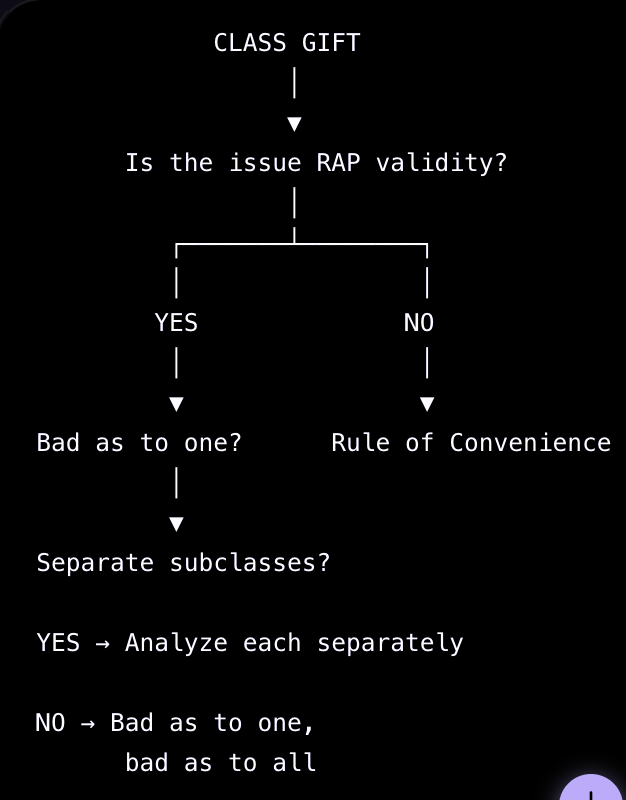
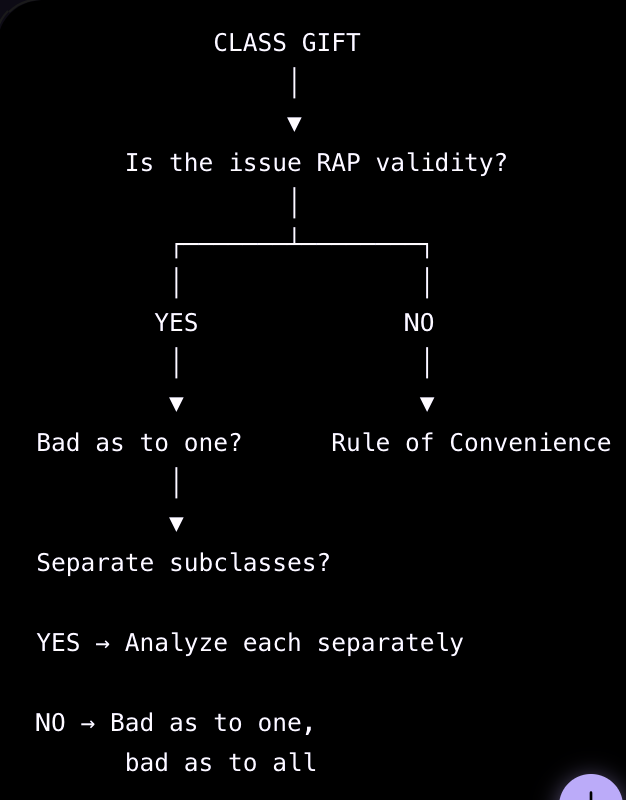
“Bad as to One, Bad as to All” Rule
If the interest of any possible member of the class could violate the Rule Against Perpetuities, then the entire class gift is void (even if there’s a class member whose interest is ready to go)
I.e.: Oliver conveys, “to Anna for life, then to her children who reach age 25.” Anna has a kid right now, Ben, who is 26.
Obviously RAP violation (25 years is over 21 years)
BUT Ben meets the conditions right now… can he just take it and court X out the rest?
“Bad as to One, Bad as to All” says NO — gift is void to all members of the class: court will correct to from O “to Anna for life,
then to her children who reach age 25.”Anna: life estate
O: right of reversion
Anna’s kids (including Ben): nothing
If gift won’t vest in all members within validating life + 21 years, no one in the class can get it
2 Exceptions for “Bad as to One, Bad as to All”
1) Transfers of specific dollar amounts to each class members
I.e. “To Anna for life, then $100k to each of Anna’s grandchildren.” → treated as individual gifts ($100k for each, rather than class gift)
I.e. “To Anna for life, then $100k for Anna’s grandchildren” → this is a class gift that we won’t be able to know if it will vest in entire class in Anna’s life + 21 years = RAP violation
2) Transfers to a subclass that vests at a specific time/separate family branches/dead parent’s branch exception
I.e. “to Anna for life, then to Anna’s children for life, then to the children of each child.” At conveyance Anna has 2 kids: Ben and Chloe. Ben has Ben Jr. and Ben III. Chloe has Chloe Jr. Ben dies. TECHNICALLY, Chloe could still have more kids (she’s alive!!!), but Ben’s branch is ready to go… ordinarily, the fact Chloe could have more kids would invalidate the entire gift.
BUT to not screw over everyone— → court will separate the branches and distribute gift among Ben’s side (Chloe’s side gets nothing — BUT the alternative is that the entire class fails!! So this is fairer than the alternative)
Rule of Convenience
A doctrine that allows the class of beneficiaries of a class gift to close when a future interest holder becomes entitled to immediate possession (not RAP violation issue — this is a “we don’t want to have to wait 21 years to get the property” solution)
I.e. O conveys to “Anna for life, then to Anna’s children who reach 21.” Anna has one child right now who’s 22, Isabella.
Rule of Convenience means that when Anna dies (terminating life estate), we’ll just give it to Isabella (vested remainder subject to open, but entitled to immediate possession) and close the class. Isabella doesn’t have to wait 21 fucking years to get her gift!!
Notice this is not a RAP problem, it’s “we don’t want to have to wait forever to get property we’re entitled to”
“To John for life, then $100k to each of John’s grandchildren.” Allowed?
Yes — allowed under “bad as to one, bad as to all” exception regarding specific dollar amounts provided to each class member. This is treated like an individual gift, rather than as one pot of a gift that will violate RAP.
2 Exceptions to RAP
Charitable gifts from one charity to another charity
Option held by a current tenant to purchase a fee interest in the leasehold property OR option/right of first refusal in a commercial transaction
Concurrent Owners and Types
Concurrent Owners: when two or more people own the property at the same time — each have the right to use/possess the whole property
Three Types:
1) Joint Tenancy
2) Tenancy in Common
3) Tenancy by the Entirety
Requirements for Joint Tenancy, Defining Feature of Joint Tenancy, and how to Convey
Joint Tenancy: right of survivorship — surviving tenants automatically take the deceased tenant’s interest
Requires 4 Unities (PITT) (if one is lost, joint tenancy is severed —> tenancy in common)
Unity of Possession: every joint tenant has equal right to possess the whole property
Unity of Interest: equal interest requirement
Unity of Time: each tenant must receive their interest at the same time
Unity of Title: must receive their interest in the same instrument
How to Convey: clear expression of intent and survivorship language
Defining Features of Each Co-Tenancy Types
Joint Tenancy: right of survivorship and four unities requirement (PITT: possession, interest, time, title)
Tenants in Common: default
Tenancy by entirety: same as joint tenancy but marriage (fifth unity) + cannot unilaterally transfer
Tenancy in Common
A concurrent estate in which two or more persons hold separate but undivided interests (undivided: NOT A owns the kitchen, you own the garage) in the same property. The co-tenants may own equal or unequal fractional shares, each has the right to possess the whole property, and there is no right of survivorship. Default concurrent estate.
No right of survivorship: each co-tenant can transfer their portion of the property freely at death/during life (but if they’re tryna sell the whole property, all co-tenants gotta sign off)
Common Ways Four Unities are Severed
1) Inter vivos transfer: one of the joint tenants transferring during life will sever their right of survivorship (but if there’s more than 2 tenants — it will keep it for them!)
I.e. Anna, Ben, Carmen are joint tenants (each ⅓). Anna transfers her share to Amy → now Amy is tenant in common, Ben and Carmen are joint tenants.
I.e. Anna and Ben are joint tenants (each own 1/2). Anna transfers her share to Amy —> now Amy and Ben are tenants in common (if either of them die, neither has right to their shares)
2) Mortgages: whether severs joint tenancy depends on whether you’re in a lien jx or title jx
Lien jx: mortgage is just seen as a lien on the property —> no sever joint tenancy
Title jx: mortgage is seen as someone coming in and having title to property —> joint tenancy in severed, now tenancy in common for the person who brought in the mortgage
3) Leases: joint tenant leases her share in property to a tenant — jx dependent
Some jx say this severs, others treat it as a temporary suspension of joint tenancy
Tenancy by Entirety
Joint tenancy between married people; includes right of survivorship; instead of four unities you have five (fifth is marriage)
Cannot alienate/encumber shares without consent of spouse
Magic Words: “as tenants by the entirety, with a right of survivorship.”
What if there are three joint tenants: A, B, and C and C decides to take out a mortgage on the house. This is in a title state. Will A and B continue to be joint tenants and C will be considered a tenant in common? What will the bank be? What will be the value of the interest? What will happen in practice?
A and B will continue to be joint tenants will rights of survivorship
C will have a tenant in common interest — bank will not have any of that, only a mortgage interest (with the property being security)
If C defaults on mortgage and bank forecloses (on C’s 1/3 interest that he offered as collateral, NOT on the entire property) — whoever bank sells to will become a tenant in common
In practice: buyer will normally pay less than 1/3 interest in exchange for headache of owning 1/3 of a property with people you don’t know — buyer will then normally assume partition action
Rights of Co-Tenants
1) Possession and Use: each co-tenant has right to possess all of property, but cannot exclude other co-tenants from use (outser)
2) Entitlement to Rents: rent received from third-party possession of property (minus operating expenses) are divided based on ownership interest of each co-tenant
If third-party renting while one of the co-tenants lives there — co-tenants just split the portion of the third-party’s rent according to ownership interest (co-tenant who lives at the property doesn’t need to pay anything for staying there)
Obligations of Co-Tenants
1) Not commit waste or impair the property
2) No outser: when co-tenant in possession denies another co-tenant access to the property (i.e. changing locks, throwing out other person’s stuff)
In order to be considered outsed, you have to make clear you want possession (risk getting AP’d)
3) Must share rents and operating expenses in proportion to ownership interest
If one co-tenant doesn’t pay their portion of operating expenses — paying co-tenant can collect contribution
Does each co-tenant have right to possess all of property? Does their share/type of co-tenancy change this?
YES, each co-tenant has right to possess all of property, regardless of share or type of co-tenancy
Exception: if you guys contracted around this
Remedies for outsed tenant
1) Injunction granting access to property AND/OR
2) Damages for value of use while co-tenant was unable to access property (this one is more common if you’re talking about a commercial property/warehouse)
Remember: to get any of this/be actually counted as outsed — you need to have made it clear that you wanted possession (can’t just silently mope around)
What Counts as Operating Expenses (thus requiring split according to ownership interest)
Operating expenses: necessary charges, insurance, necessary assessments, taxes, mortgage payments
If not paid by one co-tenant, overpaying co-tenant can collect contribution
Versus Repairs: no automatic right to reimbursement from other co-tenants for necessary repairs
Though can be reimbursed through partition or contribution after notice
Versus Improvements: no right to reimbursement, but can get credit for those improvements in partition action
For co-tenants, do necessary repairs count as operating expenses?
No, but can be reimbursed through partition or contribution after notice
For co-tenants, do improvements count as operating expenses?
NO — no right to reimbursement, but can get credit for those improvements in partition action
Partition (+ can one tenant force the division of the property without the other co-tenants or do they need the other co-tenants permission? Is it like this every co-tenancy or are there special rules for some of them?
Equitable remedy where court will divide property into distinct portions (from concurrent owners → to separate estates)
Available to all holders of a tenancy in common or a joint tenancy as a unilateral right (one tenant can force a division of the property without the other co-tenants — unless tenancy by entirety)
Can one co-tenant force partition without other co-tenants?
YES (unless tenancy in entirety)
Kinds of Partition
Partition in kind: when you actually divide the property up, preferred by courts
Partition in sale: when you sell the property and divide proceeds according to interests
When does court order partition in sale? (less preferred partition type)
1) Physical partition not practical OR
2) Physical partition would not be fair to all parties
I.e. there’s a property and one side of it is super fertile land and the other side is jagged cliffs, you can’t just split the property (gonna screw over the guy with the jagged cliff side)
Even though partition is a unilateral right, can co-tenants ever agree not to partition? What implications does this have for third-party transferees?
YES — will be enforceable if
1) Agreement is clear AND
2) Time limitation is reasonable — cannot bar partition forever
These agreements can bind third-party transferees if
1) Agreement was intended to run with the concurrently owned property AND
2) Transferees have actual or constructive notice of agreement at time of transfer
Fair Housing Act (and what actions does it prohibit and who does it protect)
Prohibits discrimination in the sale, rental, and financing of dwellings; also prohibits advertising that states a discriminatory preference
Must show causation: prohibited behavior must be linked to protected bias —> gotta show some bias
Protects: race, religion, national origin, sex, disability (mandates reasonable accommodation), familial status (kids under 18/someone who is pregnant), sexual orientation (through sex)
Prohibits:
Refusing to rent, sell, finance a dwelling
Requiring different rents
Falsely denying that a unit is available
Providing different services to facilities
Stating a discriminatory preference in an advertisement
Religious organizations and private clubs exempted from this
Ms. Murphy’s boarding house exempted if 1) shared living areas and 2) restriction is sex-based
Exceptions to Fair Housing Act
1) Single family housing that is sold or rented without a broker
Limit on how many houses you can sell without a broker → we’re trying to stop discrimination by professionals
2) Ms. Murphy’s boarding house: owner-occupied buildings with four or fewer living units
3) Religious organizations and private clubs
+roommate exemption
“One bedroom unit apartment available. Perfect bachelor pad. Hot tub and other amenities. Close to bus line, bars, and grocery. Utilities not included.” Allowed?
NO — Fair Housing Act violation. “Perfect bachelor pad” shows discriminatory preference based on both sex and familial status (there’s your causation).
What law controls property disputes? (conflict of laws)
Law of situs: controlling law is based upon where property is located — default rule
BUT will not use law of situs when
Instrument says to use law of different state
In cases involving marriage (especially when classifying property as marital or separate) —> domicile of party
Mortgage cases if mortgage document requires repayment to another state
Lease
Contract that transfers to a tenant the right to possess and use real property for a specified period of time in exchange for consideration (usually rent)
4 Types of Tenancies (list them, their defining features, and how they are created/terminated)
Tenancy for years: tenancy measured by fixed amount of time (1 year; 2 months; duration of war)… tenancy ends automatically at end of term, does not automatically repeat
Creation: agreement by landlord and tenant (if longer than 1 year must be signed and in writing)
Termination: no notice required (unless landlord writes into lease that notice is required)
1) can occur automatically at end of term
2) Tenant can surrender lease before end of term
3) Landlord/tenant can commit material breach of lease —> will terminate prematurely
Periodic tenancy: tenancy that automatically repeats (month-to-month, year-to-year) until one party gives notice of termination
Creation: express (agreement) or implied (just start paying rent every month)
Termination: require notice, usually written, at least 1 month in advance (notice effective on last day of month you’re giving notice, so lease terminated the last day of the next month)
Tenancy at will: tenancy that can be terminated by landlord or tenant at any time, for any reason
Creation: express (agreement) or implied (“stay at my condo for as long as you need”)
Termination: reasonable notice
Can also be terminated by death of tenant or landlord (unique to tenancy at will)
Tenancy at sufferance: hold-over tenant, won’t leave — tenant will owe landlord reasonable value of daily use and reasonably foreseeable special damages
But if landlord accepts money = to old rent at any point — considered re-rented
Tenant Duties (contrast to co-tenant duties) and what can modify these duties
1) Pay rent.. no longer required to pay rent in following cases:
1) Premises are destroyed (not caused by tenant)
2) Landlord completely/partially evicts tenant
3) Landlord materially breaches lease (breach of implied covenant of quiet enjoyment; breach of implied warranty of habitability)
2) Avoid Waste
Tenant must notify landlord of any needed repairs (landlord is responsible for repairs)
Co-tenant duties: 1) pay operating expenses, 2) avoid waste, 3) no outser
Tara has month-to-month lease from John. Tells John on February 15th that she’s moving out. What type of tenancy and when would notice be effective?
Periodic tenancy — notice is considered effective on the last day of the month you give it (so here: February 28). But notice also has to be one full month (regardless of # of days) in advance — so lease would be officially terminated March 31.
March 31. A periodic tenancy requires one full rental period's notice, and the notice must terminate at the end of a rental period. Since February 15 is not one full month before February 28, termination is delayed until the end of the next rental period (March 31).
How can landlord materially breach lease and what implications does either of the breaches have for tenant?
Landlord can materially breach by…
Breach of Implied Covenant of Quiet Enjoyment
Breach of Implied Warranty of Habitability
If landlord breaches either of these — tenant doesn’t need to pay rent anymore (if breach of quiet enjoyment — only if tenant leaves), fix the issue and offset costs in rent, treat breach as constructive eviction and leave, or use breach to defend against eviction
Define Implied Covenant of Quiet Enjoyment. How does breach occur, and what are the implications of that breach?
Implied in every lease (both residential and commercial), this promises that the tenant’s possession and enjoyment of the premises will not be substantially interfered with by the landlord/someone acting under landlord’s authority. (If breached — constructively/actively evicted tenant can withhold rent)
Breach:
1) Landlord takes action that makes the premises wholly or substantially unsuitable for their intended purposes AND
2) Tenant notifies landlord of problem
3) Landlord doesn’t correct the problem
4) Tenant vacates the premise after reasonable amount of time has passed — tenant is constructively evicted (requires that tenant actually leave)
Define Breach of Implied Warranty of Habitability. What is evidence that this has been breached? What can tenant do if this is breached?
Implied in every lease, this imposes an obligation on the landlord to maintain property so that it’s suitable for residential use (does not apply for commercial leases)
Evidence of breach: landlord not complying with housing code
What tenant can do:
If premises not habitable —> tenant can refuse to pay rent, fix the issue and offset costs in rent, treat breach as constructive eviction and leave, or use breach to defend against eviction
If tenant chooses to withhold rent: must…
1) Notify landlord of problem and
2) Give landlord reasonable opportunity to correct the problem
If a tenant decides to withhold rent for breach of implied warranty of habitability — what do they have to do first? What else can tenant decide to do instead of withholding rent in case of breach of implied warranty of habitability?
1) Notify landlord of problem and
2) Give landlord reasonable opportunity to correct the problem
Tenant can fix the issue and offset costs in rent, treat breach as constructive eviction and leave, or use breach to defend against eviction
Landlord’s Duty (if tenant abandons) — what is it? What are the consequences of fulfilling this duty or not fulfilling this duty?
Duty to Mitigate: if tenant abandons property early or is evicted by the landlord, landlord has an obligation to mitigate damages by re-renting the property
Must make reasonable efforts to re-rent (but doesn’t need to accept unreasonable replacement tenant) — needs to advertise, hold showings, etc.
Consequences
If landlord doesn’t mitigate: tenant relieved from obligation to pay rent for the period they ditched/were kicked out
If landlord DOES mitigate: landlord entitled to difference between original rent and replacement rent
Tara signs one year lease for $2k/month. She ditches after one month. Her landlord can only find someone to rent for $1k/month. What happens?
Landlord mitigated, but only found someone willing to pay $1k/month, when Tara was paying $2k/month. Now Tara will be liable for the other 1k/month.
If he hadn’t mitigated, Tara wouldn’t be liable for anything — landlord would be outta luck
What are the landlord’s obligations (specifically under implied covenant of quiet enjoyment and warranty of habitability)?
1) Landlord cannot deny tenant quiet enjoyment
But landlord does not have to control off-premises actions of third parties beyond his control
2) Premises must be habitable
3) If tenant complains about any conditions, landlord cannot retaliate by evicting them
What are these all examples of: changing locks, landlord repeatedly enters premises, shutting off utilities; blocking access to property; removing tenant parking rights; authorizing other tenant to interfere (landlord leases A to Emma and B to a nightclub → he knows it’s gonna be blasting music all night)
Violating//denying tenant right to quiet enjoyment of the leasehold
Landlord goes to yell at tenant and tenant says “sorry, but look I have some money for you,” (and the money is the same amount as the old lease) and landlord accepts → periodic tenancy established
This scenario illustrates that the landlord's acceptance of payment for the old lease amount indicates a mutual agreement, resulting in the establishment of a periodic tenancy.
Duty to Deliver Possession — Majority vs. Minority Rule
Majority Rule: landlord must deliver physical/actual possession (tenant is actually in leasehold)
Minority Rule: landlord only required to deliver legal possession
Analyze the following situation according to majority and minority rules regarding duty to deliver possession: Oliver leases apartment to Emma beginning June 1. Oliver’s prior tenant, Ben, was supposed to move out on May 31. Ben refuses to leave and remains in the apartment on June 1. Emma arrives with a moving truck and can’t get in. Whose responsibility is this?
Majority rule: Landlord must deliver legal AND ACTUAL possession — here, landlord loses. Emma can terminate lease and/or sue Oliver for damages (and Ben is Oliver’s problem)
Minority rule: Landlord only needs to deliver legal possession — here, it’s Emma’s problem: she needs to bring the eviction action against Ben.
Tort Liability in Leaseholds — who/for what does the landlord owe a duty of care to (common law vs. modern)? Who does tenant owe a duty to?)
Duty owed to: invitees, licensees, and foreseeable trespassers (same for tenants
Common Law: landlord responsible for
Latent defects tenant hasn’t been warned about
Faulty repairs by landlord/landlord’s agents
Negligence that causes injuries in common areas
Modern: landlord has general duty of reasonable care
Assignment
Complete transfer of tenant’s remaining term
Sublease
transfer for less than entire duration of lease — OG tenant retains right of reverter
What does a landlord need with someone in order to hold them responsible for the rent? Explain the two types and how this all factors into assignments vs. subleases
Privity (either privity of contract or privity of estate)
Privity of contract: landlord has an agreement with the party
Privity of estate: one party’s physical possession of space is carved out of someone else’s estate
Assignment:
OG tenant has privity of contract with landlord (signed a contract with landlord)
OG tenant has privity of contract with tenant2 (signed contract with them)
OG tenant no longer has privity of estate with landlord — assignment means OG tenant conveyed the entire estate has been conveyed to tenant2, no right of reverter
Since OG tenant still has privity of contract with landlord — landlord can come after OG tenant for unpaid rent
Since tenant2 has estate privity with landlord — landlord can ALSO come after tenant2 for unpaid rent
Sublease:
OG tenant has privity of contract with landlord (signed contract with landlord)
OG tenant has privity of contract with tenant 2 (signed contract with them)
OG tenant STILL HAS privity of estate with landlord — did not convey entire estate (OG tenant has right of reverter)
But OG tenant now ALSO has privity of estate with tenant2 — tenant2’s physical possession of the space is carved out of OG tenant’s estate
Since OG tenant subleased — they still retain right of reverter. This means that landlord can only come after OG tenant if tenant2 skips out on rent. BUT OG tenant and tenant2 do have contractural privity — OG tenant can go after tenant2 to recover if things get dicey (landlord just can’t do it)
Permission to Transfer Leaseholds: Right to Sublease/assign and right for landlords to transfer (and what that means for subsequent landlords/transferees)
If lease silent on transfers by tenants —> tenant can assign/sublet freely
If lease requires landlord permission, but does not set a standard
Majority: landlord may deny permission for commercially reasonable reason
Minority: landlord may deny permission at their discretion
Landlord doesn’t need tenant’s permission to transfer interest
But new landlord is bound by ALLLL the terms of existing lease (unless tenant gives them permission to switch up)
Atonement
When tenant formally acknowledges new owner as their landlord (usually written notice), by continuing to pay rent, you’ve attoned
What Controls: Deed or Contract?
Contract controls when we’re in the time period between the contract and the execution of the deed
Deed controls after the execution of the deed
What does a land sale require contracturally to be a valid transfer? Are there any exceptions to this (actions/situations that mean the transfer would still be valid?)
Statute of frauds issue
To be a valid transfer, agreement must be…
1) In writing
2) Signed by the party to be charged
3) Include essential terms (parties, property description, price, payment info)
Some flexibility on property description — doesn’t need to be a legal description (especially as it applies to identifying where property is in rural areas)
2 situational exceptions to Statute of Frauds requirements for land sale
1) Part performance: partial performance by either seller or buyer is treated as evidence that contract exists
Just need to meet 2 of 3 conditions: 1) Payment, 2) Possession, 3) Improvements to Land
2) Detrimental reliance (estoppel): party has reasonably relied on the contract and would suffer hardship if contract was not performed
Marketable Title (and what could make a title unmarketable)
Title that is free from unreasonable risk of litigation — every land sale contract has an implied covenant of market title!
Things that could make title unmarketable:
1) Defects in chain of title: no one knows who owned property during 10 year period
2) Title acquired by adverse possession that hasn’t been quieted/legally stamped
3) Existence of private encumbrances (mortgage, covenant that’s being violated, easement)
If covenant is unenforceable —> no risk of litigation, so title is still marketable —> no issue, can’t rescind
Existence of mortgage (even if they knew about it) that buyer didn’t agree to
Existence of an enforceable covenant that you didn’t agree to —> can rescind
But if you knew about it via constructive notice, can be considered to have agreed
Easement —> can rescind if you didn’t have actual/constructive/inquiry notice
If house is in violation of an enforceable covenant —> can rescind
4) Violation of zoning ordinance —> can rescind
But existence of zoning ordinance —> cannot rescind
If there’s a defect in title, what’s your course of action? (realize before deed executed vs. after deed executed)
Defect in title must be cured or fixed before closing → if seller can’t deliver marketable title, buyer’s remedy is rescission of contract
If buyer doesn’t realize defect in title and executes deed —> contract and deed merge and the deed controls (no marketable title claim for you!! Deed doesn’t have that shit in it!!)
What is the effect of failure to close on time? Does the effect depend on contractural terms?
Failure to close on time is a breach, NOT grounds for rescission (if time not of the essence)
But if parties contract/notify beforehand — time IS considered of the essence
Time of the essence clause and they don’t close on time —> can rescind
Implied Warranty of Fitness or Suitability (note majority and minority rules for subsequent litigation on this basis)
When a builder-vendor sells a newly constructed home, builder implicitly promises home is fit/suitable (basically a builder warranty)
Majority Rule: if defect was 1) latent/not reasonably discoverable and 2) caused by builder — both Buyer 1 and Buyer 2 can recover damages
Minority Rule: only buyer 1 can sue
Must bring suit within a reasonable amount of time
Duty to Disclose Defects (and what does material mean in this context) — can you dsiclaim these?
Seller has duty to disclose to the buyer, known material physical defects
Material: substantially affects the value, health and safety, or desirability of the property (i.e. haunted house)
CANNOT just disclaim with “as is”
Land Sale: Seller’s Remedies for Buyer’s Breach vs. Buyer’s Remedies for Seller’s Breach
Seller’s Remedies for Buyer’s Breach
Damages: difference between contract price and market price/fair market value
Rescission: seller can sell property to someone else
Specific performance: forcing the transaction
Buyer’s Remedies for Seller’s Breach
Damages: usually difference between contract price and market price/fair market value on date of breach
If seller breaches but acted in good faith → recovery limited to out of pocket expenses
Recission: return payment to buyer, cancel contract
Specific performance
Land Sale: what if there’s damage/destruction to the property during the period between contracting and closing? (what happens and what’s the official fancy legal name for this?)
Equitable Conversion and Risk of Loss
Majority: buyer has equitable title from contract execution to closing —> buyer bears risk
Seller still has legal title up until deed is delivered — right to possess property
Minority: buyer has equitable title from contract execution to closing, but seller bears risk until actual/legal delivery of property/delivery of deed
Adverse Possession (+ elements)
A legal doctrine allowing a person to claim ownership of land after possessing it for a specific period of time without the owner's consent provided that they meet certain conditions
Elements (CHOkE)
1) Continuous
2) Hostile
3) Open and notorious
4) Exclusive
Adverse Possession Elements in Depth (rule statements)
1) Continuous: SOL on adverse possession begins when APer enters the property — if they’re ejected by the true owner, SOL restarts
APer must actually make use of the property
Seasonal/infrequent use can suffice
Can tack your time onto previous adverse possessor if you’re in privity with each other (need to have some type of exchange)
2) Hostile: possession must be adverse to owner’s true interest/claim of competing title
3) Open and notorious: would put a reasonable true owner on notice
If designed to avoid detection —> not open and notorious
If neighbors think AP is the owner —> giving open and notorious
4) Exclusive: AP can’t share possession with true owner
If two people AP together —> can acquire title together as concurrent owners (tenants in common)
In what cases will the AP SOL clock not run against the true owner?
If true owner has a disability (infancy, insanity, incarceration) when AP begins
Can an APer tack onto a previous APer’s time to reach the SOL amount?
YES — but only if those APers are in privity with each other (mostly when someone is APing but sells you the property pretending they’re the true owner — your time can tack on theirs)
Constructive Adverse Possession Under Color of Title (compared to normal scope of adverse possession)
If someone conveys to you a fraudulent deed or an invalid title, you may still acquire title to the ENTIRE PROPERTY through constructive adverse possession if you occupy the property as if you were the true owner, provided that your possession is continuous, open, and notorious.
Even if the property is 100 acres and you only used 10 —> you can get the whole thing via constructive adverse possession under color of title
Typical Scope of AP: once SOL met, you are entitled to only the portion of the land you used (10 acres out of 100 acres)
Contents of Deed — What Does a Deed need to have to be valid?
Must
1) Identify parties
2) Be signed by grantor
Grantee doesn’t have to sign, deed doesn’t have to be witnessed/notarized
3) Have words that show present intent to transfer
“I promise to transfer Blackacre,” “I hope to transfer Blackacre” —> not going to work, these sound like promises/hopes of future action
4) Have a sufficient property description
Doesn’t have to be a legal description — can be based on monuments/physical attributes
Define deed and what are the two conditions does a deed need to meet to be valid?
Deed: legal instrument that transfers ownership of real property
When does a valid deed become effective (at which point, title is transferred) — two conditions:
1) Must be delivered: did grantor have a present intent to transfer the property?
Deed itself must be written and signed, but deed effective upon delivery (which doesn’t need to be in writing)
“Going to transfer deed in two months unless I change my mind,” “going to transfer to you later,” “I hope to sell you this” —> no present intent to transfer property —> no valid delivery —> no valid deed
2) Must be accepted: generally assumed if conveyance is beneficial to grantee (but if signs of rejection at time of delivery (not afterwards), we question this)
Mark conveys Blackacre to Barbara, gives her the deed. She takes it. Next day she calls him and says she doesn’t want it anymore… is the deed still effective?
YES — assuming that the deed was delivered (indicating a present intent to transfer), Barbara did accept it upon delivery — she took it without objecting! Thus, deed became effective and title was transferred upon Barbara’s acceptance. (just like a normal contract)
Record (as per Recording Acts) and what is the point of recording? Does a deed need this to be valid?
When you publicly register your deed (or mortgage, leases, options, judgments affecting title, easements/covenants) — serves as proof of ownership and protects against claims from third parties. Recording helps establish priority of interests in the property.
Seeks to protect subsequent purchasers (not grantees who’ve acquired by gift/intestacy/will)
Deed doesn’t have to be recorded to be valid
What if there are competing claims for title/multiple dees recorded for the same property? (Contract common law vs. the 3 types of recording statutes) — trigger words
Common Law — First in time, first in right: first grantee to receive a deed has actual claim to the property
Doesn’t matter if someone recorded first — just whoever got the deed first
Default rule for jx without recording statutes, if jx has a recording statute, go by that
Race Statute: first to record wins (notice doesn’t matter at all)
Trigger: “first recorded”
Notice Statute: first subsequent bona fide purchaser who acquires without notice wins
Trigger: “in good faith,” “without notice”
Race-Notice Statute: a subsequent bona fide purchaser who acquired without notice AND recorded first wins
Trigger: “in good faith,” “without notice” PLUS “first recorded”
On January 1, Oliver deeds Blackacre to Emma who doesn’t record it. Then on February 1, Oliver gives Blackacre to Noah as a gift. Noah records. Can he use the recording act against Emma?
NO —> recording acts are meant to protect people who have given value for the property, not people who got handed it by gift/devise/intestacy… Blackacre is Emma’s
Meaning of Notice in context of recording statutes (3 types)
Actual notice: subsequent grantee has real, personal knowledge of prior interest
Constructive notice: prior interest is recorded
Inquiry notice: reasonable investigation would have disclosed prior claims… two situations that trigger this…
1) Dude on the land (someone else living on or using the land)
2) Mentioned interest: some term of the deed refers to some other interest haver
I.e. deed mentions easement or covenant
Shelter Rule
Someone who acquires property from a bona fide purchaser retains their rights and can enforce them against prior claimants, even if they had notice of those claims.
If you have notice, but buy from someone who doesn’t → you still have good title (even if you’re in a notice/race-notice jx!!)