Module 10 - Movement and orientation to tooth surface
 Call Kai
 Learn
Learn Practice Test
 Spaced Repetition
 Match
Match Flashcards
 Knowt Play
1/21

Earn XP
Description and Tags
module 9 online textbook
Name | Mastery | Learn | Test | Matching | Spaced | Call with Kai | Chat |
|---|
No analytics yet
Send a link to your students to track their progress
22 Terms
What is periodontal instrumentation?
Fine motor (psychomotor) skill
Brain—body coordination between brain, nervous system, and muscles
Requires repeated practice to master
Stages of psychomotor development (OI-PA)
Observing
Definition: Mental attention to steps of psychomotor skill
Ex: Reading step by step instruction, viewing clip or demonstration, before preclinicals
Imitating
Definition: Attempting to copy the psychomotor skill
Ex: Attempting step by step instruction, movements not smooth or automatic, receives feedback, during preclinical
Practicing
Definition: Attempting psychomotor skill over and over
Ex: Skill is practiced repeatedly, movements becoming smoother, preclinical and clinical
Adapting
Definition: Fine tuning. Minor adjustments made to skill to perfect it.
Ex: Mentor needed to provide improvements or adjustments to perfect skill, last semester or quarter of clinic
Awkward movement —> Practice coordination —> Smoother —> Automatic/ perfect
Muscle memory
Stored in brain, not muscles
Repeated movements creates stronger neural pathway
Myelination
Forming myelin sheath around nerves
Allow nerve impulses to travel faster
More practice = more myelination = better performance
Expert musicians practice during childhood = more myelin density in brain region related to fine motor skills
Quality of practice
Practice doesn’t make perfect
Poor practice
Repeating mistakes builds muscle memory for mistakes
Good practice
Repeating correct movements builds proper muscle memory
Automaticity
Ability to perform psychomotor skill smooth, easily, without frustration
Consistent practice and repetition
Movement becomes permanent only after repetition many times
No substitution for practice
Strategies that make psychomotor learning easier
Guidance
Follow step by step instructions
Recognize what correct skill performance looks like
Practice
Slow at first and expect choppy movements
Focus solely on skill you are practicing
Delay gratification; tolerate short—term discomfort in order to achieve worthwhile goal
Feedback
Obtain feedback so muscle memory is learning correct technique, not incorrect movements
Recognition self—asessment
Recognize and contrast correct vs incorrect technique
Good recognition = improved performance
Visualize correct performance
Practice beyond “getting it right”
Do frequent sustained practice
Practice beyond
Make each movement a permanent part of your brain
Motion activation
Muscle action used to move periodontal instrumnet’s working end across a tooth’s surface
Types of motion activation
Wrist rocking motion
Strong, preferred, most common
Digital activation
Weak, only used in special situations
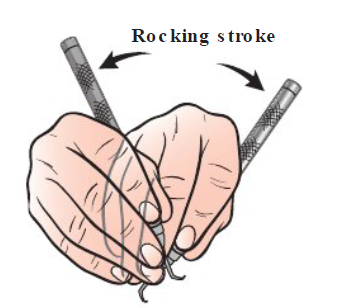
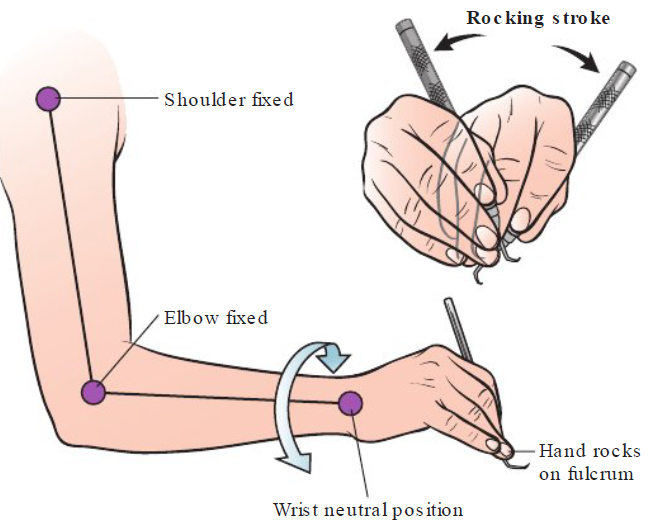
Wrist rocking motion
Hand, wrist, and arm move together as a unit for instrumentation stroke = rotating motion
Used for calculus removal
Ex: Turning a doorknob
Allows for maintaining neutral body posture
Shoulder level, upper arm vertical, forearm horizontal, less workload on wrist, hands and fingers
Advantages
Intraoral fingers — stabilizes
Reduce muscular load
More hand control
Less fatigue
Uses large muscle of wrist and forearm instead of tiny finger muscles
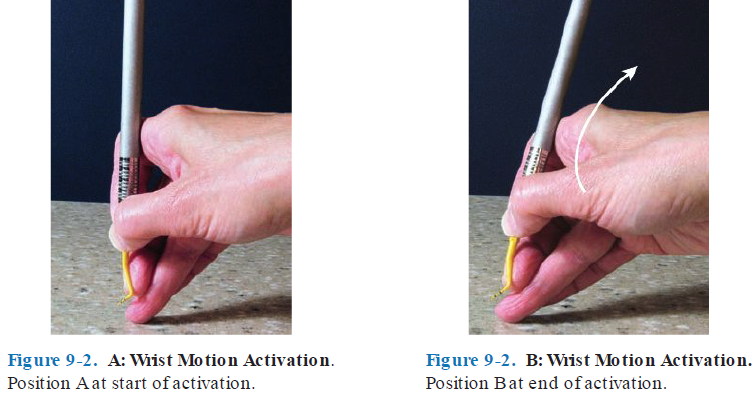
Fulcrum during wrist rocking motion
Fulcrum finger supports weight of hand
Throughout procedure:
Fulcrum finger (ring) stays planted
Acts as pivot point or brake for each stroke
Avoid: If instrument tip flies off the tooth after each stroke, fulcrum isn’t used properly.
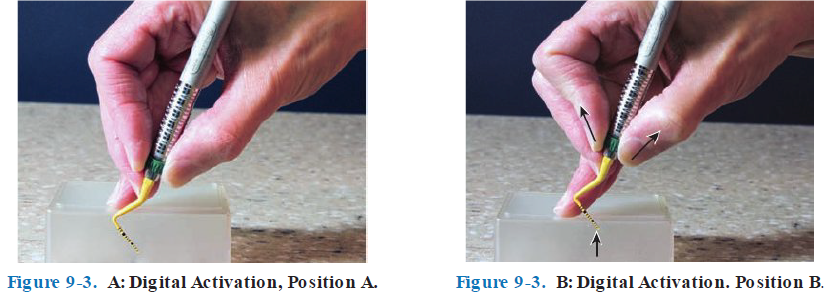
Digital activation
Digital motion activation
Moving the instrument by flexing the thumb, index, and middle fingers
Ex: Pulling something with fingertips
(Instead of using wrist — thumb, index, middle — do all the work)
Uses
Physical strength not required
Example: Probes, explorer, ultrasonic scaler
Use if movement is restricted in instrument areas (Ex: Multirooted teeth)
Why not use it all the time?
Fingers fatigue quicker
Small muscles = weaker
Do not use digital activation for calculus removal
Rolling the instrument handle
Turning the handle between thumb and index finger
Why?
Maintain contact of working end as it moves around the curve of the tooth surface
Drive finger
Thumb or index
Used to turn the instrument
Whatever finger is used to turn it clockwise or counter clockwise (as long as you maintain contact w/ tooth)
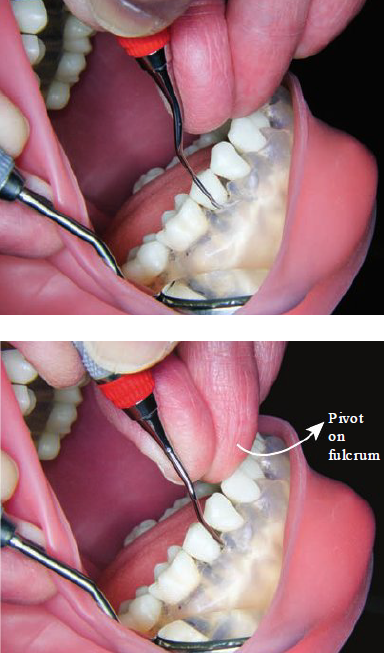
Pivoting the fulcrum
Ring (fulcrum) finger acts as a pivot as the hand turns during instrumentation
Keeps working end against tooth
Before pivoting
Clinician is moving working end across facial surface of second premolar
Only underside of middle finger is visible in photo
After pivoting
Clinician reaches mseiofacial line angle
She pivots fulcrum finger to rotate hand slightly
Working end moves from facial surface to mesial surface of premolar
Side of middle finger is visible after hand pivot
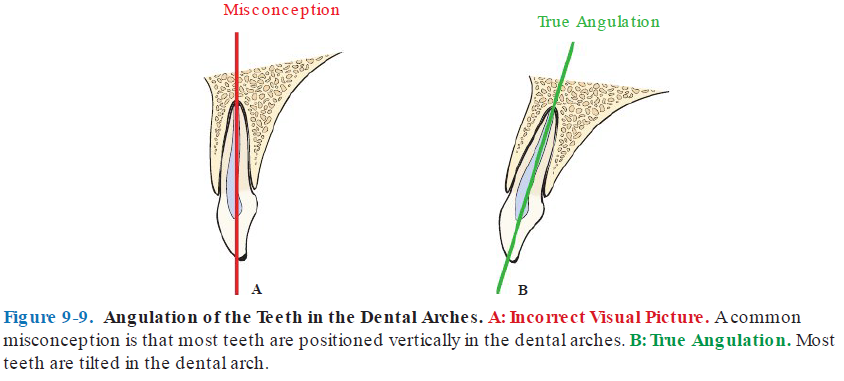
Orientation of tooth surface
Misconception — Tooth is vertical
Teeth is NOT flat
This misconception causes people to position lower shank incorrectly
True angulation
Teeth are tilted
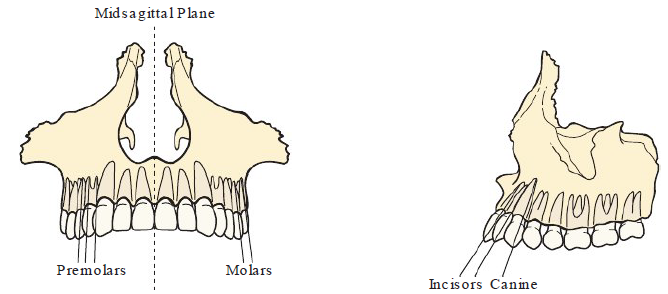
True angulation of teeth (maxillary and mandibular)
Maxillary teeth
Roots incline inward (Towards middle of mouth)
Mandibular teeth
Anteriors — tilt inward
Premolars — nearly vertical
Molars — tilt slightly outward
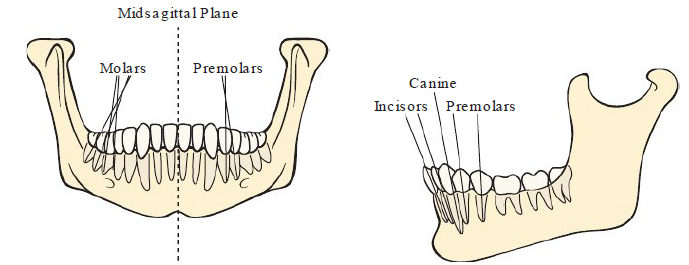
Orientation to tooth surface
Look at surface you’re working on — orient lower shank so it’s in the same direction as the tooth being instrumented on
Lower shank must be parallel to tooth surface
Tooth has many orientations
Root surfaces point in different direction
As you move around tooth…
Orientation must change too
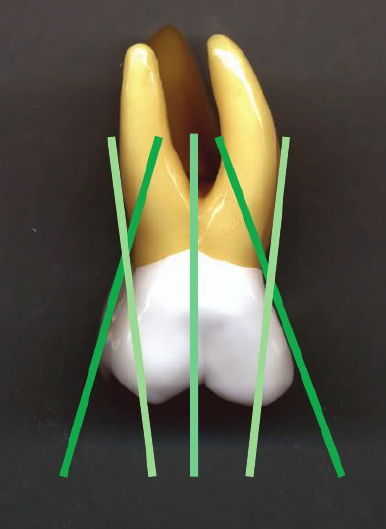
Orientation to proximal surface
A: Incorrect
Red lines — incorrect alignment to distal and mesial surfaces of maxillary central incisors
B: Correct
Green lines — Correct alignment to distal and mesial proximal surfaces of maxillary central incisors
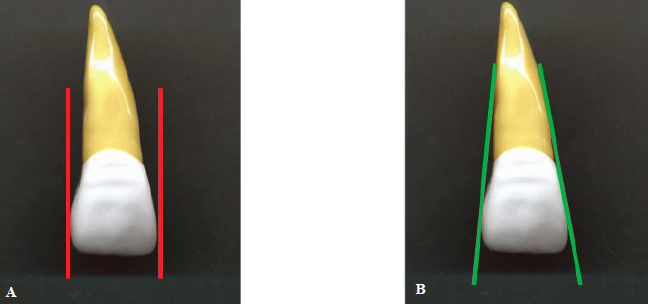
Orientation to facial and lingual surfaces
A: Incorrect
Red lines — incorrect alignment to lingual and facial surfaces of maxillary central incisor
B: Correct
Green lines — Correct alignment to lingual and facial surfaces of maxillary central incisor
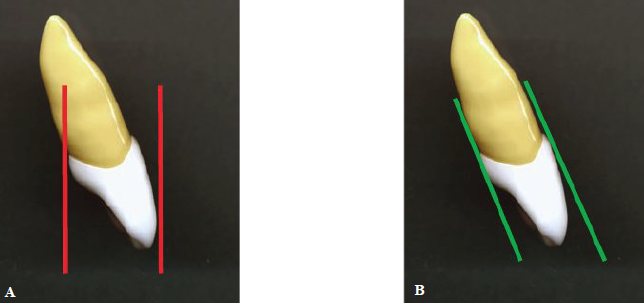
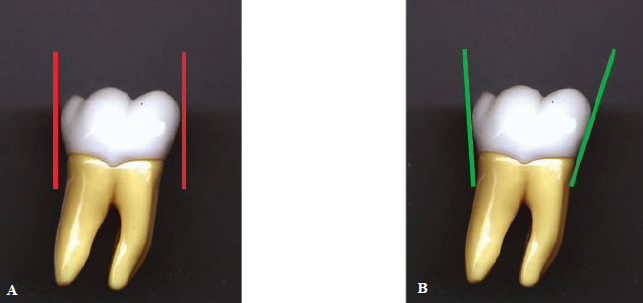
Orientation to proximal surfaces
A: Incorrect
Red lines — incorrect alignment to distal and mesial surfaces of mandibular molar
B: Correct
Green lines — Correct alignment to distal and mesial surfaces of mandibular molar
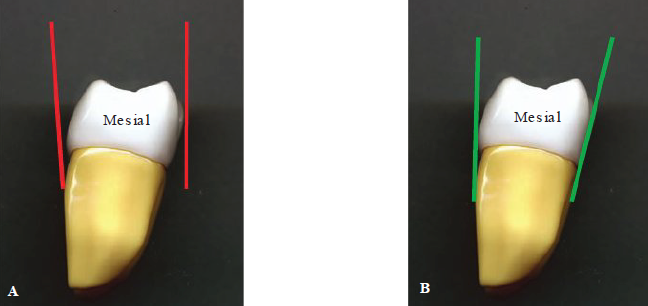
Orientation to facial and lingual surfaces
A: Incorrect
Red lines — incorrect alignment to lingual and facial surfaces of mandibular molar
B: Correct
Green lines — Correct alignment to lingual and facial surfaces of mandibular molar
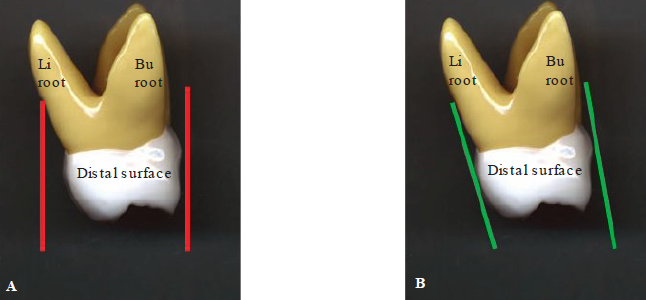
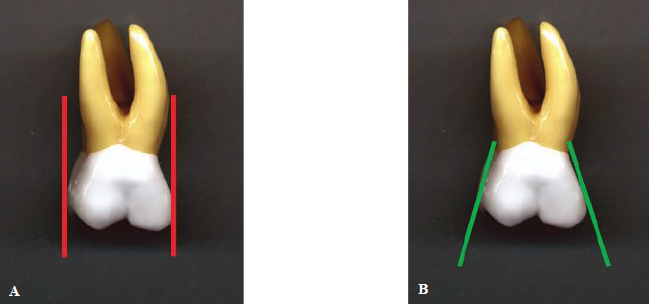
Orientation to proximal surfaces
A: Incorrect
Red lines — incorrect alignment to distal and mesial surfaces of maxillary molar
B: Correct
Green lines — Correct alignment to distal and mesial surfaces of maxillary molar
Orientation to facial and lingual surfaces
A: Incorrect
Red lines — incorrect alignment to lingual and facial surfaces of maxillary molar
B: Correct
Green lines — Correct alignment to lingual and facial surfaces of maxillary molar