Water
 Call Kai
 Learn
Learn Practice Test
 Spaced Repetition
 Match
Match Flashcards
 Knowt Play
1/10

There's no tags or description
Looks like no tags are added yet.
Name | Mastery | Learn | Test | Matching | Spaced | Call with Kai | Chat |
|---|
No analytics yet
Send a link to your students to track their progress
11 Terms
Water (Overview)
Water molecules are made up of one oxygen atom, which forms covalent bonds by sharing electrons with two hydrogen atoms.
Here on the left, you can see some common ways to depict the molecular structure of water by representing the atoms using letters.
The structures in the middle are space filling models representing the oxygen atom with red spheres, and the hydrogen atom with white spheres.
The representations of water on the right both show the two lone pairs of electrons on the oxygen atom represented in blue or yellow, which are electrons that are not shared with other atoms.
The three-dimensional model on the bottom shows the tetrahedral geometry around the oxygen atom. The lone pairs of electrons shown in yellow point in opposite directions from each other, and the hydrogen atoms shown in white point in opposite directions from each other.
The structure of water is useful for understanding the characteristics of a solution of water and molecular interactions of water molecules with other molecules.
Partial Charges and Hydrogen Bonding of Water
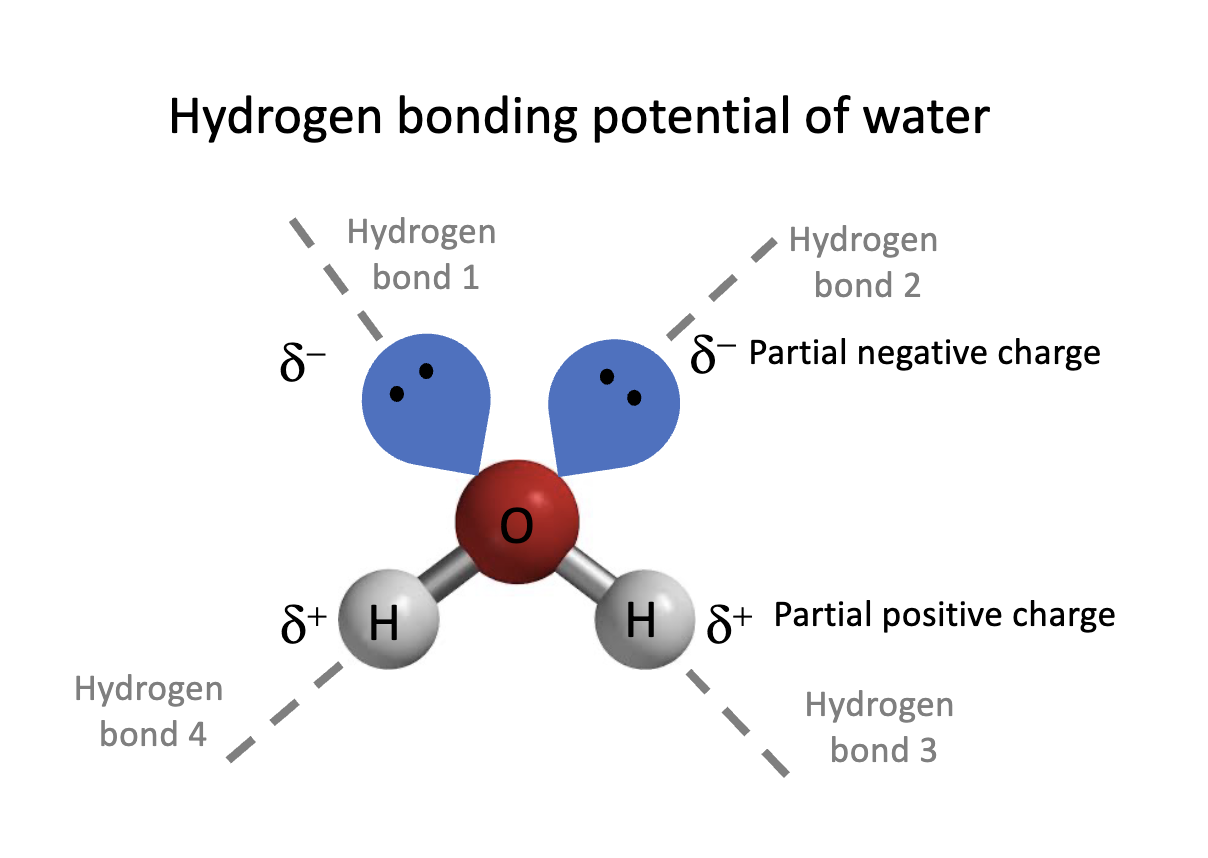
The unequal distribution of charge in the polar covalent bonds of a water molecule, results in two partial negative charges located near the lone pairs of electrons, and two partial positive charges near the hydrogen atoms.
The four regions of partial charges in a water molecule can each form a hydrogen bond with other molecules allowing water to have four potential hydrogen bonds.
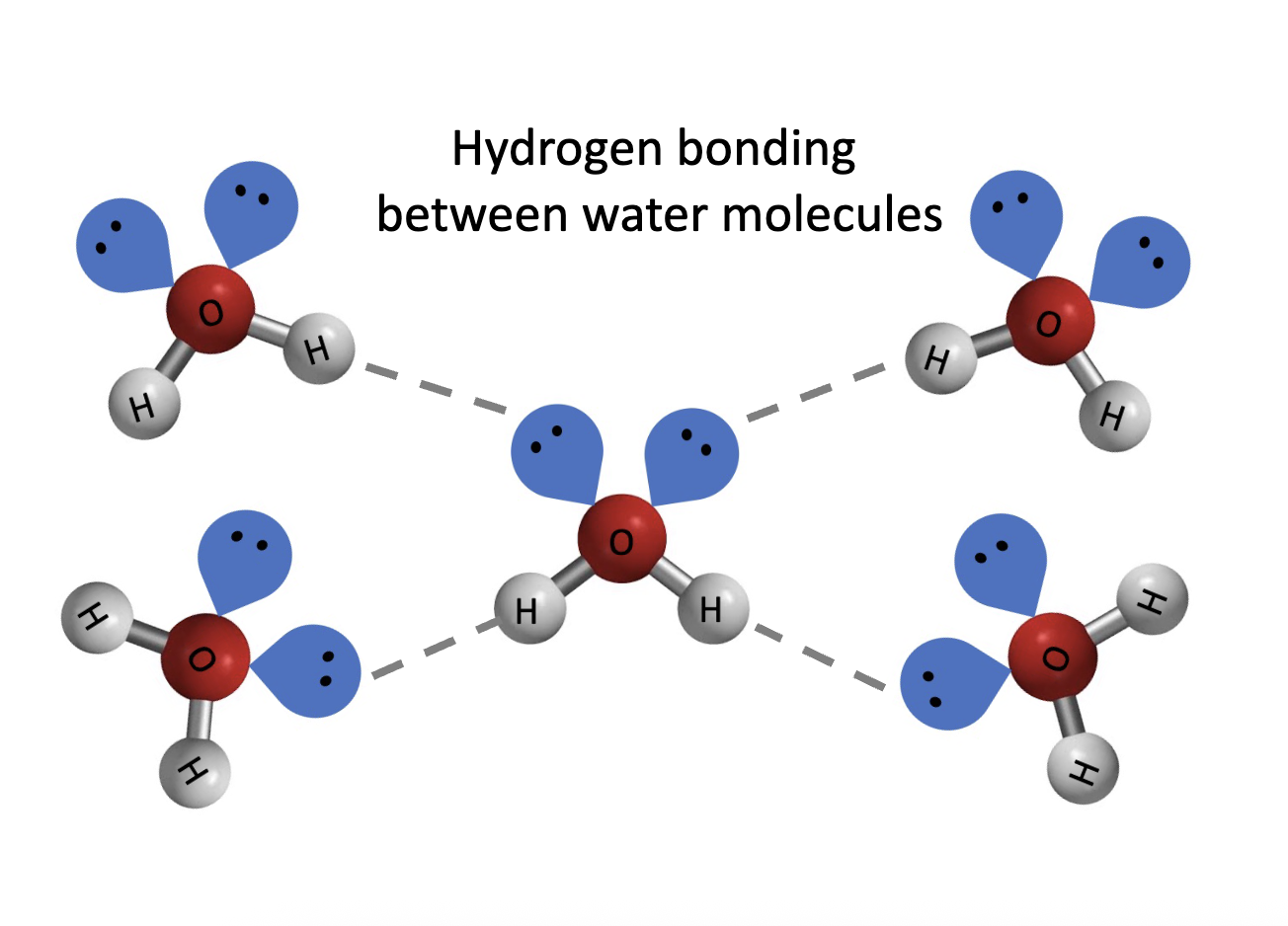
A water molecule can form hydrogen bonds with other water molecules. In this image, the water molecule in the center is forming hydrogen bonds with four other water molecules.
A water molecule can also form hydrogen bonds with other types of molecules.
When many water molecules are present together, the hydrogen bonding between water molecules results in a network of water molecules.
Ice (Solid Water)
In the solid phase of water, ice, all possible hydrogen bonds between water molecules are formed creating a highly ordered lattice structure. The water molecules in ice and the hydrogen bonds between them are static and have limited movement. In this animation of water molecules in the solid state of ice you can see that individual molecules are not moving around and are highly ordered. As the temperature increases, and the ice starts melting into liquid water, the water molecules lose some of the hydrogen bonds, start moving more, and become less ordered.
Liquid Water
In liquid water molecules form 15% less hydrogen bonds than ice, resulting in a less ordered structure with more variation. The water molecules are more dynamic, and the hydrogen bonds between water molecules are more likely to break and form.
Animations are particularly useful to help visualize the differences in the water molecules in ice and liquid water.
In this animation of water molecules in the liquid state you can see that individual molecules are moving around, and not uniformly oriented. The hydrogen bonds are not shown, but there would be hydrogen bonds being constantly formed, and broken between water molecules. At any one time, there would be a variation in how many hydrogen bonds are being formed by each water molecule.
animation of ice
individual molecules are not moving around, highly ordered
as temp increases and ice starts melting into liquid water, the water molecules lose some hydrogen bonds, start moving more, and become less ordered
Summary of Water Properties
Key points about water are that
water is made of one oxygen atom and two hydrogen atoms.
Water has two partial negative charges from lone pair electrons.
water has two partial positive charges on the hydrogen atoms.
Water can form four potential hydrogen bonds.
Liquid water has less hydrogen bonds between water molecules and is less ordered compared to ice
Structure of Water

Hydrogen bonding potential of water
Hydrogen bonding between water molecules
Hydrogen bonding of ice and liquid water

Key points
• Water is made of one oxygen atom and two hydrogen atoms
• Water has two partial negative charges from lone pair electrons
• Water has two partial positive charges on the hydrogen atoms
• Water can form four potential hydrogen bonds
• Liquid water has less hydrogen bonds between water molecules and is less ordered compared to ice