Touch and Pain
0.0(0)
Studied by 0 people Call Kai
 Learn
Learn Practice Test
 Spaced Repetition
 Match
Match Flashcards
 Knowt Play
Card Sorting
1/68

Earn XP
Description and Tags
Last updated 3:23 AM on 10/27/22
Name | Mastery | Learn | Test | Matching | Spaced | Call with Kai |
|---|
No analytics yet
Send a link to your students to track their progress
69 Terms
1
New cards
What produces a graded potential?
A stimulus to the receptor.
2
New cards
What generates an action potential?
If the graded potential is big enough, the receptor generates an action potential.
3
New cards
How can the intensity of a stimulus be coded?
Remember: all or none action potential
1. A single neuron can convey stimulus intensity by changing the frequency of its action potentials
2. Multiple neurons can act in parallel—as the stimulus strengthens, more neurons are recruited. (More neurons firing, more action potentials per second)
3. Different neurons respond to different ranges (range fractionation)
1. A single neuron can convey stimulus intensity by changing the frequency of its action potentials
2. Multiple neurons can act in parallel—as the stimulus strengthens, more neurons are recruited. (More neurons firing, more action potentials per second)
3. Different neurons respond to different ranges (range fractionation)
4
New cards
What is coding?
patterns of action potentials in a sensory system
5
New cards
We use the three strategies of coding in
Vision, hearing, and touch
6
New cards
Range fractionation
Different cells have different thresholds for firing, over a range of stimulus intensities.
7
New cards
What does the somatosensory system detect?
Touch and pain
8
New cards
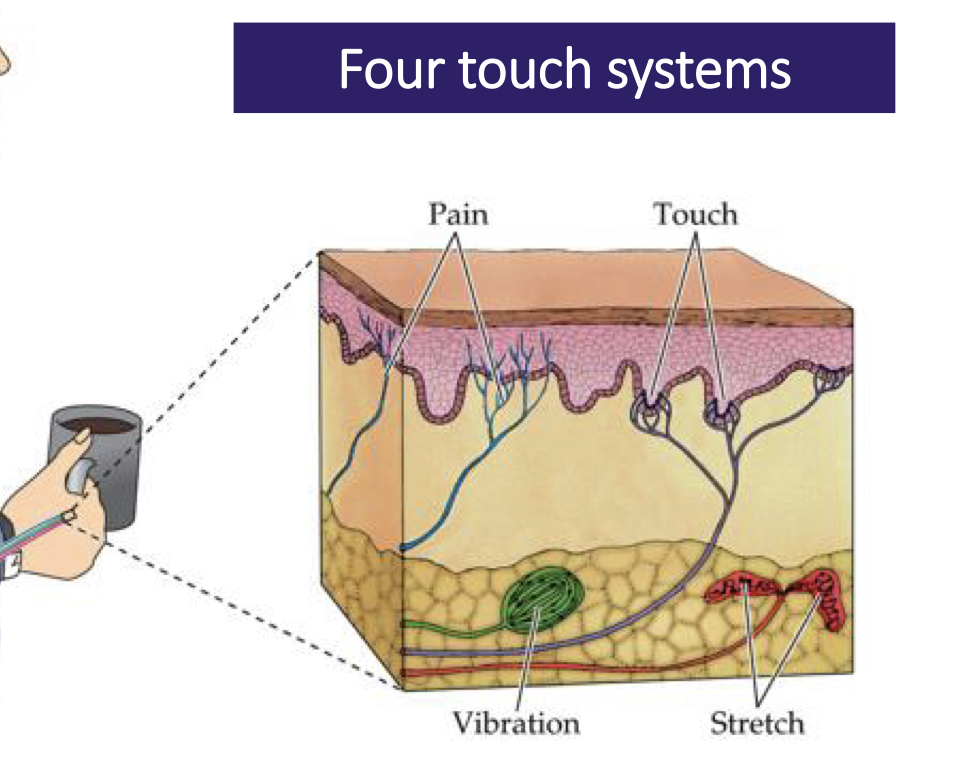
Four touch systems
Pain, touch, vibration, and stretch
9
New cards
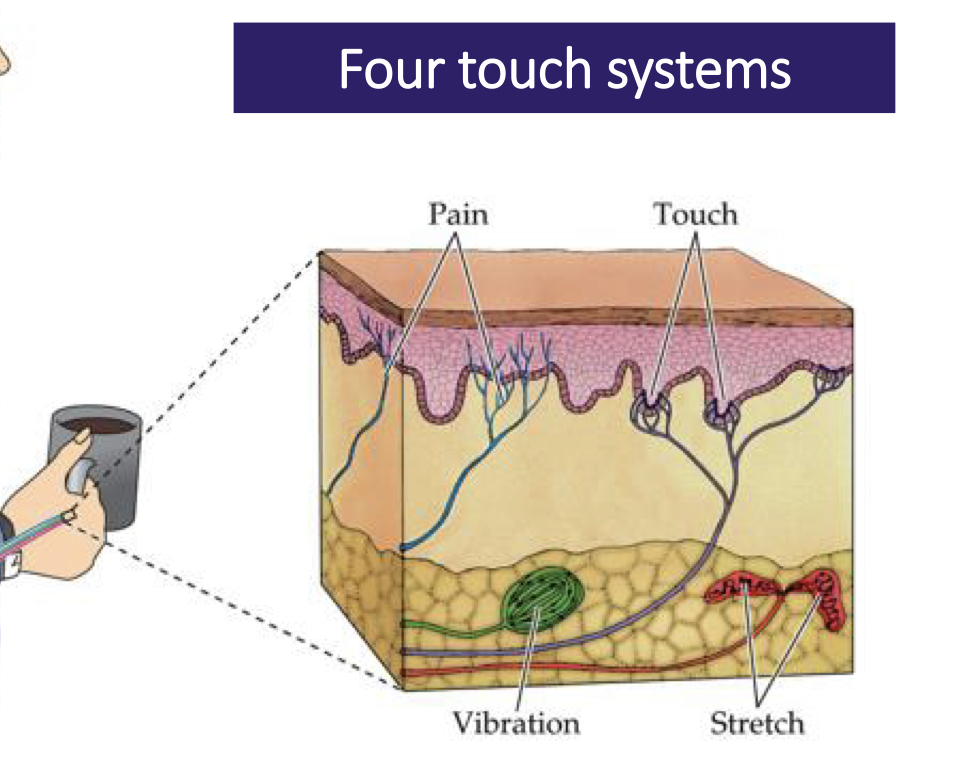
Why is skin so sensitive to pain?
Pain receptors are at the surface of the skin.
10
New cards
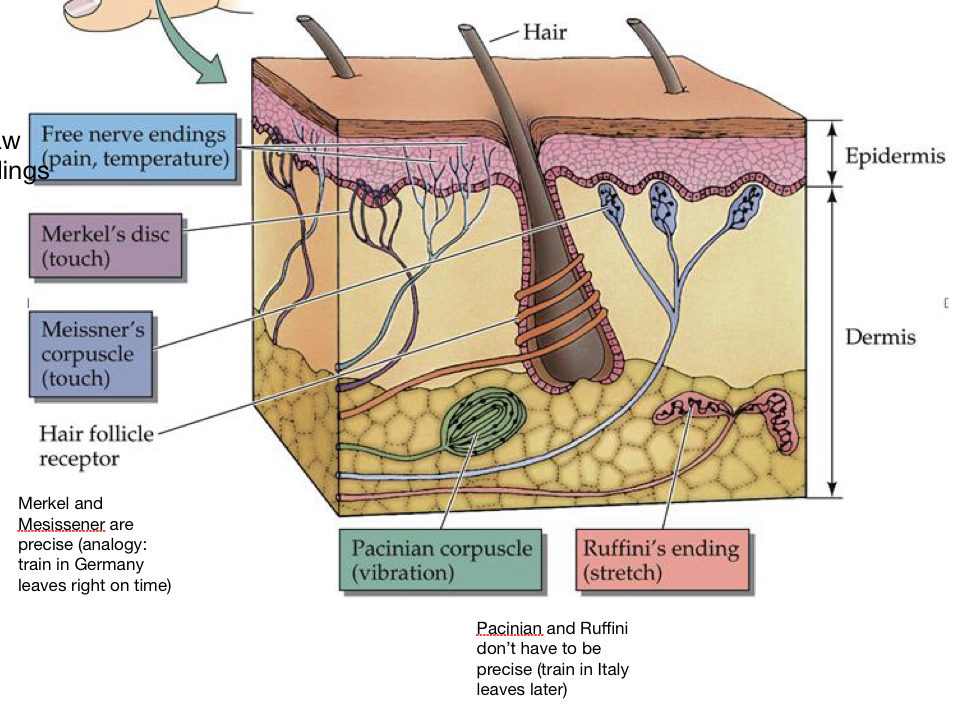
What are the five touch receptors
Free nerve endings: naked nerves (pain, temperature), merkel’s disc: precise because trains in Germany leave right on time (touch), meissner’s corpuscle: precise because trains in Germany leave right on time (touch), pacinian corpuscle: not precise because trains in Italy leave later (vibration), ruffini’s ending: not precise because trains in Italy leave later (stretch)
11
New cards
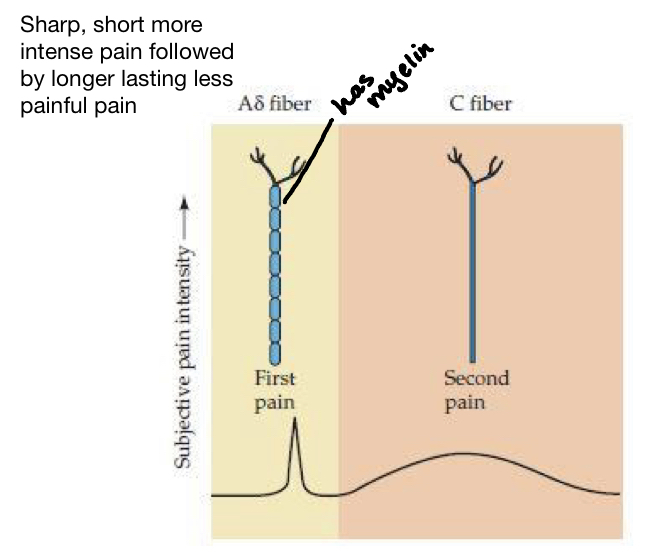
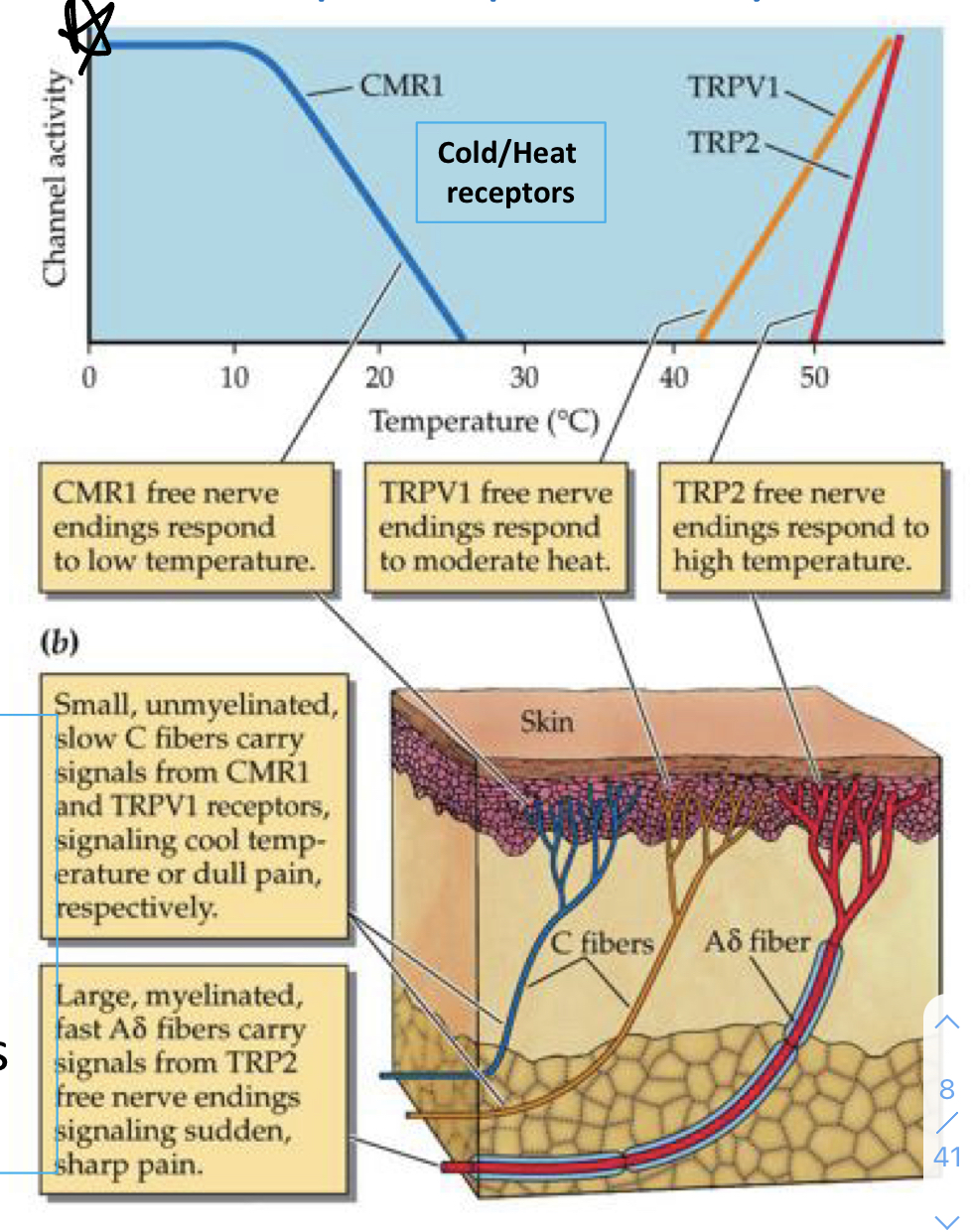
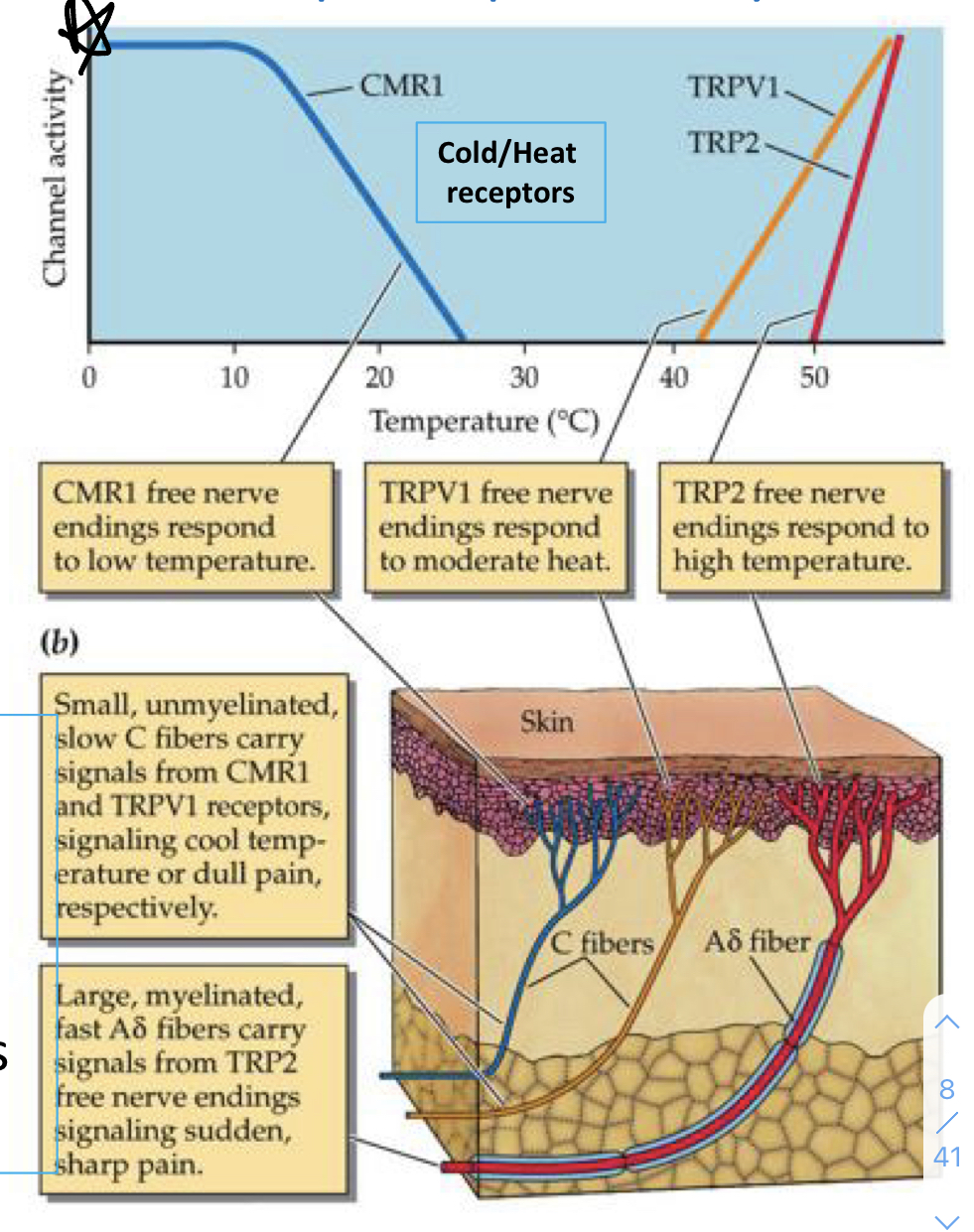
Pain uses two types of neurons:
1. Small unmyelinated (slow) C fibers- dull pain
1. Large myelinated (fast) A- delta fibers- sharp pain
1. Large myelinated (fast) A- delta fibers- sharp pain
12
New cards
CMR1 free nerve endings respond to
low temperature
13
New cards
TRPV1 free nerve endings respond to
Moderate heat
14
New cards
TRP2 free nerve endings respond to
High temperature
15
New cards
Capsaicin
The hot in chilies, activates C fibers via TRVP1 and is neurotoxic. It kills a lot of the nerves, so people who love spice keep eating more spicy food.
16
New cards
Why is capsaicin banned in equestrian sports?
Hypersensitive horses are more motivated to jump hurdles
17
New cards
The dull, long-lasting pain in toe when you hit it against the bedpost in your dark bedroom is due to activation of
A. Small unmyelinated C fibers
B. Small unmyelinated Adelta fibers
C. Large myelinated Adelta fibers
D. Large myelinated C fibers
A. Small unmyelinated C fibers
B. Small unmyelinated Adelta fibers
C. Large myelinated Adelta fibers
D. Large myelinated C fibers
A. Small unmyelinated C fibers
18
New cards
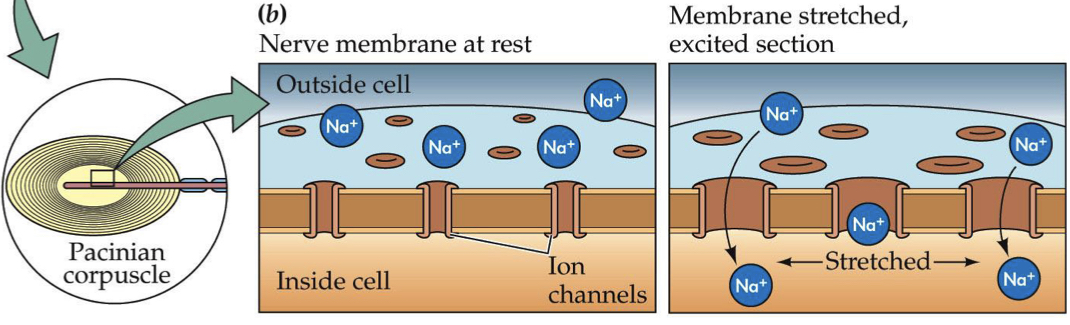
What is vibration reception
Moving the skin back and forth (stretching it)
19
New cards
What are the two parallel touch systems
Tonic receptors and phasic receptors
20
New cards
Tonic receptors
Slow or no decline in action potential frequency
21
New cards
Phasic receptors
Adapt quickly by decreased frequency
22
New cards
Receptive field
That part of the world a sensory neuron responds to, property of each single sensory neuron, differ in size and shape
23
New cards
Every sensory neuron in the brain has
A part of the body it responds to
24
New cards
Do receptive fields overlap?
No
25
New cards
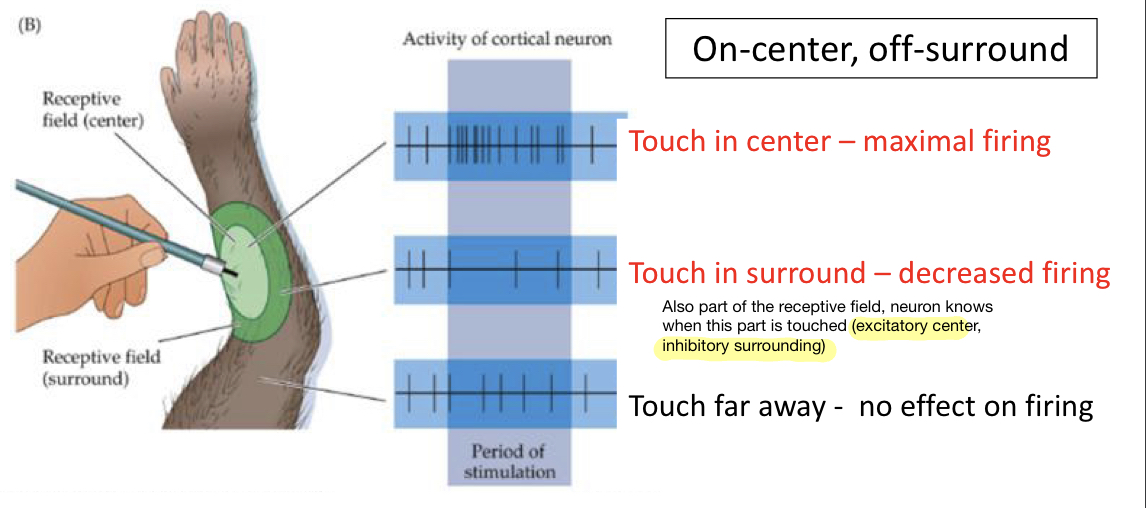
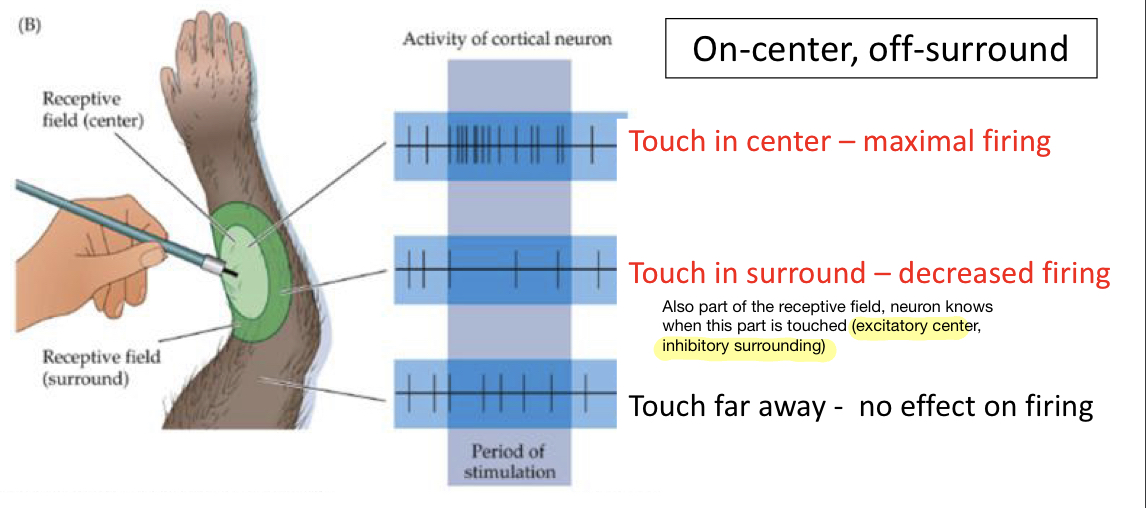
Touch receptive field: touch in center
Maximal firing
26
New cards
Touch receptive field: Touch in surround
Decreased firing (also part of the receptive field, neuron knows when this part is touched (excitatory center, inhibitory surrounding))
27
New cards
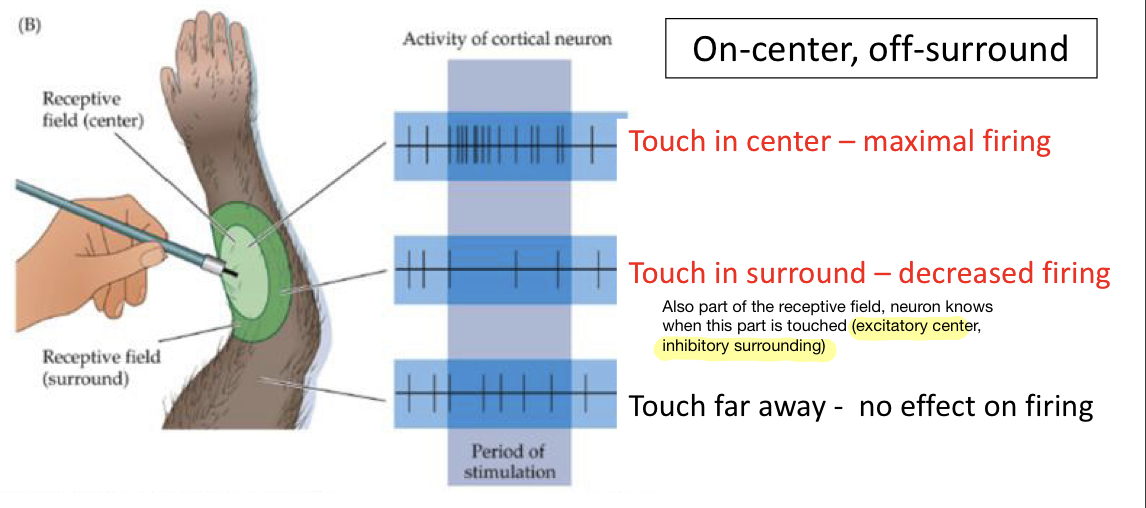
Touch receptive field: Touch far away
No effect on firing
28
New cards
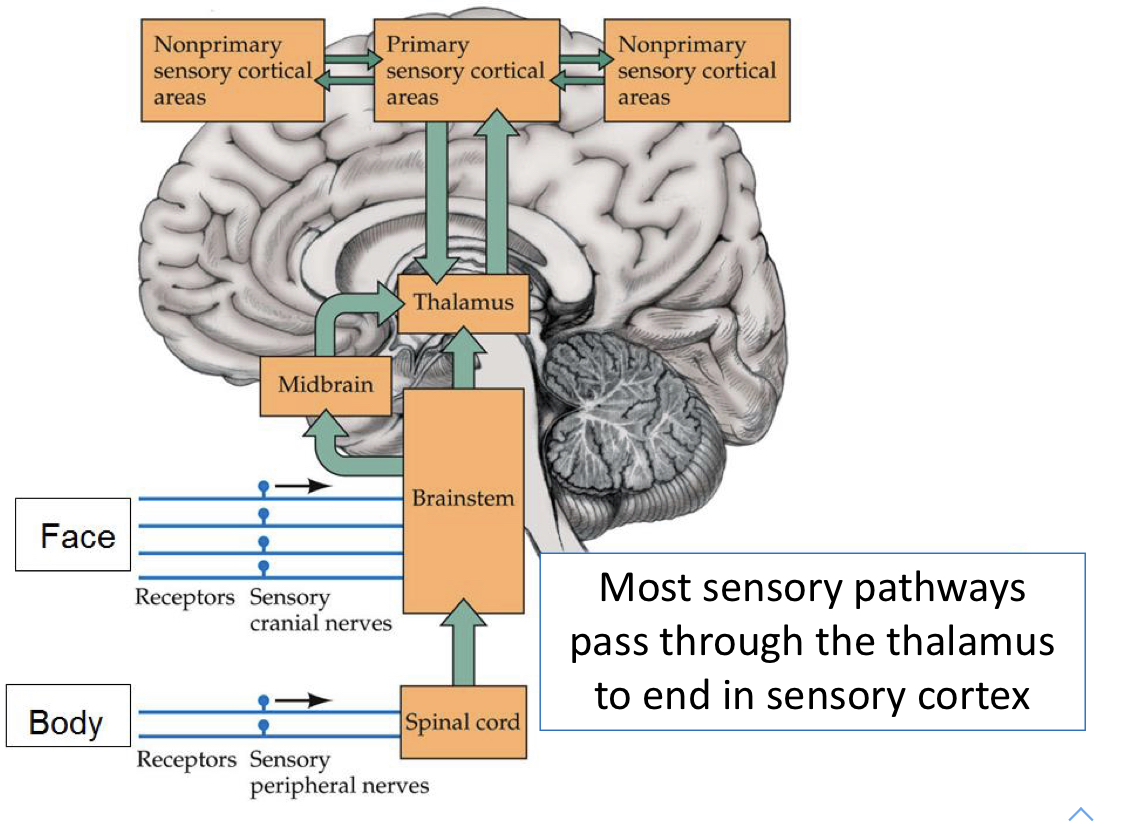
Most sensory pathways pass though the ______ to end in the ________
Thalamus; sensory cortex
29
New cards
Parallel tactile systems
Dorsal column and spinothalamic
30
New cards
Dorsal column
Touch, vibration
31
New cards
Spinothalamic
Pain, temperature, some touch
32
New cards
Cortical map
Represents the innervation of a body region
33
New cards
A small stroke just medial to you ear would cause loss of sensation of your contralateral
A. Leg
B. Face
C. Arm
D. Genitals
A. Leg
B. Face
C. Arm
D. Genitals
B. Face
34
New cards
What does the somatosensory cortex do after hand amputation?
It reorganizes
35
New cards
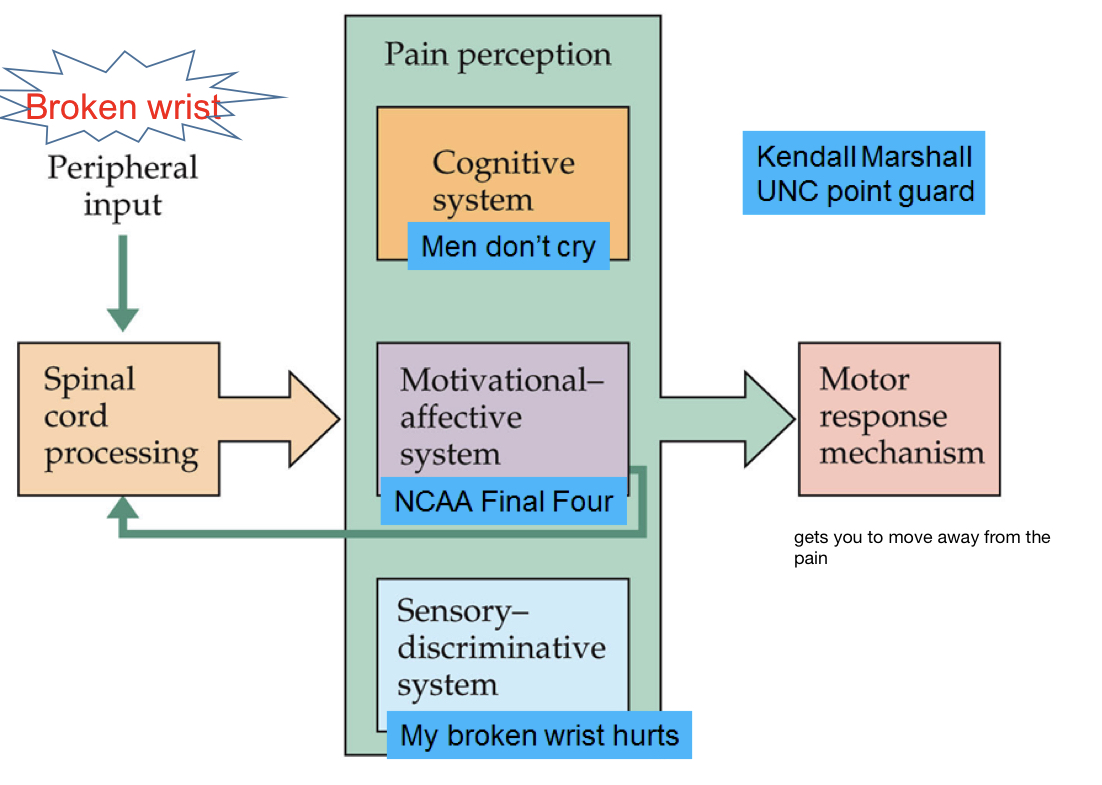
Pain perception
36
New cards
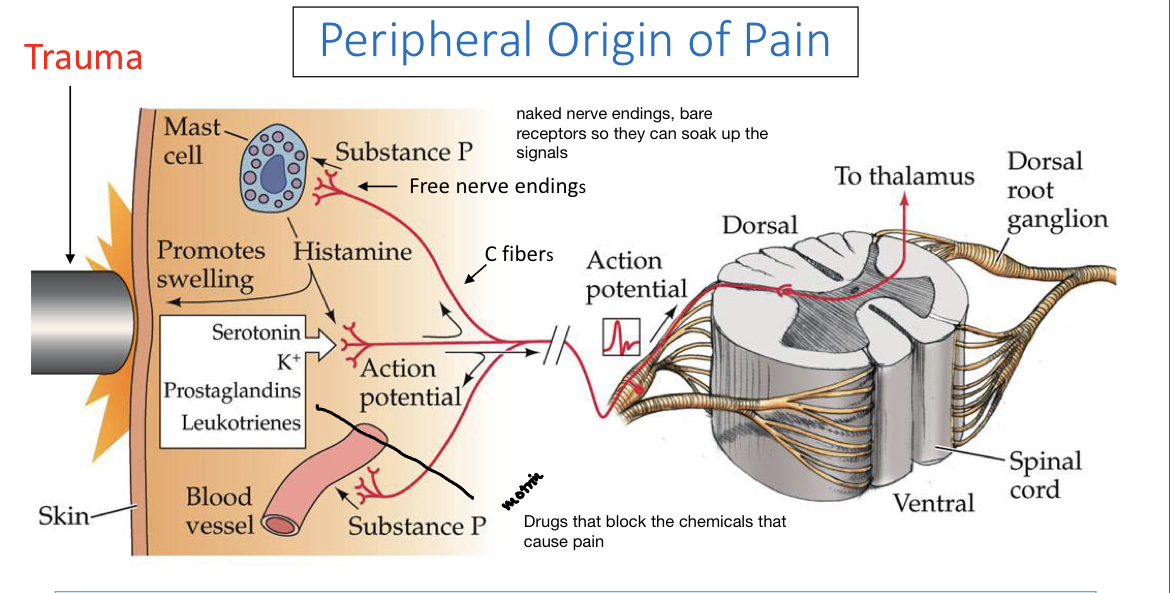
Free nerve endings (in relation to pain)
In the skin, have specialized receptors to respond to temperature change, chemicals, and tissue injury (especially substance P- a neurotransmitter)
37
New cards
Congenital insensitivity to pain
Inherited mutated sodium channel in pain fibers in dorsal root ganglia (if the sodium channels in the C fiber don’t work, C fiber cells cannot fire an action potential, and you can’t sense pain)
38
New cards
Man on fire syndrome
Congenital hypersensitivity to pain, severe burning pain
39
New cards
How is pain life saving?
Low levels of pain during everyday tasks tell us when a certain movement or prolonged posture is harmful. (Even during sleep, mild pain makes us toss and turn enough to prevent bedsores or skeletal strain)
40
New cards
Periaqueductal gray
Part of spinothalamic system, located in the midbrain, involved in pain perception; opioid receptors
41
New cards
The major part of the pain pathway that contributes emotion to pain sensation is
A. Periaqueductal gray
B. Spinothalamic tract
C. Somatosensory cortex
D. Cingulate gyrus
A. Periaqueductal gray
B. Spinothalamic tract
C. Somatosensory cortex
D. Cingulate gyrus
D. Cingulate gyrus
42
New cards
Will (cognitive)
Frontal cortex
43
New cards
Emotion (motivation)
Anterior cingulate cortex
44
New cards
Sensation (sensory)
Somatosensory cortex
45
New cards
Pain can be blocked in
Spinal cord
46
New cards
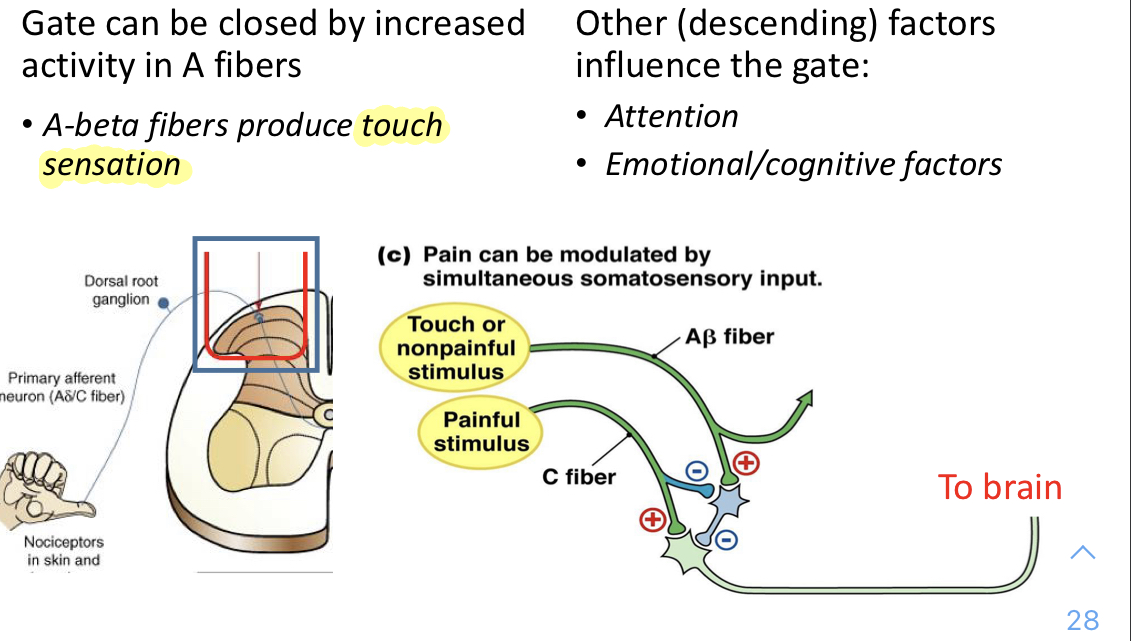
Gate control theory of pain
Gate can be closed by increased activity in A fibers
47
New cards
A-beta fibers produce
Touch sensation
48
New cards
What other factors influence the gate of pain?
Attention and emotional/cognitive factors
49
New cards
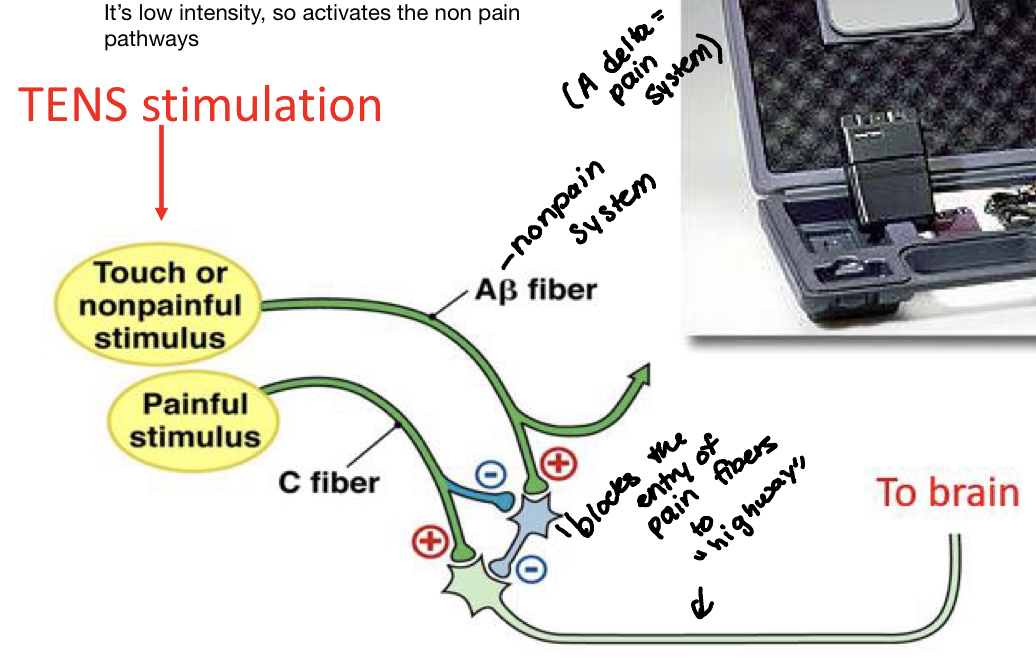
What is transcutaneous electrical nerve stimulation (TENS)
It delivers electrical pulses to the skin, and it is low intensity, so it activates the non pain pathways
50
New cards
Non-drug treatments for pain
- Meditation/prayer
- acupuncture
- massage
- physical activity
- acupuncture
- massage
- physical activity
51
New cards
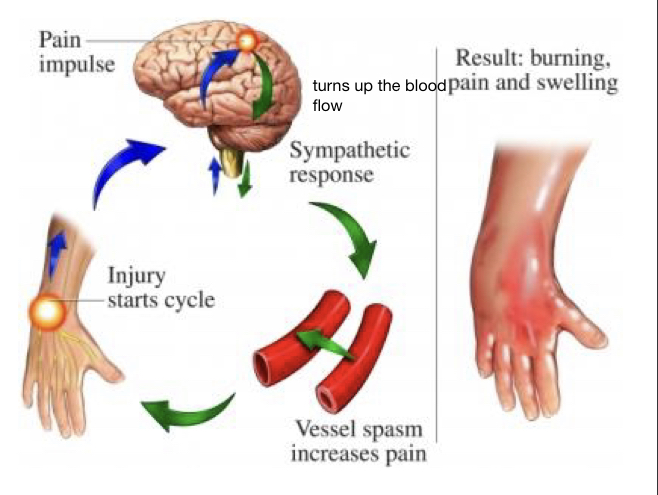
Chronic pain
Persists even long after an injury has healed and the pain and disability can worsen over time (mostly a disorder in young women)
52
New cards
Reflex sympathetic dystrophy stage 1
- onset of severe pain limited to injury site
- increased sensitivity of skin to touch
- localized swelling
- usually lasts a few weeks then subsides
- increased sensitivity of skin to touch
- localized swelling
- usually lasts a few weeks then subsides
53
New cards
Reflex sympathetic dystrophy stage 2
- pain becomes more severe and more diffuse
- swelling tends to spread
- hair and nails become brittle
- muscle wasting begins
- swelling tends to spread
- hair and nails become brittle
- muscle wasting begins
54
New cards
Vicious cycle of neurogenic chronic pain (RSD)
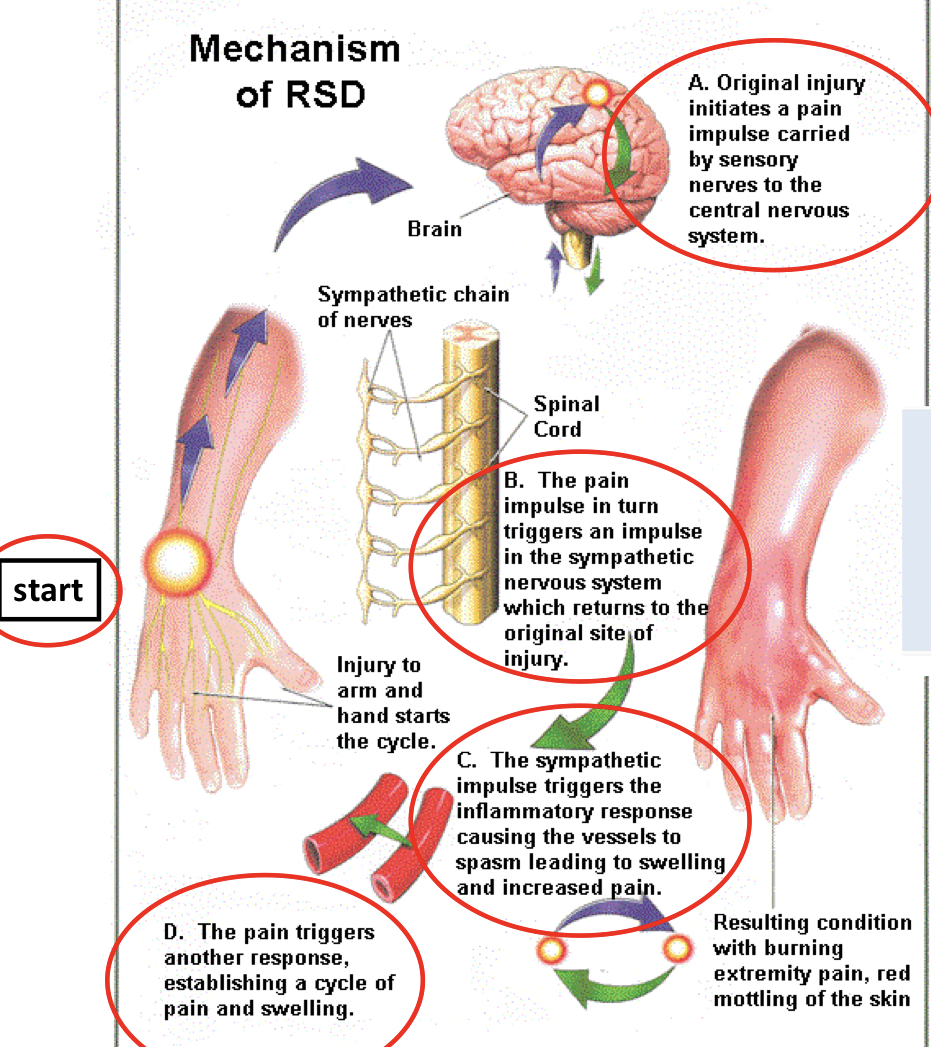
55
New cards
What surgical treatment would best help a patient with RSD (neurogenic chronic pain)?
A. Cutting the peripheral nerve from the injured area
B. Cutting the sympathetic nerve to the injured area
C. Cutting the spinal cord above the site of injury
A. Cutting the peripheral nerve from the injured area
B. Cutting the sympathetic nerve to the injured area
C. Cutting the spinal cord above the site of injury
B. Cutting the sympathetic nerve to the injured area
Cutting the peripheral nerve would result in you not being able to feel ANYTHING
Cutting the peripheral nerve would result in you not being able to feel ANYTHING
56
New cards
Neurogenic pain is due to
Inappropriate signaling of pain by neurons
57
New cards
Postsynaptic spinal cord neurons
Take up substance P, released during pain, and remodel their dendrites
58
New cards
Overactivity of sympathetic input
Dorsal horn neurons (light touch) become hyperexcitable (light touch is now felt as pain); GABA inhibitory become excitatory
59
New cards
Chronic pain remodels
The spinal cord and the sensory cortex
60
New cards
Patients in chronic pain have
Overactive somatosensory cortex even at rest
61
New cards
Pain becomes emotional in
Cingulate cortex (ACC)
62
New cards
As pain unpleasantness increases
Activity increases in the cingulate cortex, but not in the somatosensory cortex
63
New cards
Painful heat stimulates
Somatosensory cortex and anterior cingulate cortex
64
New cards
Hypersensitivity to touch
Stimulus avoiders
- hates having face washed or hail or nails cut
- picky eater, only eats certain textures
- refuses to walk barefoot on grass or sand; toe walks
- hates having face washed or hail or nails cut
- picky eater, only eats certain textures
- refuses to walk barefoot on grass or sand; toe walks
65
New cards
Hyposensitivity to touch
Stimulus seekers
- craves touch, touches everything/everyone
- hurts other children or pets while playing
- many pinch, bite, or bang own head
- craves touch, touches everything/everyone
- hurts other children or pets while playing
- many pinch, bite, or bang own head
66
New cards
Synesthesia
A stimulus in one modality creates a sensation in another (this food tastes blue)
Music —> colors
Graphemes (numbered and letters)—>colors.
Taste —> shape
Speech sound —> taste
Music —> colors
Graphemes (numbered and letters)—>colors.
Taste —> shape
Speech sound —> taste
67
New cards
During synesthesia
A. The prefrontal cortex shuts down
B. Brain areas talk to fewer other areas than normal
C. The amygdala is turned off
D. None of the above
A. The prefrontal cortex shuts down
B. Brain areas talk to fewer other areas than normal
C. The amygdala is turned off
D. None of the above
D. None of the above
68
New cards
Causes of synesthesia
- LSD
- posterior temporal lobe seizure
- result of blindness or deafness (visual cells rewire to auditory cell when blind)
- occurs spontaneously
- posterior temporal lobe seizure
- result of blindness or deafness (visual cells rewire to auditory cell when blind)
- occurs spontaneously
69
New cards
phantom limb pain
pain felt by an amputee that seems to be located in the missing limb