Carl Rogers - Chapter 6
 Call Kai
 Learn
Learn Practice Test
 Spaced Repetition
 Match
Match Flashcards
 Knowt Play
1/29

There's no tags or description
Looks like no tags are added yet.
Name | Mastery | Learn | Test | Matching | Spaced | Call with Kai | Chat |
|---|
No analytics yet
Send a link to your students to track their progress
30 Terms
Rogers was trained as a psychoanalyst, then worked as a therapist for children - found analytic techniques unsatisfying in both WHAT and WHAT
Rogers was trained as a psychoanalyst then worked as a therapist for children - found analytic techniques unsatisfying in both GOALS and RESULTS
Built the distinctly WHAT alternative = WHAT
Built the distinctly HUMANISTIC alternative = CLIENT-CENTRED THERAPY
Unlike psychoanalysis (uncover the WHAT) or behaviour therapy (identify and fix problem WHAT), the aim was simply to help clients move WHAT in their lives
Unlike psychoanalysis (uncover the PAST) or behaviour therapy (identify and fix problem BEHAVIOURS), the aim was simply to help clients move FORWARD in their lives
Each of us lives in a constantly changing WHAT world: the WHAT
Each of us lives in a constantly changing PRIVATE world: the EXPERIENTIAL FIELD
You exist at the WHAT of your own field - and it can only be fully understood from your WHAT
You exist at the CENTRE of your own field - and it can only be fully understood from your PERSPECTIVE
Behaviour must be understood as a WHAT to the field as the person perceives it - they react to it as an WHAT whole, and it is their WHAT
Behaviour must be understood as a REACTION to the field as the person perceives it - they react to it as an ORGANIZED whole, and it is their REALITY
The therapist's problem: WHAT
The therapist's problem: only the client can really UNDERSTAND their own field
Direct contrast with Freud: no objective analyst breaking through defences to a WHAT the patient WHAT see
Direct contrast with Freud: no objective analyst breaking through defences to a TRUTH the patient CANNOT see
The one basic striving: to WHAT, WHAT, and WHAT the experiencing person - the WHAT
The one basic striving: to ACTUALIZE, MAINTAIN, and ENHANCE the experiencing person - the ACTUALIZING TENDENCY
Rogers borrowed self-actualization from Kurt Goldstein: movement toward WHAT, WHAT, WHAT
Rogers borrowed self-actualization from Kurt Goldstein: movement toward MATURITY, INDEPENDENCE, SELF-RESPONSIBILITY
Personal power: WHAT
Personal power: the ability to make the choices needed to ACTUALIZE the self, and to FUFILL them
Client-centred therapy operationalizes this: the therapist consciously renounces all WHAT over and WHAT for, the client
Client-centred therapy operationalizes this: the therapist consciously renounces all CONTROL over and DECISION-MAKING for, the client
Rogers claimed no one can really WHAT your WHAT
Rogers claimed no one can really UNDERSTAND your EXPERIENTIAL FIELD
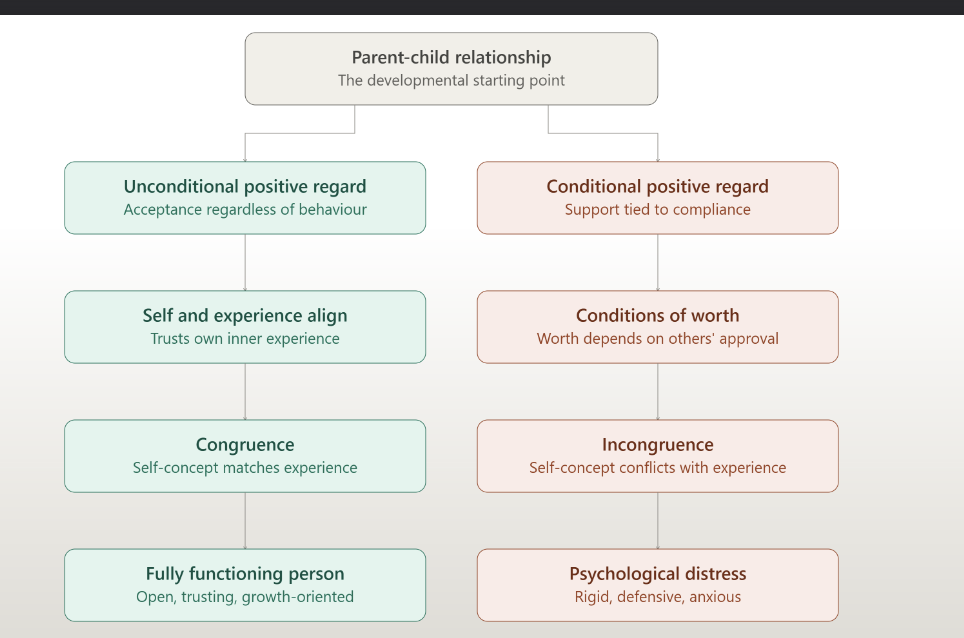
The parent-child relationship is central: WHAT
The parent-child relationship is central: it either fosters self-actualization or impedes growth
A child begins life with an WHAT tendency; with WHATcomes a need for WHAT regard
A child begins life with an ACTUALIZING tendency; with SELF-AWARENESS comes a need for POSITIVE regard
Unconditional positive regard: WHAT
Unconditional positive regard: the child is supported in all things → healthy, well-adjusted
Conditional positive regard: support only when behaviour complies with the parents' WHAT and WHAT → the child develops WHAT
Conditional positive regard: support only when behaviour complies with the parents' DESIRES and RULES → the child develops CONDITIONS OF WORTH
congruence = WHAT
congruence = alignment between the IDEAL SELF (who I would like to be) and ACTUAL BEHAVIOUR (self-image)
Congruence: sense of WHAT and lived WHAT fit together - WHAT-regard and WHAT regard closely matched → relatively happy and well-adjusted
Congruence: sense of SELF and lived EXPERIENCE fit together - SLEF-regard and POSITIVE regard closely matched → relatively happy and well-adjusted
Incongruence: WHAT
Incongruence: the sense of self and the ability to obtain positive regard do NOT match
Incongruence is threatening → activates WHAT
Incongruence is threatening → activates DEFENCE MECHANISM
Incongruence can break down and disorganize the WHAT, producing psychological WHAT that may continue throughout life (Rogers, 1959/1989)
Incongruence can break down and disorganize the SELF-STRUCTURE, producing psychological DISTRESS that may continue throughout life (Rogers, 1959/1989)
The outcome of congruence - through WHAT development or successful WHAT: the WHAT functioning person (Rogers, 1961), living the WHAT life
The outcome of congruence - through HEALTHY development or successful THERAPY: the FULLY functioning person (Rogers, 1961), living the GOOD life
The good life is a WHAT, not a WHAT of being - a direction, not a destination
The good life is a PROCESS, not a STATE of being - a direction, not a destination
It requires, and flows from, WHAT
It requires, and flows from, PSYCHOLOGICAL FREEDOM
Characteristics:
increasingly open to WHAT
Lives WHAT in each moment
WHAT themselves more and more, willing to experience all their WHAT
creative
trusts WHAT nature
experiences the WHAT of life
Characteristics:
increasingly open to NEW EXPERIENCE
Lives FULLY in each moment
TRUSTS themselves more and more, willing to experience all their FEELINGS
creative
trusts HUMAN nature
experiences the RICHNESS of life
Not simply content or happy - WHAT
Not simply content or happy - ALIVE
Starts with a parent-child relationship
WHAT positive regard
WHAT positive regard
Starts with a parent-child relationship
UNCONDITIONAL positive regard
CONDITIONAL positive regard
Unconditional positive regard
WHAT and WHAT align
WHAT
WHAT functioning person
Unconditional positive regard
SELF and EXPERIENCE align
CONGRUENCE
FULLY functioning person
Conditional positive regard
WHAT of worth
WHAT
Psychological WHAT
Conditional positive regard
CONDITIONS of worth
INCONGRUENCE
Psychological DISTRESS