PKP Kap. 5
 Call Kai
 Learn
Learn Practice Test
 Spaced Repetition
 Match
Match Flashcards
 Knowt Play
1/6

There's no tags or description
Looks like no tags are added yet.
Name | Mastery | Learn | Test | Matching | Spaced | Call with Kai | Chat |
|---|
No analytics yet
Send a link to your students to track their progress
7 Terms
Who is Carl Rogers and what view does he hold of the person?
Carl Rogers (1902–1987): American clinical psychologist; founder of person-centered/humanistic personality theory; theory derived from psychotherapy; contrasted Freud ((1) conscious experience > unconscious conflict; (2) present/lifespan relationships > childhood determinism; (3) growth > conflict repetition); integrated clinical understanding + scientific methodology.
Paradigm: phenomenological (behavior ← subjective experience; objective reality secondary); humanistic (humans possess an inherent potential for growth).
View of the person:
Subjectivity: behavior ← phenomenal field (subjective world constructed from perceptions, needs, goals, beliefs, emotions); people respond to perceived reality ≠ objective reality.
Authenticity: psychological health ← remaining connected to one’s own feelings/values; need for approval → adoption of others’ values → alienation from the true self.
Congruence: self, feelings, and experience consistent → adjustment/well-being; incongruence → psychological distress.
Human motivation: fundamental motive = growth/self-actualization; destructive behavior ≠ human nature, but consequence of fear and defensiveness; supportive conditions → maturity, autonomy, constructive functioning.
Science of personality: personality psychology must scientifically study subjective meaning; therapy → understand the client’s phenomenological world; research → objectively test psychological principles; science + subjective experience are complementary, not opposing.
Core assumptions: authenticity > façade; personal experience = highest authority; humans possess a fundamentally positive direction; life = continuous process of growth and becoming.
→ Takeaway: Rogers views humans as consciously experiencing, subjectively interpreting, and inherently growth-oriented beings whose psychological health depends on authenticity and congruence between self and experience.
How does Rogers’ theory describe personality structure?
Structure: simple (≠ Freud); central construct = self/self-concept (organized, coherent pattern of self-perceptions/meanings; SUBSET of phenomenal field; everything experienced as “I”/“me”); conscious (≠ Jung’s unconscious archetype); interprets self + world; changes over time but remains organized → continuity/identity; not an inner agent controlling behavior.
Components:
Actual self: current self-concept (“who I am”);
Ideal self: desired self-concept (“who I want to become”)
Actual ↔ ideal self relationship → basis of later congruence/incongruence, psychological adjustment, well-being.
Neuroscience (supportive; ≠ direct test); Personality = organized, conscious self-structure; functioning depends largely on the relation between actual and ideal self.
(a) Intuitive self-knowledge (immediate, emotional) → amygdala, temporal lobe, PCC (posterior cingulate cortex) vs. (b) Reflective/non-intuitive self-knowledge → more deliberative processing.
Actual self > future/past self → greater mPFC activation (greater psychological connectedness).
Operationalizations & research:
Q-Sort (Stephenson, 1953): participants sort standardized personality statements from “most” → “least characteristic of me” (forced distribution); standardized + flexible; measures actual and ideal self, with their discrepancy indexing congruence, self-esteem, and adjustment (Block & Robins: males ↑, females ↓ self-esteem from 14→23).
Semantic Differential (Osgood et al., 1957): participants rate self-related concepts on bipolar adjective scales (e.g., good–bad); flexible/non-standardized; measures subjective meanings, predicts outcomes (e.g., self–college mismatch → dissatisfaction/dropout), and distinguished the three personalities in The Three Faces of Eve (Eve White, Eve Black, Jane).
How is the self-concept operationalized?
Goal: objectively measure the central personality structure (self-concept).
Q-Sort (Stephenson, 1953):
Sort predefined personality statements (“most” → “least characteristic of me”); forced distribution.
Standardized / fixed / structured (same items; same procedure; given task) + flexible (participants organize traits according to personal meaning).
Can also be administered for actual self + ideal self → discrepancy (actual–ideal) = index of congruence/psychological adjustment.
Research: Block & Robins (1993): self-esteem = actual–ideal similarity; males (14→23): ↑ self-esteem (closer to ideal); females: ↓ self-esteem (further from ideal); likely reflects gender-role expectations; open question: content of the ideal self may matter as much as congruence (females value closeness, relationships; males value emotional control, independence).
Semantic Differential (Osgood et al., 1957):
Rate concepts (e.g., My Self, My Ideal Self) on bipolar adjective scales (e.g. also good–bad; strong–weak).
NOT standarized; flexible (concepts/scales can vary); measures subjective meaning, not fixed traits, but subjective self-experience can be measured systematically (see below):
Research: greater self–college mismatch → greater dissatisfaction/dropout.
Three Faces of Eve: distinct profiles captured three personalities:
Eve White: negative, weak, distressed, reality-oriented.
Eve Black: positive, confident, active, detached from social reality, accepted antisocial values.
Jane: healthiest; positive but realistic, socially adjusted, emotionally balanced.
How does Rogers’ theory describe the personality process?
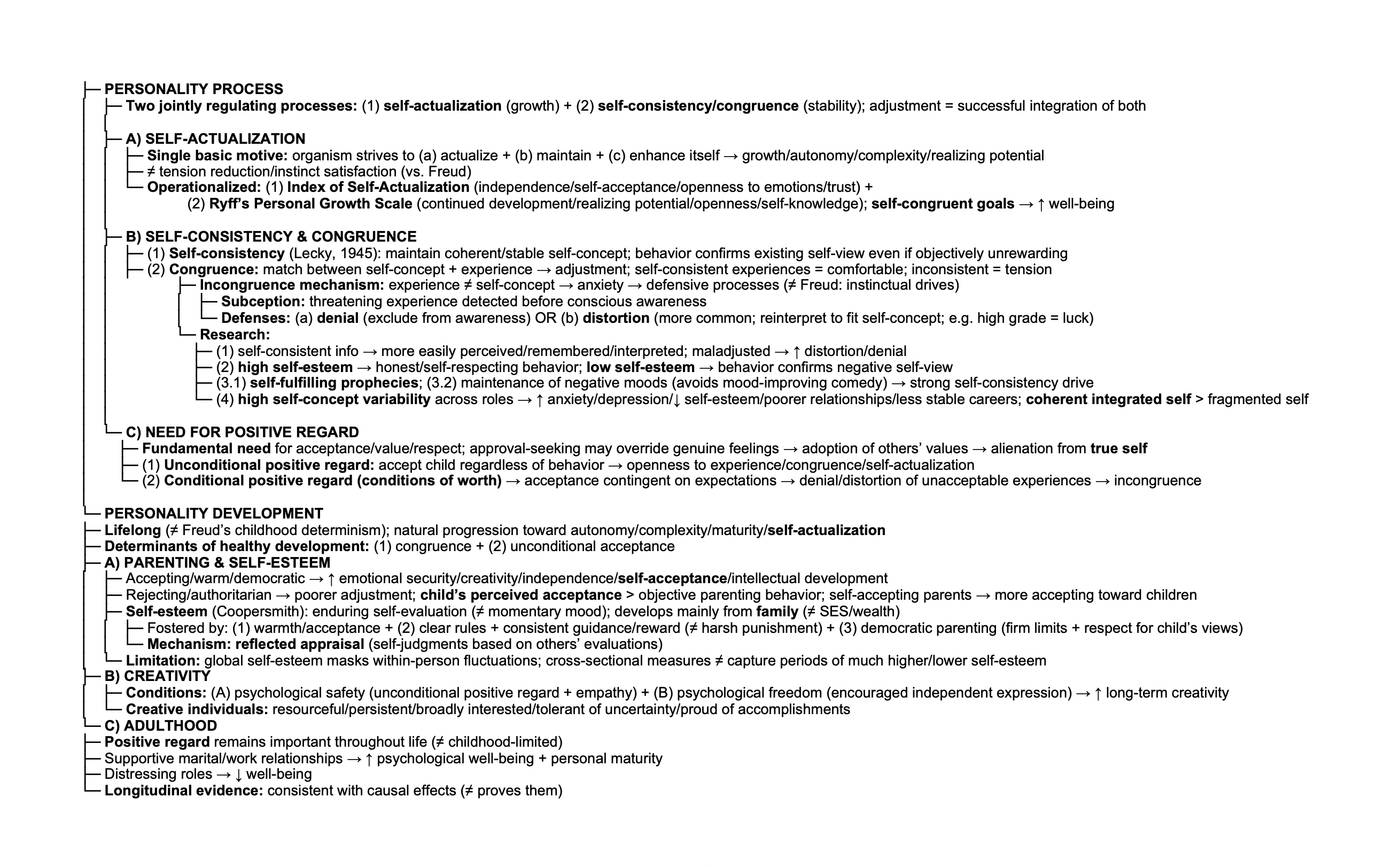
Core process: (1) self-actualization (growth) + (2) self-consistency/congruence (stability) jointly regulate personality; adjustment = successful integration of both.
Self-actualization: single basic motive; organism strives to (a) actualize, (b) maintain, (c) enhance itself → growth, autonomy, complexity, realizing potential (≠ tension reduction/instinct satisfaction); operationalized by Index of Self-Actualization (independence, self-acceptance, openness to emotions, trust) and Ryff’s Personal Growth Scale (continued development, realizing potential, openness, self-knowledge); self-congruent goals → ↑ well-being.
Self-consistency/congruence
(2.1) Self-consistency (Lecky, 1945): maintain coherent, stable self-concept; behavior tends to confirm existing self-view (even if objectively unrewarding);
(2.2) Congruence: match between self-concept and experience → adjustment; self-consistent experiences = comfortable; inconsistent experiences = tension.
Incongruence: experience ≠ self-concept → anxiety → defensive processes protecting self-concept (≠ Freud: instinctual drives) → Subception: threatening experience detected before conscious awareness → Defenses: EITHER (a) denial (exclude experience from awareness); OR (b) distortion (more common; reinterpret experience to fit self-concept; e.g., high grade = luck).
Research:
(1) self-consistent information perceived/remembered/interpreted more easily; maladjusted individuals show greater distortion/denial; (2) high self-esteem → honest, self-respecting behavior; low self-esteem → behavior consistent with negative self-view, (3.1) self-fulfilling prophecies, (3.2) maintenance of negative moods (e.g., avoiding mood-improving comedy) → strong drive for self-consistency
(4) Self-concept variability: high variability across roles → ↑ anxiety, depression, ↓ self-esteem, poorer relationships, less stable careers; moderate role specialization normal; coherent, integrated self > fragmented self.
(2.3) Need for positive regard: fundamental need for acceptance, value, respect; approval-seeking may override genuine feelings → adoption of others’ values → alienation from true self.
Positive regard: (1) unconditional (accept child regardless of behavior) → openness to experience, congruence, self-actualization; (2) conditional (conditions of worth!) → acceptance contingent on expectations → denial/distortion of unacceptable experiences → incongruence.
How does Rogers’ theory describe the growth and development of personality?
Development: lifelong (≠ Freud); natural progression toward autonomy, complexity, maturity, self-actualization. Determinants = healthy development = congruence + acceptance:
Social environment (unconditional positive regard vs. conditions of worth / conditional)
Internal self (open acceptance vs. denial/distortion of experience)
Research (Limitation: global self-esteem may mask substantial within-person fluctuations over time; individuals can experience periods of much higher/lower self-esteem than cross-sectional measures capture):
Parent–child relationships: (A) accepting, warm, democratic parenting → ↑ emotional security, creativity, independence, self-/body-acceptance, intellectual development; (B) rejecting/authoritarian parenting → poorer adjustment; child’s perceived acceptance > objective parenting behavior; self-accepting parents → more accepting toward children.
Self-esteem (Coopersmith): enduring self-evaluation! (≠ momentary mood); develops mainly from family interactions (≠ SES/wealth); fostered by (1) warmth/acceptance, (2) clear rules + consistent guidance/reward (≠ harsh punishment), (3) democratic (not dictatorial) parenting (firm limits + respect for child’s views); develops via reflected appraisal (self-judgments based on others’ evaluations).
Creativity: (A) psychological safety (unconditional positive regard, empathy) + (B) psychological freedom (encouraged independent expression) → ↑ long-term creativity; creative individuals = resourceful, persistent, broadly interested, tolerant of uncertainty, proud of accomplishments.
Adulthood: positive regard remains important throughout life; supportive marital/work relationships → ↑ psychological well-being and personal maturity; distressing roles → ↓ well-being; longitudinal evidence consistent with (but not proving!) causal effects.
Tree (PKP Ch. 5) 1/2
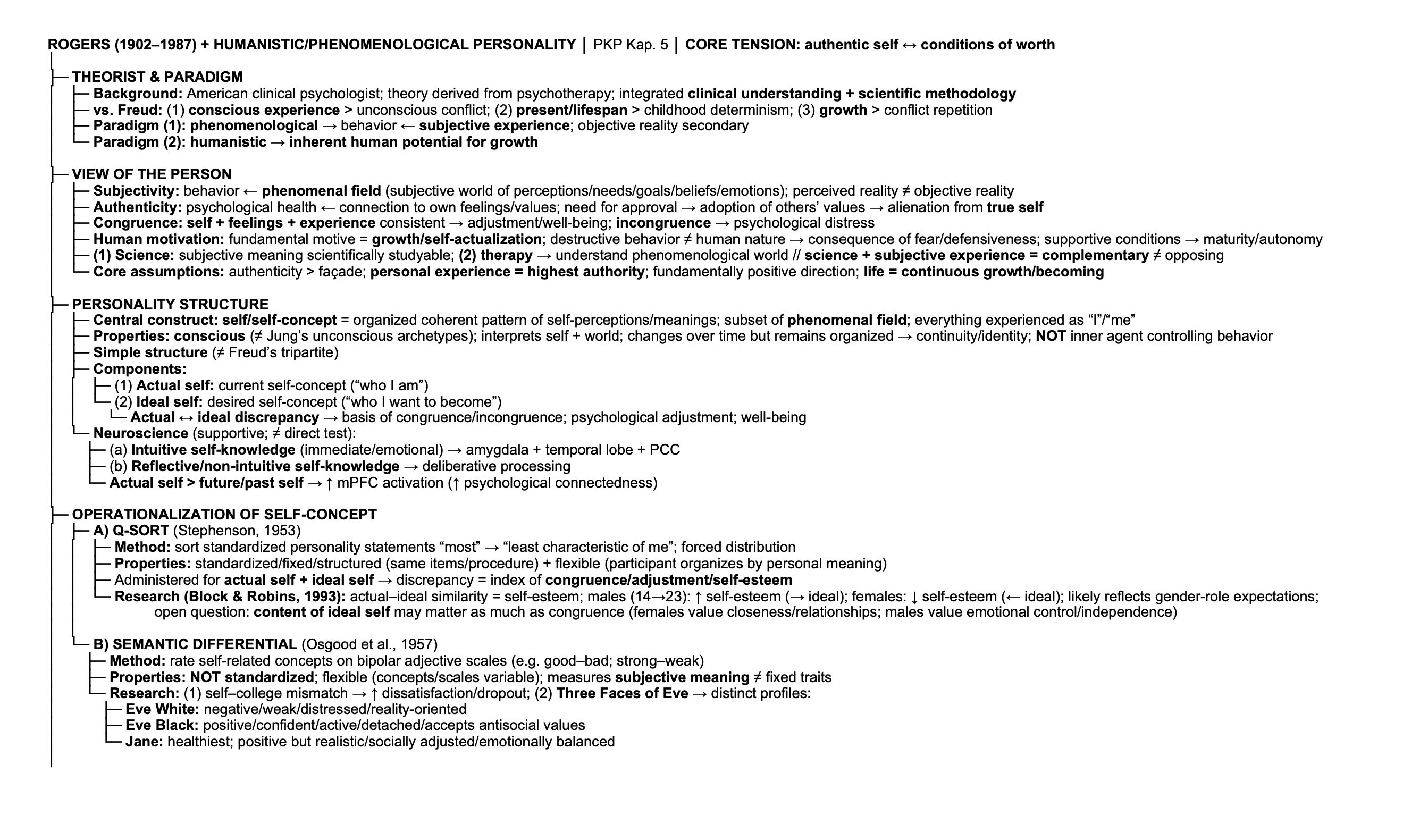
Tree (PKP Ch. 5) 2/2