Chapter 2: Biological Beginnings
 Call Kai
 Learn
Learn Practice Test
 Spaced Repetition
 Match
Match Flashcards
 Knowt Play
1/27

Earn XP
Description and Tags
Flashcards testing core concepts from Chapter 2 Biological Beginnings, including evolutionary perspective, genetics, chromosomal abnormalities, prenatal diagnostics, and heredity-environment interactions.
Name | Mastery | Learn | Test | Matching | Spaced | Call with Kai | Chat |
|---|
No analytics yet
Send a link to your students to track their progress
28 Terms
What is natural selection?
An evolutionary process by which those individuals of a species that are best adapted are the ones that survive and reproduce.
How is adaptive behavior defined in evolutionary context?
Behavior that promotes an organism's survival in its natural habitat.
What does evolutionary psychology emphasize in shaping behavior?
The importance of adaptation, reproduction, and survival of the fittest.
How do the benefits conferred by evolutionary selection change across the life span?
Benefits conferred by evolutionary selection decrease with age, with natural selection operating primarily during the first half of life.
What culture-based resources do older adults need as they weaken biologically?
Cognitive skills, literacy, medical technology, and social support.
What is considered the best approach for testing ideas coming out of evolutionary psychology?
Studying specific genes in humans and other species and their links to traits and behaviors.
What are chromosomes and DNA?
Chromosomes are threadlike structures located in the cell nucleus made up of deoxyribonucleic acid (DNA). DNA is a complex double-helix molecule that contains genetic information.

What structural relationship between cells, chromosomes, DNA, and genes is shown in this diagram?
The cell nucleus contains chromosomes made of double-helix DNA, short segments of which constitute genes.
What is the genome-wide association method used for?
To identify genetic variations linked to a particular disease.
Which environmental factors are noted to affect gene expression and DNA synthesis?
Stress, radiation, and temperature (e.g., exposure to radiation changed the rate of DNA synthesis in cells).
What are the differences between mitosis and meiosis?
Mitosis is the reproduction of somatic cells, whereas meiosis is cell division that forms sperm and eggs (gametes).
What is fertilization, and what single cell is produced by it?
Fertilization is the stage in reproduction when an egg and a sperm fuse; the single cell created is called a zygote.
Which chromosome pair determines sex, and which parent determines the child's sex?
The 23rd chromosome pair (XX for female, XY for male); the father's sperm determines the sex of the child.

What chromosome composition difference between males and females is shown in these karyotypes?
Males have an XY 23rd chromosome combination (a), whereas females have an XX 23rd chromosome combination (b).
How do monozygotic twins differ from dizygotic twins?
Monozygotic (identical) twins develop from a single zygote splitting into two identical replicas; dizygotic (fraternal) twins develop from two separate eggs fertilized by different sperm.
What is the difference between susceptibility genes and longevity genes?
Susceptibility genes make an individual more vulnerable to specific diseases or accelerated aging, while longevity genes make an individual less vulnerable to certain diseases and more likely to live to an older age.
How do genotype and phenotype differ?
Genotype is an individual's underlying genetic heritage (not outwardly visible), whereas phenotype is the outward, observable, and measurable expression of that genotype.
Why do males have a higher risk for X-linked disorders?
Males lack a second X chromosome to counteract any disorder-producing genetic information on their single X chromosome.
What is genetic imprinting?
Occurs when the expression of a gene has different effects depending on whether the mother or the father passed on the gene.
What is polygenic inheritance?
The determination of a trait or characteristic by the interaction of many different genes.
What is Phenylketonuria (PKU)?
A metabolic disorder that, if left untreated, causes mental retardation.
What is Tay-Sachs disease and its course of development?
A deceleration of mental and physical development caused by lipid accumulation in the nervous system; symptoms appear at 4 to 6 months of age leading to loss of skills, sight, hearing, and swallowing, usually causing death by age 5.
What is Noninvasive prenatal diagnosis (NIPD)?
A blood test examining fetal DNA in the maternal bloodstream for risks of Down syndrome, sex chromosome abnormalities, baby's sex, and Rh blood type.
How do Amniocentesis and Chorionic Villus Sampling (CVS) differ?
Amniocentesis analyzes fetal cells drawn by needle from amniotic fluid, while CVS analyzes samples of hairlike material surrounding the embryo.
How is infertility defined, and how does In Vitro Fertilization (IVF) address it?
Infertility is the inability to conceive after 12 months of regular intercourse without contraception. IVF combines eggs and sperm in a lab dish before transferring the fertilized egg to the woman's uterus.
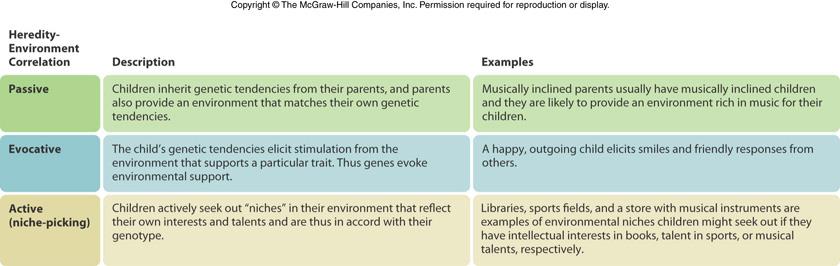
What three types of heredity-environment correlations are described in this chart?
Passive (parents pass genes and match environment), Evocative (child's genes evoke environmental responses), and Active/niche-picking (child actively seeks environments matching genotype).

What is the key conceptual difference between the Heredity-Environment Correlation View and the Epigenetic View?
The Heredity-Environment Correlation View depicts a unidirectional influence from heredity to environment, whereas the Epigenetic View depicts a bidirectional interchange between heredity and environment.
What is a Gene × Environment (G × E) interaction?
The interaction of a specific measured variation in DNA with a specific measured aspect of the environment.