Dental Porcelains
 Call Kai
 Learn
Learn Practice Test
 Spaced Repetition
 Match
Match Flashcards
 Knowt Play
1/19

There's no tags or description
Looks like no tags are added yet.
Name | Mastery | Learn | Test | Matching | Spaced | Call with Kai | Chat |
|---|
No analytics yet
Send a link to your students to track their progress
20 Terms
Porcelain:
• A ceramic material
• In dentistry, most porcelains are glasses and are used in the fabrication of crowns, teeth for dentures, pontics, facings, metal ceramic restorations, and other restorations.
• One of the most biocompatible materials with oral tissues
• Does not have the crushing or shear strength of cast metal, but when it is used in the proper bulk and with adequate support, it is very satisfactory for dental restorations
Porcelain Classification:
Dental porcelains are classified according to fusion temperature (Temps. According to the Air Force Manual)
• High-fusing temperatures
– (2350 °F to 2500 °F)
• denture teeth
• Medium-fusing temperatures
– (2000 °F to 2300 °F)
• porcelain facings
• Low-fusing temperatures
– (1200 °F to 1950 °F)
Porcelain is made up of three MAIN ingredients:
feldspar
silica
kaolin
Coloration of Dental Porcelains:
• To get different colors or shades in porcelain, the manufacturer uses metallic oxides or pigments
• Typically mixed with opaque porcelains to achieve internal shade modifications
The common metallic pigments are:
– 1. Titanium Oxide: yellow/brown
– 2. Chromium Oxide: green
– 3. Iron Oxide: red/brown
– 4. Manganese Oxide: lavender
– 5. Cobalt Oxide: blue
– 6. Copper Oxide: green
– 7. Nickel Oxide: brown
Oxide Purity and Impurity:
The oxides used as colorants for porcelain must be extremely pure, with no latent impurities
Other important physical properties of these metallic oxides include:
– Color
– Toughness
– Insolubility
– Translucency
– Strength
– Thermal expansion compatibility
Any impurities present in the oxides causes:
– Discoloration
– Porosity
– Blisters
– Repartition
• breaking of the porcelain
Review of General Properties:
• Bonded by ionic and/or covalent bonds.
• Poor thermal/electrical conductor
• Inert + Biocompatible
• Translucency, opacity
• Hard and stiff (High E. Modulus)
• Low toughness compared to METALS, but getting much better
• Earlier porcelains were brittle
Application:
– Metal-ceramic crowns and Fixed Partial Prostheses
– All-Ceramic crowns, veneers, fixed.
– Others: orthodontic brackets, dental implant abutments, and ceramic denture teeth.
Optical Properties of Ceramic Materials:
– Translucency
– Reflectance
– Opacity
– Vitality
– Biocompatibility
Processing Techniques:
• Sintering
• Heat-pressing
• Computer-aided designing and machining (CAD/CAM)
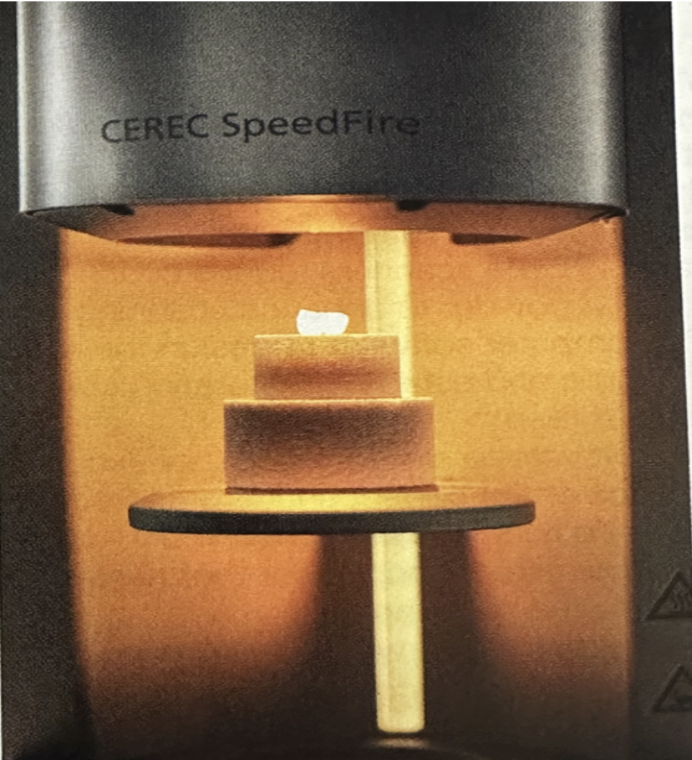
Sintering:
a method for creating objects from powders, including metal and ceramic powders. It is based on atomic diffusion. Diffusion occurs in any material above absolute zero, but it occurs much faster at higher temperatures. In most sintering processes, the powdered material is held in a mold and then heated to a temperature below the melting point. The atoms in the powder particles diffuse across the boundaries of the particles, fusing the particles together and creating one solid piece. Because the sintering temperature does not have to reach the melting point of the material, sintering is often chosen as the shaping process for materials with extremely high melting points such as porcelains.
Hard Machined Porcelain Blocks:
Currently, fully sintered ceramic materials available for CAD/CAM hard machining of dental restorations include Feldspar-based, Lucite-based and Lithium Disilicate-based ceramics and Zirconia
Soft Machined Porcelain:
Soft-machining of partially sintered zirconia ceramic blocs by CAD/CAM technology. The design compensates for the volume shrinkage that will later occur during sintering of the zirconia blocs (about 25%). The partially sintered blocs are easy to mill, which leads to substantial savings in time and tool wear.
• The dies and blocks must be designed for the 25% reduction when sintered.
• The restoration is milled in what is called a blue state then it is put in the sintering oven and it shrinks by 25% and becomes much harder.
Heat-Pressed All-Ceramics:
- External pressure application @ high T to sinter and shape the ceramic
- Indications: crowns, inlays, onlays, veneers, Fixed Partials
- Raw materials (ceramic ingots)
Heat-Pressed All-Ceramics Process:
- Ingot heated up in a investment mold produced by Lost Wax Apply pressure 0.3-0.4 MPa and Hold high T (10-20 min)
- Good dispersion of crystalline phase within the matrix
- Automated pressing furnace
- 1st generation (Leucite-based)
- 2nd generation (Lithium disilicate-based)
Heat-Pressed All-Ceramics: 1st Generation (Leucite-Based Ceramic)
Composition: leucite as reinforcing agent
- Leucite (KAlSi2O6 or K2O . Al2O3 . 4SiO2 (35-55 vol.%)
- Pressing Temperatures = 1150-1180°C (20 min)
- Ceramic ingots various shades
- Microstructure: leucite crystals (1-5 μm)
- Porosity ca. 9 vol.%
- Flexural strength ~ 120 MPa
- Disadvantages: equipment $ + low strength than all-ceramic systems.
Heat-Pressed All-Ceramics: 2nd Generation (Lithium disilicate-based)
Composition: lithium disilicate (Li2Si2O5) as reinforcing agent
- Pressing Temperatures = 890-920°C
- Ceramic ingots various shades
- Indication: Fixed Partial Prostheses
- Porosity 1 vol.%
- Flexural strength 300 MPa
- Fracture toughness KIC = 2.9 MPa*m1/2
- Microstructure: Li2Si2O5 (65 vol.%)
- Crystal size (5.2 μm in length x 0.8 μm in diameter)
- Multiple crack deflections (increase toughness)
- Porcelain veneer of matching CTE ( coefficient of thermal expansion
Microstructure:
• At the microstructural level, we can define ceramics by the nature of their composition of glass-to-crystalline ratio. There can be infinite variability of the microstructures of materials, but they can be broken down into four basic compositional categories, with a
few subgroups:
• composition category 1 – glass-based systems (mainly silica),
• composition category 2 – glass-based systems (mainly silica) with fillers, usually crystalline (typically leucite or, more recently, lithium disilicate),
• composition category 3 – crystalline- based systems with glass fillers (mainly alumina) and
• composition category 4 – polycrystalline solids (alumina and zirconia).